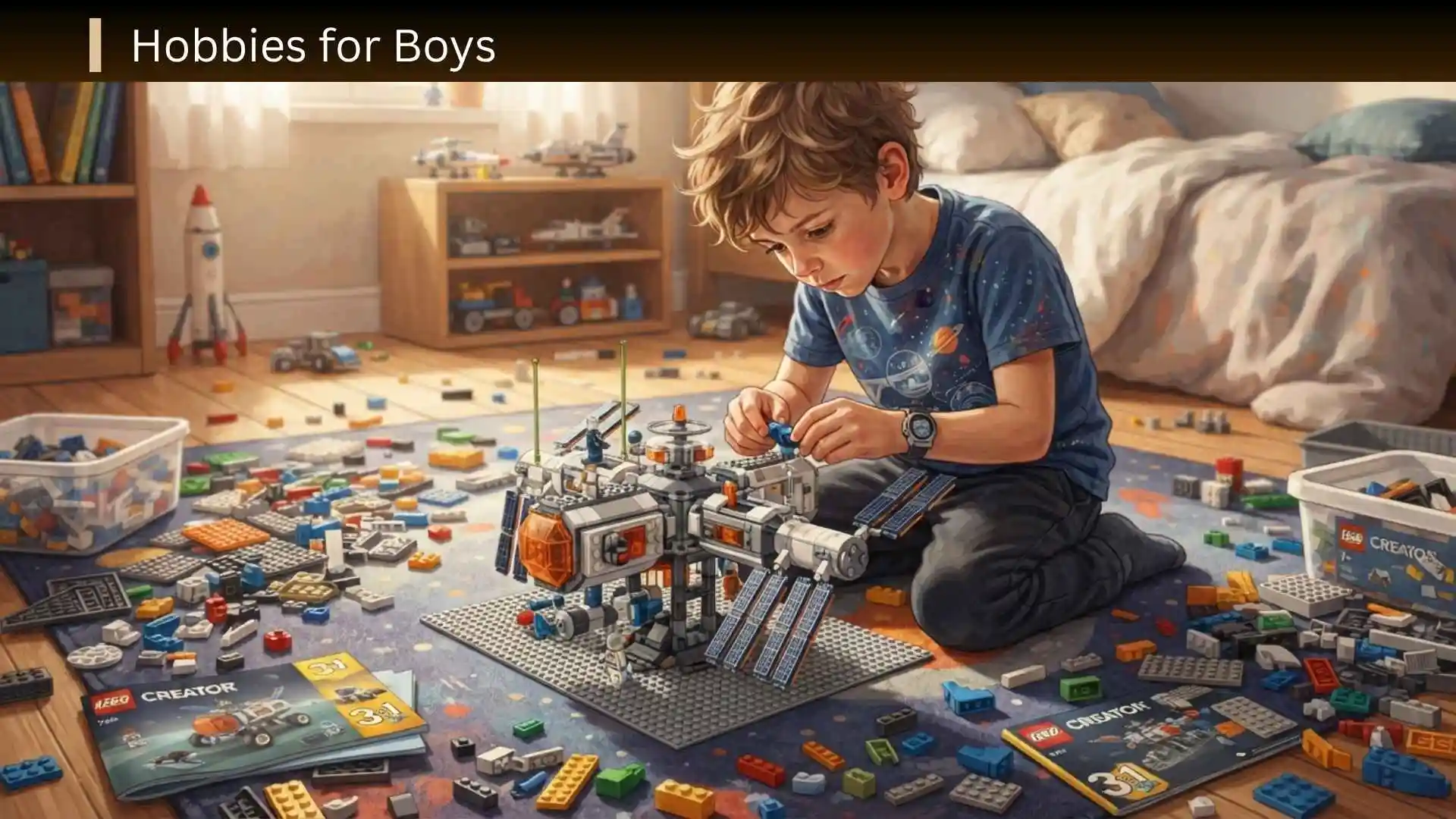
If you’re looking for hobbies for boys that are actually fun, useful, and worth sticking with, you’re in the right place. I know it can be hard to find an activity that keeps you interested beyond the first few days. You might want something creative, active, relaxing, or even a hobby that helps you learn a useful skill.
I’ve put together a variety of ideas so you can find something that fits your personality, interests, and free time. Whether you enjoy building things, playing sports, exploring technology, making art, spending time outdoors, or simply trying something new, you’ll find plenty of options to explore. You don’t need to be an expert to start, you just need to be curious enough to give something a try.
What Are Good Hobbies for Boys(Quick Answer)
Good hobbies for boys include biking, drawing, coding, robotics, photography, reading, fishing, hiking, cooking, gardening, woodworking, model building, playing a musical instrument, chess, skateboarding, camping, collecting, and science experiments.
The right choice depends on age, personality, available space, budget, and interests. Active boys may enjoy sports or outdoor activities, while curious or creative boys may prefer coding, art, music, building, or science.
How to Choose the Right Hobby

There is no single hobby that is best for every boy. A useful starting point is to consider what he naturally chooses to do when he has free time.
Start With His Interests
Pay attention to what captures his attention.
For example:
- A boy who likes taking things apart may enjoy building, electronics, or robotics.
- Someone who loves animals may enjoy birdwatching, fishing, or caring for pets.
- A child who constantly draws may enjoy sketching, painting, or digital art.
- A boy who enjoys competition may prefer chess, sports, or strategy games.
- Someone who likes being outdoors may enjoy hiking, camping, gardening, or cycling.
- A technology enthusiast may enjoy programming, game development, or photography.
A hobby should feel like an opportunity to explore rather than another school assignment.
Consider His Age
A hobby should be appropriate for his developmental stage and abilities.
Younger children generally benefit from simple activities involving exploration, movement, imagination, and basic creative skills. Older children and teenagers can often handle hobbies that require more specialized equipment, longer projects, technical knowledge, or independent practice.
For activities involving tools, cooking equipment, chemicals, water, heights, roads, or other hazards, appropriate adult supervision and safety equipment are important.
Consider the Budget
Some hobbies can cost very little.
Low-cost options include:
- Reading
- Drawing
- Writing
- Hiking
- Nature observation
- Running
- Stargazing
- Gardening with available materials
- Chess
- Origami
- Collecting leaves or rocks
- Bodyweight exercise
Other hobbies, such as robotics, photography, musical instruments, or certain sports, may require a larger initial investment.
Starting with inexpensive equipment is often a good way to determine whether he actually enjoys an activity before spending more.
35 Best Hobbies for Boys
1. Biking
Biking combines exercise, independence, and outdoor exploration. Boys can ride around appropriate neighborhood routes, parks, trails, or bike paths.
As skills improve, cycling can become more challenging through longer rides, trail riding, or learning basic bicycle maintenance.
Good for: Active kids who enjoy being outdoors
Equipment: Bicycle, properly fitted helmet, and appropriate safety gear
Difficulty: Beginner to advanced
2. Drawing and Sketching
Drawing is an accessible creative hobby that requires little more than paper and a pencil.
A beginner can start with simple objects, animals, cartoons, vehicles, landscapes, or characters. Over time, he can explore perspective, shading, anatomy, illustration, and different artistic techniques.
Good for: Creative and visually curious boys
Equipment: Pencil, paper, eraser, optional colored pencils
Difficulty: Beginner to advanced
3. Coding
Coding can turn an interest in computers into a practical creative activity. Beginners can start with visual programming environments and gradually move toward languages such as Python or JavaScript.
Instead of only following tutorials, a boy can eventually create simple games, animations, websites, calculators, or other projects.
Good for: Problem-solvers and technology enthusiasts
Equipment: Computer or tablet, depending on the platform
Difficulty: Beginner to advanced
4. Robotics
Robotics combines programming, electronics, engineering, and hands-on building.
A beginner can start with a simple educational robotics kit. More advanced projects can involve sensors, motors, programming, and autonomous movement.
The hobby is particularly useful for boys who enjoy figuring out how machines work.
Good for: Builders, programmers, and curious problem-solvers
Equipment: Robotics kit and compatible computer or controller
Difficulty: Intermediate to advanced
5. Reading
Reading is one of the simplest hobbies to begin and one that can remain enjoyable for years.
The key is allowing boys to explore subjects they genuinely like. Options might include:
- Adventure
- Science fiction
- Fantasy
- History
- Sports
- Animals
- Mysteries
- Biography
- Comics and graphic novels
- Nonfiction
Reading does not have to mean choosing only traditional novels. The goal is to develop an enjoyable relationship with books and information.
6. Photography
Photography encourages boys to notice details and think creatively about light, composition, perspective, and storytelling.
A smartphone can be enough to begin. Later, those who become seriously interested can explore cameras, lenses, editing, and specialized photography such as wildlife or landscape photography.
Good for: Creative observers and technology enthusiasts
Equipment: Smartphone or camera
Difficulty: Beginner to advanced
7. Hiking
Hiking is a simple way to combine physical activity with nature and exploration.
Depending on age and experience, boys can begin with short local trails and gradually work toward longer hikes. Learning basic outdoor skills, trail etiquette, navigation, and Leave No Trace principles can make the hobby more educational.
Good for: Adventurous and outdoors-oriented boys
Equipment: Comfortable footwear, water, weather-appropriate clothing
Difficulty: Beginner to advanced
8. Fishing
Fishing teaches patience, observation, preparation, and outdoor responsibility.
Boys can learn about local fish species, tackle, casting, water safety, and responsible fishing practices. Rules vary by location, so families should check applicable local regulations before fishing.
Good for: Patient boys who enjoy nature
Equipment: Appropriate fishing gear and required permits where applicable
Difficulty: Beginner to advanced
9. Chess
Chess is a strategy hobby that encourages planning, pattern recognition, concentration, and decision-making.
A boy does not need to become highly competitive for chess to be worthwhile. Playing casually with family or friends can be enough to make it enjoyable.
Good for: Strategic thinkers and competitive learners
Equipment: Chess set or digital chess platform
Difficulty: Beginner to advanced
10. Cooking
Cooking is both a hobby and a useful everyday skill.
Boys can start by preparing simple foods and gradually learn techniques such as measuring, chopping, mixing, baking, and following recipes. Older children and teenagers can learn meal planning, food storage, kitchen organization, and more advanced techniques.
Younger children should receive age-appropriate supervision, particularly around knives, hot surfaces, ovens, and other kitchen hazards.
Good for: Creative and practical learners
Equipment: Basic kitchen equipment and ingredients
Difficulty: Beginner to advanced
11. Gardening
Gardening gives boys an opportunity to work with living things and see the results of consistent care.
A small container garden can be enough to start. Herbs, vegetables, flowers, or other suitable plants can introduce concepts such as soil, sunlight, watering, growth, and seasonal changes.
Good for: Nature lovers and hands-on learners
Equipment: Containers, soil, seeds or plants, and basic gardening tools
Difficulty: Beginner to intermediate
12. Model Building
Model building can involve cars, airplanes, ships, buildings, spacecraft, or other subjects.
The hobby develops patience, attention to detail, and fine motor skills. More advanced modelers can learn painting, assembly techniques, customization, and historical research.
Good for: Patient builders and detail-oriented boys
Equipment: Model kit and appropriate tools
Difficulty: Beginner to advanced
13. Lego and Construction
Building with construction sets gives boys a way to experiment with design, balance, structures, mechanisms, and imagination.
Instead of following instructions every time, encourage open-ended projects. Building a bridge, vehicle, city, robot, or imaginary structure can turn a familiar toy into a creative hobby.
Good for: Builders and imaginative thinkers
Equipment: Construction blocks or compatible building sets
Difficulty: Beginner to advanced
14. Playing a Musical Instrument
Learning an instrument can become a long-term creative pursuit.
Popular choices include:
- Guitar
- Piano or keyboard
- Drums
- Violin
- Ukulele
- Trumpet
- Saxophone
The best instrument is usually one the boy actually wants to learn. Regular short practice sessions are generally more sustainable than forcing long sessions.
Good for: Creative and music-loving boys
Equipment: Instrument and learning resources
Difficulty: Beginner to advanced
15. Skateboarding
Skateboarding combines movement, balance, coordination, and skill progression.
Beginners should learn in an appropriate controlled environment and use suitable protective equipment. As skills develop, riders can learn different forms of riding and increasingly difficult techniques.
Good for: Active boys who enjoy skill-based challenges
Equipment: Skateboard, helmet, and appropriate protective gear
Difficulty: Beginner to advanced
16. Swimming
Swimming can be both recreational and skill-based.
Boys can work on technique, endurance, water confidence, and different strokes. Because water activities carry safety risks, learning from qualified instruction and following appropriate water-safety practices is especially important.
Good for: Active boys and water enthusiasts
Equipment: Swimsuit and access to an appropriate swimming facility
Difficulty: Beginner to advanced
17. Soccer
Soccer provides regular physical activity while introducing teamwork, coordination, communication, and tactical thinking.
A boy can enjoy the sport casually with friends or participate in organized leagues if he wants a more structured experience.
Good for: Social and active boys
Equipment: Soccer ball and appropriate footwear
Difficulty: Beginner to advanced
18. Basketball
Basketball is easy to practice in many community settings where a suitable court is available.
Boys can work on dribbling, passing, shooting, footwork, and conditioning. It can also be played casually without requiring a formal team.
Good for: Active and competitive boys
Equipment: Basketball and access to a suitable court
Difficulty: Beginner to advanced
19. Running
Running is a straightforward hobby that requires relatively little equipment.
Younger boys may enjoy short runs as part of play, while older children and teenagers can gradually develop structured running habits appropriate to their age and ability.
The focus should be on enjoyment and healthy movement rather than unnecessary pressure to achieve particular times or distances.
Good for: Active boys who enjoy personal challenges
Equipment: Comfortable running shoes and suitable clothing
Difficulty: Beginner to advanced
20. Camping
Camping introduces boys to outdoor skills while creating opportunities for family or group experiences.
Depending on age, they can learn how to organize gear, prepare food safely, identify basic outdoor hazards, set up camp, and respect the natural environment.
Good for: Adventurous and outdoors-oriented boys
Equipment: Appropriate camping gear
Difficulty: Beginner to advanced
21. Birdwatching
Birdwatching turns an ordinary outdoor walk into an observation challenge.
Boys can learn to identify birds by appearance, behavior, habitat, and calls. A simple notebook or nature app can be used to record observations.
Good for: Curious, patient, and nature-loving boys
Equipment: Eyes, notebook, optional binoculars
Difficulty: Beginner to advanced
22. Stargazing
Stargazing can introduce boys to astronomy and science without requiring expensive equipment.
They can begin by learning the Moon’s phases, recognizing bright stars and constellations, and understanding basic concepts about planets and the night sky. A beginner-friendly astronomy guide or app can make identification easier.
Good for: Curious boys interested in science and space
Equipment: Little to none; optional binoculars or telescope
Difficulty: Beginner to advanced
23. Magic Tricks
Learning magic provides a combination of performance, practice, presentation, and problem-solving.
Card tricks, simple illusions, and close-up techniques can give boys achievable goals while also helping them become more comfortable performing for others.
Good for: Confident, curious, or performance-oriented boys
Equipment: Playing cards or beginner magic kit
Difficulty: Beginner to advanced
24. Writing Stories
Creative writing gives boys a way to turn their ideas into stories.
They can write:
- Short stories
- Adventure stories
- Comic scripts
- Science-fiction stories
- Mystery stories
- Fantasy adventures
- Journals
- Poems
Writing can be done with paper and pencil or digitally.
Good for: Imaginative and storytelling-oriented boys
Equipment: Notebook or computer
Difficulty: Beginner to advanced
25. Making Comics
Comic creation combines writing, drawing, character development, and visual storytelling.
A beginner can start with a single-page comic featuring a simple character and gradually experiment with panels, dialogue, settings, action, and longer stories.
Good for: Boys who enjoy both art and storytelling
Equipment: Paper and drawing supplies or digital tools
Difficulty: Beginner to advanced
26. Woodworking
Woodworking can teach planning, measurement, patience, and craftsmanship.
Age-appropriate projects might include simple shelves, small boxes, signs, or other beginner projects. Because woodworking involves sharp tools and machinery, children should use equipment appropriate for their age and skill level with responsible adult supervision.
Good for: Hands-on builders and makers
Equipment: Appropriate tools and materials
Difficulty: Intermediate to advanced
27. Electronics
Basic electronics can help boys understand circuits, electricity, components, and how everyday devices work.
Educational kits can provide a safer and more structured starting point than experimenting with household electrical systems.
Good for: Curious problem-solvers and future makers
Equipment: Beginner electronics kit
Difficulty: Intermediate to advanced
28. Science Projects
Science can become a hobby when boys are encouraged to ask questions and investigate them.
Projects might explore:
- Plants
- Magnets
- Simple machines
- Weather
- Astronomy
- Water
- Sound
- Forces and motion
- Crystals
- Basic chemistry concepts
Experiments should be age-appropriate and conducted with appropriate safety precautions.
Good for: Curious and analytical boys
Equipment: Depends on the project
Difficulty: Beginner to advanced
29. Collecting
Collecting can turn an ordinary interest into an organized hobby.
Possible collections include:
- Coins
- Stamps
- Sports cards
- Rocks and minerals
- Postcards
- Model cars
- Books
- Shells where collection is legal and environmentally appropriate
The educational side of collecting can include classification, research, organization, history, and preservation.
Good for: Detail-oriented and curious boys
Equipment: Depends on the collection
Difficulty: Beginner to advanced
30. Geocaching
Geocaching combines outdoor exploration with navigation and problem-solving.
Participants use GPS-enabled devices to locate hidden containers or designated geocaches. It can turn a walk or hike into a treasure-hunting adventure.
Families should choose age-appropriate locations and follow local rules and property boundaries.
Good for: Adventurous boys who enjoy puzzles and exploration
Equipment: GPS-enabled device or suitable app
Difficulty: Beginner to advanced
31. Model Trains
Model railroading combines construction, organization, engineering, history, and creativity.
A boy can begin with a small layout and gradually add tracks, buildings, scenery, trains, and other details. Some enthusiasts also learn about electrical systems and automation.
Good for: Patient builders and transportation enthusiasts
Equipment: Model train equipment
Difficulty: Intermediate to advanced
32. Video Game Development
Playing games can become more creative when a boy learns how games are actually made.
Game development can introduce programming, storytelling, sound, graphic design, level design, and problem-solving.
A beginner can start with simple game-making software before moving to more advanced development tools.
Good for: Gamers interested in creating rather than only playing
Equipment: Computer and appropriate development software
Difficulty: Beginner to advanced
33. Martial Arts
Martial arts can provide structured physical activity while teaching technique, discipline, and respect.
Different styles have different approaches, so families should research instructors and programs carefully. A qualified instructor and an appropriate training environment are important.
Good for: Boys who enjoy structured physical activities
Equipment: Depends on the discipline and program
Difficulty: Beginner to advanced
34. Fishing, Nature, and Wildlife Journaling
For boys who enjoy being outside but want a quieter activity, keeping a nature journal can be an excellent hobby.
He can record animals spotted, weather conditions, interesting plants, sketches, photographs, or questions for later research.
This turns ordinary outdoor experiences into an ongoing personal project.
Good for: Observant and curious boys
Equipment: Notebook, pencil, optional camera or binoculars
Difficulty: Beginner to advanced
35. Volunteering and Community Projects
Volunteering can become a meaningful interest when the activity is appropriate for the child’s age and local requirements.
Possible projects may involve community cleanups, helping at suitable nonprofit activities, participating in environmental projects, or assisting with community events.
The important thing is to choose opportunities that are safe, age-appropriate, and genuinely interesting to the boy.
Good for: Social, helpful, and community-minded boys
Equipment: Depends on the activity
Difficulty: Varies
Best Hobbies for Boys by Interest

Sometimes choosing by personality is easier than choosing from a long list.
| If He Likes… | Hobbies to Try |
| Sports and movement | Soccer, basketball, swimming, biking, running |
| Technology | Coding, robotics, electronics, game development |
| Building | LEGO, model building, woodworking, model trains |
| Art | Drawing, painting, photography, comics |
| Animals | Birdwatching, nature journaling, wildlife observation |
| Science | Astronomy, science projects, electronics, nature study |
| Adventure | Hiking, camping, geocaching, fishing |
| Music | Guitar, piano, drums, violin, ukulele |
| Strategy | Chess, puzzles, model building, coding |
| Writing | Storytelling, journaling, comics, creative writing |
| Cooking | Baking, simple meals, recipe experimentation |
| Collecting | Coins, stamps, cards, rocks, books |
Best Lo Cost Hobbies for Boys
A hobby does not need to be expensive to be rewarding.
Some inexpensive choices include:
- Reading
- Drawing
- Writing
- Hiking
- Running
- Nature observation
- Stargazing
- Chess
- Origami
- Gardening
- Photography with a smartphone
- Storytelling
- Collecting natural objects where appropriate
- Birdwatching
- Bodyweight movement and age-appropriate fitness activities
Libraries, parks, community centers, and local recreation programs can also provide access to activities without requiring a large collection of equipment at home.
Best Indoor Hobbies for Boys
Indoor hobbies can be particularly useful during hot weather, rainy days, or periods when outdoor activities are inconvenient.
Good options include:
- Reading
- Drawing
- Painting
- Coding
- Robotics
- Chess
- Model building
- LEGO construction
- Cooking
- Music
- Writing
- Comic creation
- Electronics
- Science projects
- Collecting
- Magic tricks
- Video game development
The best indoor hobby is one that provides active engagement rather than simply filling time.
Best Outdoor Hobbies for Boys
Outdoor hobbies provide opportunities for movement, exploration, observation, and practical learning.
Consider:
- Biking
- Hiking
- Camping
- Fishing
- Gardening
- Birdwatching
- Stargazing
- Soccer
- Basketball
- Swimming
- Running
- Skateboarding
- Geocaching
- Nature photography
- Wildlife observation
Outdoor hobbies should always be matched to the child’s age, abilities, environment, and weather conditions.
Best Creative Hobbies for Boys
Creative hobbies allow boys to make something rather than simply consume entertainment.
Strong options include:
- Drawing
- Painting
- Photography
- Creative writing
- Comic making
- Music
- Cooking
- Model building
- LEGO design
- Woodworking
- Video production
- Game development
Creative hobbies are especially useful when children are given freedom to make mistakes and develop their own ideas.
Best Educational Hobbies for Boys
Many hobbies naturally combine entertainment with learning.
Coding
Teaches computational thinking and problem-solving through projects.
Chess
Encourages strategic thinking, planning, and pattern recognition.
Gardening
Introduces boys to plants, seasons, responsibility, and observation.
Astronomy
Creates opportunities to explore space and basic scientific concepts.
Cooking
Builds practical skills involving measurements, processes, planning, and food preparation.
Robotics
Combines engineering, programming, construction, and experimentation.
Reading
Provides opportunities to explore subjects ranging from history and science to literature and culture.
How to Turn a Hobby Into a Long Term Interest

Starting is often easier than continuing. A few simple strategies can help.
Keep the First Project Small
A boy who is new to woodworking does not need to build complicated furniture. Someone learning photography does not need an expensive camera.
Start with a project that can be completed relatively quickly.
Let Him Choose Some of the Direction
Adults can introduce options, but children are more likely to remain interested when they have some control over what they create or learn.
For example, instead of saying, “You should learn guitar,” offer several instruments and let him explore which one interests him.
Focus on Progress Rather Than Perfection
Beginners naturally make mistakes.
A drawing does not need to look professional. A first coding project may be simple. A first chess game may end quickly. A first garden may not produce a perfect harvest.
The value comes from learning and improving.
Avoid Turning Every Hobby Into Competition
Competition can be motivating for some boys, but not everyone enjoys it.
A hobby can remain valuable even when there are no trophies, rankings, tournaments, or public performances involved.
Allow Interests to Change
A boy may love dinosaurs one year, coding the next, and music later.
Changing hobbies is not necessarily a waste of time. Each activity can introduce new skills, interests, and experiences.
Should Boys Have More Than One Hobby?
Yes. There is no reason a boy needs to limit himself to a single hobby.
A useful combination might include:
- One active hobby: biking, swimming, soccer, or hiking
- One creative hobby: drawing, music, writing, or photography
- One thinking hobby: chess, coding, puzzles, or science
This gives him different ways to spend his free time depending on his mood and circumstances.
However, there is no need to create a packed schedule. Free time and unstructured play are also important parts of childhood.
What If a Boy Says He Is Not Interested in Any Hobby?
Avoid treating this as a failure.
Instead, offer small experiments. Try a new activity for an afternoon rather than immediately committing to a class or purchasing expensive equipment.
For example, you could:
- Visit a library and let him choose a book.
- Take a short nature walk.
- Try a simple building project.
- Cook something together.
- Play a board game.
- Visit a science museum.
- Try a beginner drawing challenge.
- Explore a local park.
- Borrow an instrument before purchasing one.
- Try a simple coding project.
The goal is to discover what creates genuine curiosity.
Frequently Asked Questions
What are the best hobbies for boys?
Some of the most versatile hobbies include biking, reading, drawing, coding, robotics, cooking, hiking, chess, photography, music, gardening, model building, and sports. The best option depends on the boy’s age, interests, personality, and circumstances.
What are good hobbies for boys who are bored?
Try activities that involve making, exploring, learning, or moving. Building something, going for a bike ride, drawing, cooking, playing chess, exploring nature, learning a magic trick, or starting a small coding project can be more engaging than simply looking for another form of passive entertainment.
What are good hobbies for teenage boys?
Teenagers can explore more advanced versions of many hobbies, including programming, photography, music, woodworking, cooking, fitness activities, hiking, robotics, gaming development, sports, creative writing, filmmaking, and collecting.
What are good hobbies for boys who like technology?
Coding, robotics, electronics, photography, digital art, 3D design, game development, and video production are strong choices. Technology hobbies can also combine several interests—for example, robotics can involve programming, engineering, and construction.
What are good hobbies for boys who like sports?
Soccer, basketball, swimming, biking, running, skateboarding, martial arts, tennis, and other age-appropriate physical activities can provide structured ways to stay active.
What are good hobbies for boys who don’t like sports?
Sports are not necessary for having an active and interesting childhood. Hiking, gardening, photography, cooking, coding, drawing, chess, music, model building, reading, astronomy, science projects, and woodworking offer many alternatives.
What are good hobbies for boys that can be done at home?
Reading, drawing, writing, chess, coding, LEGO construction, model building, cooking, music, robotics, electronics, collecting, and creative projects can all be adapted for home use.
What is a good hobby for a shy boy?
Quiet hobbies such as drawing, reading, coding, photography, model building, chess, writing, gardening, and astronomy can provide opportunities to develop confidence without requiring constant social interaction. Group versions of these hobbies can later provide a comfortable way to meet others with similar interests.
How much should a hobby cost?
There is no required amount. Many hobbies can begin for little or no money. Before purchasing specialized equipment, it is often sensible to try a beginner version first and see whether the interest continues.
Can hobbies help boys develop useful skills?
Yes. Different hobbies naturally practice different skills. Coding can involve logical problem-solving, music requires practice and coordination, cooking develops practical skills, gardening involves responsibility and observation, and team sports involve communication and cooperation.
Conclusion
The best hobbies for boys are not determined by a particular age, personality type, or stereotype. A good hobby is one that gives a boy a reason to be curious, practice something, create something, explore the world, or simply enjoy his free time.
For an active boy, biking, hiking, swimming, soccer, or skateboarding may be a natural fit. A creative boy might prefer drawing, music, photography, writing, or comics. A technology enthusiast may enjoy coding, robotics, electronics, or game development. Boys who love the outdoors can explore fishing, gardening, camping, birdwatching, or astronomy.
The most effective approach is to offer choices, start small, keep the experience enjoyable, and let interests develop naturally. A hobby does not have to become a career or a competition to be worthwhile. Sometimes the most valuable result is simply discovering something a boy genuinely loves doing.

I’m Olivia Bennett, a passionate writer who loves exploring ideas, learning new concepts, and sharing knowledge in a straightforward way. I write for Cognivoora with the goal of making useful topics easier to understand without unnecessary complexity. My approach combines research, clarity, and a reader-first perspective.
Books:
- Think Clearly, Live Better
- The Curious Reader’s Guide