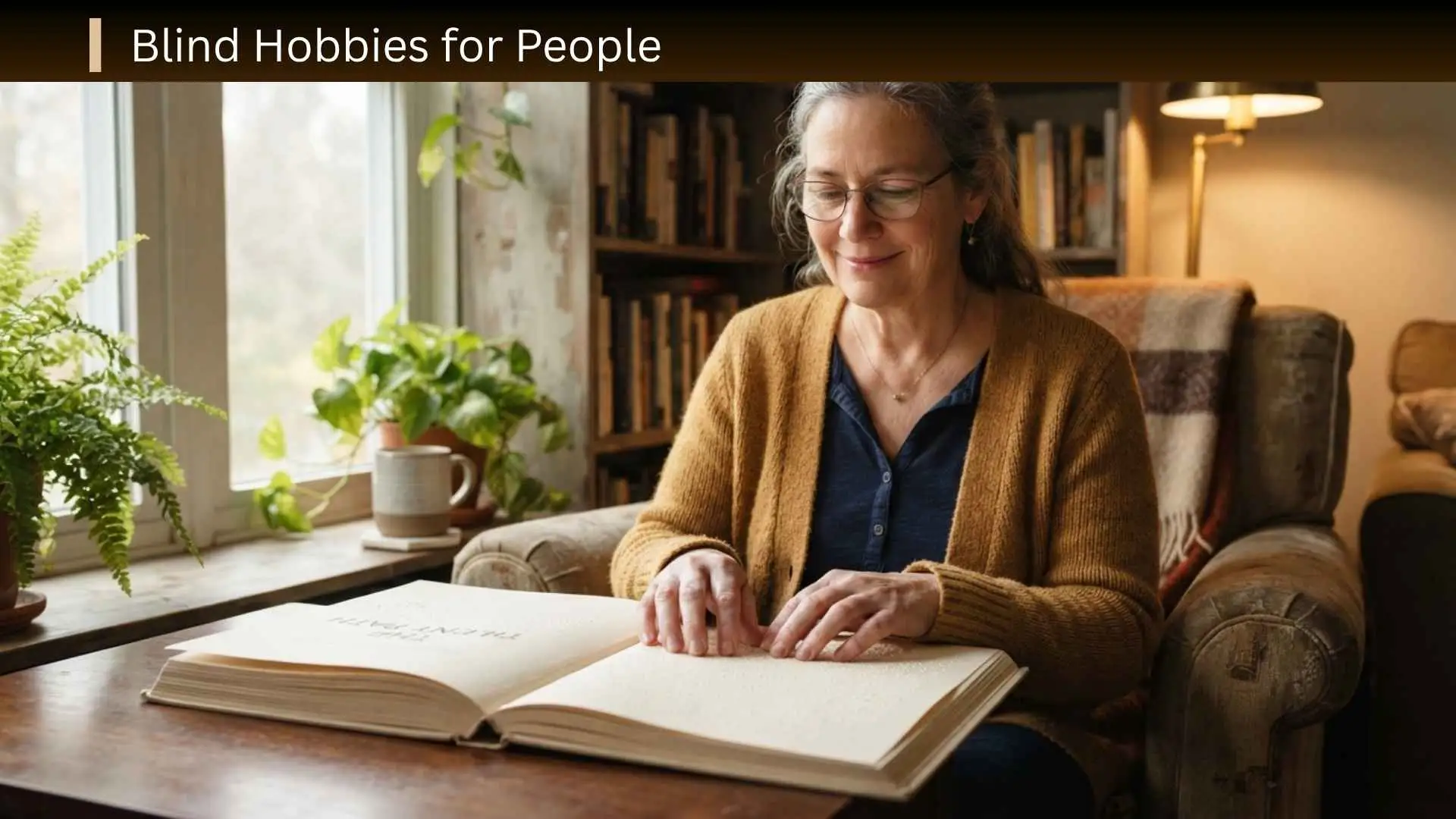
Have you ever wondered what hobbies you could enjoy if you’re blind or have limited vision? I believe a hobby should never be limited by eyesight.it should be something that makes you curious, creative, relaxed, or simply happy. Whether you love music, crafts, cooking, technology, storytelling, or spending time outdoors, there are plenty of activities you can explore and make your own.
You might be looking for a new way to spend your free time, build a skill, meet people, or simply discover something enjoyable to do independently. In this guide, I’ll help you explore a variety of blind hobbies for people of different interests and abilities, so you can find an activity that feels right for you.
What Are Good Hobbies for Blind People(Quick Answer )
Some of the most accessible and enjoyable hobbies for blind people include:
- Audiobooks and accessible reading
- Listening to and creating music
- Singing
- Playing accessible board and card games
- Knitting and crocheting
- Sewing
- Tactile crafts
- Cooking and baking
- Gardening
- Walking and hiking
- Swimming
- Tandem cycling
- Bowling
- Beep baseball and adapted sports
- Yoga and exercise
- Photography with accessibility tools
- Podcasting
- Writing and journaling
- Learning languages
- Playing accessible video games
- Bird listening and nature exploration
- Woodworking or tactile DIY projects
- Pet care and animal-related activities
- Collecting and organizing objects
- Social clubs and community activities
Many of these activities require little or no modification, while others can become accessible with tactile markings, audio instructions, screen readers, adapted equipment, or assistance from another person. AFB specifically identifies hobbies, games, gardening, exercise, tandem biking, bowling, golfing, and skiing among recreational possibilities for people with vision loss.
1. Audiobooks and Accessible Reading
Reading does not have to depend on conventional print. Audiobooks, accessible e-books, braille books, podcasts, newspapers in accessible formats, and text-to-speech technology can make reading an enjoyable hobby.
For someone who loves fiction, possibilities include:
- Mystery novels
- Science fiction
- Romance
- Historical fiction
- Biographies
- Fantasy
- Short stories
- Poetry
- Nonfiction
- Self-improvement books
A person who prefers tactile reading can explore braille, while someone who enjoys technology may use a smartphone, computer, or dedicated accessible reading device.
Reading can also become a social hobby through book clubs. An accessible book club can meet in person or online and discuss the same audiobook, braille book, or accessible digital publication.
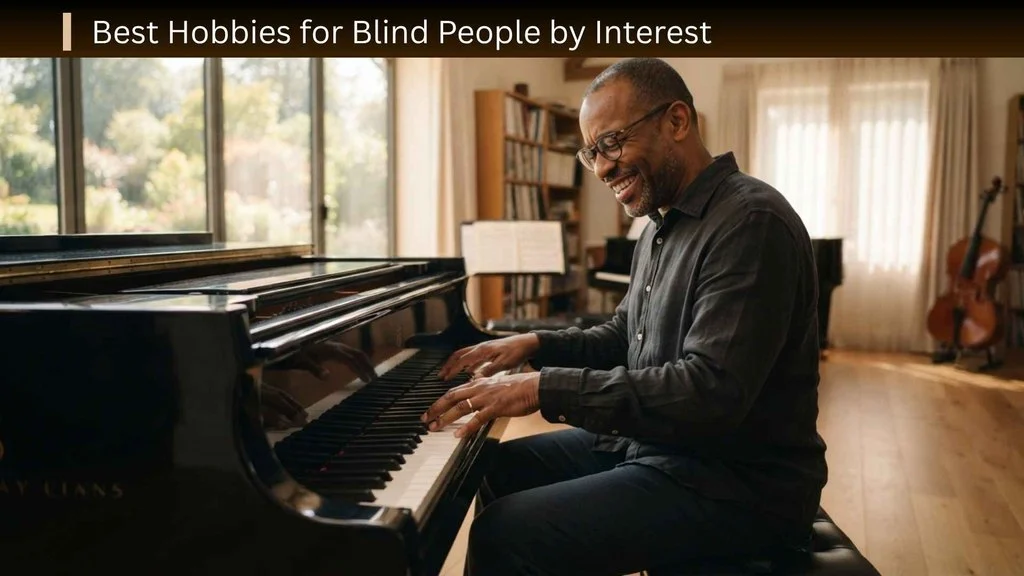
2. Listening to Music
Music is one of the most flexible hobbies for blind people because it can be enjoyed without relying on vision.
You can explore music simply by listening, or make it an active hobby by learning:
- Piano
- Guitar
- Keyboard
- Drums
- Violin
- Harmonica
- Ukulele
- Percussion
- Digital music production
Music can be practiced independently or with a teacher. Audio-based learning can be particularly useful, while tactile markings on instruments or equipment may help with orientation.
For people who enjoy technology, accessible computers and smartphones can also provide opportunities for music production and audio editing. Assistive technologies such as screen readers and speech synthesizers can provide access to many computer functions.
3. Singing
Singing requires little equipment and can be practiced alone or with others.
You might join:
- A choir
- A community singing group
- A church or community music program
- A karaoke group
- An online singing community
Singing can also become a more structured hobby by learning vocal technique, practicing different musical styles, or recording performances.
4. Playing Accessible Board Games
Blindness does not mean giving up board games.
Many traditional games have tactile, braille, large-print, or high-contrast adaptations. AFB lists accessible versions of games including chess, checkers, tic-tac-toe, Monopoly, Scrabble, dominoes, and other games.
Tactile game designs can help players identify pieces and board positions by touch. Some adapted boards also keep pieces in place, making it easier to play independently.
Accessible games can be particularly valuable because they combine entertainment with social interaction.
5. Card Games
Card games are another excellent option.
Depending on the player’s preferences and level of vision, accessible playing cards may use:
- Braille markings
- Tactile markings
- Large print
- High contrast
- Distinctive card designs
Games such as Uno, poker, blackjack, and other familiar card games can be adapted for players with vision loss. AFB notes that large-print and braille card games are among the available adaptations for people with visual impairments.
The best setup depends on whether the person wants to play independently or with friends.
6. Knitting and Crocheting
Knitting and crocheting are tactile activities, which can make them appealing hobbies for people who are blind.
With practice, a person can use touch to monitor yarn, needles, hooks, and stitches. Accessible instructions can be provided through audio, braille, or carefully explained verbal guidance.
Possible projects include:
- Scarves
- Blankets
- Hats
- Potholders
- Simple clothing
- Decorative items
- Small gifts
Some patterns are available in alternate formats. AFB has documented accessible craft resources involving activities such as knitting, crocheting, plastic canvas, latch hook, and origami.
7. Sewing
Sewing can also be adapted for someone who is blind or has low vision.
Useful adaptations may include:
- Tactile markings
- Talking or large-print measuring tools
- Needle threaders
- Pre-threaded needles
- Verbal instructions
- Consistent organization of materials
AFB specifically notes adaptations such as needle threaders, pre-threaded needles, and talking or large-print measuring tools for sewing.
Safety should always be considered when using needles, pins, scissors, sewing machines, or other sharp equipment.
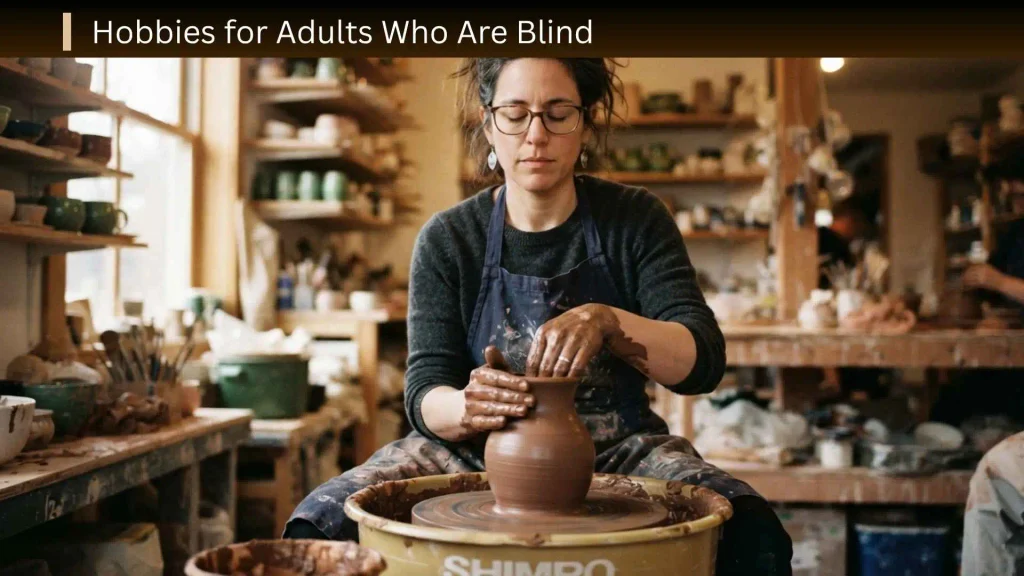
8. Tactile Crafts
Crafting does not have to be a visually dominated activity.
Tactile projects can include:
- Clay modeling
- Sculpting
- Beadwork
- Macramé
- Simple weaving
- Plastic canvas
- Latch hook
- Origami with tactile or verbal instruction
- Textured art
- Handmade decorations
The key is to choose projects where shape, texture, position, and progress can be understood through touch or audio instructions.
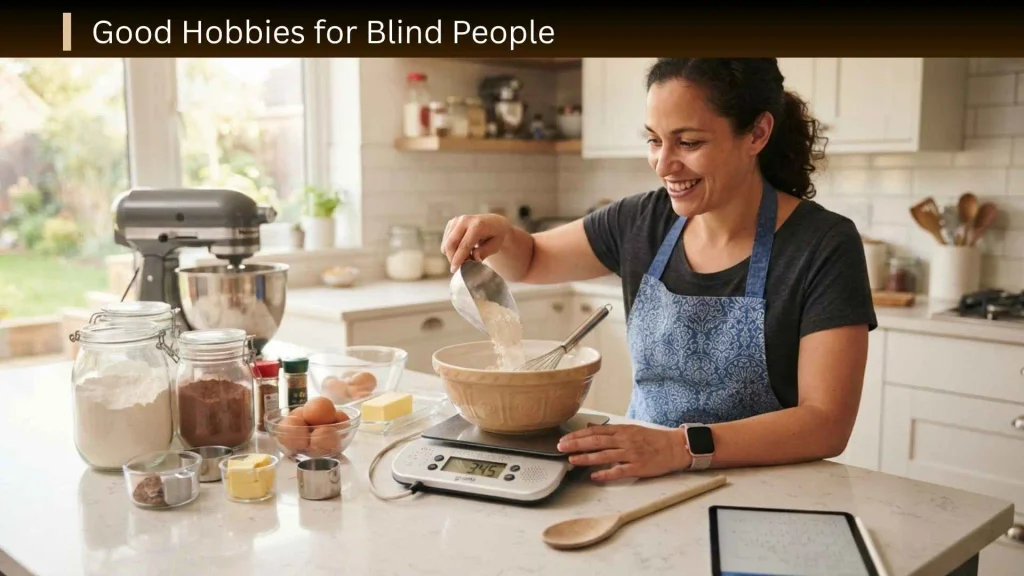
9. Cooking and Baking
Cooking can be a rewarding hobby because it involves touch, smell, taste, sound, planning, and creativity.
A blind cook may use accessible methods such as:
- Voice assistants
- Talking timers
- Tactile markings
- Consistent kitchen organization
- Accessible recipe formats
- Measuring tools designed for accessibility
- Smartphone accessibility features
Recipes can also be converted into audio-friendly instructions so they are easier to follow step by step.
Kitchen safety is important. Hot surfaces, boiling liquids, sharp knives, and appliances require appropriate training and individualized techniques. A person should use methods they are comfortable with and seek professional orientation and mobility or adaptive-living instruction when necessary.
10. Gardening
Gardening is an excellent hobby for people who enjoy nature and hands-on activities.
A person who is blind may enjoy:
- Container gardening
- Herb gardens
- Raised beds
- Indoor plants
- Vegetable gardening
- Flower gardening
- Seed starting
Gardening is particularly suited to tactile and sensory exploration. Plants can be identified through texture, scent, shape, and organization, while consistent placement can make it easier to locate tools and plants.
AFB has specifically highlighted gardening and container gardening as recreational activities for people with vision loss.
11. Walking
Walking can be both recreation and a way to explore familiar surroundings.
Some people enjoy walking as a simple daily hobby, while others turn it into a structured activity by:
- Exploring established routes
- Tracking distance
- Listening to podcasts
- Walking with friends
- Joining an accessible walking group
- Exploring parks with appropriate support
For people who are blind, orientation and mobility skills can be important for navigating unfamiliar environments. A qualified orientation and mobility professional can teach techniques for safe and independent travel.
12. Hiking
Hiking can be an exciting way to experience nature through sound, smell, touch, temperature, and changes in terrain.
People with vision loss may hike using different approaches depending on their skills and the environment, including a cane, guide dog, or sighted guide.
AFB has featured hiking as a recreational activity for people who are blind or visually impaired and discusses approaches such as using a cane and hiking with a guide dog or guide.
When choosing a trail, consider terrain, accessibility, weather, transportation, communication, and the availability of appropriate assistance.
13. Swimming
Swimming can be both an enjoyable hobby and a form of physical activity.
A person who is blind may enjoy:
- Recreational swimming
- Lap swimming
- Water exercise
- Swimming with friends
- Organized adaptive swimming
Clear communication about pool layout, entry and exit points, lane positions, and surroundings can make the activity more accessible.
AFB has specifically discussed swimming as a recreational option for people who are blind or visually impaired.
14. Tandem Cycling
Tandem cycling allows a blind cyclist to ride with a sighted cycling partner.
The two riders share one bicycle and coordinate their movements. For someone who enjoys outdoor recreation, cycling can become a social hobby as well as a way to explore roads or designated cycling areas.
AFB identifies tandem biking as one of the recreational activities enjoyed by people with vision loss.
Anyone considering cycling should choose an appropriate environment and learn communication and safety techniques before riding in more demanding settings.
15. Bowling
Bowling can be adapted in several ways and offers a strong social component.
Players can participate recreationally with friends or explore organized adapted bowling opportunities.
Useful accessibility considerations may include:
- Verbal descriptions
- Consistent starting positions
- Tactile orientation
- Assistance with lane alignment
- Clearly organized equipment
Bowling is among the sports and recreational activities AFB has highlighted for people with vision loss.
16. Beep Baseball and Adapted Sports
People who enjoy competitive sports have options beyond traditional recreational activities.
Beep baseball is specifically designed to allow blind and visually impaired athletes to participate in baseball using audible cues. Other adapted sports may include:
- Goalball
- Blind soccer
- Bowling
- Swimming
- Tandem cycling
- Adapted skiing
- Golf with appropriate assistance
The best choice depends on physical ability, access to local programs, transportation, and personal interest.
For someone who enjoys competition, joining an adaptive sports organization can also provide a valuable social community.
17. Yoga and Exercise
Exercise can become a hobby rather than simply a fitness routine.
Options include:
- Yoga
- Stretching
- Strength training
- Balance exercises
- Walking
- Dance
- Stationary cycling
- Adaptive fitness classes
Accessible instruction matters. For example, verbal descriptions of movements can make an exercise class easier to follow than demonstrations that rely entirely on visual cues. AFB has recommended clear verbal explanations and accessible design for recreational exercise programs and apps.
Anyone beginning a new physical activity should choose an appropriate level and obtain professional guidance when needed.
18. Playing Accessible Video Games
Video games are no longer limited to players who can see a conventional screen.
Some games can be played using:
- Screen readers
- Audio cues
- Self-voicing interfaces
- Keyboard controls
- Accessible mobile interfaces
- Tactile or alternative controls
The accessibility of games varies considerably, so players should check whether a particular game supports their preferred technology.
AFB notes that some computer and electronic games are accessible through screen readers or self-voicing systems, while accessible physical games may use braille or tactile markings.
19. Podcasting
Podcasting can combine creativity, technology, communication, and social interaction.
A blind person can create a podcast about almost any subject, such as:
- Books
- Music
- Technology
- Sports
- Hobbies
- Interviews
- Personal interests
- History
- Entertainment
Recording can begin with a smartphone or computer and an accessible audio-editing setup.
Podcasting can also be done collaboratively, allowing the creator to interview friends, experts, or members of a community.
20. Writing and Journaling
Writing is another flexible hobby.
You can write:
- Short stories
- Poetry
- Personal reflections
- Fiction
- Reviews
- Blog posts
- Journals
- Family histories
Accessible writing can be done using braille devices, smartphones, tablets, computers, speech-to-text tools, or screen readers.
For people who enjoy storytelling, writing can become a long-term creative project.
21. Learning a New Language
Language learning can work particularly well with audio-based resources.
A learner can practice through:
- Audiobooks
- Conversation groups
- Podcasts
- Language-learning apps
- Audio lessons
- Speaking exercises
- Accessible digital courses
A conversation partner can also make language learning more interactive.
The most important consideration is whether the specific learning platform is compatible with the user’s accessibility technology.
22. Bird Listening and Nature Exploration
Nature can be experienced through more than sight.
Bird listening, for example, can become a hobby based on identifying birds through their calls and songs.
Other sensory-based nature activities include:
- Identifying plants by scent
- Listening for different environmental sounds
- Exploring textures
- Visiting accessible parks
- Keeping an audio nature journal
A smartphone or audio recorder can be used to record interesting sounds and create a personal collection.
23. Photography With Accessibility Tools
Photography may seem highly visual, but it can still be an interesting hobby for someone who is blind or has low vision.
The experience can focus on:
- Learning camera controls
- Experimenting with composition through assistance or accessible tools
- Recording meaningful moments
- Working with tactile or audio feedback
- Editing photographs using accessible software
- Collaborating with a sighted partner
For someone with partial sight, accessibility settings, magnification, contrast adjustments, or other tools may make photography more practical.
24. Caring for Pets
For someone who enjoys animals, pet care can become a meaningful hobby.
Activities may include:
- Grooming
- Feeding
- Training
- Playing
- Walking
- Learning about animal behavior
A person’s ability to safely care for a particular animal depends on the animal’s needs, the person’s mobility and skills, and the environment.
Pet ownership should be approached as a responsibility rather than simply a hobby, because animals require consistent care and attention.
25. Social Clubs and Community Activities
Sometimes the best hobby is one that brings people together.
Blind and visually impaired people may enjoy participating in:
- Book clubs
- Music groups
- Craft circles
- Sports teams
- Community organizations
- Volunteer activities
- Game nights
- Discussion groups
- Accessible classes
Social hobbies can be especially valuable for people who want to meet others with similar interests.
AFB has documented barriers involving inaccessible virtual recreational platforms and emphasized the importance of inclusive design so people with vision loss can participate fully in social and recreational activities.
Best Hobbies for Blind People by Interest
The ideal hobby depends more on personal preference than on blindness itself. Here is a simple way to narrow the choices.
| If you enjoy… | Consider… |
| Books and stories | Audiobooks, braille reading, book clubs, writing |
| Music | Singing, instruments, music production |
| Creativity | Knitting, crocheting, sewing, crafts, clay |
| Nature | Gardening, hiking, bird listening |
| Exercise | Swimming, walking, yoga, bowling |
| Competition | Beep baseball, goalball, accessible games |
| Technology | Accessible gaming, podcasting, digital music |
| Socializing | Clubs, sports, game nights, community groups |
| Cooking | Baking, cooking, recipe experimentation |
| Animals | Pet care, animal training |
| Quiet activities | Reading, journaling, crafts, music |
| Outdoor adventure | Hiking, tandem cycling, swimming |
How to Choose the Right Hobby
The best hobby should fit the person rather than forcing the person to fit the activity.
Start With Existing Interests
Think about activities you already enjoy.
If you liked reading before losing your sight, accessible reading may be a natural choice. If you enjoyed sports, investigate adapted sports instead of assuming you need to give them up.
AFB notes that vision loss does not mean people must abandon activities they previously enjoyed; many recreational pursuits can continue with appropriate adaptations.
Consider the Main Sensory Experience
Ask what makes the activity enjoyable.
A hobby based on:
- Sound may include music or bird listening.
- Touch may include crafts or gardening.
- Taste and smell may include cooking.
- Movement may include swimming or exercise.
- Social interaction may include clubs and team sports.
This can make it easier to find activities that naturally work well with your abilities.
Look for Accessible Instruction
A hobby may be technically possible but difficult to learn if the instructions are inaccessible.
Look for resources available in:
- Audio
- Braille
- Accessible digital formats
- Verbal instruction
- Tactile formats
Assistive technology can expand access to computers, mobile devices, games, reading, and other activities. AFB maintains resources covering screen readers, refreshable braille displays, accessible apps, digital talking-book tools, and other assistive technologies.
Think About Social Preferences
Some people prefer solitary hobbies, while others become more motivated when they participate with friends.
If you want more social interaction, consider a club, sports team, community class, book group, or accessible gaming group.
If you prefer quiet time, reading, music, writing, gardening, and crafts may be better choices.
Start Small
A new hobby does not need to become a major project immediately.
Try a small version first:
- Read one audiobook.
- Grow one plant.
- Learn one song.
- Make one simple craft.
- Attend one accessible sports session.
- Play one accessible game.
- Take one short walk.
A small trial can help determine whether the activity is genuinely enjoyable before investing more time or money.
Making Common Hobbies More Accessible
Accessibility does not always require specialized equipment. Sometimes a simple change in how an activity is organized can make a significant difference.
Use Tactile Markings
Raised dots, textured labels, rubber bands, bump dots, and other tactile markers can help identify buttons, containers, game pieces, or household objects.
Use Audio Instructions
Audio instructions can replace information that would otherwise be provided visually.
This can be especially useful for:
- Recipes
- Craft patterns
- Exercise instructions
- Technology tutorials
- Games
- Educational materials
Keep Equipment Organized
Consistent organization can make a hobby easier to perform independently.
For example, keeping gardening tools in the same locations or organizing craft materials into clearly identifiable containers can reduce unnecessary searching.
Use Assistive Technology
Smartphones and computers can provide accessibility features such as screen readers, speech output, magnification, and accessible applications.
AFB’s technology resources specifically cover computers, smartphones, screen readers, electronic notetakers, braille displays, accessible apps, and other tools used by people who are blind or have low vision.
Ask for Specific Assistance
When assistance is needed, specific communication can make activities easier.
Instead of general help, explain exactly what information or action is needed. For example, someone may need a verbal description of an object, help locating equipment, or guidance about the layout of an unfamiliar space.
Hobbies for Blind Children
Children who are blind can participate in many of the same recreational categories as sighted children when activities are made accessible.
Good possibilities include:
- Music
- Singing
- Tactile toys
- Accessible board games
- Storytelling
- Audiobooks
- Building activities
- Crafts
- Swimming
- Gardening
- Cooking with appropriate supervision
- Accessible video games
- Sports
The goal should not be to limit children to activities considered “for blind children.” Instead, accessibility can be added to activities that match the child’s interests and developmental level.
Hobbies for Adults Who Are Blind
Adults may prefer hobbies that provide relaxation, creativity, social connection, physical activity, or intellectual stimulation.
Popular categories include:
- Reading
- Music
- Gardening
- Cooking
- Crafts
- Technology
- Writing
- Fitness
- Outdoor recreation
- Accessible gaming
- Social clubs
- Volunteer activities
The possibilities can expand considerably when assistive technology and adaptive techniques are incorporated.
Hobbies for Older Adults With Vision Loss
Older adults who experience vision loss may worry that activities they once enjoyed are no longer possible. In many cases, activities can be adapted instead of abandoned.
AFB has specifically discussed continued participation in hobbies, games, gardening, sewing circles, exercise, tandem biking, bowling, golf, and other recreational pursuits after vision loss.
For older adults, it can be helpful to prioritize hobbies that are enjoyable, appropriately challenging, socially engaging, and compatible with mobility and safety needs.
Are Hobbies for Blind People Expensive?
Not necessarily.
Some hobbies can begin with little or no specialized equipment:
- Listening to free audio content
- Walking
- Singing
- Writing
- Bird listening
- Community social activities
- Simple exercise
- Gardening with existing materials
Other hobbies may require adaptive equipment or specialized instruction.
Before buying expensive equipment, try to determine whether the activity can be tested through a local organization, community center, library, adaptive recreation program, or club.
Where Can Blind People Find Accessible Hobby Opportunities in the USA?
Start with local organizations rather than searching only for activities labeled specifically for blind people.
Potential places to explore include:
- Public libraries
- Parks and recreation departments
- Adaptive sports programs
- Community centers
- Blindness and low-vision organizations
- Local hobby clubs
- Community colleges
- Recreation centers
- Accessible online communities
- Volunteer organizations
Organizations serving people with blindness or low vision may also provide information about recreation, technology, training, and community resources. AFB maintains extensive resources related to blindness, low vision, technology, recreation, and independent living.
How Can Friends and Family Make Hobbies More Inclusive?
Friends and family can make a major difference by treating accessibility as a practical issue rather than assuming a person cannot participate.
Helpful approaches include:
- Ask what kind of assistance is wanted.
- Provide clear verbal descriptions.
- Keep shared equipment organized.
- Avoid moving personal items without explaining the change.
- Include the blind person in group activities.
- Choose accessible games and materials.
- Allow the person to learn techniques independently.
- Focus on the person’s interests rather than assumptions about blindness.
The person should remain in control of how they want to participate.
Frequently Asked Questions
What are the best hobbies for blind people?
There is no single best hobby for everyone. Reading, music, crafts, gardening, cooking, accessible games, swimming, walking, hiking, adapted sports, writing, podcasting, and social clubs are all possibilities. The best choice depends on interests, skills, accessibility, and personal preferences.
Can blind people play board games?
Yes. Many board games can be adapted with tactile, braille, large-print, or high-contrast features. AFB lists accessible versions of games such as chess, checkers, Monopoly, Scrabble, dominoes, and other games.
Can blind people do arts and crafts?
Yes. Knitting, crocheting, sewing, clay work, beadwork, weaving, plastic canvas, latch hook, and other crafts can be adapted using tactile techniques and accessible instructions.
Can a blind person garden?
Yes. Gardening can be a tactile and sensory hobby. Container gardening and organized garden beds can be particularly practical options, depending on the individual’s mobility and gardening setup.
Can blind people play video games?
Yes. Some video games use screen readers, self-voicing, audio cues, or other accessibility features. However, accessibility varies significantly between games, so each game should be evaluated individually.
What are good social hobbies for blind adults?
Book clubs, accessible game nights, choirs, sports teams, community classes, craft groups, volunteer activities, and local organizations can provide opportunities for social interaction.
What are inexpensive hobbies for blind people?
Walking, singing, writing, listening to available audio content, simple exercise, bird listening, and some community activities can be started with little equipment. Crafting and gardening can also be inexpensive when beginning with basic materials.
Are outdoor hobbies possible for blind people?
Yes. Walking, hiking, swimming, tandem cycling, gardening, and adapted sports are examples of outdoor or physically active recreation that people with vision loss can participate in. The appropriate approach depends on the environment and the person’s mobility and safety skills.
How can I find hobbies if I recently became blind?
Start with activities you already enjoyed and look for accessible versions rather than assuming you need entirely new interests. Orientation and mobility training, rehabilitation services, assistive technology, and organizations serving people with vision loss can also help you regain confidence and discover new recreational options. AFB notes that appropriate support, rehabilitation, and assistive technology can help people with blindness or low vision live independently and pursue fulfilling lives.
Conclusion
The best hobbies for blind people are not limited to a small list of specially adapted activities. Reading, music, crafts, gardening, cooking, games, technology, exercise, sports, outdoor recreation, writing, and social activities can all be part of an enjoyable and fulfilling life.
Accessibility often comes from practical adjustments: tactile markings, audio instructions, accessible technology, organized equipment, adaptive products, or support from another person when needed. AFB’s recreation and technology resources demonstrate the wide range of activities and adaptations available to people with vision loss.
Most importantly, choose hobbies based on interest first and accessibility second. Blindness does not eliminate the desire to create, explore, compete, learn, relax, or connect with other people. With the right approach, a hobby can become much more than a way to pass the time it can provide creativity, confidence, friendship, and a meaningful part of everyday life.

I’m Sophia Carter, a writer who enjoys discovering interesting ideas and transforming them into helpful content. At Cognivoora, I write with a simple goal: to make information clearer, more accessible, and genuinely useful for readers. I value thoughtful research, easy explanations, and content that people can trust and return to whenever they need it.
Books:
- The Knowledge Journey
- Understanding the World Around Us