Finding a hobby doesn’t have to be complicated, expensive, or time-consuming. I know that when life gets busy, you may want something enjoyable to do without adding another stressful task to your schedule. That’s where easy hobbies can make a real difference.
Whether you want to relax after a long day, learn something new, get creative, or simply spend less time scrolling on your phone, you can find an easy hobby that fits your lifestyle. You don’t need special skills or a big budget to get started you just need a little curiosity and a few minutes to yourself.
In this guide, I’ll help you discover easy hobbies that you can start as a beginner, including simple creative, relaxing, active, and indoor activities. So, if you’ve been thinking, “I want a hobby, but I don’t know where to start,” you’re in the right place. Let’s find something you’ll actually enjoy doing.
35 Easy Hobbies for Beginners
1. Reading
Reading is one of the simplest hobbies to start because you only need access to a book, magazine, or digital reading device. You can choose fiction, nonfiction, biographies, history, mysteries, science fiction, or almost any other subject that interests you.
If reading regularly feels difficult, start with 10–15 minutes rather than trying to finish a whole chapter every day. Libraries can also make exploring different genres inexpensive.
Best for: Quiet, low-cost leisure
Starting cost: Free to low
Space needed: Minimal
2. Journaling
Journaling can be as simple as writing a few sentences about your day, recording ideas, keeping a gratitude list, or documenting goals.
You do not need a special notebook or a particular writing style. A basic notebook and pen are enough, although digital notes work just as well.
Best for: People who enjoy writing or reflection
Starting cost: Free to low
Space needed: Minimal
3. Drawing
Drawing is easy to begin but offers almost unlimited opportunities for improvement. Start with pencils and ordinary paper rather than immediately investing in professional art supplies.
Try simple subjects such as household objects, plants, animals, or basic shapes. Sketching for a few minutes at a time can help you develop consistency without making the hobby feel like an assignment.
Best for: Creative, visual learners
Starting cost: Low
Space needed: Small
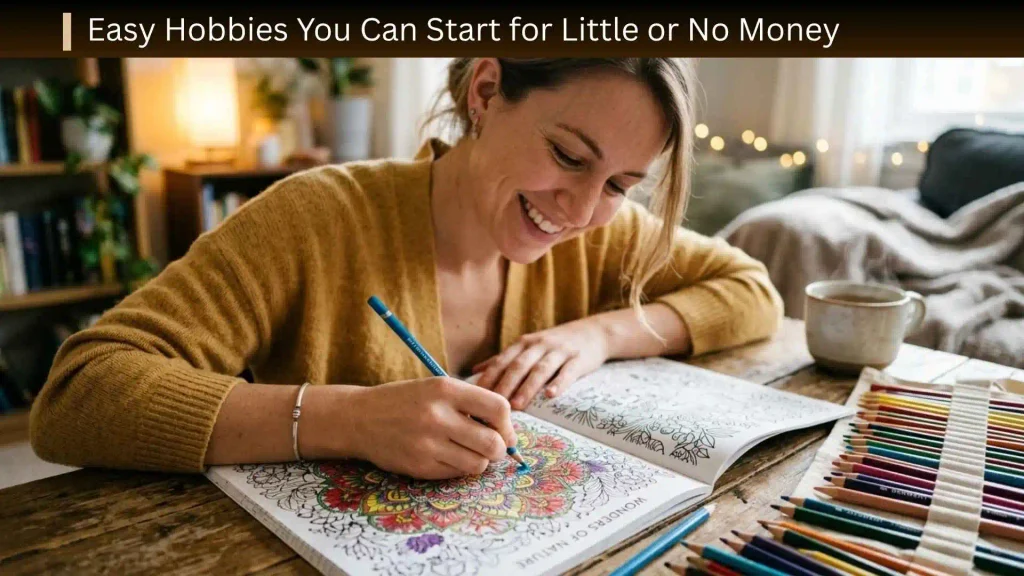
4. Coloring
Adult coloring books provide a particularly accessible introduction to creative hobbies. Unlike drawing, coloring does not require you to create an image from scratch.
Colored pencils, markers, or crayons can be enough to get started. You can also experiment with different coloring techniques as your interest develops.
Best for: Relaxed, low-pressure creativity
Starting cost: Low
Space needed: Small
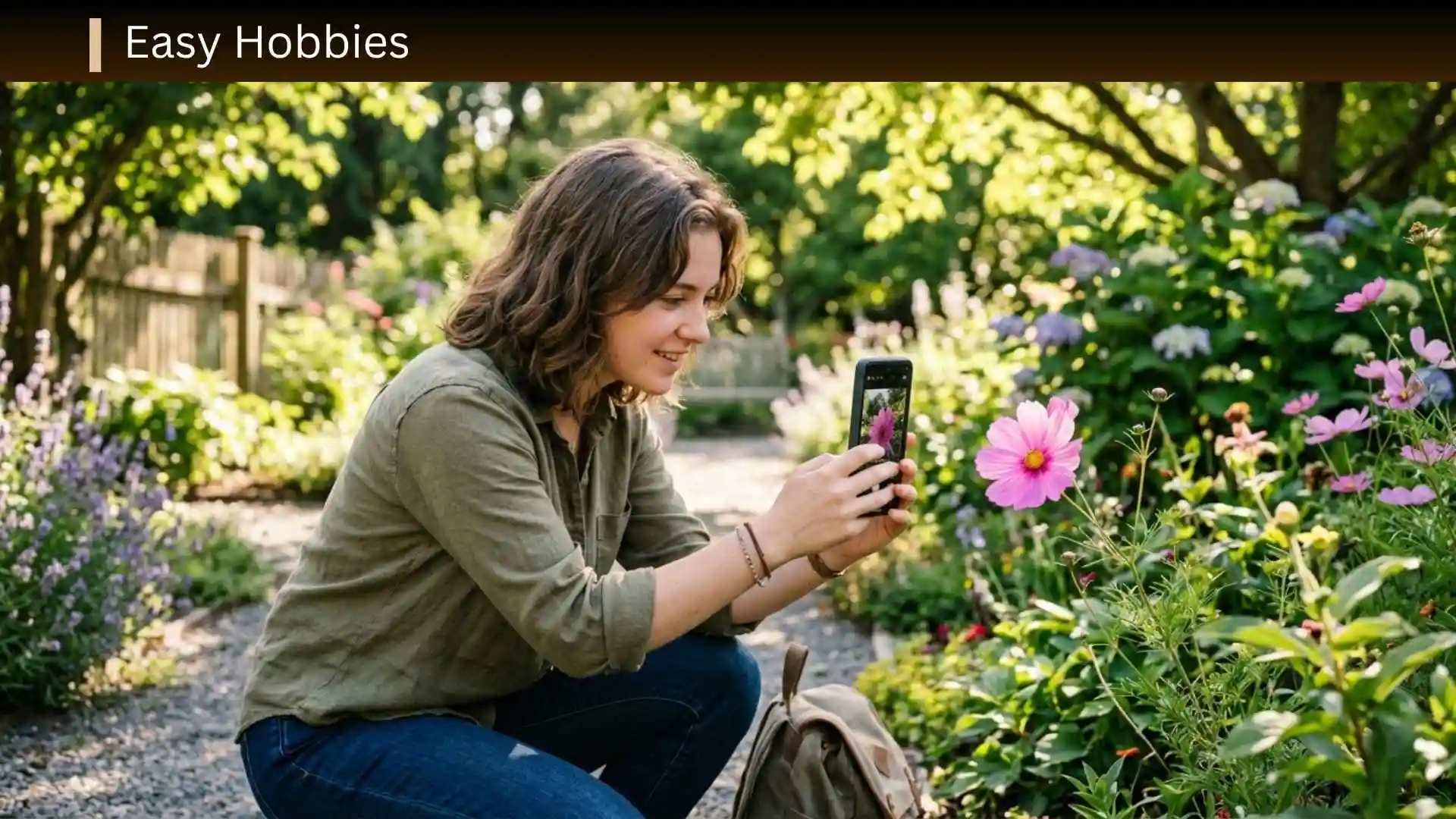
5. Photography
You do not need a dedicated camera to begin photography. A smartphone can provide everything necessary to learn basic concepts such as composition, perspective, framing, and lighting.
Try giving yourself simple themes, such as photographing interesting architecture, nature, textures, or everyday objects.
Best for: Visual exploration
Starting cost: Free to low if using a phone
Space needed: None
6. Walking
Walking can function as both everyday movement and a recreational hobby. Instead of treating every walk as exercise, use it as an opportunity to explore different neighborhoods, parks, trails, or local sights.
You can make it more engaging by photographing interesting places, listening to an audiobook, or keeping a record of new routes.
Best for: People who enjoy being outdoors
Starting cost: Usually free
Space needed: Outdoor access
7. Gardening
Gardening does not require a large backyard. Herbs, flowers, and some vegetables can be grown in containers if you have suitable light and space.
For beginners, starting with a few easy-to-manage plants is generally more practical than creating a large garden immediately.
Best for: Nature lovers and hands-on learners
Starting cost: Low to moderate
Space needed: Varies
8. Houseplant Care
If outdoor gardening is impractical, caring for houseplants can provide a smaller-scale alternative.
Choose plants according to the light available in your home rather than simply selecting plants because they look attractive. Keep the number of plants manageable while you learn their basic care requirements.
Best for: Indoor nature enthusiasts
Starting cost: Low to moderate
Space needed: Small
9. Baking
Baking can turn an ordinary kitchen activity into a creative hobby. Beginners can start with simple recipes such as cookies, muffins, quick breads, or basic cakes.
Following a recipe carefully is useful when starting because baking often depends on measurements and technique more than improvisation.
Best for: Food lovers and practical learners
Starting cost: Low if you already have kitchen basics
Space needed: Kitchen counter space
10. Cooking
Cooking offers a broader range of possibilities than baking because you can experiment with cuisines, ingredients, techniques, and flavors.
A useful beginner approach is to learn a few versatile meals rather than trying to master an entire cuisine at once.
Best for: People who like practical skills
Starting cost: Low to moderate
Space needed: Kitchen
11. Puzzles
Jigsaw puzzles, crossword puzzles, logic puzzles, and other puzzle formats can make a convenient hobby for people who enjoy solving problems.
Choose the difficulty according to your patience and available time. A smaller puzzle is often easier to fit into a busy schedule.
Best for: Problem solvers
Starting cost: Low
Space needed: Small to moderate
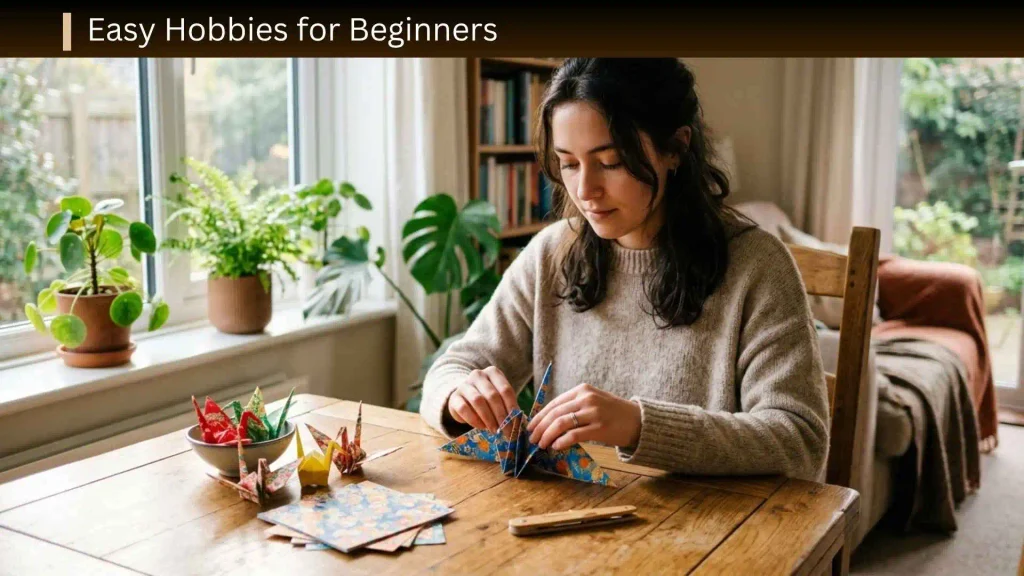
12. Origami
Origami involves folding paper into shapes and figures. It requires very little equipment, making it particularly approachable for beginners.
Start with simple models before moving toward more complicated designs. The challenge comes from following folding sequences accurately.
Best for: Patient, detail-oriented beginners
Starting cost: Very low
Space needed: Minimal
13. Calligraphy
Calligraphy can make handwriting practice more creative. Beginners can start with a basic writing tool and practice paper before deciding whether they want specialized pens or additional supplies.
Learning consistent letterforms and spacing is more useful at first than trying to create elaborate decorative pieces.
Best for: People who enjoy lettering and detail
Starting cost: Low
Space needed: Small
14. Hand Lettering
Hand lettering is related to calligraphy but focuses more on drawing and designing letters than following traditional writing styles.
You can experiment with different fonts, words, signs, and greeting-card designs using ordinary pens and paper.
Best for: Creative people who like typography
Starting cost: Low
Space needed: Small
15. Knitting
Knitting can look complicated when you see advanced projects, but the basic techniques are relatively limited. Beginners can start by learning how to hold the needles, make a slip knot, cast on, and create basic stitches.
A small scarf, dishcloth, or simple swatch can provide practice without requiring a large project.
Best for: Hands-on, repetitive creative work
Starting cost: Low to moderate
Space needed: Small
16. Crocheting
Crochet requires a hook and yarn, and many beginners find it approachable because you work with one main hook rather than two knitting needles.
Once you understand a few basic stitches, you can create items such as scarves, small accessories, blankets, or decorative pieces.
Best for: Fiber-art beginners
Starting cost: Low
Space needed: Small
17. Sewing
Basic sewing can begin with simple hand stitches and inexpensive fabric scraps. You do not need to start with complicated garments.
Small projects such as repairing clothing, making simple fabric items, or creating decorations can teach useful techniques while keeping the learning curve manageable.
Best for: Practical and creative learners
Starting cost: Low to moderate
Space needed: Small
18. Origami and Paper Crafts
Paper crafts extend beyond traditional origami. You can make cards, bookmarks, paper decorations, collages, gift tags, and simple models.
This is particularly useful if you want a creative hobby without accumulating specialized equipment.
Best for: Craft enthusiasts
Starting cost: Low
Space needed: Small
19. Scrapbooking
Scrapbooking combines photographs, paper, captions, decorations, and memorabilia into organized pages.
You can keep it simple with photographs and handwritten notes rather than purchasing a large collection of decorative supplies.
Best for: Memory keeping and creative organization
Starting cost: Low to moderate
Space needed: Small to moderate
20. Birdwatching
Birdwatching can be started simply by observing birds in your yard, neighborhood, or local park.
Binoculars can be useful but are not essential at first. A bird-identification guide or app can help you learn to recognize different species.
Best for: Nature enthusiasts
Starting cost: Free to moderate
Space needed: Outdoor access
21. Stargazing
Stargazing can begin without a telescope. On a clear night, you can simply observe the sky and learn to identify prominent stars, planets, and constellations.
As your interest grows, you can explore astronomy resources or consider binoculars or a telescope.
Best for: Curious beginners interested in astronomy
Starting cost: Free to low
Space needed: Outdoor access
22. Learning a Language
Learning a new language can become a long-term hobby, but you can start with just a few minutes of practice each day.
Focus initially on useful phrases, pronunciation, common vocabulary, and simple listening practice. Consistency matters more than trying to study large amounts at once.
Best for: Lifelong learners
Starting cost: Free to moderate
Space needed: None
23. Learning About History
History can become a hobby without requiring formal study. Choose a period, country, event, or historical figure that genuinely interests you and explore books, documentaries, museums, and reputable educational resources.
A specific starting question is often more engaging than attempting to learn “all of history.”
Best for: Curious readers
Starting cost: Free to low
Space needed: Minimal
24. Creative Writing
Creative writing includes short stories, poetry, fictional scenes, character development, and personal essays.
A useful way to begin is with short pieces. Writing 300 words about a fictional situation can be much less intimidating than deciding to write an entire novel.
Best for: Storytellers and imaginative thinkers
Starting cost: Free
Space needed: Minimal
25. Poetry
Poetry is another accessible writing hobby. You can experiment with rhyme, free verse, imagery, rhythm, or very short poems.
There is no need to begin with a long composition. Writing a few lines around a particular image, memory, or idea is enough to practice.
Best for: People who enjoy language and expression
Starting cost: Free
Space needed: Minimal
26. Listening to and Exploring Music
You can turn ordinary music listening into a more active hobby by exploring new genres, learning about artists, comparing recordings, or creating themed playlists.
You might focus on a particular decade, instrument, region, genre, or composer.
Best for: Music lovers
Starting cost: Free to moderate
Space needed: None
27. Playing an Instrument
Learning an instrument takes more practice than some hobbies on this list, but the starting point can still be simple.
A beginner might learn a few chords on guitar, basic melodies on keyboard, or introductory rhythms on another instrument. The key is to choose an instrument that fits your interests and living situation.
Best for: People who want a skill-building hobby
Starting cost: Moderate, depending on the instrument
Space needed: Varies
28. Singing
Singing requires no special equipment and can be practiced privately or socially.
Beginners can start by learning songs they already enjoy and gradually explore breathing, pitch, rhythm, and vocal technique.
Best for: Music enthusiasts
Starting cost: Free to low
Space needed: None
29. Hiking
For people who enjoy walking outdoors and want more variety, hiking can provide an easy progression from short local trails to longer routes.
Beginners should choose routes appropriate for their experience and conditions, check local trail information, and bring suitable water and clothing.
Best for: Outdoor exploration
Starting cost: Low to moderate
Space needed: Outdoor access
30. Geocaching
Geocaching combines outdoor exploration with a treasure-hunt-style activity. Participants use GPS-enabled devices to locate hidden containers or designated locations.
It can make familiar parks and neighborhoods feel more exploratory because the activity gives you a specific destination to find.
Best for: Adventurous beginners
Starting cost: Free to low
Space needed: Outdoor access
31. Collecting
Collecting can involve almost anything that interests you, from postcards and stamps to rocks, books, vintage objects, or sports memorabilia.
A good collection has some personal logic behind it. Setting boundaries around what you collect can also prevent the hobby from becoming unnecessarily expensive or cluttered.
Best for: Detail-oriented enthusiasts
Starting cost: Varies widely
Space needed: Depends on the collection
32. Puzzles and Board Games
Board games can be a hobby for solo players, couples, families, or groups of friends. Modern board games range from simple games that take a few minutes to complex strategy games that require substantial learning.
Start with games whose rules match the amount of complexity you actually enjoy.
Best for: Social or strategic play
Starting cost: Low to moderate
Space needed: Small to moderate
33. Digital Art
Digital art can be started with a computer, tablet, or compatible smartphone and an appropriate drawing application.
You can experiment with sketching, illustration, graphic design, digital painting, or simple photo manipulation without needing a physical collection of art supplies.
Best for: Tech-oriented creative people
Starting cost: Free to moderate
Space needed: Minimal
34. Video Editing
Video editing can become a hobby even if you never intend to become a professional creator. You can edit family footage, travel clips, short creative projects, or videos made specifically to practice editing.
Start by learning basic trimming, sequencing, audio adjustment, and transitions before moving into more advanced techniques.
Best for: Creative people interested in technology and media
Starting cost: Free to moderate
Space needed: Computer or mobile device
35. Learning a New Craft
If none of the specific hobbies above appeals to you, exploring crafts can be a good starting point. Options include candle-making, model building, woodcraft, embroidery, beadwork, pottery, leathercraft, or other creative activities.
Choose based on the space, tools, materials, and safety requirements involved rather than assuming every craft has the same learning curve or cost.
Best for: People who want hands-on experimentation
Starting cost: Varies
Space needed: Varies
Easy Hobbies by Interest
Choosing by personality or interest can make the decision easier than looking at a long list.
| If you enjoy… | Try… |
| Reading and learning | Reading, history, language learning |
| Creativity | Drawing, coloring, writing, digital art |
| Nature | Gardening, birdwatching, hiking, stargazing |
| Making things | Knitting, crochet, sewing, paper crafts |
| Food | Cooking, baking |
| Music | Singing, music exploration, an instrument |
| Solving problems | Puzzles, board games |
| Exploring | Photography, walking, geocaching |
| Quiet activities | Reading, journaling, drawing, origami |
| Technology | Photography, digital art, video editing |
The important distinction is that an “easy” hobby does not necessarily mean a hobby you will master quickly. It usually means the barrier to getting started is low.
Easy Hobbies You Can Start for Little or No Money
If budget is your biggest concern, consider activities that use things you already have.
Good low-cost choices include:
- Reading through a public library
- Walking
- Journaling
- Creative writing
- Drawing with basic paper and pencils
- Singing
- Stargazing without equipment
- Learning a language with free resources
- Photography with a smartphone
- Exploring music
- Birdwatching without binoculars
- Origami using ordinary paper
You can always invest more later if the hobby proves worthwhile. Starting cheaply also gives you a chance to discover whether you genuinely enjoy an activity before buying specialized equipment.
Easy Hobbies for Small Spaces
Living in an apartment or small home does not prevent you from having a hobby. Consider activities that require little equipment or can be packed away easily.
Good choices include:
- Reading
- Journaling
- Drawing
- Coloring
- Origami
- Calligraphy
- Hand lettering
- Crochet
- Knitting
- Creative writing
- Puzzles
- Digital art
- Language learning
- Music listening
For space-intensive hobbies, such as certain crafts or gardening projects, look for smaller versions first rather than committing to a large setup.
Easy Hobbies for Busy People
If you have only a few minutes available, choose hobbies that can be stopped and restarted easily.
Good options include:
- Reading a few pages
- Journaling
- Sketching
- Coloring
- Photography
- Language practice
- Listening to music
- Origami
- Short walks
- Puzzles
A hobby does not need a fixed two-hour block on your calendar. Ten or fifteen minutes of regular participation can be enough to make an activity part of your routine.
Easy Hobbies to Do Alone
For people who prefer independent activities, several hobbies can be enjoyed without coordinating with other people.
Consider:
- Reading
- Drawing
- Journaling
- Photography
- Gardening
- Creative writing
- Puzzles
- Stargazing
- Language learning
- Digital art
- Cooking
- Knitting or crochet
- Collecting
- Music exploration
Some hobbies can also shift between solo and social participation. For example, you can cook alone, join a cooking class, or share recipes with friends.
Easy Hobbies to Do With Other People
If the social aspect is important, choose hobbies that naturally create opportunities for interaction.
Options include:
- Board games
- Cooking
- Baking
- Hiking
- Walking groups
- Gardening
- Photography outings
- Book clubs
- Language practice
- Craft groups
- Singing
- Learning an instrument
The hobby itself does not have to be highly social. Even an individual activity such as photography can become social when you participate in a photography group or explore locations with friends.
How to Choose the Right Easy Hobby
A long list of possibilities can create a different problem: having too many choices. Instead of asking which hobby is objectively best, ask which one fits your current life.
Consider your available time
If you have only short periods of free time, avoid hobbies that require extensive setup every time you practice.
Reading, sketching, journaling, puzzles, and language practice are easy to fit into short sessions.
Consider your budget
Set a starting budget before purchasing supplies. Many hobbies have inexpensive entry points but can become substantially more expensive as you become more involved.
For example, photography can start with a smartphone, while specialized cameras and lenses can create a much larger equipment budget.
Consider your space
A hobby that requires a permanent workbench may not be practical in a small apartment. Portable activities are often easier when your living space is limited.
Decide whether you want a skill or an experience
Some hobbies are primarily about enjoyment and exploration. Others are appealing because you want to develop a measurable skill.
If you want visible progress, consider drawing, cooking, playing an instrument, photography, writing, or a craft.
If you mainly want something pleasant to do during free time, reading, music listening, walking, coloring, or puzzles may be more suitable.
Match the hobby to your energy level
Think about when you are most likely to practice.
If you want something quiet after a long day, reading or journaling may work better than an activity requiring extensive preparation. If you want to get out of the house, walking, hiking, photography, or geocaching may be a better fit.
Try before you invest
One of the best ways to choose a hobby is to experiment with several inexpensive options.
Give each activity a fair trial rather than buying a complete setup immediately. If you keep coming back to one activity without forcing yourself, that is a useful sign that it may be a good match.
A Simple Way to Start a New Hobby
You do not need a complicated plan.
Step 1: Pick one activity.
Choose something that sounds genuinely interesting rather than something you think you are supposed to enjoy.
Step 2: Set a small starting goal.
For example, read 10 pages, sketch for 15 minutes, cook one new recipe, or take five photographs.
Step 3: Use what you already have.
Avoid purchasing specialized equipment until you understand whether you want to continue.
Step 4: Practice consistently.
A small amount of regular practice is easier to maintain than an ambitious schedule.
Step 5: Evaluate after a few sessions.
Ask yourself whether you looked forward to doing it, whether the setup was manageable, and whether you want to learn more.
Step 6: Either continue or try something else.
There is no requirement to stick with a hobby that does not suit you.
Common Mistakes When Starting an Easy Hobby
Buying too much equipment
Beginners sometimes purchase everything associated with a hobby before discovering whether they enjoy it. Start with the minimum practical equipment.
Choosing a hobby because it looks impressive
A hobby does not need to produce impressive results to be worthwhile. Choose an activity you actually enjoy doing.
Making the first project too ambitious
Your first knitting project does not need to be a complicated sweater, and your first creative-writing project does not need to be a novel.
Small projects make it easier to learn the basics and see progress.
Expecting immediate skill
An easy hobby can have an easy starting point while still requiring substantial practice to master. Separate easy to begin from easy to become highly skilled at.
Turning the hobby into another obligation
If every session feels like another task you have to complete, reconsider your approach. A hobby should fit your life rather than creating unnecessary pressure.
Frequently Asked Questions
What is the easiest hobby to start?
Reading, walking, journaling, drawing, coloring, photography with a smartphone, and creative writing are among the easiest hobbies to start because they require little equipment and can be practiced almost immediately.
What are some easy hobbies that cost little money?
Reading through a library, walking, journaling, drawing with basic supplies, creative writing, singing, stargazing without equipment, and learning a language with free resources can all be started inexpensively.
What is a good hobby for someone who has never had a hobby?
Start with something that matches an existing interest. If you like stories, try reading. If you enjoy making things, try drawing or a simple craft. If you like being outdoors, try walking or birdwatching. Your existing interests provide a natural starting point.
Can a hobby really be easy to start but difficult to master?
Yes. “Easy” generally describes the entry barrier, not the ultimate difficulty. Photography, cooking, drawing, music, and crafts can all be started simply while offering years of opportunities for improvement.
What are good easy hobbies to do at home?
Reading, journaling, drawing, coloring, puzzles, baking, cooking, knitting, crochet, origami, creative writing, digital art, and language learning can all be practiced at home.
What are good easy hobbies for busy adults?
Look for hobbies that can be done in short sessions and require little setup. Reading, journaling, photography, drawing, language practice, puzzles, walking, and music exploration are flexible choices.
Should I buy equipment before choosing a hobby?
Usually, it is better to start with basic or existing equipment. Once you know that you enjoy the activity and want to progress, you can decide whether additional equipment is actually useful.
Conclusion
The easiest hobby is not necessarily the one with the fewest steps. It is the one you can realistically start and genuinely want to return to.
If you want something quiet, try reading, journaling, drawing, or puzzles. If you prefer being outdoors, consider walking, gardening, birdwatching, or photography. For hands-on creativity, knitting, crochet, origami, baking, and other crafts provide plenty of room to learn.
Start small, use what you already have, and give yourself permission to experiment. You do not need to find your perfect hobby immediately; trying a few simple activities is often the easiest way to discover what fits.

I’m Olivia Bennett, a passionate writer who loves exploring ideas, learning new concepts, and sharing knowledge in a straightforward way. I write for Cognivoora with the goal of making useful topics easier to understand without unnecessary complexity. My approach combines research, clarity, and a reader-first perspective.
Books:
- Think Clearly, Live Better
- The Curious Reader’s Guide