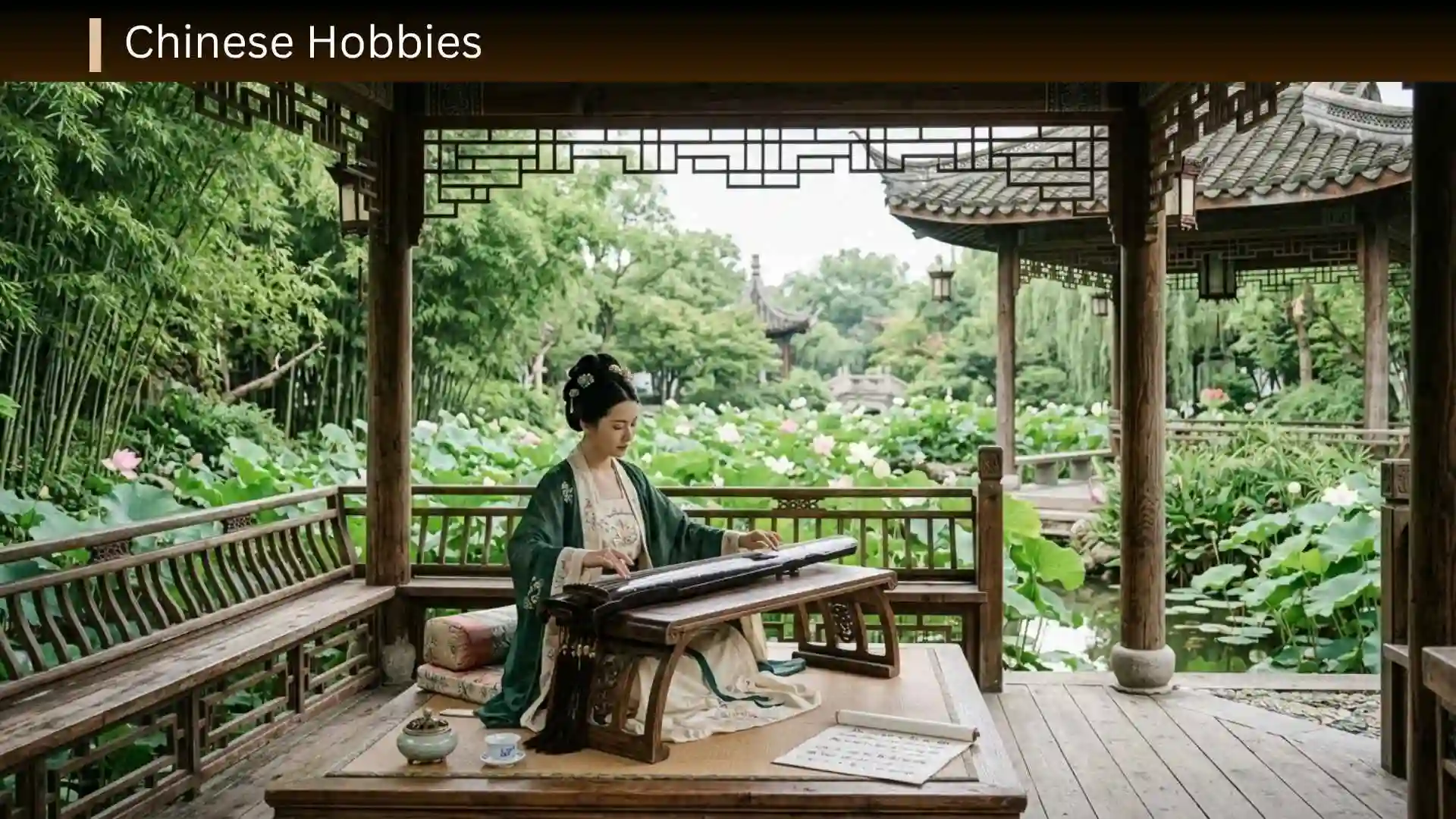
If you’re curious about Chinese hobbies, you’ll find a fascinating mix of traditional arts, creative activities, games, food-related skills, and modern pastimes.
I love how these hobbies can give you more than just something fun to do,they can also help you explore Chinese culture, history, and everyday life. Whether you want to learn calligraphy, try Chinese painting, practice tea appreciation, play mahjong, or discover a new craft, you can find a hobby that matches your interests while giving you a deeper connection to Chinese culture.
Chinese Hobbies(Quick Answer)
Some popular Chinese hobbies include:
- Chinese calligraphy
- Chinese brush painting
- Tea appreciation
- Mahjong
- Chinese chess (xiangqi)
- Weiqi (Go)
- Tai chi
- Qigong
- Chinese martial arts
- Chinese cooking
- Paper cutting
- Chinese knotting
- Traditional Chinese music
- Guzheng
- Guqin
- Kite making and flying
- Chinese gardening
- Hanfu and traditional clothing culture
- Chinese dance
- Learning Mandarin through cultural activities
These hobbies offer different experiences. Calligraphy and painting are creative, mahjong and chess are strategic and social, tai chi is movement-based, and cooking combines practical skills with cultural exploration.
Best Chinese Hobbies to Try
1. Chinese Calligraphy
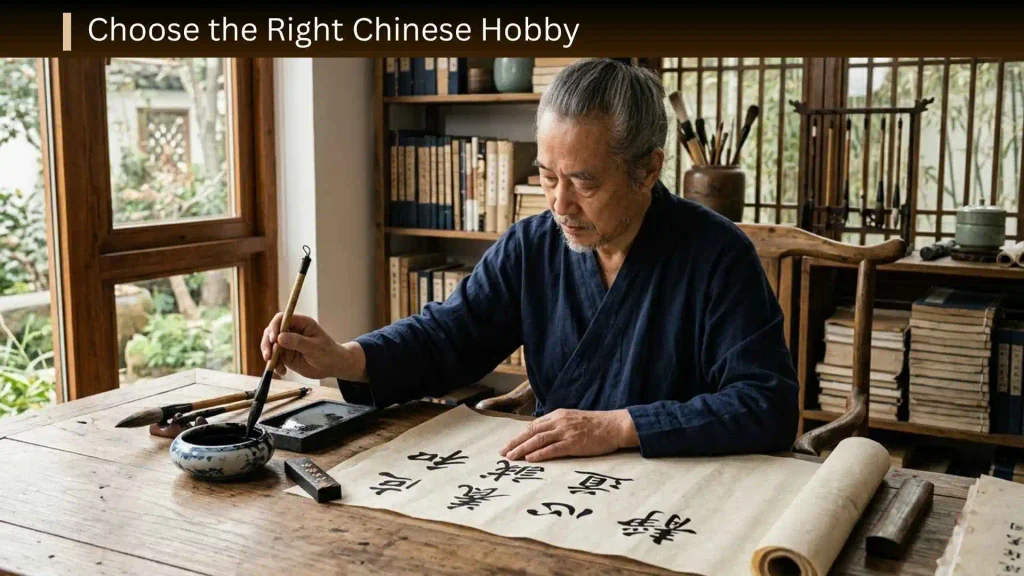
Chinese calligraphy, known as shūfǎ (书法), is the traditional art of writing Chinese characters with a brush. It involves much more than producing attractive handwriting. Practitioners learn to control brush pressure, direction, spacing, proportions, and the structure of individual characters.
Calligraphy is a good choice for someone who enjoys drawing, lettering, or quiet creative activities.
Best for: Artists, language learners, creative people, and anyone who enjoys focused activities.
Difficulty: Beginner-friendly, although advanced mastery takes considerable practice.
Cost: Low to moderate.
Where: Indoors.
What you need: Brushes, ink, suitable paper, and a basic practice guide.
Beginner tip: Start by practicing individual brush strokes before attempting complicated characters or compositions.
You do not need to speak Chinese fluently to begin. Learning a few basic Chinese characters and understanding their structure can make the hobby more rewarding.
2. Chinese Brush Painting
Chinese brush painting, often called guóhuà (国画), uses brushes, ink, and pigments to depict subjects such as landscapes, plants, animals, and flowers.
Calligraphy and brush painting share some techniques, particularly the importance of controlled brush movements. Beginners can start with simple subjects instead of trying to reproduce complicated landscapes.
Best for: Artists, nature lovers, and creative hobbyists.
Difficulty: Moderate.
Cost: Low to moderate.
Where: Indoors.
Beginner tip: Practice simple subjects such as bamboo, flowers, or leaves to develop brush control.
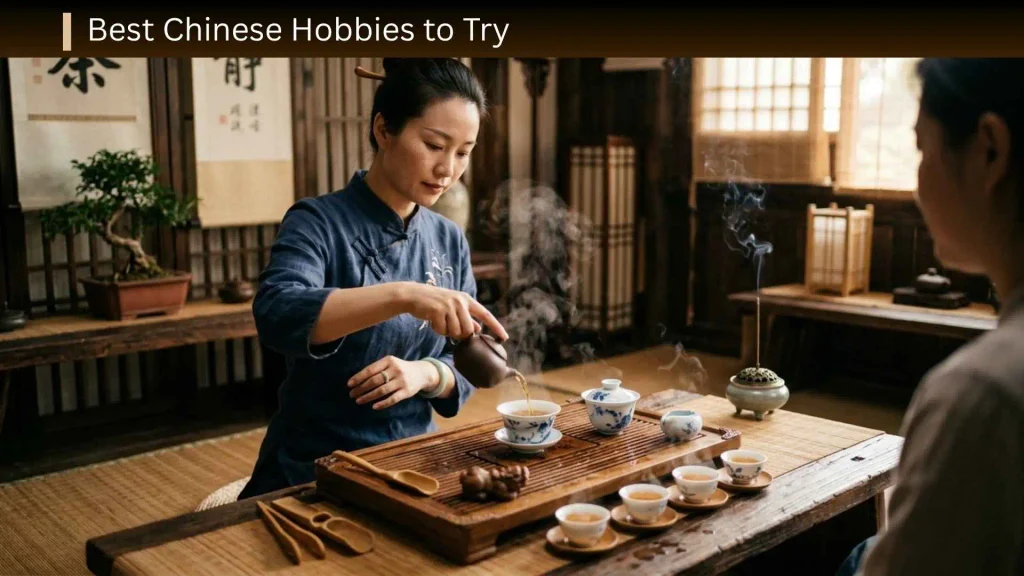
3. Chinese Tea Appreciation
Chinese tea culture is an excellent hobby for people who enjoy beverages, sensory experiences, and cultural traditions.
Instead of simply drinking tea, you can explore different varieties, brewing methods, tea equipment, aromas, flavors, and serving traditions. A simple setup can include a gaiwan or teapot, cups, and several types of tea.
Best for: Tea lovers, food enthusiasts, and people who prefer quiet hobbies.
Difficulty: Easy to begin.
Cost: Low to moderate.
Where: Indoors.
Beginner tip: Start with a small selection of teas and compare their aroma, flavor, appearance, and aftertaste rather than buying a large collection immediately.
4. Mahjong
Mahjong is a traditional Chinese tile game that combines strategy, pattern recognition, probability, and luck. It is also strongly associated with social gatherings.
One important point for beginners is that mahjong does not have only one universal ruleset. Different communities and regions can use different rules, scoring systems, and variations.
Best for: Social people, game enthusiasts, and strategic thinkers.
Difficulty: Moderate.
Cost: Low to moderate.
Where: Indoors.
Beginner tip: Ask which ruleset a group follows before joining a game.
For someone in the United States, mahjong can also be a way to connect with Chinese American communities and cultural groups.
5. Chinese Chess (Xiangqi)
Xiangqi (象棋), commonly called Chinese chess, is a traditional two-player strategy game. Although it shares some broad similarities with Western chess, its board, pieces, movement rules, and tactical concepts are different.
It can be especially interesting for someone who already enjoys chess but wants to learn a completely different strategic system.
Best for: Chess players, puzzle enthusiasts, and strategy lovers.
Difficulty: Moderate to advanced.
Cost: Low.
Where: Indoors.
Beginner tip: Learn how every piece moves and understand the special rules before studying advanced openings.
6. Weiqi (Go)
Weiqi (围棋), known internationally as Go, is an ancient strategy board game played with black and white stones.
The basic rules can be learned relatively quickly, but strategic understanding develops over a much longer period. This makes Go a good hobby for someone who enjoys activities with a deep learning curve.
Best for: Strategic thinkers and people who enjoy challenging games.
Difficulty: Easy to learn, difficult to master.
Cost: Low.
Where: Indoors.
Beginner tip: Practice on a smaller board when learning so you can understand the consequences of individual moves more easily.
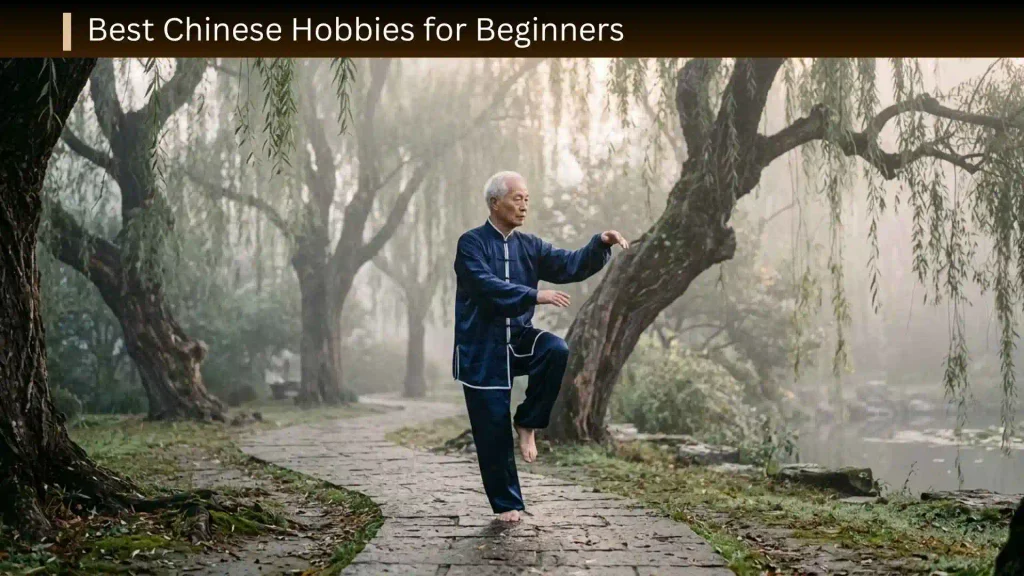
7. Tai Chi
Tai chi, or tàijíquán, is a Chinese martial art commonly practiced through slow, controlled movements and carefully coordinated changes in posture and weight.
For many hobbyists, the attraction is the process of learning and repeating sequences rather than competition.
Best for: People interested in traditional movement practices and martial arts.
Difficulty: Beginner-friendly at an introductory level.
Cost: Low to moderate depending on whether you take classes.
Where: Indoors or outdoors.
Beginner tip: A qualified instructor can help beginners understand proper movement and technique.
8. Qigong
Qigong combines movement, breathing practices, and focused attention. There are many different qigong exercises and traditions, so practices can vary considerably between instructors and schools.
It can be appealing if you want a movement hobby that does not require a large amount of space.
Best for: People interested in gentle movement and quiet physical practice.
Difficulty: Beginner-friendly for basic routines.
Cost: Low to moderate.
Where: Indoors or outdoors.
Beginner tip: Choose a clear beginner program rather than trying to learn advanced exercises immediately.
9. Chinese Martial Arts
Chinese martial arts encompass numerous traditions and styles. The term “kung fu” is often used broadly in English, while wushu is another commonly encountered term.
Different schools can emphasize forms, conditioning, competition, self-defense, traditional training, or combinations of these approaches.
Best for: People who want a physically active hobby and structured skill development.
Difficulty: Moderate to advanced depending on the style.
Cost: Moderate.
Where: Usually indoors.
Beginner tip: Attend an introductory class and observe the instructor’s teaching style and training environment before committing to long-term lessons.
10. Chinese Cooking
Chinese cooking is one of the most practical Chinese hobbies because the skills you develop can be used in everyday life.
Rather than treating Chinese cuisine as a single style, explore regional traditions. Sichuan, Cantonese, Hunan, Jiangsu, and other regional cuisines have different ingredients, techniques, and flavor profiles.
Beginners can explore:
- Dumpling making
- Stir-frying
- Fried rice
- Noodle dishes
- Steamed dishes
- Chinese soups
- Homemade sauces
- Simple vegetable dishes
- Traditional festival foods
Best for: Food lovers, families, and practical hobbyists.
Difficulty: Easy to advanced.
Cost: Low to moderate.
Where: Indoors.
Beginner tip: Learn fundamental techniques such as heat control, knife skills, steaming, and stir-frying instead of relying entirely on individual recipes.
11. Chinese Paper Cutting
Chinese paper cutting, or jiǎnzhǐ (剪纸), is a traditional craft involving the cutting of paper into decorative patterns.
It is one of the most accessible Chinese crafts because beginners can start with inexpensive paper and scissors.
Symmetrical designs are particularly suitable for beginners because folding and cutting can help create balanced patterns.
Best for: Craft lovers, families, children with appropriate supervision, and creative hobbyists.
Difficulty: Easy to moderate.
Cost: Very low.
Where: Indoors.
Beginner tip: Start with simple symmetrical designs before moving to detailed patterns.
12. Chinese Knotting
Chinese knotting is a traditional decorative craft that uses cord to create intricate knots and patterns.
The hobby requires patience and attention to tension, but the basic materials are inexpensive. Once you understand a few fundamental knots, you can gradually move toward more elaborate designs.
Best for: People who enjoy crafts, repetitive handwork, and detailed projects.
Difficulty: Moderate.
Cost: Low.
Where: Indoors.
Beginner tip: Master one basic knot before attempting complicated multi-part designs.
13. Traditional Chinese Music
Learning a traditional Chinese musical instrument can turn an interest in Chinese culture into a long-term hobby.
Instruments you might explore include:
- Guzheng
- Guqin
- Erhu
- Pipa
- Dizi
Each instrument has a different playing technique, sound, and learning curve.
Best for: Musicians, music lovers, and people interested in traditional culture.
Difficulty: Moderate to advanced.
Cost: Low to high depending on the instrument.
Where: Indoors.
Beginner tip: Take an introductory lesson before purchasing an expensive instrument.
14. Guzheng
The guzheng is a traditional Chinese plucked-string instrument. Its large body and multiple strings create a distinctive resonant sound.
A beginner can start with basic finger techniques and simple melodies before progressing to more complicated pieces.
Best for: People interested in instrumental music and traditional Chinese culture.
Difficulty: Moderate to advanced.
Cost: Moderate to high.
Where: Indoors.
Beginner tip: Learn basic technique from an instructor before investing in an instrument.
15. Kite Making and Flying
Kite making combines craft, design, and outdoor recreation.
You can approach it as a creative project by designing and constructing a kite, or focus primarily on learning how to fly different types.
It can also make an enjoyable family activity because the construction and flying stages offer different challenges.
Best for: Families, outdoor enthusiasts, and people who enjoy making things.
Difficulty: Easy to moderate.
Cost: Low to moderate.
Where: Making indoors; flying outdoors.
Beginner tip: Start with a simple design before attempting complicated traditional kite construction.
16. Chinese Festival Crafts
Chinese festivals offer opportunities to explore traditional crafts and decorations throughout the year.
Depending on the festival and tradition, activities can include:
- Making paper lanterns
- Paper cutting
- Decorative crafts
- Festival cards
- Handmade ornaments
- Simple cultural displays
This can be particularly enjoyable for families and children because the hobby combines making something with learning about the cultural context behind it.
Best for: Families, children with supervision, teachers, and craft enthusiasts.
Difficulty: Easy to moderate.
Cost: Low.
17. Chinese Dance
Chinese dance includes many different traditions rather than one single dance style. Classical, folk, regional, ethnic, and contemporary forms can differ substantially.
Taking a class lets you explore movement while also learning about music, costume, performance, and cultural traditions.
Best for: Dance enthusiasts, performers, and people who enjoy group activities.
Difficulty: Beginner to advanced.
Cost: Moderate.
Where: Usually indoors.
Beginner tip: Ask what specific dance tradition a class teaches so you know what you are learning.
18. Hanfu and Traditional Clothing Culture
Hanfu refers to historical Chinese clothing traditions associated with the Han Chinese. Exploring Hanfu can become a hobby involving fashion, history, photography, textiles, and historical research.
You might study historical clothing without purchasing anything, participate in photography sessions, attend cultural events, or research garments from particular historical periods.
Best for: Fashion enthusiasts, photographers, history lovers, and people interested in traditional clothing.
Difficulty: Easy to begin.
Cost: Low to high depending on the activity.
Beginner tip: Research the historical period and terminology before purchasing clothing advertised simply as “traditional Chinese.”
19. Chinese Gardening
Chinese garden traditions offer an interesting hobby for gardeners and landscape enthusiasts.
Rather than attempting to recreate a large classical garden, you can explore ideas about plants, rocks, water, pathways, views, and spatial composition through a small garden or container project.
Best for: Gardeners, nature lovers, photographers, and landscape-design enthusiasts.
Difficulty: Easy to moderate.
Cost: Low to moderate.
Where: Primarily outdoors.
Beginner tip: Start with one small container or planting project and focus on composition rather than trying to reproduce an entire historical garden.
20. Learning Mandarin Through Cultural Activities
Learning Mandarin can become more interesting when it is connected to another hobby.
For example, you could learn Mandarin while:
- Reading Chinese recipes
- Studying calligraphy
- Learning mahjong vocabulary
- Watching Chinese cooking content
- Reading simple Chinese stories
- Learning tea-related vocabulary
- Studying Chinese songs
- Practicing Chinese characters
This approach gives language study a practical context and allows you to encounter words repeatedly through an activity you already enjoy.
Best for: Language learners and people interested in Chinese culture.
Difficulty: Beginner to advanced.
Cost: Free to moderate.
Chinese Hobbies by Interest
There is no single “best” Chinese hobby. Your choice should depend on the experience you want.
| Hobby | Difficulty | Cost | Main Appeal | Setting |
| Chinese calligraphy | Easy–Moderate | Low | Art and focus | Indoor |
| Brush painting | Moderate | Low–Moderate | Creativity | Indoor |
| Tea appreciation | Easy | Low–Moderate | Sensory and cultural | Indoor |
| Mahjong | Moderate | Low–Moderate | Social strategy | Indoor |
| Xiangqi | Moderate | Low | Strategy | Indoor |
| Weiqi | Easy–Advanced | Low | Deep strategy | Indoor |
| Tai chi | Easy–Moderate | Low–Moderate | Movement | Both |
| Qigong | Easy–Moderate | Low | Gentle movement | Both |
| Martial arts | Moderate–Advanced | Moderate | Physical skill | Indoor |
| Chinese cooking | Easy–Advanced | Low–Moderate | Practical creativity | Indoor |
| Paper cutting | Easy–Moderate | Very low | Craft | Indoor |
| Knotting | Moderate | Low | Handcraft | Indoor |
| Guzheng | Moderate–Advanced | Moderate–High | Music | Indoor |
| Kite making | Easy–Moderate | Low–Moderate | Craft + outdoors | Both |
| Chinese dance | Moderate | Moderate | Movement + community | Indoor |
| Hanfu culture | Easy–Moderate | Variable | Fashion + history | Both |
Best Chinese Hobbies for Beginners
If you are completely new to Chinese culture, you do not need to begin with an expensive instrument or a demanding physical activity.
For a Low-Cost Hobby
Try paper cutting, basic calligraphy, Chinese chess, or tea appreciation.
These activities can be explored with relatively simple materials and do not require a major initial investment.
For a Creative Hobby
Choose Chinese calligraphy, brush painting, paper cutting, or Chinese knotting.
Calligraphy is particularly interesting if you are also curious about Chinese characters and writing.
For a Social Hobby
Consider mahjong, Chinese dance, martial arts classes, or tea groups.
These activities can provide opportunities to learn alongside other people instead of practicing entirely alone.
For a Relaxing Hobby
Consider tea appreciation, calligraphy, brush painting, tai chi, or qigong.
Their slower pace can make them suitable for people who prefer focused, unhurried activities.
For an Intellectual Hobby
Try xiangqi or weiqi.
Both are strategic board games, but their rules and styles are very different.
For an Active Hobby
Explore tai chi, qigong, Chinese martial arts, or Chinese dance.
The right option depends on the level of physical activity and instruction you want.
For Families
Paper crafts, festival projects, Chinese cooking, kite making, and beginner-friendly games can provide activities that parents and children can explore together.
How to Choose the Right Chinese Hobby
Choosing a hobby becomes easier when you start with the activity rather than the cultural label.
Ask yourself:
- Do I want to make something?
Try calligraphy, painting, paper cutting, knotting, cooking, or kite making. - Do I want to socialize?
Consider mahjong, dance, martial arts, or tea gatherings. - Do I want a mental challenge?
Try xiangqi or weiqi. - Do I want to be physically active?
Look at tai chi, qigong, martial arts, or dance. - Do I want to learn Chinese culture?
Combine a practical hobby such as tea, cooking, calligraphy, music, or crafts with cultural reading and research.
Your available space, budget, schedule, and access to local classes should also influence the decision.
How to Start a Chinese Hobby in the USA
You do not need to travel to China to begin exploring Chinese hobbies.
In the United States, Chinese cultural organizations, museums, universities, libraries, community centers, and local cultural groups may offer workshops and events.
A practical way to begin is:
1. Choose One Activity
Pick the hobby that genuinely interests you instead of trying several at once.
2. Try a Beginner Class or Workshop
A single introductory class can help you understand whether you actually enjoy the activity before buying equipment.
3. Start With Basic Materials
Avoid buying advanced equipment immediately. Begin with the essentials and upgrade only after you know you will continue.
4. Practice Consistently
Short, regular practice sessions can be easier to maintain than occasional long sessions.
5. Learn the Cultural Background
Understanding the history and context of a traditional activity can make the hobby more meaningful and help you avoid treating diverse Chinese traditions as one uniform culture.
6. Connect With Other Learners
Local cultural organizations, community groups, classes, and hobby clubs can turn an individual activity into a social experience.
Common Beginner Mistakes
Treating Chinese Culture as One Single Tradition
China has diverse regional, historical, linguistic, and cultural traditions. A practice associated with one period or region should not automatically be treated as representative of all Chinese culture.
Buying Too Much Equipment
It is easy to become interested in expensive tea equipment, musical instruments, art supplies, or specialized gear before knowing whether the hobby suits you.
Start small.
Assuming Every Mahjong Game Uses the Same Rules
Ask about the ruleset before playing. Different groups may use different versions of mahjong.
Expecting Fast Mastery
Calligraphy, music, martial arts, and strategic games can appear simple when demonstrated by experienced practitioners. Developing proficiency requires continued practice.
Choosing Based Only on Appearance
A beautiful brush set, tea set, instrument, garment, or game set may attract you, but the actual hobby should be something you enjoy doing regularly.
Are Chinese Hobbies Good for Cultural Learning?
They can be, particularly when you explore the cultural context alongside the activity.
For example, calligraphy can lead you toward Chinese characters and visual art. Tea appreciation can introduce different teas, preparation methods, and social traditions. Mahjong can provide an opportunity to explore the history of a game that also became part of Chinese American community life. Cooking can introduce regional Chinese cuisines and culinary techniques.
The key is to treat the hobby as a doorway into a broader subject rather than assuming that one activity represents all of Chinese culture.
Frequently Asked Questions About Chinese Hobbies
What are traditional Chinese hobbies?
Traditional Chinese leisure and cultural activities include calligraphy, brush painting, tea culture, mahjong, xiangqi, weiqi, tai chi, qigong, martial arts, paper cutting, knotting, traditional music, cooking, gardening, and various festival activities.
What is the easiest Chinese hobby to learn?
Paper cutting, basic tea appreciation, simple calligraphy exercises, and beginner Chinese chess are accessible starting points. More advanced calligraphy, traditional instruments, martial arts, and strategic games generally require longer practice.
What Chinese hobby is best for adults?
It depends on your interests. Adults who enjoy creative activities may prefer calligraphy or painting, while social players may enjoy mahjong. Strategy enthusiasts can try xiangqi or weiqi, and people who prefer movement can explore tai chi, qigong, or martial arts.
What Chinese hobbies can I do at home?
Many Chinese hobbies can be practiced at home, including calligraphy, brush painting, tea appreciation, mahjong, xiangqi, weiqi, paper cutting, Chinese knotting, cooking, music practice, and Mandarin study.
Is mahjong a Chinese hobby?
Yes. Mahjong originated in China and became an important social game. It has also developed a significant history within Chinese American communities and broader American culture.
Do I need to know Chinese to enjoy Chinese hobbies?
No. You can begin many Chinese hobbies without speaking Mandarin. Activities such as cooking, painting, calligraphy, crafts, martial arts, tea appreciation, and board games can be learned through English-language instruction.
Which Chinese hobbies are good for families?
Paper cutting, festival crafts, cooking, kite making, cultural games, and beginner workshops can work well for families. Activities involving tools or heat should be matched to the child’s age and supervised appropriately.
Where can I learn Chinese hobbies in the United States?
Look for Chinese cultural organizations, museums, universities, libraries, community centers, cultural festivals, and local hobby groups. Many offer workshops or classes covering traditional arts, cooking, music, games, and movement practices.
Conclusion
Chinese hobbies offer a wide range of ways to spend your free time while exploring Chinese art, games, food, music, language, movement, and cultural traditions.
For creative people, calligraphy, brush painting, paper cutting, and Chinese knotting are strong choices. If you prefer strategy and social interaction, mahjong, xiangqi, and weiqi are worth exploring. For movement, consider tai chi, qigong, martial arts, or Chinese dance. Cooking, tea appreciation, traditional music, Hanfu culture, and Mandarin can provide other paths into Chinese culture.
The best place to start is with one activity that matches your interests, available time, budget, and space. Start with the basics, practice consistently, and explore the cultural background as your interest develops.

I’m James Anderson, a dedicated writer and lifelong learner who enjoys researching topics and explaining them in a practical way. Through my work at Cognivoora, I aim to give readers reliable, easy-to-follow information that helps them learn something new. I always try to keep my writing natural, useful, and focused on the questions readers actually have.
Books:
- A Practical Guide to Better Thinking
- Questions Worth Asking