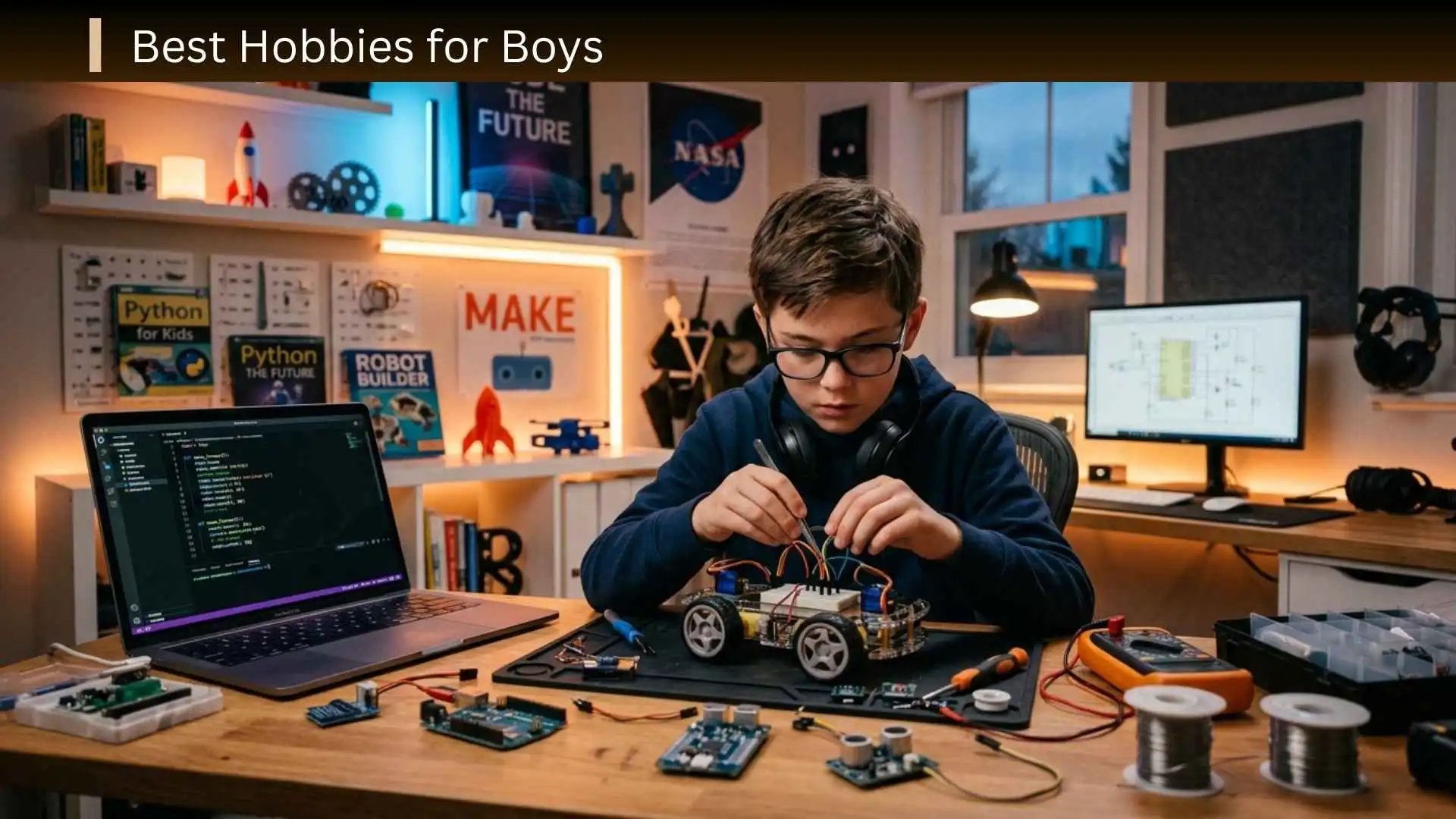
Finding the best hobbies for boys can be easier than you think. I believe a good hobby is more than just something to do when you’re bored it can help you discover what you enjoy, build useful skills, and make your free time more exciting. Whether you love being active, creating things, exploring technology, spending time outdoors, or simply trying something new, there is a hobby that can fit your personality.
You don’t need to be an expert to get started. I want to help you explore fun and meaningful options so you can find something that truly interests you. From sports and gaming to drawing, coding, photography, cooking, collecting, and outdoor adventures, these best hobbies for boys offer plenty of ways to learn, have fun, and grow while doing something you actually enjoy.
Best Hobbies for Boys(Quick Answer)
Some of the best hobbies for boys include building LEGO models, coding, drawing, photography, playing a musical instrument, reading, fishing, hiking, biking, skateboarding, sports, cooking, woodworking, robotics, model building, gardening, chess, camping, and collecting.
The best choice depends on the individual. A boy who enjoys solving problems may prefer chess, coding, robotics, or model building, while someone who likes being active may enjoy biking, basketball, swimming, hiking, or skateboarding.
Best Hobbies for Boys at a Glance
| Hobby | Difficulty | Cost | Time Commitment | Setting | Best For |
| LEGO & Building | Easy–Moderate | Low–Moderate | Flexible | Indoor | Builders and creative thinkers |
| Drawing | Easy–Advanced | Low | Flexible | Indoor | Artistic boys |
| Coding | Easy–Advanced | Low–Moderate | Flexible | Indoor | Problem solvers |
| Reading | Easy | Low | Flexible | Indoor | Curious, independent learners |
| Chess | Easy–Advanced | Low | Flexible | Indoor | Strategic thinkers |
| Photography | Easy–Advanced | Low–High | Flexible | Both | Visual storytellers |
| Cooking | Easy–Moderate | Low–Moderate | Moderate | Indoor | Practical learners |
| Music | Easy–Advanced | Low–High | Regular practice | Both | Creative and musical learners |
| Robotics | Moderate–Advanced | Moderate–High | Moderate | Indoor | STEM enthusiasts |
| Biking | Easy–Advanced | Moderate | Flexible | Outdoor | Active explorers |
| Hiking | Easy–Advanced | Low–Moderate | Moderate | Outdoor | Nature lovers |
| Fishing | Easy–Moderate | Moderate | Moderate | Outdoor | Patient, outdoorsy boys |
| Skateboarding | Moderate | Moderate | Regular practice | Outdoor | Action-oriented learners |
| Gardening | Easy–Moderate | Low–Moderate | Regular care | Outdoor | Nature and hands-on learners |
| Woodworking | Moderate | Moderate–High | Moderate | Indoor/Outdoor | Hands-on builders |
| Model Building | Easy–Advanced | Low–Moderate | Flexible | Indoor | Detail-oriented hobbyists |
| Sports | Easy–Advanced | Low–High | Regular | Outdoor/Indoor | Competitive and active boys |
| Camping | Moderate | Moderate | Occasional | Outdoor | Adventurous families |
| Collecting | Easy | Low–High | Flexible | Both | Curious collectors |
| Magic | Easy–Advanced | Low–Moderate | Flexible | Both | Performers and entertainers |
1. LEGO and Creative Building
Building with LEGO or similar construction sets is a versatile hobby because there is no single correct way to approach it. A beginner can follow instructions, while a more experienced builder can design vehicles, buildings, machines, scenes, or entirely original creations.
Why it’s worth trying: It combines creativity with planning and hands-on problem-solving.
Best for: Boys who enjoy constructing things, experimenting, or turning ideas into physical objects.
Difficulty: Easy to advanced.
Cost: Low to moderate, depending on the sets and pieces.
Where to do it: Indoors.
What you need: Building bricks or a construction set and a clear workspace.
Beginner tip: Start with open-ended building challenges such as “build a bridge that holds a small book” rather than only completing instruction-based sets.
A natural progression is to move from simple construction to LEGO Technic, mechanical builds, robotics, or engineering projects.
2. Drawing and Sketching

Drawing is one of the easiest creative hobbies to start because it requires very little equipment. A pencil and paper are enough for a beginner.
Boys can explore cartooning, comic characters, animals, architecture, landscapes, technical sketches, or realistic drawing. Digital drawing can become an option later if there is interest in tablets and illustration software.
Best for: Creative boys who like visual expression.
Cost: Low to start.
Difficulty: Easy initially, with plenty of room for advanced skill development.
Beginner tip: Instead of trying to create perfect artwork immediately, practice basic shapes, proportions, shading, and perspective.
Drawing can also lead naturally into animation, graphic design, comic creation, character design, painting, and digital art.
3. Coding and Programming
Coding turns problem-solving into something interactive. Beginners can start with block-based programming before progressing to text-based languages and larger projects.
A boy might create a simple game, interactive story, website, animation, calculator, or small software project.
Why it’s worth trying: The hobby rewards curiosity. Instead of simply consuming technology, the learner begins creating with it.
Best for: Boys who enjoy computers, puzzles, games, mathematics, or figuring out how things work.
Cost: Low if a computer is already available.
Difficulty: Beginner to advanced.
Beginner tip: Build small projects rather than trying to learn an entire programming language before making anything.
One of the biggest advantages is that coding can develop alongside other hobbies. Someone interested in sports could create a statistics tracker; a gamer could experiment with game development; and a photographer could build a personal portfolio website.
4. Reading
Reading is a flexible hobby that can follow almost any interest.
A boy who dislikes fiction may still enjoy biographies, science books, history, sports writing, graphic novels, comics, mythology, technology books, or nonfiction about animals and space.
Best for: Curious boys who enjoy stories, facts, imagination, or independent learning.
Cost: Low, especially when using a public library.
Setting: Indoors or anywhere with suitable reading conditions.
Beginner tip: Let the reader choose the subject. A book that genuinely interests him is usually a better starting point than a book selected simply because it is considered educational.
Reading can also become the gateway to other hobbies. A child fascinated by astronomy can move toward stargazing, while someone interested in ancient history might become interested in archaeology, museums, or historical reenactment.
5. Chess
Chess is a strategy game that can be played casually with family or pursued competitively through clubs and tournaments.
It offers a particularly useful hobby for boys who enjoy analyzing possibilities, planning ahead, and learning from mistakes.
Best for: Strategic and patient thinkers.
Cost: Low.
Difficulty: Easy to learn, difficult to master.
Setting: Indoors.
Beginner tip: Learn the basic rules first, then play short games regularly rather than attempting to memorize large amounts of opening theory.
Chess also provides an easy social dimension. A boy can play against parents, siblings, classmates, friends, or members of a local chess club.
6. Playing a Musical Instrument
Learning an instrument turns music from something a person listens to into something he can create.
Popular starting choices include guitar, piano or keyboard, drums, ukulele, violin, trumpet, and other band or orchestra instruments.
Best for: Boys interested in music, performance, rhythm, or learning through practice.
Cost: Low to high depending on the instrument and whether lessons are taken.
Difficulty: Beginner to advanced.
Time commitment: Regular practice produces better progress than occasional long sessions.
Beginner tip: Choose an instrument based partly on the music the learner actually wants to play.
The hobby can eventually branch into songwriting, music production, recording, performing, or joining a school or community ensemble.
7. Photography
Photography can turn an ordinary walk, family trip, sports event, or neighborhood into an opportunity to look more carefully at the surroundings.
A dedicated camera is not necessary at first. A smartphone can provide a practical way to learn composition, framing, perspective, and lighting.
Best for: Boys interested in technology, nature, people, travel, sports, or visual storytelling.
Cost: Low to high.
Setting: Both indoors and outdoors.
Beginner tip: Give yourself themed challenges, such as photographing reflections, interesting textures, unusual angles, or changing light.
As skills improve, photography can branch into portrait photography, wildlife photography, sports photography, landscape photography, astrophotography, and photo editing.
8. Cooking and Baking
Cooking is both a hobby and a practical life skill. It can be especially engaging when the learner gets to choose what to make.
Beginners might start with simple breakfasts, sandwiches, pasta, tacos, pizza, smoothies, cookies, or other age-appropriate recipes before attempting more complicated dishes.
Best for: Boys who enjoy food, experimentation, practical projects, or creating something they can share.
Cost: Low to moderate when using an existing kitchen.
Setting: Indoors.
Beginner tip: Learn basic kitchen safety and simple techniques before moving to more complicated equipment or recipes. Younger children should have appropriate adult supervision.
Cooking can grow into baking, international cuisine, grilling, food photography, recipe development, or hosting meals for family and friends.
9. Robotics
Robotics combines several interests into one activity: mechanical construction, electronics, programming, design, and problem-solving.
A beginner robotics kit can provide a structured starting point, while clubs and competitions can add a team-based challenge.
Best for: Boys who enjoy machines, engineering, coding, and building.
Cost: Moderate to high.
Difficulty: Moderate to advanced.
Setting: Indoors.
Beginner tip: Choose a kit appropriate to the learner’s age and experience rather than buying the most sophisticated system available.
Robotics is particularly useful for someone who likes both physical construction and computer-based problem-solving.
10. Biking
Biking can remain a simple recreational activity or develop into a more specialized hobby.
A boy might enjoy neighborhood rides, paved trails, mountain biking, BMX, bike maintenance, or longer cycling trips.
Best for: Active boys who like independence and outdoor exploration.
Cost: Moderate, although the initial cost varies substantially depending on the bicycle.
Setting: Outdoors.
Beginner tip: Use a properly fitted helmet and choose riding areas appropriate for the rider’s age and skill level. Learn basic traffic and trail-safety rules.
For someone who becomes interested in the mechanical side, bicycle maintenance can become a hobby of its own.
11. Hiking and Nature Exploration
Hiking is more than simply walking on a trail. It can become a gateway to learning about plants, animals, geology, maps, weather, photography, and local ecosystems.
Best for: Boys who enjoy exploration and spending time outside.
Cost: Low to moderate.
Difficulty: Easy to advanced depending on terrain and distance.
Setting: Outdoors.
Beginner tip: Start with short, familiar trails and gradually increase difficulty rather than treating the longest trail as the goal.
Nature exploration can also lead to birdwatching, wildlife photography, camping, fishing, geocaching, or stargazing.
12. Fishing
Fishing combines outdoor time with patience, observation, and practical skills. For many families, it also provides a hobby that can be shared across generations.
Best for: Boys who enjoy lakes, rivers, outdoor settings, and slower-paced activities.
Cost: Low to moderate for basic equipment, with additional costs depending on the type of fishing.
Difficulty: Easy to moderate for beginners.
Setting: Outdoors.
Beginner tip: Learn local regulations, access rules, and basic water safety before fishing. Regulations can differ by state and location.
Fishing can eventually expand into learning about fish species, conservation, knot tying, boating, outdoor cooking, or fly fishing.
13. Skateboarding
Skateboarding offers a strong combination of movement, balance, repetition, and personal progression.
Unlike a traditional team sport, it allows a boy to practice independently and work toward individual goals.
Best for: Boys attracted to action sports and skill-based challenges.
Difficulty: Moderate.
Cost: Moderate.
Setting: Outdoors, usually on suitable pavement or designated skateboarding areas.
Beginner tip: Start with balance, stance, stopping, and basic board control before attempting advanced tricks. Appropriate protective equipment and a suitable riding area are important.
Progress can be measured by skills rather than simply by winning a competition, which can make the hobby especially appealing to independent learners.
14. Gardening
Gardening gives boys a chance to work with living things and see the results of consistent care.
A beginner does not need a large yard. A few containers on a balcony, patio, or suitable outdoor space can provide a starting point.
Best for: Boys interested in plants, food, animals, nature, or hands-on activities.
Cost: Low to moderate.
Difficulty: Easy to moderate.
Setting: Primarily outdoors, although some plants can be grown indoors.
Beginner tip: Start with a small number of easy-to-manage plants instead of creating a large garden immediately.
Gardening can lead to interests in cooking, composting, botany, landscaping, ecology, or growing vegetables and herbs.
15. Model Building
Model building is a good choice for boys who enjoy detailed work and seeing a project develop gradually.
Possible subjects include cars, airplanes, ships, spacecraft, buildings, trains, miniatures, and fictional subjects.
Best for: Patient, detail-oriented builders.
Cost: Low to moderate.
Difficulty: Easy to advanced.
Setting: Indoors.
Beginner tip: Begin with a simpler kit and learn basic assembly and finishing techniques before attempting highly detailed models.
Model building can eventually include painting, weathering, diorama construction, historical research, or custom design.
16. Sports
Sports remain among the most accessible hobbies because there are many different ways to participate.
Popular choices in the United States include basketball, soccer, baseball, football, swimming, tennis, volleyball, track and field, wrestling, golf, and martial arts.
The best sport depends heavily on personality and physical preferences. A boy who enjoys team interaction may prefer soccer or basketball, while someone who likes individual progression may prefer swimming, running, golf, or tennis.
Beginner tip: Let interest guide the choice. Trying several sports for a short period can be more useful than deciding immediately that one sport must become a long-term commitment.
For younger boys, the emphasis should generally be on learning skills and enjoying participation rather than treating early performance as a career decision.
17. Camping
Camping can combine several smaller hobbies into one larger experience: cooking outdoors, hiking, fishing, identifying plants, navigation, photography, and observing wildlife.
Best for: Boys who enjoy outdoor adventure and family or group activities.
Cost: Low to high depending on the equipment already available.
Time commitment: Usually occasional rather than daily.
Beginner tip: Start with a simple, well-planned camping trip rather than an ambitious remote expedition. Check local conditions, weather, campsite rules, and appropriate safety requirements.
Camping can also encourage an interest in broader outdoor skills without requiring the boy to specialize immediately.
18. Collecting
Collecting works particularly well for boys who become deeply interested in specific subjects.
Possible collections include rocks and minerals, coins, stamps, sports cards, books, model cars, fossils, trading cards, postcards, or other appropriate objects.
The educational value often comes from researching what is being collected rather than simply accumulating objects.
Best for: Curious boys who enjoy categories, history, identification, organization, or discovery.
Cost: Very flexible.
Beginner tip: Create a simple catalog showing the item’s name, date acquired, source, and interesting information.
Parents can also use collecting as an opportunity to teach organization, budgeting, research, and responsible purchasing.
19. Magic and Card Tricks
Magic is a surprisingly rich hobby because it combines performance, memory, dexterity, presentation, and practice.
A beginner can learn a few simple effects and gradually work toward more sophisticated routines.
Best for: Boys who enjoy entertaining friends, performing, and practicing skills privately.
Cost: Low to moderate.
Difficulty: Easy to advanced.
Setting: Both.
Beginner tip: Focus on learning a small number of effects well instead of collecting dozens of tricks without mastering them.
Magic can also build confidence in speaking and performing, although the main attraction is usually the challenge of creating a convincing presentation.
20. Woodworking
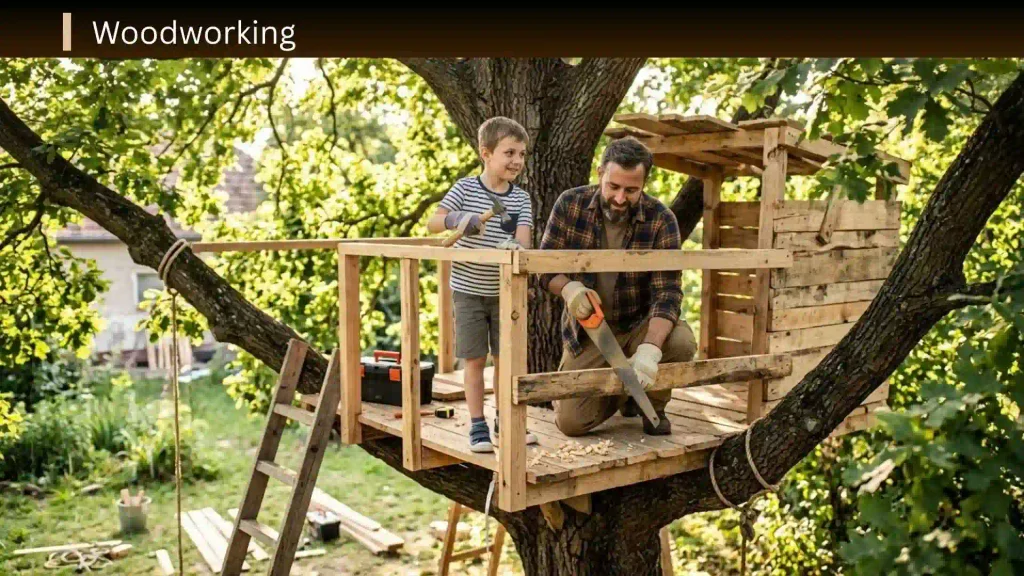
Woodworking is a hands-on hobby centered on designing, measuring, cutting, joining, sanding, and finishing wood.
Projects can range from simple decorative objects to more complicated furniture.
Best for: Boys who enjoy making physical objects and working with materials.
Cost: Moderate to high because tools and workspace can become significant investments.
Difficulty: Moderate to advanced.
Setting: Usually a suitable workshop or outdoor workspace.
Beginner tip: Younger beginners should work with appropriate adult supervision and age-appropriate tools. Learn tool safety before attempting projects that require powered equipment.
The appeal of woodworking is that the finished object has a practical purpose, making progress easy to see.
21. Geocaching
Geocaching turns outdoor exploration into a treasure-hunt-style activity using GPS-enabled devices.
Participants search for hidden caches and follow clues or coordinates while exploring parks, trails, and other permitted locations.
Best for: Boys who enjoy puzzles, technology, exploration, and outdoor activities.
Cost: Low.
Difficulty: Easy to moderate.
Setting: Outdoors.
Beginner tip: Begin with an easy cache in a familiar public location and understand the rules of the specific geocaching platform being used.
It pairs particularly well with hiking and photography.
22. Astronomy and Stargazing
Astronomy provides a way to explore space without immediately investing in expensive equipment.
Beginners can start by learning major constellations, observing the Moon, following visible planets, or using a sky map. A telescope can come later if interest develops.
Best for: Boys fascinated by space, science, planets, and the night sky.
Cost: Low to high.
Difficulty: Easy to advance.
Setting: Primarily outdoors.
Beginner tip: Learn the night sky before buying sophisticated equipment. Knowing what you are trying to observe makes the equipment much more useful.
Astronomy can develop into astrophotography, science reading, telescope operation, or participation in astronomy clubs.
23. Model Railroading
Model railroading combines construction, electrical systems, design, geography, history, scenery, and storytelling.
A small layout can be built on a manageable scale, while larger projects can become long-term hobbies involving detailed landscapes and realistic operations.
Best for: Boys who enjoy trains, engineering, design, history, and detailed projects.
Cost: Moderate to high depending on the scale of the project.
Difficulty: Easy to advanced.
Beginner tip: Start small. A compact layout or simple train set can teach the basics without requiring a large dedicated room.
24. Birdwatching
Birdwatching is an accessible nature hobby that encourages observation and identification.
A beginner can start simply by noticing birds in a backyard or local park. Binoculars and a field guide or identification app can be added later.
Best for: Boys who enjoy animals, nature, photography, and discovery.
Cost: Low to moderate.
Difficulty: Easy.
Setting: Outdoors.
Beginner tip: Keep a list of species observed and record where and when they were seen.
Birdwatching also pairs naturally with hiking, nature photography, drawing, and wildlife study.
25. Writing Stories, Comics, or Poetry
Writing does not have to mean writing long novels. Boys can create short stories, comic scripts, fantasy worlds, jokes, poems, adventure stories, sports stories, or science-fiction ideas.
Best for: Boys with strong imaginations or a fascination with stories.
Cost: Very low.
Setting: Indoors or anywhere suitable for writing.
Beginner tip: Start with short projects. A one-page story with a beginning, problem, and ending can be more approachable than attempting a full-length book.
Combining writing with drawing can produce original comics, while coding can turn stories into interactive games.
How to Choose the Right Hobby for a Boy
There is no universal “best” hobby. A better approach is to match the activity to the boy rather than trying to make the boy fit the activity.
Start With What He Already Likes
Existing interests provide useful clues.
- Likes video games → coding, game development, robotics, chess, or digital art
- Likes sports → basketball, soccer, biking, photography, coaching games, or sports statistics
- Likes animals → birdwatching, wildlife photography, gardening, or nature exploration
- Likes building → LEGO, model kits, woodworking, robotics, or model railroading
- Likes drawing → illustration, comics, animation, painting, or graphic design
- Likes science → astronomy, robotics, electronics, experiments, or nature study
- Likes being outdoors → hiking, fishing, camping, biking, gardening, or geocaching
- Likes music → guitar, piano, drums, singing, songwriting, or music production
Consider His Preferred Type of Challenge
Ask whether he prefers:
- Physical challenges: biking, sports, swimming, skateboarding
- Mental challenges: chess, coding, puzzles, strategy games
- Creative challenges: drawing, music, writing, photography
- Hands-on challenges: building, cooking, woodworking, gardening
- Exploration: hiking, fishing, camping, astronomy, geocaching
- Social activities: team sports, music groups, clubs, theater, chess
This can narrow the choices much faster than simply asking, “What hobby do you want?”
Match the Hobby to the Available Space
A hobby can be excellent but impractical if there is nowhere to do it.
For a small home or apartment, consider reading, drawing, chess, coding, music with appropriate noise considerations, model building, collecting, or photography.
For access to a yard, garage, workshop, trails, or parks, options such as gardening, woodworking, biking, hiking, and nature hobbies become easier.
Think About the Realistic Budget
Some hobbies can start for almost nothing, while others become expensive as interest grows.
Low-cost options:
Reading, drawing, writing, chess, hiking, birdwatching, coding with an existing computer, and basic collecting.
Moderate-cost options:
Biking, photography, cooking, fishing, model building, music, and gardening.
Potentially higher-cost options:
Robotics, advanced photography, woodworking, model railroading, specialized sports, and extensive musical equipment.
A useful rule is to test the hobby before making a major equipment purchase whenever possible.
Best Hobbies for Boys by Age
Age is important because the ideal hobby should match a child’s abilities, attention span, independence, and need for supervision.
Best Hobbies for Younger Boys
Younger children often benefit from activities that are simple to understand and provide immediate feedback.
Good options include:
- LEGO and building
- Drawing
- Simple crafts
- Reading
- Beginner cooking with supervision
- Gardening
- Puzzles
- Nature walks
- Collecting
- Basic sports
- Music and rhythm activities
The focus should be on exploration rather than mastering complicated techniques.
Best Hobbies for Tweens
Tweens can often handle hobbies with more complex rules and longer-term projects.
Consider:
- Coding
- Chess
- Photography
- Model building
- Robotics
- Musical instruments
- Fishing
- Biking
- Cooking
- Sports
- Astronomy
- Magic
- Creative writing
- Gardening
This is also a good stage for allowing the child to take increasing ownership of the hobby.
Best Hobbies for Teenage Boys
Teenagers may want hobbies that provide greater independence, specialization, creativity, or social interaction.
Strong options include:
- Coding and programming
- Photography
- Weight-appropriate fitness activities
- Music production or playing an instrument
- Sports
- Hiking and camping
- Skateboarding
- Chess
- Robotics
- Woodworking with appropriate supervision
- Cooking
- Writing
- Graphic design
- Video production
- Automotive-related learning in safe, supervised environments
- Volunteering connected to personal interests
For teenagers, a hobby can also become a meaningful skill that supports school projects, portfolios, friendships, or future career exploration without turning every hobby into a career exercise.
Best Indoor Hobbies for Boys
If outdoor space or weather is a limitation, there are plenty of engaging indoor choices:
- Coding
- LEGO building
- Drawing
- Reading
- Chess
- Model building
- Musical instruments
- Cooking
- Writing
- Robotics
- Magic
- Collecting
- Digital art
- Puzzles
- Model railroading
Indoor hobbies are particularly useful when a boy wants an activity he can return to independently.
Best Outdoor Hobbies for Boys
For boys who dislike sitting indoors for long periods, consider:
- Biking
- Hiking
- Fishing
- Camping
- Gardening
- Birdwatching
- Geocaching
- Skateboarding
- Sports
- Photography
- Astronomy
- Nature exploration
The best outdoor hobby does not necessarily need to be highly competitive. Exploring a trail, identifying birds, tending plants, or learning the night sky can provide a completely different type of engagement.
Best Creative Hobbies for Boys
Creative hobbies allow boys to produce something rather than simply consume entertainment.
Good options include:
- Drawing
- Painting
- Photography
- Writing
- Comic creation
- Playing music
- Songwriting
- Digital art
- Model building
- LEGO design
- Cooking
- Woodworking
- Video production
- Animation
A useful way to choose among them is to ask what kind of creation sounds most appealing: a picture, story, object, performance, meal, video, or digital project.
Best Hobbies for Boys Who Love Technology
Technology-related hobbies can go far beyond playing games.
Consider:
- Coding
- Game development
- Robotics
- Digital art
- Photography
- Video editing
- Music production
- Electronics
- 3D design
- Animation
- Website creation
The best starting point is usually a small project with a visible result. Completing something simple can be more motivating than spending weeks working through theory without creating anything.
Best Hobbies for Boys Who Don’t Like Sports
Not every boy enjoys organized sports, and that is perfectly fine. Physical activity is not the only valuable form of recreation.
Alternatives include:
- Hiking
- Photography
- Gardening
- Geocaching
- Astronomy
- Fishing
- Coding
- Chess
- Drawing
- Music
- Cooking
- Model building
- Robotics
- Reading
- Woodworking
- Collecting
If a boy dislikes competitive sports but enjoys movement, noncompetitive activities such as hiking, biking, swimming, or nature exploration may be a better match.
Best Social Hobbies for Boys
Some boys want hobbies that naturally create opportunities to meet and work with other people.
Good social options include:
- Team sports
- Chess clubs
- Robotics teams
- Music groups
- Theater
- Scouting and outdoor organizations
- Photography clubs
- Community gardening
- Martial arts
- Board-game groups
- Volunteer activities
Social hobbies can be especially appealing when the activity itself provides a reason to interact. A robotics team, for example, gives members a shared problem to solve rather than requiring conversation to be the primary purpose of the activity.
Best Low Cost Hobbies for Boys
A limited budget does not prevent a boy from developing a meaningful hobby.
Some of the easiest low-cost choices are:
- Reading through a public library
- Drawing
- Writing
- Hiking
- Chess
- Nature observation
- Birdwatching
- Basic coding
- Photography using an existing phone
- Gardening from seeds or cuttings where appropriate
- Puzzles
- Creative storytelling
- Collecting inexpensive natural objects where collection is permitted
The cost of a hobby should be judged by its starting cost, not just the price of advanced equipment. Many hobbies can begin simply and become more sophisticated only if the interest lasts.
Hobbies That Can Grow With a Boy
One of the strongest reasons to choose a hobby is its ability to evolve.
Coding
Can progress from simple games to software, websites, automation, or advanced programming.
Photography
Can progress from smartphone photos to editing, specialized photography, and advanced camera equipment.
Music
Can progress from basic lessons to performing, songwriting, recording, or music production.
Building
Can progress from LEGO to robotics, engineering projects, woodworking, or 3D design.
Outdoor Exploration
Can progress from local walks to hiking, camping, fishing, astronomy, or wildlife photography.
Cooking
Can progress from simple recipes to baking, international cuisine, meal planning, and advanced techniques.
A hobby with room for growth can remain interesting for years because the learner is not forced to abandon it once the beginner stage is complete.
How to Help a Boy Start a New Hobby
The first step should be intentionally easy.
1. Let Him Choose From a Shortlist
Instead of presenting 25 options at once, choose three to five that fit his interests and let him decide which sounds most appealing.
2. Start Small
Buy or borrow only what is necessary to try the activity.
For example, someone interested in photography does not need a professional camera on day one, and someone curious about astronomy does not necessarily need an expensive telescope.
3. Give Him a First Project
A concrete challenge is often easier to understand than “learn photography” or “learn coding.”
Examples:
- Photograph five interesting things in the neighborhood.
- Build a LEGO vehicle that can roll down a ramp.
- Write a one-page mystery story.
- Learn three chess openings.
- Grow one type of vegetable.
- Cook one simple meal.
- Identify five constellations or prominent stars.
4. Don’t Turn Every Hobby Into School
Learning is valuable, but a hobby should still feel like something the boy chooses to explore.
Not every activity needs a worksheet, competition, certificate, or measurable achievement.
5. Allow Interests to Change
A hobby does not have to become a lifelong commitment. Trying an activity for several weeks and deciding it is not interesting can still be useful because it helps identify what the learner actually enjoys.
Common Mistakes When Choosing a Hobby
Choosing the Hobby Adults Prefer
A parent may love golf, music, woodworking, or sports, but that does not automatically make it the right hobby for a child.
Buying Too Much Equipment Too Early
Expensive equipment can create pressure to continue an activity that the child does not actually enjoy.
Focusing Only on “Productive” Hobbies
A hobby does not have to teach a marketable skill to be worthwhile. Enjoyment, creativity, exploration, social connection, and personal interest are legitimate reasons to have a hobby.
Treating Competition as the Main Goal
Some boys enjoy tournaments and competition; others prefer private practice or recreational participation. The hobby should accommodate the learner’s preferred level of competition.
Comparing One Boy With Another
One child may progress quickly at chess while another takes months to become comfortable with an instrument. Progress should be judged against the individual’s starting point rather than another child’s abilities.
How to Make a Hobby More Engaging
A hobby becomes easier to sustain when there is a sense of progress.
Try:
- Setting small challenges
- Creating personal projects
- Keeping a record of completed work
- Learning from someone more experienced
- Joining an appropriate club or group
- Sharing finished projects with family or friends
- Exploring related hobbies
- Entering competitions only if the child enjoys them
- Taking occasional breaks
- Increasing difficulty gradually
The goal is not constant improvement. Sometimes the best hobby is simply one that a boy looks forward to returning to.
Frequently Asked Questions
What are the best hobbies for boys?
The best hobbies for boys depend on individual interests, but strong options include coding, building, drawing, reading, chess, music, photography, cooking, sports, biking, hiking, fishing, robotics, gardening, model building, astronomy, and collecting.
What is a good hobby for a boy who is bored?
Start with an activity that produces a tangible result. Building something, cooking a recipe, creating a drawing, solving a puzzle, photographing a local area, or completing a small coding project can be more engaging than simply offering another form of passive entertainment.
What are good hobbies for boys who don’t like sports?
Coding, chess, drawing, reading, photography, music, robotics, model building, cooking, writing, astronomy, collecting, gardening, and magic are all alternatives. Hiking, fishing, and geocaching are also options for boys who like being outdoors without wanting competitive team sports.
What are the best inexpensive hobbies for boys?
Reading, drawing, writing, chess, hiking, nature observation, basic coding, photography with an existing smartphone, puzzles, and some forms of collecting can be started relatively inexpensively.
What are good hobbies for teenage boys?
Teenagers can explore coding, photography, music, sports, hiking, camping, cooking, robotics, chess, writing, graphic design, video production, woodworking with appropriate supervision, astronomy, and other interests that allow greater independence.
What hobbies can boys do at home?
Good at-home hobbies include coding, drawing, reading, chess, LEGO building, model building, writing, music, cooking, digital art, robotics, collecting, magic, and model railroading. The best choice depends on available space and equipment.
How do I know which hobby is right for my son?
Look at what he naturally chooses to do, what subjects make him curious, whether he prefers movement or quiet concentration, and whether he enjoys creating, competing, exploring, building, or socializing. Then offer a few suitable choices rather than forcing one activity.
Should boys have more than one hobby?
Yes. Having several hobbies can expose a boy to different types of experiences. For example, he might combine an active hobby such as biking with a creative hobby such as drawing and a mentally challenging hobby such as chess.
Final Thoughts
The best hobbies for boys are the ones that fit the individual rather than a stereotype. Building, coding, sports, music, art, cooking, nature exploration, collecting, and dozens of other activities can all become meaningful hobbies when they match genuine interests.
A good starting point is simple: identify what he already enjoys, choose an activity that fits his age and circumstances, start with minimal equipment, and give him enough freedom to explore it his own way. The right hobby may eventually become a skill, a social community, a creative outlet, an outdoor adventure, or simply something enjoyable to look forward to each week.

I’m Ethan Mitchell, a curious writer who enjoys turning complex ideas into simple, useful information. At Cognivoora, I focus on creating clear and engaging content that readers can understand and apply in everyday life. I believe good writing should educate, answer real questions, and leave readers with something valuable to remember.
Books:
- The Everyday Mind
- Simple Ideas, Better Thinking