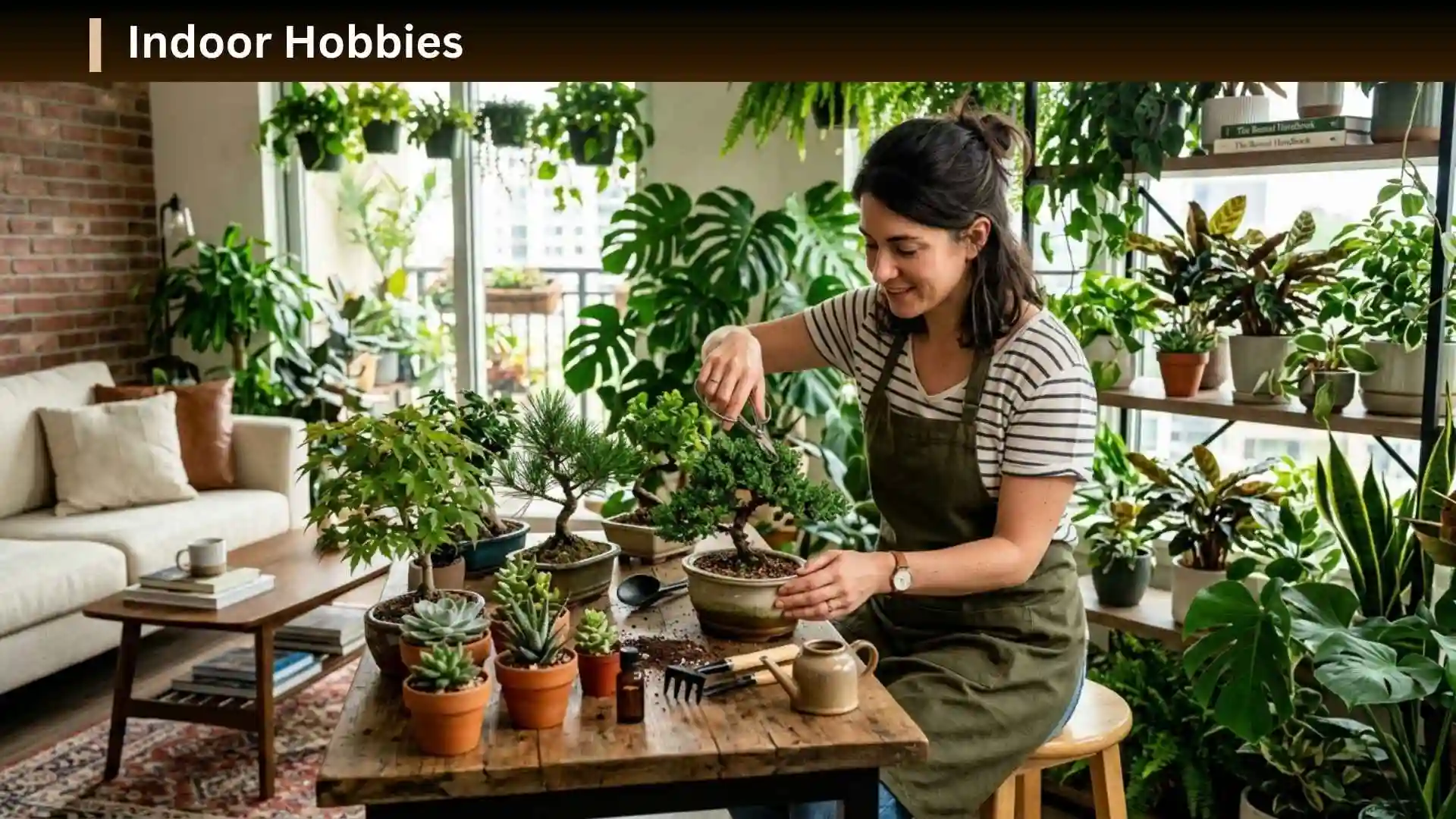
If you are looking for indoor hobbies that are enjoyable, practical, affordable, or easy to start at home, you have plenty of options beyond watching TV or scrolling on your phone. The right hobby can give you something interesting to practice, create, collect, learn, or simply enjoy during your free time.
Indoor hobbies range from quiet activities such as reading and journaling to hands-on pursuits such as knitting, painting, baking, model building, and woodworking. Some require almost no equipment, while others can grow into serious creative or technical pursuits.
The best choice depends on what you want from your free time: relaxation, creativity, exercise, learning, social connection, or simply something fun to do indoors.
What Are Indoor Hobbies?
Indoor hobbies are recreational activities that can primarily be practiced inside a home, apartment, studio, community center, workshop, or other indoor space.
They can be:
- Creative or artistic
- Educational or skill-based
- Relaxing and low-pressure
- Physically active
- Social
- Collecting-based
- Food-related
- Technology-based
- Craft-oriented
- Competitive or strategic
An indoor hobby does not necessarily have to be done entirely alone or entirely at home. For example, you can practice guitar in your living room, attend an indoor pottery class, join a board-game group, or work on photography and photo editing indoors.
Modern hobby trends also show growing interest in hands-on, analog activities such as crafts, baking, collecting, flower pressing, embroidery, and other tactile projects.
Best Indoor Hobbies at a Glance
| Indoor hobby | Best for | Typical starting cost | Space needed |
| Reading | Relaxation and learning | Low | Very little |
| Journaling | Writing and reflection | Low | Very little |
| Drawing | Creativity | Low | Very little |
| Watercolor painting | Art and relaxation | Low–moderate | Small |
| Crochet | Crafting | Low | Small |
| Knitting | Crafting | Low | Small |
| Puzzles | Quiet entertainment | Low–moderate | Table |
| Chess | Strategy | Free–low | Small |
| Baking | Cooking and creativity | Low–moderate | Kitchen |
| Cooking | Practical skills | Low–moderate | Kitchen |
| Photography | Creativity | Varies | Small |
| Digital art | Creative technology | Low–high | Desk |
| Guitar | Music | Moderate | Small |
| Yoga | Movement | Low | Floor space |
| Indoor gardening | Plants and nature | Low–moderate | Small–moderate |
| Model building | Detailed crafting | Moderate | Table |
| Sewing | Crafting and practical skills | Low–moderate | Table |
| Calligraphy | Art and lettering | Low | Small |
| Language learning | Education | Low | Very little |
| Board games | Social fun | Low–moderate | Table |
Costs vary considerably depending on the quality of equipment, whether you already own basic supplies, and how deeply you pursue the hobby.
Creative Indoor Hobbies
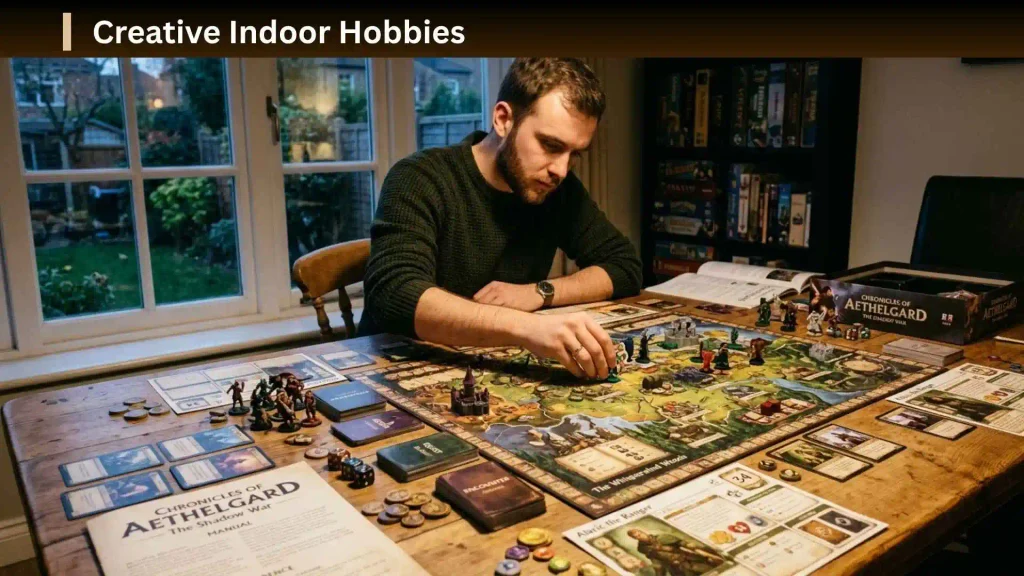
Creative hobbies are a strong choice if you want to make something rather than simply consume entertainment. Many can be started with inexpensive supplies and developed over time.
1. Drawing and Sketching
Drawing is one of the easiest indoor hobbies to begin. A pencil, eraser, and sketchbook can be enough for your first projects.
You can practice:
- Still-life drawing
- Portraits
- Animals
- Architecture
- Character design
- Gesture drawing
- Botanical sketches
- Doodling
You do not need to consider yourself “artistic” to start. Treat drawing as a skill that improves through practice.
2. Painting
Painting offers many directions, including watercolor, acrylic, gouache, and oil painting.
For beginners, watercolor or acrylic can provide relatively accessible entry points. You can begin with simple subjects such as landscapes, flowers, objects around your home, or abstract compositions.
3. Digital Art
If you enjoy technology as much as creativity, digital art combines both.
Depending on your equipment, you can explore:
- Digital illustration
- Character design
- Concept art
- Photo manipulation
- Typography
- Digital painting
- Pixel art
A computer or tablet can become the central workspace for this hobby.
4. Calligraphy and Hand Lettering
Calligraphy focuses on creating controlled, decorative lettering, while hand lettering gives you more freedom to draw individual letters and words.
You can use the skill to create:
- Greeting cards
- Signs
- Journals
- Invitations
- Artwork
- Gift tags
5. Scrapbooking
Scrapbooking combines photographs, paper, writing, layouts, and decorative elements.
It can be especially appealing if you enjoy preserving memories rather than simply storing photographs digitally.
6. Origami
Origami turns sheets of paper into figures and objects through folding.
Simple designs require very little equipment, while advanced models can become surprisingly intricate. Because paper is inexpensive and portable, origami works well for small homes and short sessions.
7. Collage
Collage involves combining paper, photographs, illustrations, fabric, or other materials into a single composition.
It is useful if you enjoy experimenting but do not necessarily want to draw or paint.
8. Adult Coloring
Adult coloring books provide a structured creative activity without requiring you to create an image from scratch.
Colored pencils, markers, or similar supplies can be enough to get started.
9. Flower Pressing
Pressed flowers can become part of:
- Greeting cards
- Framed artwork
- Bookmarks
- Scrapbooks
- Decorative crafts
This hobby also gives you a reason to pay closer attention to plants and seasonal changes.
10. Creative Writing
Creative writing can be practiced almost anywhere indoors.
Possible directions include:
- Short stories
- Poetry
- Fiction
- Personal essays
- Character development
- Screenwriting
- Memoir-style writing
You can write with paper and a pen or use a computer.
Craft Based Indoor Hobbies
Craft hobbies are ideal when you like working with your hands and want a tangible result at the end of a session.
11. Knitting
Knitting uses yarn and needles to create clothing, accessories, blankets, and decorative pieces.
Beginners can start with simple scarves or small projects before progressing to more complicated patterns.
12. Crochet
Crochet requires a hook rather than two knitting needles. Common projects include:
- Blankets
- Hats
- Scarves
- Amigurumi
- Bags
- Coasters
- Home decorations
The equipment is relatively portable, making crochet convenient for small spaces.
13. Embroidery
Embroidery involves decorating fabric with thread and stitches.
You can begin with basic stitches and gradually learn more elaborate patterns. Small embroidery projects are particularly suitable when you want a hobby that can fit on a desk.
14. Sewing
Sewing can begin as a simple hand-sewing hobby and eventually develop into machine sewing.
Possible projects include:
- Clothing repairs
- Tote bags
- Pillow covers
- Fabric decorations
- Quilts
- Costumes
One advantage of sewing is that it can combine creativity with a practical skill.
15. Quilting
Quilting involves joining pieces of fabric and adding layers to create functional or decorative quilts.
It can be a long-term hobby because projects can range from small table pieces to elaborate quilts.
16. Model Building
Model building includes assembling miniature cars, aircraft, ships, buildings, figures, and other subjects.
It is particularly suited to people who enjoy detailed work, following instructions, painting, and gradually improving craftsmanship.
17. Miniature Painting
Miniature painting combines fine-detail painting with collecting or tabletop gaming.
You can paint:
- Fantasy figures
- Historical miniatures
- Tabletop game models
- Diorama pieces
- Decorative figures
A small desk can be enough for beginner projects.
18. Bookbinding
Bookbinding involves creating or repairing books using paper, thread, covers, and binding techniques.
It is a good option if you enjoy both crafts and books.
19. Leathercraft
Leathercraft can involve making wallets, key holders, belts, bags, journal covers, and other objects.
It requires more specialized tools than paper crafts, so it is worth learning basic safety and tool-handling practices before advancing.
20. Air-Dry Clay Crafts
Air-dry clay can be shaped into small decorative or functional objects without requiring access to a pottery kiln. Beginner-friendly projects can include trays, ornaments, small sculptures, and decorative pieces.
Relaxing Indoor Hobbies
Not every hobby needs to produce something. Sometimes the best indoor hobby is one that gives you a calm activity to look forward to.
21. Reading
Reading remains one of the most flexible indoor hobbies.
You can choose:
- Fiction
- History
- Biography
- Science
- Mystery
- Fantasy
- Personal development
- Travel
- Essays
- Comics and graphic novels
A library can also make reading an inexpensive hobby.
22. Journaling
Journaling can be as simple as writing a few sentences about your day.
Other approaches include:
- Gratitude journaling
- Travel journaling
- Creative journaling
- Reading journals
- Goal journals
- Idea notebooks
There is no requirement to follow a complicated system.
23. Jigsaw Puzzles
Jigsaw puzzles provide a focused activity that can be completed alone or with other people.
Choose the size according to your available space. If you do not have a permanent puzzle table, a portable puzzle mat can make it easier to pause and store an unfinished puzzle.
24. Crossword Puzzles
Crosswords are a compact option if you enjoy words, clues, and problem-solving.
They can be done in print or digitally.
25. Sudoku
Sudoku is a number-placement puzzle that requires logical reasoning rather than advanced mathematics.
It works well for short sessions because individual puzzles can often be completed independently.
26. Adult Coloring
Coloring can also fit into a relaxing-hobby category because the activity has clear boundaries and does not require you to invent an entire composition.
27. Tea or Coffee Exploration
You can turn an everyday beverage into a hobby by exploring different beans, brewing methods, teas, origins, recipes, and preparation techniques.
The key is to approach it as learning and experimentation rather than simply buying increasingly expensive equipment.
Indoor Hobbies for Learning and Personal Development

If your goal is to use free time to develop a skill, consider hobbies with a clear learning curve.
28. Learning a Language
Language learning can be practiced in short sessions.
You can combine:
- Vocabulary practice
- Listening
- Reading
- Writing
- Speaking exercises
- Movies or podcasts
- Conversation practice
Choose one language and build a consistent routine instead of trying to study several at once.
29. Playing Chess
Chess is an accessible strategy hobby that can be played against another person, a computer, or through online platforms.
Beginners can focus on basic rules, opening principles, tactics, and endgame concepts before worrying about advanced theory.
30. Learning an Instrument
Music is an excellent indoor hobby because progress can be measured through songs, scales, exercises, and techniques.
Popular choices include:
- Guitar
- Piano or keyboard
- Ukulele
- Violin
- Harmonica
- Drums using an electronic kit
For apartment living, consider the instrument’s volume and your household or building’s noise restrictions.
31. Genealogy
Genealogy involves researching family history using records, documents, photographs, oral histories, and other sources.
It can become a substantial research hobby because each discovery can lead to another question.
32. Home Astronomy Study
You do not need to own a telescope to begin learning about astronomy. Books, star maps, educational resources, and astronomy software can introduce you to constellations, planets, galaxies, and other subjects.
You can later add outdoor stargazing when convenient.
33. Coding
Coding can function as a hobby rather than a career activity.
Beginners might explore:
- HTML and CSS
- Python
- JavaScript
- Game development
- Automation
- Web projects
The best approach is usually project-based: learn a concept and immediately use it to make something.
34. Electronics
Electronics can involve assembling circuits, experimenting with components, repairing simple devices, or creating small projects.
Because some projects involve electricity, heat, batteries, or soldering equipment, beginners should follow appropriate safety instructions and start with projects designed for their skill level.
Indoor Hobbies That Keep You Active
Indoor hobbies do not have to involve sitting at a desk.
35. Yoga
Yoga can be practiced in a relatively small area with minimal equipment.
Beginners should choose instruction appropriate for their experience and avoid forcing movements that cause pain.
36. Pilates
Pilates focuses on controlled movement and core-oriented exercises. Many routines can be adapted to a living room or bedroom with enough clear floor space.
37. Indoor Dance
Dance can be both a creative and physical hobby.
You can learn:
- Hip-hop
- Ballroom
- Salsa
- Jazz
- Ballet
- Contemporary dance
- Line dancing
Online classes can provide structure if you prefer learning at home.
38. Jump Rope
If you have adequate ceiling height and floor space, jump rope can turn a small indoor area into an exercise space.
Check the flooring and surroundings first, particularly in apartments.
39. Indoor Rock Climbing
Indoor climbing gyms provide a more social and structured hobby for people who enjoy physical challenges.
Unlike home-based hobbies, this one requires leaving home, but it remains an indoor activity and can be practiced year-round.
Food Based Indoor Hobbies
The kitchen can become a hobby space rather than simply a place for preparing everyday meals.
40. Baking
Baking gives you a clear process and a tangible result.
You can explore:
- Bread
- Cookies
- Cakes
- Pies
- Muffins
- Pastries
- Pizza dough
Start with a small number of reliable recipes and improve one technique at a time.
41. Cooking New Cuisines
Turn cooking into a hobby by choosing cuisines you do not normally prepare.
For example, you might spend several weeks learning dishes from one region rather than randomly trying recipes.
42. Bread Making
Bread making allows you to explore dough preparation, shaping, proofing, and baking.
You can begin with straightforward recipes before experimenting with more advanced techniques.
43. Cake Decorating
Cake decorating adds an artistic dimension to baking.
You can practice piping, frosting techniques, fondant work, lettering, and simple decorative designs.
44. Indoor Herb Gardening
Growing herbs indoors can combine gardening with cooking.
Common choices include herbs that suit your available light and growing conditions. Before buying plants, check whether your chosen location provides enough light and whether containers have suitable drainage.
Games and Social Indoor Hobbies
If you want your hobby to help you connect with other people, choose an activity that naturally creates opportunities for interaction.
45. Board Games
Board games range from quick party games to complex strategy games.
You can choose based on:
- Number of players
- Playing time
- Complexity
- Theme
- Competitive versus cooperative play
Some games also offer solo modes.
46. Card Games
Traditional card games require little equipment and can work for two or more players.
You can learn classic games, collectible card games, trick-taking games, or modern strategy card games.
47. Tabletop Role-Playing Games
Tabletop role-playing games combine storytelling, strategy, improvisation, and social interaction.
They can be played around a physical table or remotely with online tools.
48. Puzzles and Brain Games
Logic puzzles, word games, riddles, and strategy challenges can make good solo hobbies while also working as group activities.
49. Indoor Collecting
Collecting can focus on almost any category that genuinely interests you, such as:
- Books
- Coins
- Stamps
- Vintage postcards
- Vinyl records
- Sports memorabilia
- Trading cards
- Art prints
- Rocks and minerals
A good collection benefits from organization and a clear reason for collecting rather than simply accumulating objects.
50. Photography and Photo Editing
Photography can be an indoor hobby when you focus on still-life photography, product photography, portraits, food photography, macro subjects, or indoor architecture.
Photo editing can extend the hobby by teaching you how to crop, adjust exposure, organize images, and develop a consistent visual style.
Best Indoor Hobbies for Small Apartments
Living in a small apartment does not eliminate your hobby options. The key is choosing activities with low storage and cleanup requirements.
Good choices include:
- Reading
- Journaling
- Drawing
- Calligraphy
- Origami
- Crochet
- Knitting
- Embroidery
- Digital art
- Language learning
- Chess
- Sudoku
- Photography
- Creative writing
- Small puzzles
- Miniature painting
A useful rule is to choose hobbies where the equipment can fit into one drawer, box, shelf, or portable case.
Best Low Cost Indoor Hobbies
If budget is your biggest limitation, start with activities that use things you already own.
Free or nearly free options
- Reading books you already own
- Writing
- Journaling
- Drawing with existing pencils
- Chess
- Language practice
- Creative writing
- Bodyweight movement
- Learning through public educational resources
- Photography with an existing phone
- Decluttering and organizing collections
Low cost hobbies
- Origami
- Crochet
- Embroidery
- Coloring
- Puzzles
- Calligraphy
- Baking
- Knitting
- Scrapbooking
You do not need to purchase a complete professional setup before deciding whether you enjoy a hobby.
Best Indoor Hobbies for Adults Who Are Bored
If boredom is the main problem, choose a hobby with a clear objective rather than something completely open-ended.
For example:
- Finish one puzzle
- Learn one song
- Bake one recipe
- Draw one object
- Complete one embroidery design
- Read one chapter
- Build one model section
- Learn ten new words
- Make one card
- Complete one short coding project
A small finish line makes it easier to start.
How to Choose the Right Indoor Hobby
Instead of asking which hobby is objectively “best,” ask which hobby fits your current life.
Consider your available time
If you have only 15 minutes at a time, choose something that starts quickly.
Good options include:
- Reading
- Drawing
- Journaling
- Crochet
- Chess puzzles
- Language practice
- Calligraphy
If you have several uninterrupted hours on weekends, you can consider more involved hobbies such as baking, sewing, model building, woodworking, or painting.
Consider your space
Think about:
- Storage
- Noise
- Ventilation
- Lighting
- Cleanup
- Work surfaces
- Whether projects can remain unfinished
This matters more than simply asking whether a hobby is technically “indoor.”
For example, embroidery may need only a small chair-side setup, while woodworking or pottery can require significantly more space, equipment, and cleanup.
Consider your budget
Start with the smallest reasonable investment.
If you are interested in painting, buy a basic beginner set rather than immediately purchasing professional supplies. If you want to learn guitar, focus on learning before building a large collection of accessories.
Consider your energy level
Your ideal hobby may change depending on the time of day.
A demanding strategy game or complex craft may suit a high-energy afternoon, while reading, coloring, knitting, or journaling may be better after a long workday.
Decide whether you want a tangible result
Some people enjoy hobbies because they produce something.
Examples include:
- A knitted item
- A painting
- A baked recipe
- A completed model
- A handmade card
- A finished story
- A repaired object
Others prefer experiences such as reading, playing music, learning, or solving puzzles.
Neither approach is better. Choose what makes you want to return to the activity.
How to Start an Indoor Hobby Without Getting Overwhelmed
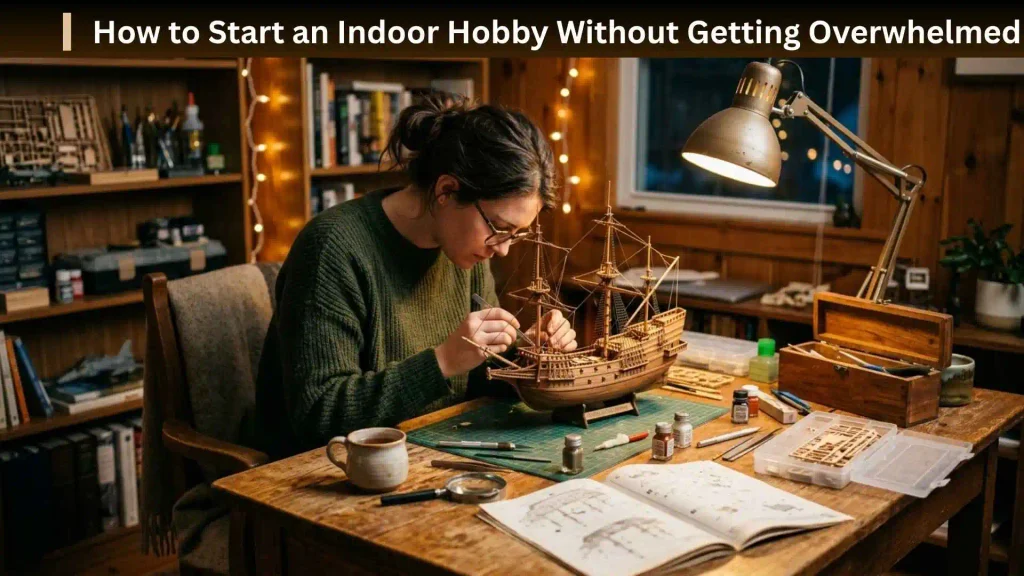
One common mistake is buying too much equipment before developing the habit.
Use a simpler approach.
Start with one hobby
Choose one activity that interests you instead of starting five hobbies simultaneously.
Buy only the essentials
Get enough equipment for your first few sessions.
After you know you enjoy the hobby, you can upgrade or expand your supplies.
Make the first project easy
Your first project should be achievable.
If the first project is too difficult, you may mistake frustration with the project for a lack of interest in the hobby.
Give yourself a small schedule
You might practice for 20 minutes several evenings a week or reserve a longer weekend session.
Consistency matters more than creating an ambitious schedule you cannot maintain.
Keep supplies easy to access
If starting the hobby requires moving furniture, searching through boxes, or setting up complicated equipment every time, you are adding friction.
Keep frequently used supplies together when possible.
Let yourself change hobbies
Trying a hobby does not mean committing to it permanently.
If you discover that painting is not enjoyable, move on to drawing, puzzles, music, cooking, or something else. The goal is to find an activity that fits your interests and lifestyle.
Indoor Hobby Ideas by What You Want
| If you want… | Try… |
| Something relaxing | Reading, coloring, knitting, puzzles |
| Something creative | Drawing, painting, writing, collage |
| Something productive | Sewing, cooking, coding, woodworking |
| Something social | Board games, card games, tabletop RPGs |
| Something active | Yoga, Pilates, dance |
| Something inexpensive | Reading, writing, drawing, chess |
| Something educational | Language learning, genealogy, astronomy |
| Something hands-on | Model building, crochet, ceramics |
| Something for a small apartment | Origami, journaling, embroidery |
| Something screen-free | Knitting, baking, puzzles, calligraphy |
| Something you can monetize eventually | Sewing, photography, art, baking, crafts |
| Something you can do in short sessions | Reading, crochet, chess, drawing |
Indoor Hobbies vs. Indoor Activities
An indoor activity and an indoor hobby are not always the same thing.
Watching a movie, scrolling social media, or playing a game once may simply be entertainment. A hobby usually involves repeated interest, participation, practice, exploration, or skill development.
For example:
- Watching a cooking show is an activity.
- Learning to cook different cuisines can become a hobby.
Similarly:
- Looking at photographs is an activity.
- Practicing photography and learning composition can become a hobby.
The distinction is useful because hobbies tend to give you an ongoing subject to explore rather than a one-time way to pass time.
Frequently Asked Questions About Indoor Hobbies
What are the best indoor hobbies for adults?
Some of the most versatile indoor hobbies for adults include reading, drawing, painting, cooking, baking, knitting, crochet, puzzles, board games, learning an instrument, photography, writing, gardening, and language learning. The best option depends on your budget, available space, energy level, and interests.
What is a good indoor hobby for someone who is bored?
Choose something with a clear, achievable goal. Baking a recipe, completing a puzzle, drawing an object, learning a song, building a model, or making a small craft can be easier to start than an activity with no defined endpoint.
What are some indoor hobbies that cost little or no money?
Reading books you already own, writing, journaling, drawing with existing materials, learning a language, practicing chess, creative writing, photography with a phone, and bodyweight exercise can require little or no additional spending.
What are good indoor hobbies for small spaces?
Origami, reading, journaling, drawing, calligraphy, embroidery, crochet, knitting, digital art, language learning, chess, and photography can work particularly well in small spaces because they require relatively little room.
What are relaxing indoor hobbies?
Reading, coloring, knitting, crochet, embroidery, puzzles, journaling, drawing, calligraphy, and gentle music practice can all provide quiet alternatives to passive entertainment.
What indoor hobbies can help you learn a useful skill?
Cooking, baking, sewing, woodworking, coding, photography, language learning, music, electronics, drawing, and bookbinding can all develop skills that extend beyond the hobby itself.
Can indoor hobbies be social?
Yes. Board games, card games, tabletop role-playing games, music groups, craft circles, cooking activities, and hobby clubs can make indoor hobbies highly social. You can also join online communities related to many hobbies.
How do I find an indoor hobby I actually enjoy?
Start by identifying what you want from your free time. Decide whether you want to create something, learn something, relax, move your body, solve problems, collect things, or connect with other people. Then choose one inexpensive beginner-friendly hobby and try it several times before deciding whether it fits you.
Conclusion
The best indoor hobbies are not necessarily the most expensive, popular, or impressive ones. They are the activities you genuinely want to return to.
If you want creativity, try drawing, painting, writing, calligraphy, or crafts. If you want relaxation, consider reading, puzzles, knitting, coloring, or journaling. If you want practical skills, explore cooking, baking, sewing, coding, or woodworking. And if you want more interaction, board games, card games, music, and tabletop hobbies can bring other people into your indoor routine.
Start small, use the space and equipment you already have when possible, and give yourself permission to experiment. A good hobby does not need to transform your life. It simply needs to make your free time more interesting, meaningful, or enjoyable

I’m Olivia Bennett, a passionate writer who loves exploring ideas, learning new concepts, and sharing knowledge in a straightforward way. I write for Cognivoora with the goal of making useful topics easier to understand without unnecessary complexity. My approach combines research, clarity, and a reader-first perspective.
Books:
- Think Clearly, Live Better
- The Curious Reader’s Guide