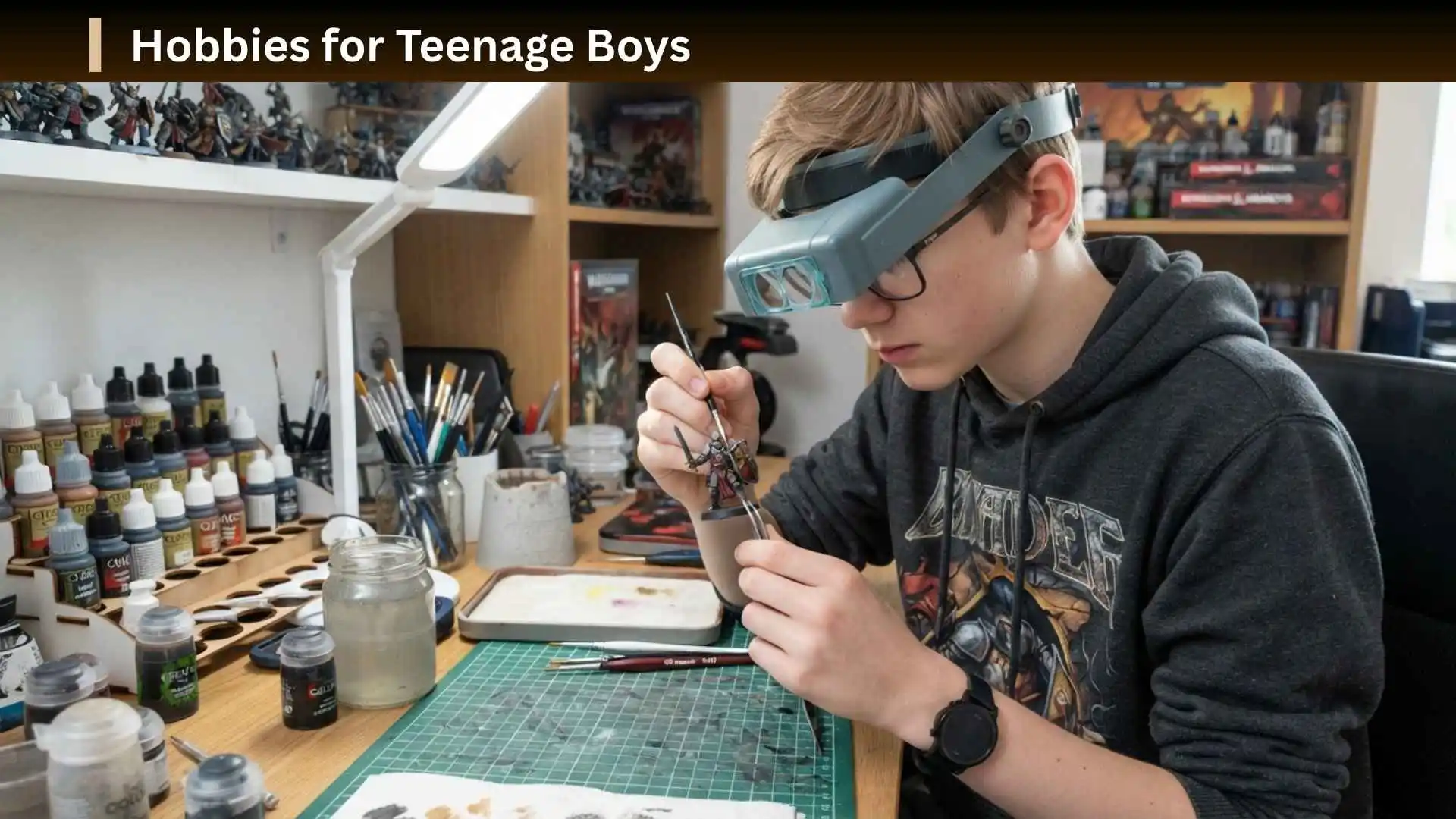
Teenage years are a great time to discover interests that go beyond school and social media. The best hobbies for teenage boys are not necessarily expensive or competitive—they are activities that make free time more enjoyable while helping develop skills, creativity, confidence, fitness, or curiosity.
Whether a teen prefers technology, sports, the outdoors, music, making things, collecting, or creative projects, there are plenty of hobbies to explore. The key is finding something that matches his personality and interests rather than choosing an activity simply because it is popular.
Best Hobbies for Teenage Boys
Here are some of the most worthwhile hobbies for teens, covering different interests, budgets, and skill levels.
| Hobby | Type | Cost to Start | Difficulty | Best For |
| Photography | Creative | $–$$$ | Beginner | Visual thinkers |
| Drawing | Creative | $ | Beginner | Artistic teens |
| Guitar | Music | $$ | Beginner–Intermediate | Music lovers |
| Coding | Technology | $ | Beginner–Advanced | Problem solvers |
| Gaming | Entertainment | $$–$$$ | Beginner | Strategy and competition |
| Basketball | Sports | $–$$ | Beginner | Active teens |
| Skateboarding | Outdoor | $$ | Intermediate | Adventure seekers |
| Hiking | Outdoor | $ | Beginner | Nature lovers |
| Fishing | Outdoor | $$ | Beginner | Patient, outdoorsy teens |
| Model building | Making | $–$$ | Beginner–Intermediate | Detail-oriented teens |
| Cooking | Life skill | $–$$ | Beginner | Independent learners |
| Reading | Educational | $ | Beginner | Curious minds |
| Chess | Strategy | $ | Beginner–Advanced | Strategic thinkers |
| Woodworking | Making | $$–$$$ | Intermediate | Hands-on learners |
| Robotics | STEM | $$–$$$ | Intermediate | Engineering-minded teens |
| Gardening | Outdoor | $ | Beginner | Nature and science |
| Creative writing | Creative | $ | Beginner | Storytellers |
| Cycling | Fitness | $$–$$$ | Beginner | Active explorers |
| Camping | Outdoor | $$ | Beginner | Adventure seekers |
| Volunteering | Community | Free | Beginner | Socially minded teens |
The costs above are relative rather than fixed. Many hobbies can be started inexpensively using borrowed, secondhand, or basic equipment.
Creative Hobbies for Teenage Boys

Creative hobbies give teenagers a way to make something rather than simply consume entertainment. They can also be changed to fit almost any skill level.
1. Drawing and Sketching
Drawing is one of the easiest hobbies to start because the basic equipment is inexpensive. A pencil, eraser, sketchbook, and a little practice are enough to begin.
A teen can experiment with:
- Pencil portraits
- Cartoon characters
- Nature sketches
- Architecture
- Comic art
- Character design
- Digital drawing
There is no need to start with complicated techniques. Regularly drawing for 15–30 minutes can provide a simple creative routine.
2. Photography
Photography can turn everyday surroundings into creative subjects. A teenager does not necessarily need an expensive camera; a smartphone can be enough for learning composition, lighting, perspective, and editing.
Good beginner projects include photographing:
- Landscapes
- Pets
- Sports
- Architecture
- Food
- Sunsets
- Interesting objects
- Local scenery
Photography can become more challenging as skills improve, with topics such as manual camera settings, portrait photography, and photo editing.
3. Creative Writing
Writing stories, poems, scripts, or short fictional scenes can be an excellent hobby for teens who enjoy imagination and storytelling.
A simple challenge is to write one short scene each week. The goal does not have to be publication. Writing regularly can simply be a way to develop ideas and express them.
4. Video Editing
Video editing combines creativity with technology. Teens can create short videos about hobbies, sports, travel, gaming, school projects, or fictional stories.
A beginner can learn basic skills such as:
- Cutting clips
- Adding transitions
- Using titles
- Adjusting audio
- Adding subtitles
- Organizing footage
- Creating simple visual effects
It is useful to learn responsible editing and respect other people’s privacy when creating or sharing videos.
5. Music Production
A teenager interested in music can explore beat-making, recording, songwriting, or digital music production.
A computer or tablet and suitable beginner software can provide a starting point. Teens can experiment with rhythm, melodies, sampling, and basic mixing before deciding whether they want to invest in more equipment.
Technology Hobbies for Teenage Boys
Technology hobbies can be particularly engaging for teens who enjoy figuring out how things work.
6. Coding and Programming
Coding is a flexible hobby because it can be used to create games, websites, apps, animations, and useful tools.
Beginners can start with visual programming or a beginner-friendly programming language. Rather than trying to learn everything at once, it is usually more motivating to build a small project.
Examples include:
- A simple quiz
- A calculator
- A basic website
- A text-based game
- A personal webpage
- A small animation
The project itself provides a reason to learn new programming concepts.
7. Robotics
Robotics combines programming, electronics, mechanics, and problem-solving. A beginner robotics kit can provide a structured way to build and experiment.
Teens can work toward projects such as:
- A line-following robot
- A robotic arm
- A sensor-based device
- A small automated vehicle
- A programmable moving object
Robotics is particularly suitable for teenagers who enjoy hands-on STEM activities.
8. 3D Design and 3D Printing
3D design allows teens to create digital objects that can potentially be turned into physical models with a 3D printer.
Beginners can design simple:
- Keychains
- Desk organizers
- Game pieces
- Decorative objects
- Small containers
- Custom models
A teen does not need to own a printer to learn 3D design. Libraries, schools, makerspaces, and community facilities may provide access to equipment.
9. Electronics
Basic electronics can teach how components work together to create functioning devices.
Projects might involve LEDs, switches, sensors, buzzers, or small programmable boards. Beginners should use age-appropriate projects and follow the safety instructions provided with equipment.
10. Game Design
Teens who enjoy video games may find it interesting to learn how games are actually made.
Game design can involve:
- Story development
- Level design
- Programming
- Art
- Animation
- Sound
- Game testing
Starting with a very small game is generally more manageable than attempting to create a large open-world project.
Sports and Fitness Hobbies for Teenage Boys

Physical hobbies can add movement to a teen’s routine while making exercise more enjoyable.
11. Basketball
Basketball is easy to practice alone or with friends. A teen can work on dribbling, shooting, passing, footwork, and defensive movement.
It can also become a social hobby through school teams, community leagues, or casual games.
12. Soccer
Soccer offers opportunities for both individual practice and team participation.
A teenager can practice basic ball control, passing, shooting, and dribbling independently before joining a team or recreational league.
13. Swimming
Swimming can be both recreational and skill-based. Teens can work on technique, endurance, and different strokes.
For beginners, lessons with a qualified instructor can be especially useful for learning proper water safety and technique.
14. Cycling
Cycling combines physical activity with exploration. A teen can ride around suitable local areas, participate in organized rides, or gradually work toward longer distances.
Safety equipment and following local cycling rules are important.
15. Skateboarding
Skateboarding appeals to teens who enjoy learning physical skills progressively. Beginners can focus on balance, riding, stopping, and turning before attempting more advanced tricks.
Protective equipment and an appropriate practice environment can reduce the risk of injury.
16. Martial Arts
Martial arts can involve physical conditioning, technique, discipline, and structured progression.
Different styles have different approaches, so visiting a reputable local school and observing a class can help a teen determine whether the environment suits him.
Outdoor Hobbies for Teenage Boys
Outdoor hobbies can provide a break from screens while encouraging exploration and practical skills.
17. Hiking
Hiking can be as simple as exploring an established local trail. Teens can gradually learn about navigation, weather awareness, trail etiquette, and outdoor preparation.
A beginner should choose an appropriate trail and let a parent or responsible adult know the plan, particularly for longer or remote hikes.
18. Fishing
Fishing combines patience, outdoor time, observation, and practical knowledge.
A beginner can start with basic equipment and learn:
- How to set up a rod
- How to cast
- How to identify local fish
- How to handle equipment safely
- Local fishing regulations
- Catch-and-release practices where appropriate
Fishing rules vary by location, so local regulations should always be checked.
19. Camping
Camping can introduce teenagers to practical outdoor skills such as setting up shelter, preparing food, organizing equipment, and understanding basic campsite safety.
It can be a family activity at first and become more independent as a teen gains appropriate experience.
20. Birdwatching
Birdwatching is an inexpensive hobby that encourages observation and an interest in nature.
A pair of binoculars can be helpful but is not essential at the beginning. A smartphone or field guide can help identify birds and record observations.
21. Gardening
Gardening combines outdoor activity with biology and responsibility.
A teen can grow herbs, vegetables, flowers, or container plants. Starting with a few easy-to-manage plants is usually more practical than creating a large garden immediately.
Hobbies for Teenage Boys Who Like Building and Making Things
Some teenagers would rather build something with their hands than work on a screen.
22. Model Building
Model building can involve cars, aircraft, ships, buildings, or fictional subjects.
The hobby develops patience and attention to detail. Beginners should choose simpler kits before moving to highly detailed models.
23. LEGO Building
LEGO and similar construction systems can be used for structured builds or completely original creations.
Teens can challenge themselves to design:
- Vehicles
- Buildings
- Machines
- Dioramas
- Robots
- Original inventions
It can be especially enjoyable when a teen moves beyond following instructions and begins designing independently.
24. Woodworking
Woodworking can teach planning, measuring, joining, sanding, and finishing.
Because woodworking tools can cause serious injuries when used improperly, teenagers should learn from an experienced adult or qualified instructor and use appropriate protective equipment.
Beginner projects might include simple shelves, boxes, or small organizers.
25. Model Rockets
Model rocketry can combine building, science, and outdoor activity.
A beginner should use age-appropriate equipment, follow the manufacturer’s instructions, understand local rules, and launch only in suitable legal locations under appropriate supervision.
26. Mechanics
Teens fascinated by cars, bicycles, or machines may enjoy learning basic mechanical skills.
Working on a bicycle can be a practical starting point because it introduces concepts such as adjusting brakes, maintaining chains, changing tires, and using basic tools.
Automotive work requires additional safety knowledge and supervision, particularly around vehicles, lifting equipment, batteries, fuel, and moving parts.
Educational Hobbies for Teenage Boys
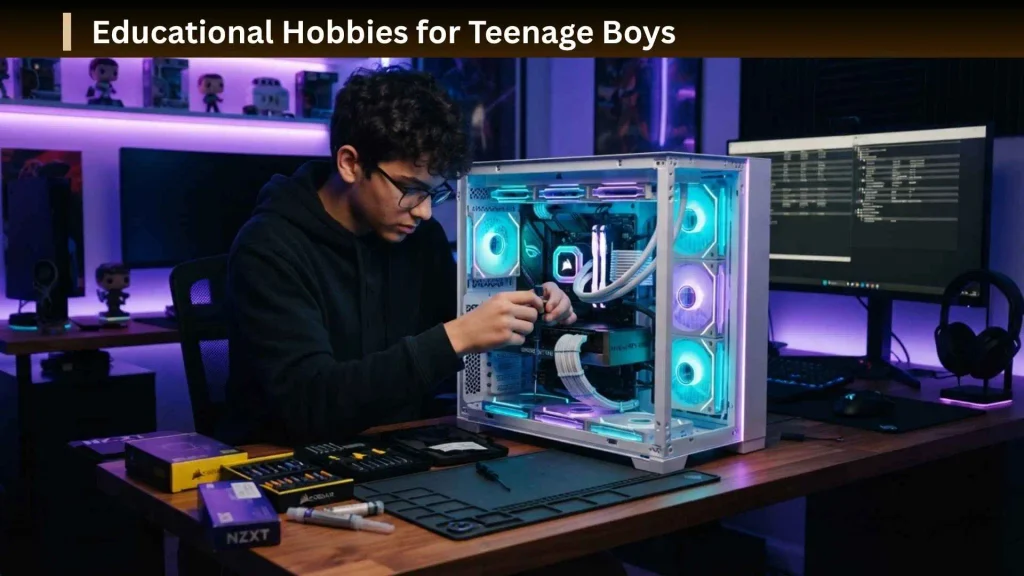
A hobby does not have to feel like homework to be educational. The strongest learning hobbies often begin with genuine curiosity.
27. Reading
Reading can cover almost any interest, including science fiction, history, biographies, sports, technology, mysteries, fantasy, and nonfiction.
Teens who struggle to enjoy traditional books may prefer graphic novels, short stories, magazines, audiobooks, or nonfiction related to an existing interest.
28. Chess
Chess provides a structured strategy challenge that can be played casually or competitively.
Beginners can learn the rules first and gradually study tactics, openings, endgames, and common strategic principles.
29. Learning a New Language
Learning another language can be a long-term hobby with practical applications.
A teen can combine:
- Vocabulary practice
- Listening
- Speaking
- Reading
- Music
- Movies
- Conversation practice
Progress tends to be easier when language study becomes a regular habit rather than an occasional activity.
30. Astronomy
Astronomy is a good option for teens fascinated by space.
A beginner does not need a telescope immediately. Learning major constellations, planets, the phases of the Moon, and basic astronomy concepts can be done with observation and educational resources.
A telescope can be considered later if the interest continues.
Social Hobbies for Teenage Boys
Some teens become more motivated when a hobby includes friends or a community.
31. Board Games
Modern board games include far more than traditional classics. Strategy, cooperative, deduction, trading, and adventure games provide different experiences.
Board games can also encourage face-to-face interaction and strategic thinking.
32. Volunteering
Volunteering can become a meaningful long-term activity when a teen chooses a cause or organization that genuinely interests him.
Possible areas include:
- Animal care
- Environmental projects
- Community events
- Libraries
- Food distribution
- Youth programs
- Local cleanups
Teen volunteer opportunities and age requirements vary by organization.
33. Theater and Acting
Acting can help teens explore storytelling, performance, teamwork, and public speaking.
A teenager does not have to want a professional acting career to benefit from participating in school productions, community theater, or improvisation groups.
34. Debate and Public Speaking
Debate provides a structured way to research topics, construct arguments, listen to opposing viewpoints, and communicate clearly.
For teens who enjoy discussion and competition, debate clubs or speech programs can turn those interests into a practical skill.
35. Cooking
Cooking is both a hobby and a useful life skill.
A teenager can begin with straightforward recipes and gradually learn:
- Knife safety
- Measuring
- Food preparation
- Basic cooking methods
- Kitchen organization
- Recipe adaptation
- Meal planning
Cooking can also become more interesting when a teen chooses a particular cuisine or learns to recreate favorite meals.
How to Choose the Right Hobby
With so many possibilities, choosing one can be harder than finding ideas. Instead of asking, “What is the best hobby for a teenage boy?” it is more useful to ask, “What type of activity fits this particular teenager?”
Consider these questions:
Does He Prefer Screens or Hands-On Activities?
A teen who already enjoys computers might like coding, game development, video editing, or 3D design. Someone who constantly wants to build things may prefer woodworking, robotics, model building, or mechanics.
Does He Prefer Competition or Relaxation?
Competitive teens may enjoy basketball, chess, esports, martial arts, debate, or organized sports.
Teens looking for a quieter experience might prefer drawing, reading, photography, fishing, gardening, or model building.
Does He Prefer Solo or Social Activities?
Some hobbies work particularly well alone, while others naturally create opportunities to meet people.
Solo-friendly options: reading, coding, drawing, photography, writing, fishing, and model building.
Social options: team sports, theater, debate, board games, volunteering, and group cycling.
Many hobbies can work either way.
What Is the Budget?
There is no reason to spend hundreds of dollars before knowing whether a teenager actually enjoys an activity.
A better approach is to start with basic equipment, borrow what is available, use free resources, or look for secondhand gear. If the interest continues, additional equipment can be purchased gradually.
Does He Want a Skill or Simply Something Fun?
Some hobbies have an obvious skill progression, such as coding, guitar, photography, cooking, or martial arts.
Others are primarily recreational. Gaming, casual cycling, collecting, or watching and discussing sports can still be legitimate hobbies if they provide enjoyment and meaningful engagement.
Best Cheap Hobbies for Teenage Boys
If cost is the main concern, several hobbies can be started with very little money.
Good low-cost choices include:
- Drawing
- Reading
- Creative writing
- Hiking
- Running
- Chess
- Birdwatching
- Gardening
- Bodyweight fitness
- Photography with a smartphone
- Learning a language
- Coding with free learning resources
- Sketching
- Stargazing
- Cooking with ingredients already available at home
The important distinction is between starting a hobby and buying everything associated with it. A teenager can often explore an activity first and invest later.
Best Indoor Hobbies for Teenage Boys
Indoor hobbies are especially useful during bad weather, school breaks, or when outdoor opportunities are limited.
Some strong options include:
- Coding
- Drawing
- Digital art
- Reading
- Chess
- Cooking
- Guitar
- Creative writing
- Model building
- Video editing
- Game design
- Electronics
- Robotics
- Photography
- Music production
- Board games
Indoor does not have to mean passive. Many of these activities involve creating, solving, practicing, or building something.
Best Outdoor Hobbies for Teenage Boys
For teens who need more time outside, consider:
- Hiking
- Cycling
- Fishing
- Camping
- Gardening
- Soccer
- Basketball
- Skateboarding
- Running
- Swimming
- Birdwatching
- Photography
- Model rocketry
- Nature observation
The right choice depends on the teenager’s interests, local environment, available facilities, and appropriate supervision.
Hobbies That Can Become Useful Skills
Some hobbies have particularly clear connections to practical skills.
| Hobby | Skills It Can Develop |
| Cooking | Food preparation, planning, independence |
| Coding | Logic, problem-solving, technical skills |
| Photography | Composition, observation, editing |
| Woodworking | Measuring, planning, tool use |
| Gardening | Plant care, patience, observation |
| Public speaking | Communication, confidence, organization |
| Writing | Communication, creativity, research |
| Cycling | Maintenance, fitness, road awareness |
| Electronics | Troubleshooting, circuits, technical thinking |
| Budgeting a collection | Organization, research, decision-making |
This does not mean a hobby needs to become a career. A useful hobby can simply make everyday life more interesting while developing transferable abilities.
How to Help a Teenager Start a New Hobby
Parents and caregivers can make hobbies easier to explore without turning them into another obligation.
Start Small
A teenager does not need a full setup on day one. Start with a simple project or introductory class.
Let the Teen Choose
A hobby is much more likely to last when the teenager has genuine interest in it. Suggestions are useful, but forcing a particular hobby can make the activity feel like another school assignment.
Expect Some Trial and Error
It is normal to try a hobby and decide it is not enjoyable. Exploring several activities can help a teenager discover what actually fits.
Focus on Progress Rather Than Talent
Being bad at something during the first few attempts is not evidence that the hobby is a poor choice. Beginners need time to develop skills.
Avoid Turning Every Hobby Into a Competition
Some teens thrive on competition, while others prefer personal improvement. The goal is to create an enjoyable and meaningful use of free time.
How Many Hobbies Should a Teen Have?
There is no ideal number of hobbies for every teenager.
One teen might become deeply interested in a single activity, while another may enjoy several hobbies throughout the year. A healthy approach is to leave enough room for school, sleep, family, friendships, physical activity, and downtime.
A hobby should generally add something positive to a teenager’s life rather than becoming another source of unnecessary pressure.
When a Hobby Becomes More Than a Hobby
A hobby can sometimes develop into a serious skill, creative portfolio, competition, community activity, or future career interest.
For example:
- Drawing can develop into illustration or graphic design.
- Coding can lead to software projects.
- Photography can become a creative portfolio.
- Cooking can develop into advanced culinary skills.
- Robotics can lead to engineering projects.
- Writing can lead to stories, journalism, or publishing.
- Sports can lead to organized competition or coaching.
- Gardening can develop into deeper interests in plants and environmental science.
There is no requirement to turn a hobby into a career. The value of a hobby can simply come from enjoying the process.
FAQs About Hobbies for Teenage Boys
What are the best hobbies for teenage boys?
The best hobbies depend on the teen’s interests and personality. Popular choices include sports, coding, gaming, photography, drawing, music, cooking, hiking, fishing, chess, robotics, woodworking, reading, and creative writing.
What are some cheap hobbies for teenage boys?
Drawing, reading, writing, hiking, running, chess, gardening, birdwatching, coding, stargazing, and smartphone photography can all be started relatively inexpensively.
What are good hobbies for a teenage boy who likes technology?
Coding, game development, robotics, electronics, video editing, 3D design, digital art, photography, and music production are strong options.
What are good outdoor hobbies for teenage boys?
Hiking, cycling, fishing, camping, gardening, birdwatching, photography, swimming, skateboarding, soccer, and basketball are good possibilities.
What hobbies can help teenage boys learn useful skills?
Cooking, coding, woodworking, photography, gardening, public speaking, writing, electronics, bicycle maintenance, and budgeting or organizing a collection can all develop practical or transferable skills.
What is a good hobby for a teenage boy who does not know what he likes?
Start with several low-cost activities instead of committing to one expensive hobby. Trying drawing, cooking, hiking, chess, photography, coding, sports, or building projects can help reveal which types of activities hold his attention.
Can gaming be considered a hobby?
Yes. Gaming can be a hobby when it is an enjoyable recreational activity. Some forms of gaming also involve strategy, problem-solving, creativity, teamwork, or competition. Like any leisure activity, it is best balanced with sleep, school, physical activity, relationships, and other responsibilities.
How can a teenager stick with a new hobby?
Start with a manageable goal, practice consistently without demanding perfection, choose projects that are genuinely interesting, and allow enough time for improvement. It is also perfectly reasonable to stop an activity that consistently feels uninteresting and try something different.
Conclusion
The best hobbies for teenage boys are the ones that fit the individual teenager. A sports enthusiast may thrive on basketball or cycling, a creative teen may prefer drawing or photography, and a technology-focused teenager may become absorbed in coding or robotics.
There is no need to find the perfect hobby immediately. Starting small, experimenting with different activities, and paying attention to what naturally keeps a teen curious can make the process much easier. A good hobby should provide enjoyment first while offering opportunities to learn, create, explore, connect with others, or develop useful skills along the way.

I’m James Anderson, a dedicated writer and lifelong learner who enjoys researching topics and explaining them in a practical way. Through my work at Cognivoora, I aim to give readers reliable, easy-to-follow information that helps them learn something new. I always try to keep my writing natural, useful, and focused on the questions readers actually have.
Books:
- A Practical Guide to Better Thinking
- Questions Worth Asking