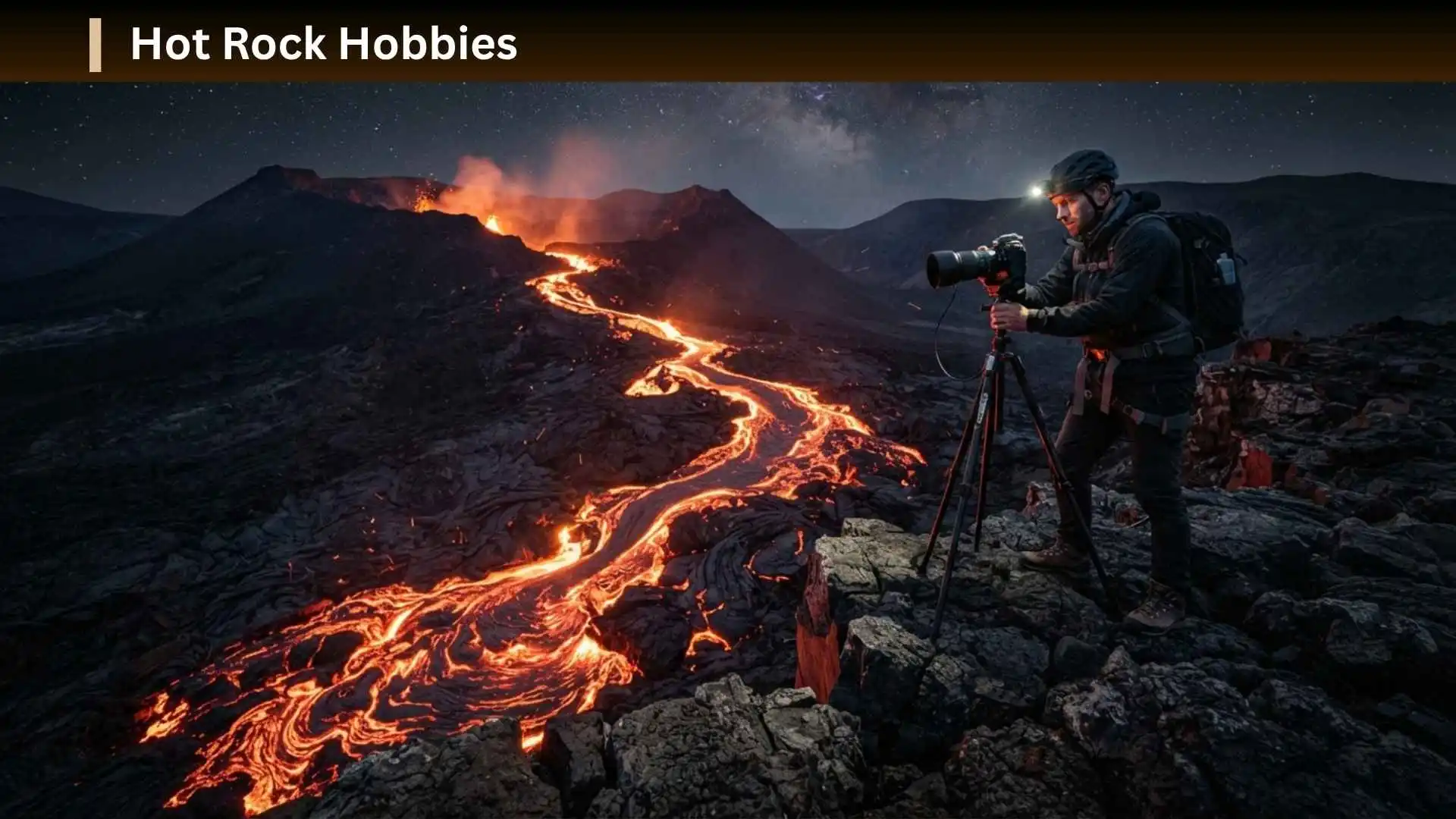
If you are searching for hot rock hobbies, you may be referring to hobbies involving rocks, minerals, rock collecting, or metal detecting where “hot rocks” are commonly encountered. The term can be confusing because a hot rock is not necessarily a rock that is physically hot.
In metal detecting, a hot rock is generally a rock or piece of mineralized material that produces a detector response because its mineralization differs significantly from the surrounding soil. Highly mineralized rocks can create false signals and may be particularly noticeable when prospecting for gold.
For hobbyists interested in rocks, however, hot rocks are only one small part of a much larger world that includes rockhounding, mineral collecting, gem hunting, fossil collecting, lapidary arts, gold prospecting, and metal detecting.
What Does “Hot Rock” Mean in a Hobby?
The meaning depends on the hobby.
In metal detecting, a hot rock is a naturally occurring rock or mineralized material that causes a detector to respond as though a metal target may be present. This usually happens because the rock has different magnetic or mineral characteristics from the surrounding ground.
This is especially relevant to people searching for gold. Hot rocks can sometimes resemble desirable targets on a detector, making it important for prospectors to learn how their machine responds to mineralized ground.
The term does not normally mean that the rock is physically heated.
There are also unrelated meanings of “hot rock.” For example, the dictionary has a separate definition involving a highly skilled or daredevil airplane pilot, so context matters.
Hot Rock Hobbies You Can Try

If your interest is in rocks and minerals rather than the technical meaning of hot rocks, several hobbies are worth exploring.
| Hobby | What You Do | Good for Beginners? | Typical Setting |
| Rockhounding | Search for interesting rocks and minerals | Yes | Outdoors |
| Mineral collecting | Build a collection of mineral specimens | Yes | Indoors/outdoors |
| Gem hunting | Search for gemstones and gem-bearing material | Yes | Outdoors |
| Fossil collecting | Search for and study fossils | Yes | Outdoors |
| Metal detecting | Search for buried metal objects | Yes, with practice | Outdoors |
| Gold prospecting | Search for natural gold | Yes, but requires learning | Outdoors |
| Lapidary | Cut, shape, polish, and work with stone | Yes, with instruction | Workshop |
| Rock painting | Decorate rocks for art and crafts | Very easy | Indoors/outdoors |
| UV mineral collecting | Find minerals that fluoresce under UV light | Yes | Indoors/outdoors |
The best choice depends on whether you enjoy field exploration, science, collecting, artistic work, or treasure hunting.
1. Rockhounding
Rockhounding is one of the most accessible rock-related hobbies.
A rockhound searches for and collects interesting rocks, minerals, crystals, and sometimes fossils, depending on local regulations and the collecting site.
You might look for:
- Quartz
- Agates
- Jasper
- Geodes
- Calcite
- Feldspar
- Fluorescent minerals
- Regional mineral specimens
- Interesting geological formations
One of the biggest advantages is that you do not need an expensive setup to begin.
A basic starter kit can include:
- Safety glasses
- Gloves
- Small hand tools where permitted
- Magnifying glass or loupe
- Field notebook
- Containers or specimen bags
- Water
- Appropriate footwear
- A beginner-friendly rock and mineral identification guide
The most important skill is learning to observe and identify specimens rather than simply collecting everything you see.
2. Mineral Collecting
Mineral collecting is a good option if you enjoy science, organization, and beautiful specimens.
Instead of primarily searching outdoors, you can build a collection from:
- Field-collected specimens
- Rock and mineral shows
- Exchanges with other collectors
- Educational collections
- Specialty dealers
- Gifts or inherited specimens
A useful collection does not have to be large. You could organize specimens by mineral type, locality, crystal habit, color, hardness, or geological origin.
Keeping accurate labels is particularly valuable. Record the specimen’s name and, when known, its locality and collection information.
3. Gem Hunting
Gem hunting combines outdoor exploration with mineral identification.
Depending on where you live and where you have permission to collect, you may encounter materials such as:
- Quartz varieties
- Garnet
- Tourmaline
- Topaz
- Beryl
- Amethyst
- Opal
Some locations are commercial collecting sites where visitors pay for access and keep what they find. Others are public or private lands with specific collecting rules.
Before collecting, always check the current rules for the specific property or collecting area. Land ownership and collecting regulations can vary considerably.
4. Fossil Collecting
If ancient life interests you more than crystals, fossil collecting can be an excellent alternative.
Fossils can include:
- Shells
- Plant impressions
- Petrified wood
- Trace fossils
- Marine fossils
- Vertebrate remains
Fossil collecting also introduces you to paleontology, geology, stratigraphy, and Earth’s history.
However, collecting rules can be particularly important for fossils. The fact that you find a fossil does not automatically mean you are legally allowed to remove it from the ground.
5. Metal Detecting and Hot Rocks
This is where the phrase hot rocks becomes especially relevant.
Metal detecting uses an electromagnetic field to detect conductive or magnetic responses from targets. Mineralized ground can complicate the process because some rocks produce signals that resemble metal.
Hot rocks can therefore become a nuisance for detectorists.
Why do hot rocks trigger metal detectors?
The key issue is the difference between the rock and the surrounding soil.
A detector is ground-balanced to deal with the mineral characteristics of the ground. A rock with substantially different mineralization can produce a response when the coil passes over it.
Some hot rocks are associated with iron-bearing minerals such as magnetite. Detector manuals commonly describe negative hot rocks as rocks containing magnetite or similar magnetic minerals.
Are hot rocks valuable?
Usually, the detector response itself does not mean the rock contains a valuable metal.
A hot rock may simply be mineralized material creating a false or misleading signal.
However, prospecting is more complicated than simply throwing every unusual rock away. In gold-bearing areas, mineralized rocks can occur in geological environments associated with mineralization, so experienced prospectors learn to evaluate the geology rather than assuming every detector response is either worthless or valuable.
6. Gold Prospecting
Gold prospecting is another hobby closely connected with hot rocks.
Depending on the area and applicable rules, hobby prospectors may use:
- Gold pans
- Classifiers
- Sluices
- Hand tools
- Metal detectors
- Magnets
- Sampling containers
- Geological maps
Hot rocks can be particularly frustrating when using a detector in mineralized gold country. Modern detectors may provide ground-balancing and other tools to help manage mineralized soil, but hot rocks can still create challenging signals.
Gold prospecting is therefore partly a treasure-hunting hobby and partly an exercise in understanding geology.
7. Lapidary: Turning Rocks Into Art
If you prefer working with rocks rather than searching for them, consider lapidary arts.
Lapidary work involves cutting, shaping, grinding, and polishing stone and mineral specimens.
Common projects include:
- Polished cabochons
- Tumbling stones
- Decorative slabs
- Gemstone jewelry
- Polished mineral specimens
- Display pieces
This hobby can become quite technical because cutting and polishing equipment requires appropriate safety practices.
Dust control, eye protection, hearing protection, and correct equipment use are important considerations when working with stone.
8. Rock Painting
For a simple and inexpensive creative hobby, rock painting is much easier to start.
You can collect or purchase suitable stones and turn them into:
- Garden decorations
- Painted animals
- Inspirational designs
- Seasonal decorations
- Miniature landscapes
- Patterned stones
- Gifts
Unlike mineral collecting or metal detecting, rock painting requires little geological knowledge.
It is therefore particularly suitable for people who are more interested in crafts and creativity than field exploration.
9. Fluorescent Mineral Collecting
Some minerals fluoresce when exposed to ultraviolet light.
This creates a fascinating hobby because specimens that look ordinary under normal lighting can display striking colors under the appropriate UV illumination.
Fluorescent mineral collecting combines:
- Mineral identification
- Field collecting
- Photography
- Scientific curiosity
- Collection building
If you explore fluorescent minerals, use appropriate UV safety practices and follow the manufacturer’s instructions for your equipment.
How to Choose the Right Rock Hobby
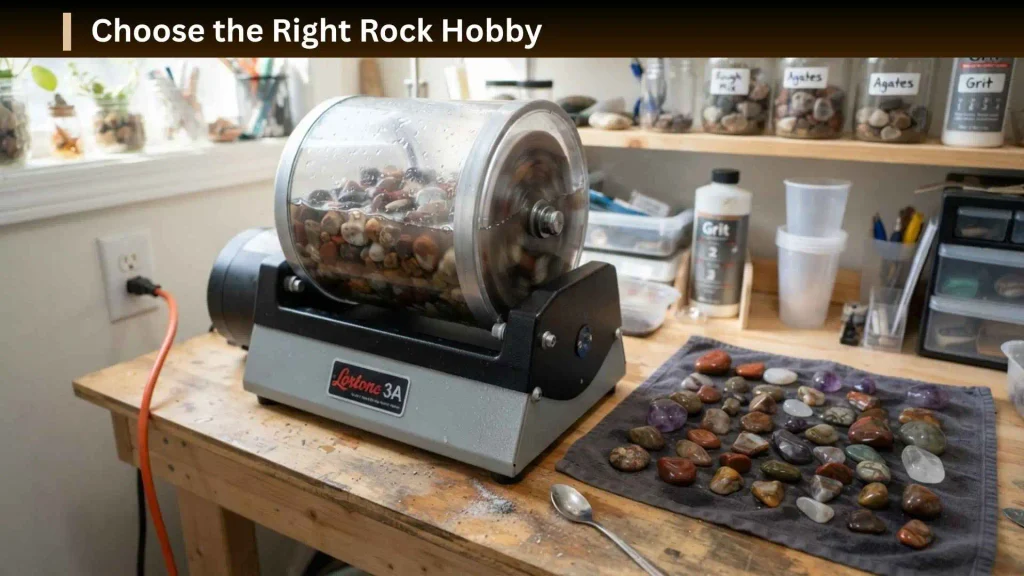
The easiest way to choose is to start with what you enjoy doing.
Choose rockhounding if you like exploration
Rockhounding is a good fit if you enjoy hiking, geology, discovering unusual specimens, and spending time outdoors.
Choose metal detecting if you like treasure hunting
Metal detecting may suit you if you enjoy technology, searching, history, and the excitement of investigating signals.
Hot rocks will eventually become part of the learning process, especially in mineralized areas.
Choose gold prospecting if you like geology and discovery
Gold prospecting is attractive if you enjoy learning about geological environments and searching for natural gold.
Choose lapidary if you like making things
If you would rather transform raw material into something attractive, lapidary work may be more rewarding than collecting alone.
Choose rock painting if you want a simple craft
Rock painting is a low-barrier way to incorporate rocks into a creative hobby without needing specialized geological knowledge.
What Equipment Do You Need to Start?
Your equipment depends heavily on the specific hobby.
For rockhounding
Start with:
- Safety glasses
- Gloves
- Magnifying loupe
- Field notebook
- Specimen containers
- Identification references
- Water and outdoor essentials
Avoid buying a large collection of specialized tools before you know what type of collecting you enjoy.
For metal detecting
A beginner setup generally centers on:
- Metal detector
- Search coil
- Headphones, if supported
- Pinpointer
- Recovery tool
- Finds pouch
- Ground-appropriate footwear
The detector’s ground-balance capabilities and how it handles mineralized soil can matter considerably if you frequently encounter hot rocks.
For lapidary
Equipment becomes more specialized. Depending on the work, it can include:
- Rock saw
- Grinding equipment
- Polishing equipment
- Appropriate abrasives
- Eye protection
- Dust-control equipment
Beginners should learn the safe operating procedures for each machine rather than treating lapidary equipment like ordinary craft tools.
How to Deal With Hot Rocks When Metal Detecting
If your detector repeatedly responds to rocks, do not immediately assume your detector is malfunctioning.
Try this basic troubleshooting approach:
1. Check the target away from the ground
Pass the rock over the coil after removing it from the soil.
If the response changes substantially, the surrounding soil may be contributing to the problem.
2. Test the rock from different directions
Rotate the specimen and sweep over it from different angles.
The character of the response can provide useful information, although target IDs and tones vary between detector models.
3. Use a magnet when appropriate
A magnet can help determine whether a specimen contains strongly magnetic material. It is useful information, but a magnetic response alone does not prove that a rock is a hot rock or identify its mineral composition.
4. Recheck the ground balance
Incorrect or poorly adjusted ground balance can make mineralized ground more difficult to handle.
Follow your detector manufacturer’s instructions rather than relying on a universal setting.
5. Learn your detector’s audio language
Experienced detectorists often learn to distinguish different types of responses by tone, consistency, target ID, and behavior from multiple sweep directions.
That skill takes practice.
Hot Rocks vs. Metal Targets
| Characteristic | Hot Rock | Typical Metal Target |
| Made primarily of rock/mineral material | Yes | No |
| Can trigger detector | Yes | Yes |
| Always valuable | No | No |
| May respond differently from different angles | Often | Depends on target |
| Can be magnetic | Some are | Some are |
| Requires investigation | Sometimes | Often |
The important lesson is that a detector signal is not automatically proof of buried metal.
Is Rockhounding Better Than Metal Detecting?
Neither hobby is universally better.
Rockhounding is usually more focused on geology, specimens, landscapes, and natural materials.
Metal detecting is more focused on locating buried or concealed targets.
You can also combine them. A detectorist may become interested in geology because of hot rocks, while a rockhound may eventually become curious about prospecting or metal detecting.
The two hobbies can therefore complement each other rather than compete.
Where Can You Practice Rock Related Hobbies in the USA?
The United States offers an enormous variety of geological environments, but the best location depends on the specific material you want to find.
Potential places include:
- Public collecting areas where permitted
- Fee-based collecting sites
- Rock and mineral clubs
- Private property with permission
- Certain beaches
- Designated recreational areas
- Geological sites where collecting is explicitly allowed
Before removing anything, check the rules for the exact land manager and location.
Rules can differ between federal, state, local, tribal, and private lands. Archaeological resources, fossils, minerals, and other materials may also have different protections.
A Beginner Friendly Way to Start
If you are completely new to rock hobbies, avoid buying expensive equipment immediately.
Instead:
- Choose one type of hobby.
- Learn basic identification skills.
- Join a local rock, mineral, prospecting, or detecting club.
- Visit a beginner-friendly collecting site.
- Keep notes about what you find.
- Research specimens before buying more equipment.
- Learn the land-access and collecting rules.
- Upgrade your tools only when you know what you need.
This approach reduces unnecessary spending while helping you discover which part of the hobby actually interests you.
Frequently Asked Questions About Hot Rock Hobbies
What are hot rocks in metal detecting?
Hot rocks are rocks or mineralized materials that produce a metal-detector response because their mineralization differs from the surrounding soil. They can create false or misleading signals.
Are hot rocks actually hot?
Usually, no. In metal detecting terminology, “hot” refers to their effect on a detector, not their physical temperature.
Do hot rocks contain gold?
Not necessarily. A hot-rock signal does not prove that gold is present. Some mineralized rocks can occur in gold-prospecting environments, but the signal alone cannot establish their value.
What hobbies involve collecting rocks?
Popular options include rockhounding, mineral collecting, gem hunting, fossil collecting, gold prospecting, and fluorescent mineral collecting.
Is rockhounding an expensive hobby?
It does not have to be. Beginners can start with basic field equipment and gradually invest in better tools, reference materials, specimens, or specialized equipment as their interests develop.
Can metal detecting and rockhounding be combined?
Yes. Both involve outdoor exploration and learning to recognize geological materials. Metal detecting can also expose hobbyists to mineralized ground and hot rocks, which encourages greater interest in geology.
What is the easiest rock hobby for beginners?
Rock collecting and rock painting are among the easiest entry points. Rockhounding is also accessible if you have a suitable collecting location and learn the local rules.
Are you allowed to collect rocks anywhere in the USA?
No. Permission and regulations depend on the land and material involved. Always verify the rules for the specific location before collecting.
Conclusion
Hot rock hobbies can refer to several different interests, but the phrase is most closely associated with the experience of encountering mineralized rocks during metal detecting and gold prospecting.
If you are interested in rocks more broadly, you have many options: rockhounding, mineral collecting, gem hunting, fossil collecting, gold prospecting, metal detecting, lapidary arts, fluorescent mineral collecting, and rock painting.
For beginners, the best approach is to choose the activity that matches your interests rather than buying equipment first. Start small, learn how to identify what you find, respect land-access rules, and gradually develop your skills. That turns a simple curiosity about rocks into a rewarding long-term hobby.

I’m James Anderson, a dedicated writer and lifelong learner who enjoys researching topics and explaining them in a practical way. Through my work at Cognivoora, I aim to give readers reliable, easy-to-follow information that helps them learn something new. I always try to keep my writing natural, useful, and focused on the questions readers actually have.
Books:
- A Practical Guide to Better Thinking
- Questions Worth Asking