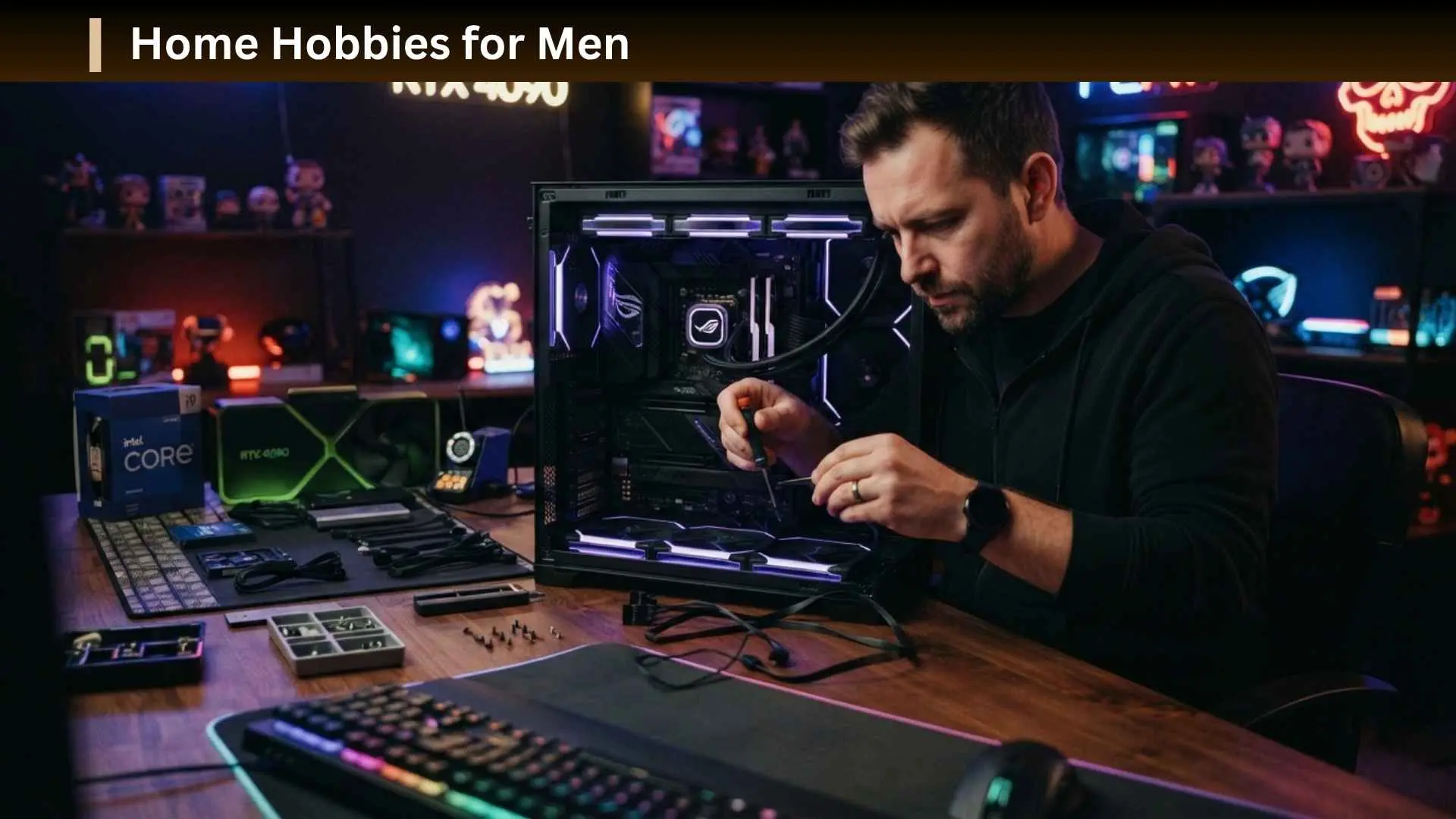
Finding good home hobbies for men does not have to mean spending hours gaming or watching TV. The best at-home hobbies give you something to build, learn, practice, collect, create, or improve.
Whether you live in an apartment, have a garage workshop, share a home with family, or simply want a hobby that fits into a busy schedule, there are plenty of options. Current hobby guides commonly include hands-on activities such as woodworking and model building alongside cooking, music, creative projects, reading, and home fitness.
The key is choosing a hobby based on what you want from your free time rather than whether an activity is traditionally considered a “man’s hobby.”
How to Choose a Home Hobby
Before buying equipment, think about four things:
- Space: Do you have a desk, kitchen, garage, basement, or only a small corner?
- Budget: Do you want something nearly free or are you comfortable investing in equipment?
- Time: Can you dedicate an hour several times a week, or do you need something you can do in 15–30 minutes?
- Payoff: Do you want to relax, make things, learn a skill, stay active, socialize, or simply have fun?
A good beginner strategy is to choose a hobby that lets you complete a small first project without buying a large collection of equipment.
Best Home Hobbies for Men at a Glance
| Hobby | Best For | Space Needed | Typical Starting Cost |
| Cooking | Practical skills | Kitchen | Low |
| Reading | Relaxation and learning | Very little | Low |
| Drawing | Creativity | Small desk | Low |
| Model building | Detail-oriented makers | Small desk | Low–Moderate |
| Woodworking | Hands-on projects | Garage/workspace | Moderate–High |
| Photography | Visual creativity | Small | Low–Moderate |
| Guitar | Music | Small | Moderate |
| Home fitness | Exercise | Small–Moderate | Low–Moderate |
| Gardening | Plants and routine | Windowsill/balcony/yard | Low–Moderate |
| Chess | Strategy | Small table | Low |
| Writing | Creativity | Small desk | Very low |
| 3D printing | Technology and making | Small–Moderate | Moderate |
| Coffee brewing | Experimentation | Kitchen | Low–Moderate |
| Painting | Art | Small desk | Low |
| Gaming | Entertainment | Small–Moderate | Moderate |
Costs vary considerably depending on equipment, quality, and whether you already own basic supplies.
1. Woodworking
Woodworking is one of the most rewarding hobbies for men who like working with their hands. You can start with simple projects such as shelves, boxes, frames, or small decorative objects before progressing to furniture.
It is also a hobby where your workspace matters. A garage or dedicated workshop makes larger projects easier, while apartment dwellers can focus on small projects and hand tools.
Because power tools can cause serious injuries, beginners should learn proper tool operation and use appropriate safety equipment before working independently. Professional guidance or a woodworking class can be useful when learning unfamiliar machinery.
Good first project: Build a simple wooden shelf or small storage box.
2. Cooking

Cooking is an especially practical hobby because the skills you develop can become part of everyday life.
Instead of trying to master everything at once, choose a category:
- Steak and grilling
- Italian food
- Asian-inspired dishes
- Bread baking
- Homemade pizza
- Sauces and marinades
- Meal preparation
- Regional American cooking
- Desserts
Try preparing the same dish several times and changing one variable at a time. That turns ordinary cooking into an actual learning hobby.
3. Home Coffee Brewing
If you enjoy coffee, learning how different brewing methods work can turn your morning cup into a small daily experiment.
You can explore:
- Pour-over coffee
- French press
- AeroPress
- Espresso
- Cold brew
- Coffee grinding
- Water temperature and extraction
- Different beans and roast levels
The advantage is that you can start with equipment you already have and gradually experiment rather than immediately building an expensive coffee setup.
4. Model Building
Model building is ideal for men who enjoy patience, precision, history, engineering, or miniature design.
Possible subjects include:
- Cars
- Aircraft
- Ships
- Trains
- Military vehicles
- Architecture
- Science-fiction subjects
- Scale dioramas
Begin with a relatively simple kit. As your skills improve, you can experiment with painting, weathering, custom parts, lighting, and detailed scenery.
Model building is also well suited to evenings because a project can be divided into small sessions.
5. Reading
Reading is one of the easiest hobbies to start because it requires very little space or equipment.
You do not have to limit yourself to novels. Consider:
- History
- Biography
- Science
- Business
- Philosophy
- Psychology
- Travel
- Sports
- Technology
- Mystery and fiction
If you struggle to stay consistent, choose a specific reading goal such as 10 pages before bed rather than trying to finish an entire book quickly.
6. Home Fitness
Home fitness can turn exercise into a regular hobby rather than something you do only when you feel motivated.
Depending on your space and interests, you might explore:
- Bodyweight training
- Dumbbell workouts
- Kettlebell training
- Mobility work
- Yoga
- Calisthenics
- Jump rope
- Indoor cycling
- Stretching routines
The equipment required depends heavily on the activity. You can begin with bodyweight movements and add equipment later.
7. Guitar or Another Musical Instrument
Learning an instrument gives you a skill you can continually develop.
Guitar is a popular choice because it can be practiced in relatively small spaces, but other possibilities include:
- Piano or keyboard
- Bass
- Drums with an appropriate setup
- Ukulele
- Harmonica
- Violin
- Digital music production
Start by learning a handful of songs rather than spending all your time studying theory. You can gradually add scales, technique, music theory, and improvisation.
8. Drawing
Drawing requires little space and can be inexpensive to start.
You can practice:
- Sketching
- Portraits
- Architecture
- Landscapes
- Cartooning
- Technical drawing
- Character design
- Pen and ink
- Digital illustration
A simple sketchbook and pencil are enough for your first session.
9. Painting
Painting gives you more freedom to experiment with color and texture.
Try:
- Acrylic painting
- Watercolor
- Oil painting
- Miniature painting
- Abstract art
- Landscape painting
- Still life
If you have limited space, acrylics and watercolor can be easier to manage than a large oil-painting setup.
10. Photography
Photography can be practiced indoors with surprisingly ordinary subjects.
Try photographing:
- Food
- Household objects
- Architecture
- Plants
- Pets
- Portraits
- Products
- Light and shadows
You do not necessarily need an expensive camera to learn composition, lighting, perspective, and editing. A smartphone can provide a useful starting point.
11. Chess
Chess is a compact hobby that can provide a continuous learning challenge.
You can study:
- Openings
- Tactical patterns
- Endgames
- Famous games
- Strategy
- Calculation
Playing online can provide convenient practice, while a physical chessboard gives the hobby a more traditional tabletop experience.
12. Puzzles and Brain Games
If you enjoy solving problems, try:
- Jigsaw puzzles
- Crossword puzzles
- Sudoku
- Logic puzzles
- Mechanical puzzles
- Word games
- Rubik’s Cube
- Puzzle books
These are particularly useful when you want a hobby that can be picked up for 15 minutes and put away without preparation.
13. Writing and Journaling
Writing can be both creative and practical.
You could write:
- Short stories
- Essays
- Poetry
- Personal reflections
- Family memories
- Fiction
- Travel notes
- Reviews
- A private journal
Another option is to create a personal knowledge journal where you record things you learn about subjects that interest you.
14. Creative Writing
If you enjoy stories but have never written one, start with short fiction rather than attempting a full novel.
Try writing:
- A 500-word story.
- A character description.
- A single dramatic scene.
- A mystery with a simple twist.
- A story based on an unusual object.
The goal at first is to finish small pieces.
15. 3D Printing
3D printing combines technology, design, troubleshooting, and physical making.
Once you understand your printer and its software, you can create:
- Desk organizers
- Replacement parts
- Hobby accessories
- Small models
- Tool holders
- Decorative objects
- Custom household items
It can become much more than simply downloading models: learning basic 3D design allows you to make objects specifically for your own needs.
16. Electronics
Electronics is a good choice if you enjoy understanding how things work.
Beginner projects can involve:
- LEDs
- Simple sensors
- Small motors
- Microcontrollers
- Basic circuits
- Arduino-style projects
- Home automation experiments
Start with beginner-friendly kits and follow electrical safety practices rather than experimenting with household mains electricity.
17. Programming
Programming can become a serious long-term hobby because there is always another project to build.
You could learn programming by creating:
- Small games
- Websites
- Personal tools
- Automation scripts
- Data projects
- Simple mobile applications
- Interactive experiments
The best beginner project is usually something you personally want to use.
18. Video Games
Gaming can be a legitimate hobby when approached intentionally.
Instead of simply playing whatever is available, explore different genres:
- Strategy
- Role-playing games
- Simulation
- Racing
- Puzzle games
- Sports
- Adventure
- Cooperative games
You can also turn gaming into a deeper hobby by studying game design, speedrunning, competitive play, modding, or game development.
19. Board Games
Board gaming provides a break from screens while still offering strategy and entertainment.
You can explore:
- Strategy games
- Cooperative games
- Card games
- Deck-building games
- Trivia games
- Abstract games
- Campaign games
Many board games also work well as a shared hobby with friends or family.
20. Collecting
Collecting becomes more interesting when you choose a clear theme instead of simply accumulating objects.
Possible collections include:
- Coins
- Stamps
- Books
- Vinyl records
- Watches
- Sports memorabilia
- Movie posters
- Vintage tools
- Model cars
- Maps
Research is an important part of collecting. Learning an item’s history, condition, rarity, and provenance can become as interesting as owning it.
21. Watch Appreciation and Horology

If you enjoy mechanical objects and design, learning about watches can become a fascinating hobby.
You can study:
- Mechanical movements
- Quartz movements
- Watch history
- Case designs
- Complications
- Servicing
- Vintage watches
- Strap materials
You do not need an expensive collection. Learning how watches work and researching their history can be the hobby itself.
22. Home Gardening
Gardening is not limited to people with large yards.
At home, you can grow:
- Herbs
- Tomatoes
- Peppers
- Succulents
- Houseplants
- Microgreens
- Small vegetables
A windowsill or balcony can be enough to begin with a few containers.
23. Bonsai
Bonsai combines plant care, patience, design, and observation.
It is particularly suitable if you enjoy hobbies where progress happens gradually rather than immediately.
Before buying a plant, learn about its species, light requirements, watering needs, pruning, and appropriate growing conditions.
24. Indoor Hydroponics
Hydroponic gardening lets you explore plant cultivation using water-based systems rather than conventional soil gardening.
Small countertop systems can make the hobby accessible to people who have limited outdoor space.
You can learn about:
- Nutrient management
- Lighting
- Water quality
- Plant growth
- Root systems
- Harvesting
25. DIY Home Improvement
If you like practical projects, turn ordinary household maintenance into a learning hobby.
You might learn:
- Painting
- Basic carpentry
- Shelving
- Furniture repair
- Caulking
- Organization
- Simple hardware replacement
Always distinguish between projects appropriate for a beginner and jobs involving electrical, gas, structural, or other specialized work that may require qualified professionals.
26. Leathercraft
Leathercraft allows you to make functional objects by hand.
Beginner projects can include:
- Card holders
- Keychains
- Simple wallets
- Coasters
- Tool organizers
- Small cases
As your skills improve, you can explore stitching, tooling, dyeing, and more complex construction.
27. Knife and Tool Sharpening
Learning to maintain everyday tools can appeal to people who enjoy precision and practical skills.
Sharpening requires learning the correct technique for the specific tool and using appropriate safety precautions. It can also become part of a broader interest in maintaining household or workshop equipment.
28. Calligraphy and Hand Lettering
Calligraphy is an inexpensive desk-based hobby that rewards patience.
You can experiment with:
- Traditional lettering
- Modern calligraphy
- Brush lettering
- Fountain pens
- Handwritten cards
- Decorative quotes
It is also a useful way to combine writing with visual design.
29. Home Brewing of Non Alcoholic Drinks
You can experiment with homemade beverages without making alcohol.
Ideas include:
- Kombucha
- Cold-brew coffee
- Iced tea
- Homemade lemonade
- Flavored sparkling water
- Ginger-based drinks
Fermentation requires careful attention to food safety and appropriate methods, so beginners should use reliable recipes and established food-safety guidance.
30. Baking
Baking turns cooking into a more precise hobby.
Try learning:
- Bread
- Pizza dough
- Cookies
- Cakes
- Pies
- Muffins
- Sourdough
Baking is particularly useful for people who enjoy measurable progress because ingredients, ratios, temperature, and timing all affect the result.
31. Digital Music Production
If you enjoy music but do not have space for traditional instruments, digital music production can be an excellent alternative.
You can learn:
- Beat making
- Recording
- Sampling
- Arrangement
- Mixing
- Sound design
- Basic music theory
A computer and suitable software can provide a starting point, with additional equipment added only when needed.
32. Genealogy and Family History
Researching your family history combines reading, organization, historical research, and detective work.
You can investigate:
- Family names
- Census records
- Immigration records
- Historical photographs
- Military records
- Old newspapers
- Family documents
Be careful to distinguish documented information from family stories or assumptions, and respect the privacy of living relatives.
33. Astronomy
You can begin learning astronomy without immediately purchasing a telescope.
Start by learning:
- Major constellations
- Planets
- Moon phases
- Seasonal night skies
- Basic stellar classification
- Space missions
- How to use a sky map or astronomy app
If the hobby sticks, you can later explore binoculars or a telescope.
34. Lego and
Construction Sets
Building sets are not limited to children. Adult builders can use construction systems to explore architecture, engineering, mechanical design, or simply relaxation.
You can also create original designs rather than following instructions.
35. Learning a New Language
A language-learning hobby can fit into even a busy schedule.
You can combine:
- Vocabulary practice
- Reading
- Listening
- Speaking
- Movies and television
- Music
- Writing
- Conversation practice
Choose a language connected to a genuine interest—such as travel, family history, food, literature, or culture—because that gives you more reasons to keep practicing.
Best Home Hobbies for Men by Personality

If You Like Building Things
Try:
- Woodworking
- Model building
- 3D printing
- Electronics
- Leathercraft
- DIY projects
These hobbies provide a tangible result, which can make progress easier to see.
If You Like Technology
Consider:
- Programming
- 3D printing
- Electronics
- Digital music production
- Photography
- Gaming
If You Prefer Quiet Hobbies
Try:
- Reading
- Chess
- Writing
- Drawing
- Painting
- Model building
- Puzzles
- Genealogy
If You Want a Practical Hobby
Choose:
- Cooking
- Baking
- Gardening
- Home improvement
- Coffee brewing
- Tool maintenance
- Electronics
If You Want a Creative Outlet
Good choices include:
- Photography
- Drawing
- Painting
- Writing
- Music
- Leathercraft
- Model building
If You Have Very Little Space
Look at:
- Reading
- Writing
- Drawing
- Chess
- Puzzles
- Language learning
- Photography
- Digital music
- Programming
Best Cheap Home Hobbies for Men
You do not need to spend hundreds of dollars to begin a hobby.
Some inexpensive starting points include:
- Reading
- Writing
- Drawing
- Chess
- Bodyweight fitness
- Language learning
- Photography with a smartphone
- Puzzles
- Cooking
- Gardening from seeds
- Digital learning
- Calligraphy
A useful rule is try first, upgrade later. Buying professional equipment before discovering whether you actually enjoy the activity is one of the easiest ways to turn a hobby into unnecessary expense.
Best Home Hobbies for Men Who Are Bored
If boredom is the main problem, choose something that requires active participation rather than passive consumption.
Instead of watching another show, try:
- Build a small model.
- Cook a new dish.
- Learn three guitar chords.
- Draw an object in your room.
- Solve a chess puzzle.
- Start a small garden.
- Repair something you own.
- Write 500 words.
- Create a simple computer program.
- Organize a collection.
- Learn basic photography.
- Start a woodworking project.
The important distinction is that a hobby should give you something to do, not merely something to consume.
How to Start a New Hobby Without Overspending
1. Choose One Hobby
Do not start five hobbies simultaneously. Pick the one that sounds most interesting.
2. Set a Small First Goal
For example:
- Cook one unfamiliar recipe.
- Complete one model.
- Read one chapter.
- Draw for 20 minutes.
- Build one small wooden project.
3. Use What You Already Own
Look around your home before shopping. You may already have books, kitchen equipment, a smartphone, notebooks, computers, plants, tools, or exercise equipment that can get you started.
4. Give It Several Sessions
One frustrating first attempt does not necessarily mean you dislike the hobby. Give it enough time to determine whether you enjoy the learning process.
5. Upgrade Only When You Know What You Need
Once you understand the activity, you can make much smarter equipment purchases.
How to Turn a Home Hobby Into a Long Term Interest
A hobby becomes more sustainable when you create a progression.
For example:
Cooking: basic recipes → regional cuisine → knife skills → bread → specialty dishes
Woodworking: simple projects → hand tools → joinery → furniture → advanced projects
Photography: smartphone photography → composition → manual controls → editing → specialized photography
Guitar: chords → songs → rhythm → scales → theory → improvisation
Programming: fundamentals → small scripts → personal project → larger application
This progression keeps the hobby challenging without requiring you to become an expert immediately.
Frequently Asked Questions
What are the best home hobbies for men?
Some of the most versatile options include cooking, woodworking, model building, reading, gaming, photography, home fitness, gardening, music, programming, drawing, chess, and DIY projects. The best choice depends on your available space, budget, time, and interests.
What is a good hobby for a man who is bored at home?
Choose an activity that requires active participation, such as cooking, model building, drawing, woodworking, programming, playing an instrument, gardening, puzzles, or learning a new skill.
What are some cheap hobbies for men at home?
Reading, writing, drawing, chess, bodyweight exercise, language learning, smartphone photography, puzzles, cooking, and gardening can all be started relatively inexpensively.
What are good hobbies for men with limited space?
Reading, writing, drawing, chess, photography, programming, language learning, digital music production, model building, and puzzles can work well in apartments or small rooms.
What are good creative hobbies for men?
Drawing, painting, photography, woodworking, leathercraft, model building, writing, music, baking, cooking, and 3D design are strong creative options.
What is a good practical hobby for men?
Cooking, gardening, woodworking, DIY home improvement, electronics, baking, coffee brewing, and basic tool maintenance can all produce useful skills or tangible results.
Are video games a good hobby for men?
Video games can be a hobby like other forms of entertainment, particularly when the player enjoys the challenge, storytelling, strategy, competition, or social interaction. The important consideration is whether the activity fits reasonably alongside work, relationships, responsibilities, sleep, and other priorities.
How do I find a hobby I actually enjoy?
Start with the activity that makes you curious rather than choosing based on what you think you are supposed to enjoy. Try a low-cost version first, complete a small project, and then decide whether you want to continue or explore something else.
Conclusion
The best home hobbies for men are not necessarily the most expensive, impressive, or traditionally masculine. They are the activities that make you want to spend your free time doing something meaningful, interesting, challenging, relaxing, or creative.
If you like building, start with woodworking, models, electronics, or 3D printing. If you prefer creativity, try photography, drawing, painting, writing, or music. If you want something practical, cooking, gardening, baking, and DIY projects are excellent starting points. For quiet evenings, reading, chess, puzzles, and language learning require very little space.
Start with one hobby, keep the first project small, and avoid buying a roomful of equipment before you know you enjoy it. A hobby does not need to become a major achievement to be worthwhile—it simply needs to make your time at home more enjoyable.

I’m Ethan Mitchell, a curious writer who enjoys turning complex ideas into simple, useful information. At Cognivoora, I focus on creating clear and engaging content that readers can understand and apply in everyday life. I believe good writing should educate, answer real questions, and leave readers with something valuable to remember.
Books:
- The Everyday Mind
- Simple Ideas, Better Thinking