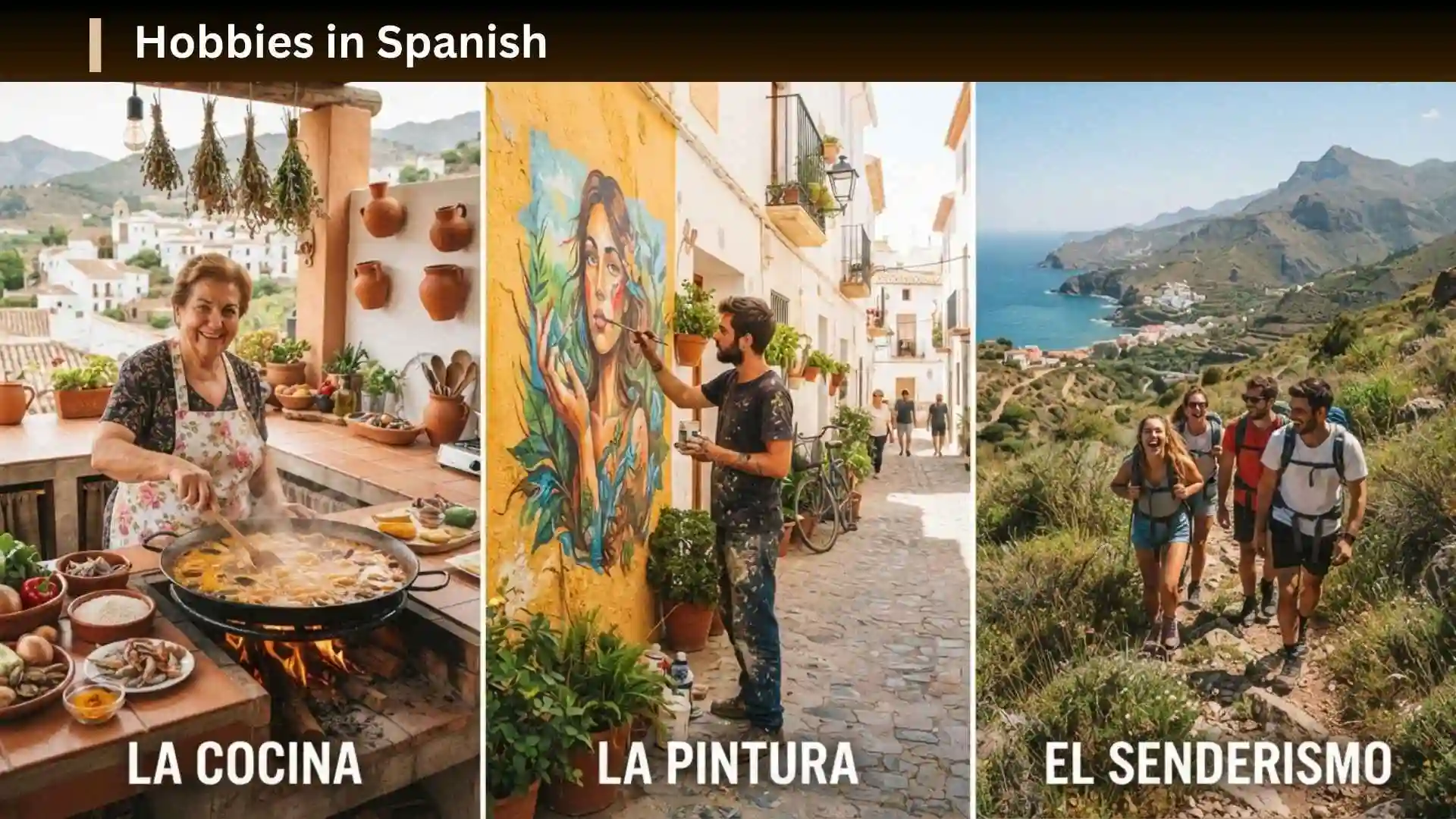
Learning the Spanish words for hobbies is a useful way to expand your vocabulary while talking about everyday interests, free-time activities, and personal preferences. Whether you are studying Spanish for travel, school, work, or conversation, knowing how to describe what you enjoy can make communication more natural.
In Spanish, hobbies can include a wide range of activities, such as reading, cooking, painting, playing sports, listening to music, traveling, gaming, and spending time outdoors. Learning the names of these activities along with simple phrases can help beginners talk about their interests with greater confidence.
This guide explores common hobbies in Spanish, their English meanings, useful vocabulary, and practical phrases you can use in everyday conversations. It is designed to make learning hobby-related Spanish simple, clear, and useful for real-life communication.
What Does “Hobbies” Mean in Spanish?
The English word “hobbies” can be translated into Spanish in several natural ways. The most common expression is “pasatiempos,” which means activities you enjoy during your free time.
Depending on the country and context, Spanish speakers may also use “aficiones” or simply describe an activity they enjoy.
For example:
- Hobbies → Pasatiempos
- My hobbies → Mis pasatiempos
- My favorite hobby → Mi pasatiempo favorito
- I have many hobbies → Tengo muchos pasatiempos
- What are your hobbies? → ¿Cuáles son tus pasatiempos?
In everyday conversation, it is also very natural to ask what someone likes to do in their free time rather than using the word pasatiempos.
Common Hobbies in Spanish
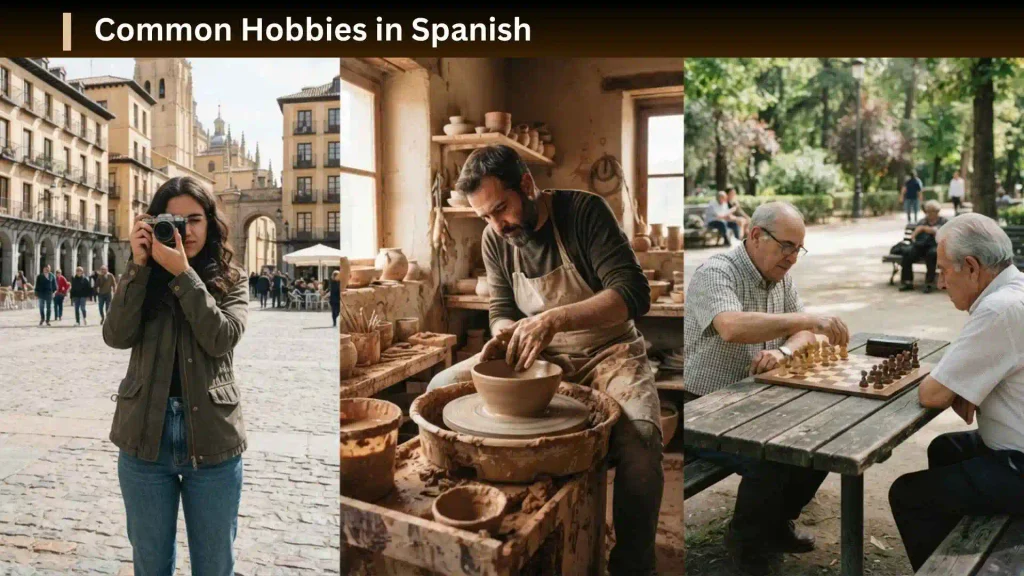
Here are common hobbies in Spanish, along with their English meanings:
| Spanish | English |
| Leer | To read |
| Escribir | To write |
| Cocinar | To cook |
| Hornear | To bake |
| Dibujar | To draw |
| Pintar | To paint |
| Fotografiar | To take photographs |
| Viajar | To travel |
| Bailar | To dance |
| Cantar | To sing |
| Escuchar música | To listen to music |
| Ver películas | To watch movies |
| Ver series | To watch TV shows |
| Jugar videojuegos | To play video games |
| Jugar al ajedrez | To play chess |
| Hacer senderismo | To go hiking |
| Montar en bicicleta | To ride a bicycle |
| Nadar | To swim |
| Pescar | To fish |
| Acampar | To go camping |
| Jardinería | Gardening |
| Tejer | To knit |
| Hacer manualidades | To do crafts |
| Coleccionar monedas | To collect coins |
| Coleccionar sellos | To collect stamps |
| Tocar la guitarra | To play the guitar |
| Tocar el piano | To play the piano |
| Aprender idiomas | To learn languages |
| Practicar yoga | To practice yoga |
| Hacer ejercicio | To exercise |
| Correr | To run |
| Jugar al fútbol | To play soccer |
| Jugar al tenis | To play tennis |
| Patinar | To skate |
| Hacer fotografía | To do photography |
How to Talk About Your Hobbies in Spanish
Knowing individual vocabulary words is useful, but learning complete phrases helps you actually use the language.
“My Hobby Is…”
To say “My hobby is…”, you can say:
Mi pasatiempo es…
Examples:
- Mi pasatiempo es leer. — My hobby is reading.
- Mi pasatiempo es cocinar. — My hobby is cooking.
- Mi pasatiempo es pintar. — My hobby is painting.
- Mi pasatiempo es tocar la guitarra. — My hobby is playing the guitarra.
You can also use “Mi afición es…”, although pasatiempo may be easier for beginners to recognize.
“My Hobbies Are…”
For several hobbies:
Mis pasatiempos son…
For example:
Mis pasatiempos son leer, cocinar y viajar.
This means:
“My hobbies are reading, cooking, and traveling.”
How to Ask Someone About Their Hobbies
These Spanish questions are useful in casual conversations.
¿Cuáles son tus pasatiempos?
What are your hobbies?
This is a direct and useful question for learners.
¿Qué te gusta hacer en tu tiempo libre?
What do you like to do in your free time?
This can sound very natural because it focuses on activities rather than asking specifically about “hobbies.”
¿Qué haces en tu tiempo libre?
What do you do in your free time?
This is another common way to start a conversation about someone’s interests.
¿Cuál es tu pasatiempo favorito?
What is your favorite hobby?
You can use this when asking about one favorite activity.
Useful Spanish Vocabulary for Different Types of Hobbies
Grouping hobbies by category makes them easier to learn and remember.
Creative Hobbies
If you enjoy making things, these Spanish words are useful:
- Dibujar — drawing
- Pintar — painting
- Escribir — writing
- Tejer — knitting
- Hacer manualidades — doing crafts
- Hacer cerámica — making pottery
- Tocar un instrumento — playing an instrument
- Fotografía — photography
Example:
Me gusta dibujar en mi tiempo libre.
I like drawing in my free time.
Outdoor Hobbies
For activities outside the home:
- Hacer senderismo — hiking
- Acampar — camping
- Pescar — fishing
- Montar en bicicleta — cycling
- Correr — running
- Nadar — swimming
- Jardinería — gardening
- Observar aves — birdwatching
Example:
Me gusta hacer senderismo los fines de semana.
I like hiking on weekends.
Sports and Fitness Hobbies
Common sports and fitness activities include:
- Jugar al fútbol — playing soccer
- Jugar al tenis — playing tennis
- Jugar al baloncesto — playing basketball
- Nadar — swimming
- Correr — running
- Montar en bicicleta — cycling
- Practicar yoga — practicing yoga
- Hacer ejercicio — exercising
Example:
Me gusta jugar al tenis.
I like playing tennis.
Indoor Hobbies
Many hobbies can be enjoyed at home:
- Leer — reading
- Cocinar — cooking
- Hornear — baking
- Ver películas — watching movies
- Escuchar música — listening to music
- Jugar videojuegos — playing video games
- Jugar al ajedrez — playing chess
- Tejer — knitting
- Dibujar — drawing
How to Say “I Like” and “I Love” a Hobby
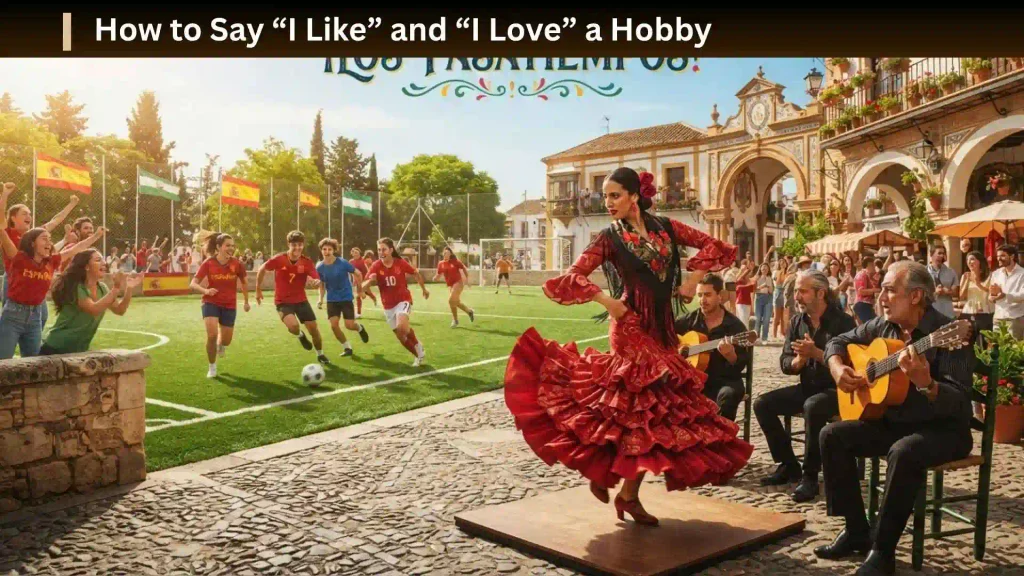
One of the most useful structures for discussing hobbies is “me gusta.”
Me gusta + singular noun or infinitive verb
Examples:
- Me gusta leer. — I like reading.
- Me gusta cocinar. — I like cooking.
- Me gusta la fotografía. — I like photography.
- Me gusta el senderismo. — I like hiking.
For multiple activities, use:
Me gustan + plural noun
For example:
Me gustan los deportes.
I like sports.
Saying You Really Like Something
You can say:
Me encanta… — I love…
Examples:
- Me encanta viajar. — I love traveling.
- Me encanta pintar. — I love painting.
- Me encanta escuchar música. — I love listening to music.
How to Say “I Don’t Like” a Hobby
To express dislike, use “no me gusta.”
Examples:
- No me gusta correr. — I don’t like running.
- No me gusta pescar. — I don’t like fishing.
- No me gusta jugar videojuegos. — I don’t like playing video games.
For stronger dislike, you can say:
No me gusta nada… — I don’t like … at all.
For example:
No me gusta nada el fútbol.
I don’t like soccer at all.
Spanish Sentences About Hobbies
If you are learning Spanish, these sentences can help you practice talking about your interests:
- Me gusta leer libros. — I like reading books.
- Me gusta escuchar música. — I like listening to music.
- Me encanta viajar. — I love traveling.
- Me gusta cocinar para mi familia. — I like cooking for my family.
- Juego al fútbol los fines de semana. — I play soccer on weekends.
- Me gusta hacer senderismo. — I like hiking.
- En mi tiempo libre, veo películas. — In my free time, I watch movies.
- Me gusta aprender idiomas. — I like learning languages.
- Mi pasatiempo favorito es la fotografía. — Mi hobby es la fotografía.
- Tengo varios pasatiempos. — Tengo several hobbies.
Hobbies in Spanish: Useful Grammar Patterns
Spanish learners can describe hobbies using a few simple patterns.
Me gusta + Infinitive
Use this structure when talking about an activity:
Me gusta + verb
Examples:
- Me gusta leer.
- Me gusta escribir.
- Me gusta cocinar.
- Me gusta bailar.
- Me gusta viajar.
The verb remains in its infinitive form after me gusta.
Me gusta + Noun
You can also describe hobbies with nouns:
- Me gusta la música. — I like music.
- Me gusta la fotografía. — I like photography.
- Me gusta la jardinería. — I like gardening.
- Me gusta el ajedrez. — I like chess.
En mi tiempo libre…
This phrase means “In my free time…”
It is particularly useful for describing hobbies:
En mi tiempo libre, me gusta leer.
In my free time, I like reading.
You can replace leer with almost any activity:
En mi tiempo libre, me gusta cocinar.
En mi tiempo libre, me gusta dibujar.
En mi tiempo libre, me gusta hacer senderismo.
Hobbies in Spanish for Beginners
If you’re just starting to learn Spanish, you don’t need to memorize dozens of words immediately. Start with a small group that you are likely to use.
A useful beginner set includes:
- Leer — read
- Escribir — write
- Cocinar — cook
- Bailar — dance
- Cantar — sing
- Viajar — travel
- Dibujar — draw
- Pintar — paint
- Nadar — swim
- Correr — run
- Escuchar música — listen to music
- Ver películas — watch movies
- Jugar videojuegos — play video games
- Hacer ejercicio — exercise
- Hacer senderismo — go hiking
Then practice combining them with “Me gusta…” and “En mi tiempo libre…”
For example:
En mi tiempo libre, me gusta leer y escuchar música.
Hobbies in Spanish for Kids
Children can learn hobby vocabulary through simple words and activities they already know.
Some useful examples are:
- Dibujar — drawing
- Pintar — painting
- Jugar — playing
- Cantar — singing
- Bailar — dancing
- Nadar — swimming
- Leer — reading
- Montar en bicicleta — riding a bike
- Jugar videojuegos — playing video games
- Jugar al fútbol — playing soccer
Simple questions work well for beginners:
¿Qué te gusta hacer?
What do you like to do?
¿Te gusta dibujar?
Do you like drawing?
¿Te gusta nadar?
Do you like swimming?
Hobbies in Spanish for Conversation Practice
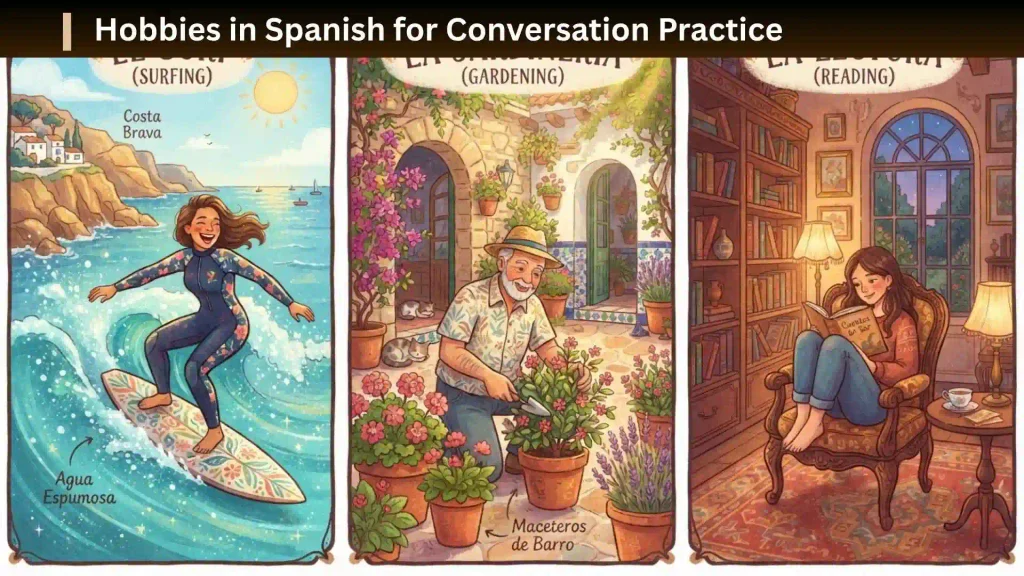
A short dialogue can help put the vocabulary into context.
Ana: ¿Qué te gusta hacer en tu tiempo libre?
What do you like to do in your free time?
Luis: Me gusta leer y escuchar música.
I like reading and listening to music.
Ana: ¿Cuál es tu pasatiempo favorito?
What is your favorite hobby?
Luis: Mi pasatiempo favorito es cocinar.
My favorite hobby is cooking.
Ana: ¿Te gusta viajar?
Do you like traveling?
Luis: Sí, me encanta viajar.
Yes, I love traveling.
This type of conversation gives you several reusable sentence patterns instead of isolated vocabulary.
Hobbies in Spanish vs. English
Some hobby expressions do not translate word-for-word between English and Spanish.
| English expression | Natural Spanish |
| My hobby is reading | Mi pasatiempo es leer |
| I like reading | Me gusta leer |
| I like hiking | Me gusta hacer senderismo |
| I play soccer | Juego al fútbol |
| I play the guitar | Toco la guitarra |
| I watch movies | Veo películas |
| I listen to music | Escucho música |
| I ride a bike | Monto en bicicleta |
| I go camping | Voy de camping / Acampar |
| I collect stamps | Colecciono sellos |
A common learning mistake is translating every phrase literally. Spanish often uses a different verb or grammatical structure to express the same hobby.
How to Learn Hobby Vocabulary in Spanish
The easiest approach is to connect vocabulary with actual sentences.
Instead of memorizing only:
leer = to read
practice:
Me gusta leer.
Then expand it:
Me gusta leer novelas.
And finally:
En mi tiempo libre, me gusta leer novelas.
This approach helps you learn vocabulary, grammar, and sentence structure together.
You can also create a personal list of five hobbies you actually enjoy and describe each one in Spanish. For example:
- Me gusta cocinar.
- Me gusta escuchar música.
- Me gusta viajar.
- Me gusta hacer ejercicio.
- Me gusta leer.
Once those sentences feel comfortable, add details about when, where, or with whom you enjoy each activity.
FAQs About Hobbies in Spanish
What are “hobbies” in Spanish?
The most common translation is “pasatiempos.” Depending on the context or region, “aficiones” can also be used.
How do you say “my hobbies” in Spanish?
“My hobbies” is “mis pasatiempos.” For example, Mis pasatiempos son leer y cocinar means “My hobbies are reading and cooking.”
How do you ask “What are your hobbies?” in Spanish?
You can say “¿Cuáles son tus pasatiempos?” Another natural option is “¿Qué te gusta hacer en tu tiempo libre?”
How do you say “my favorite hobby” in Spanish?
“Mi hobby” is “mi pasatiempo favorito.”
For example:
Mi pasatiempo favorito es pintar.
“My favorite hobby is painting.”
How do you say “I like reading” in Spanish?
“Me gusta leer.”
The structure me gusta + infinitive is commonly used to express that you enjoy an activity.
What is a natural way to talk about hobbies in Spanish?
Rather than always using the word pasatiempo, you can say what you like doing in your free time:
Me gusta cocinar en mi tiempo libre.
This means, “I like cooking in my free time.”
What are some easy hobbies to learn in Spanish?
Good beginner examples include leer (reading), cocinar (cooking), dibujar (drawing), bailar (dancing), cantar (singing), viajar (traveling), and escuchar música (listening to music).
Conclusion
Learning hobbies in Spanish is a practical way to build everyday vocabulary and start conversations about personal interests. Begin with familiar activities such as leer, cocinar, viajar, dibujar, and escuchar música, then practice putting them into sentences with “me gusta” and “en mi tiempo libre.”
Once you know how to ask ¿Qué te gusta hacer en tu tiempo libre? and answer with a few activities you enjoy, you already have the foundation for a simple conversation about hobbies in Spanish.

I’m James Anderson, a dedicated writer and lifelong learner who enjoys researching topics and explaining them in a practical way. Through my work at Cognivoora, I aim to give readers reliable, easy-to-follow information that helps them learn something new. I always try to keep my writing natural, useful, and focused on the questions readers actually have.
Books:
- A Practical Guide to Better Thinking
- Questions Worth Asking