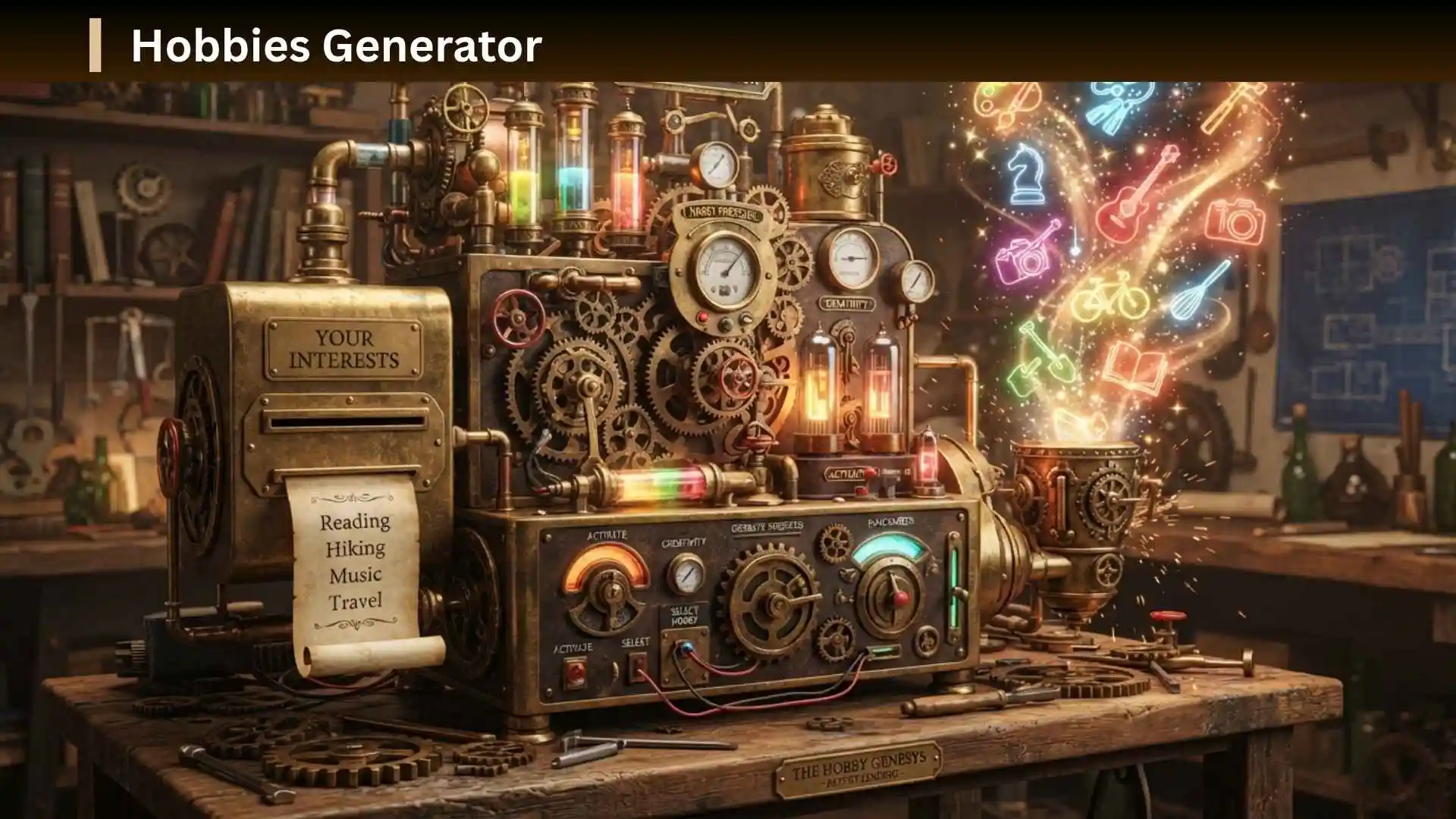
If you want to discover a new hobby but keep getting stuck choosing from hundreds of possibilities, a hobbies generator can make the process much easier. Instead of endlessly searching through lists, you can generate random or preference-based hobby ideas and then narrow them down based on your interests, budget, available time, location, and comfort level.
A hobby generator is best used as a discovery tool, not as a test that determines your perfect hobby. The goal is to turn “I want something new to do” into a few realistic activities you can actually try.
What Is a Hobbies Generator?
A hobbies generator is an online tool that produces hobby suggestions based on a random selection, categories, preferences, or filters.
Depending on the tool, you may be able to choose characteristics such as:
- Indoor or outdoor activities
- Creative or artistic hobbies
- Physical hobbies
- Social hobbies
- Learning-based activities
- Technology-related interests
- Music
- Games and puzzles
- Low-cost or free activities
- Time commitment
- Beginner-friendly activities
Some current hobby generators offer category filters, while others allow users to generate several suggestions at once.
For example, a generator might suggest birdwatching, watercolor painting, chess, gardening, photography, hiking, calligraphy, woodworking, or learning a language.
The suggestion itself is only the starting point. You then decide whether the hobby fits your life.
Why Use a Hobbies Generator?
Choosing a hobby sounds easy until you start considering all the possibilities. You might want something creative, inexpensive, social, relaxing, educational, or completely different from your usual routine.
That can create decision fatigue.
A hobby generator helps by giving you a smaller starting point.
It helps when you do not know what you like
You do not need to have a clearly defined passion before trying something new. A random suggestion can introduce you to activities you would not normally search for.
It breaks decision paralysis
Instead of asking yourself, “Which of these 100 hobbies should I choose?” you can generate a few options and evaluate them.
It can reveal overlooked interests
A generated result may remind you of an activity you enjoyed as a child or something you have always wanted to try but never considered seriously.
It works well for experimentation
You can treat hobbies as experiments. Try something for a few sessions, decide what you liked or disliked, and use that information to choose your next activity.
How Does a Hobbies Generator Work?
The exact method varies by tool.
A simple random generator selects an activity from a predefined list. More advanced tools may organize suggestions by categories or allow filters for factors such as budget and time. Some current generators provide information such as difficulty, estimated time commitment, or starting cost alongside the hobby suggestion.
A typical process looks like this:
- Choose a category, if the generator provides one.
- Set preferences such as budget or time when available.
- Generate one or several hobbies.
- Review the suggestions.
- Remove activities that clearly do not fit your circumstances.
- Research your favorite two or three.
- Try the most practical option before buying expensive equipment.
The important distinction is that random selection creates possibilities; your circumstances determine suitability.
Random Hobbies You Might Get
A good hobby generator can produce ideas from many different areas.
| Category | Example hobbies | Best for |
| Creative | Drawing, painting, calligraphy, pottery | Making and expressing |
| Outdoor | Hiking, gardening, birdwatching, fishing | Time outside |
| Learning | Languages, astronomy, history, chess | Curiosity and skill building |
| Social | Book clubs, dancing, community theater | Meeting people |
| Physical | Cycling, swimming, tennis, yoga | Active recreation |
| Craft | Knitting, woodworking, crochet, model building | Hands-on projects |
| Music | Guitar, piano, singing, music production | Musical interests |
| Technical | Coding, electronics, 3D printing | Technology and problem-solving |
| Relaxing | Journaling, puzzles, coloring, meditation | Quiet downtime |
| Collecting | Coins, postcards, books, records | Research and collecting |
Many hobbies can fit more than one category. Photography, for example, can be creative, technical, outdoor, and social depending on how you practice it.
How to Choose the Right Hobby From a Generator
Generating a hobby is easy. Choosing one that fits your life is the more important step.
Consider your available time
A hobby should fit your actual schedule rather than the schedule you wish you had.
If you only have an hour on weekends, a hobby that requires frequent practice or long travel may be difficult to maintain.
Ask yourself:
- How much free time do I have each week?
- Can I practice at home?
- Does the hobby require scheduled classes?
- How much travel is involved?
- Can I enjoy it in short sessions?
Consider your budget
Do not assume that an interesting hobby is automatically affordable.
Before committing, separate the cost to try from the cost to pursue seriously.
For example, you may be able to try photography with a smartphone before purchasing a dedicated camera. You might try a craft using basic supplies before buying specialized equipment.
A generator generally cannot understand your personal financial situation, so budget checking should happen after generation.
Consider your environment
Your location and living situation can eliminate some options immediately.
Someone living in a small apartment may prefer:
- Sketching
- Reading
- Origami
- Puzzles
- Journaling
- Digital art
- Language learning
- Miniature painting
Someone with easy access to parks or trails might consider:
- Hiking
- Birdwatching
- Nature photography
- Gardening
- Fishing
- Cycling
Your environment can turn an appealing hobby into either a convenient activity or a major logistical project.
Consider your social preference
Think about whether you want more interaction or more solitude.
For solo time:
Writing, drawing, reading, puzzles, gardening, coding, and photography may work well.
For social interaction:
Dancing, recreational sports, book clubs, community theater, tabletop gaming, and group classes can provide more opportunities to interact with others.
For a mixture:
Photography, cooking, hiking, music, and crafts can be practiced alone or with other people.
Hobbies Generator for Beginners
If you are completely new to hobbies, do not choose based only on what sounds impressive.
Look for an activity with a low barrier to entry.
Good beginner characteristics include:
- Minimal equipment
- Affordable starter materials
- Easy access to introductory resources
- Flexible practice times
- A simple first project
- Room to improve gradually
For example, instead of immediately buying a complete woodworking workshop, a beginner could start by learning basic woodworking concepts and completing a small project.
The same principle applies to music, art, photography, cooking, crafts, and technical hobbies.
Start small enough that trying the hobby feels easy.
Best Hobbies to Generate When You Are Bored
If your main goal is simply finding something interesting to do, use the generator to explore categories rather than repeatedly generating completely random results.
Creative hobbies
Try:
- Sketching
- Watercolor
- Photography
- Creative writing
- Calligraphy
- Origami
- Jewelry making
- Pottery
These are useful when you want to make something rather than simply consume entertainment.
Outdoor hobbies
Consider:
- Hiking
- Gardening
- Birdwatching
- Stargazing
- Cycling
- Fishing
- Nature photography
- Geocaching
Outdoor options can also provide a change of environment when you spend much of your day indoors.
Intellectual hobbies
Try:
- Chess
- Learning a language
- Astronomy
- History
- Puzzles
- Creative writing
- Coding
- Genealogy
These hobbies can turn curiosity into a structured activity.
Social hobbies
Consider:
- Book clubs
- Recreational sports
- Dance classes
- Community theater
- Board games
- Trivia
- Volunteer activities
- Group photography
These can be especially useful if your main objective is to meet people with similar interests.
Free and Low Cost Hobbies

If cost is your biggest concern, generate hobbies with a free or low-cost starting point.
Some possibilities include:
- Walking
- Hiking
- Journaling
- Reading
- Drawing
- Writing
- Birdwatching
- Stargazing
- Meditation
- Chess
- Origami
- Photography with a smartphone
- Learning a language
- Gardening from existing plants or seeds
- Digital learning
- Puzzles you already own
A hobby being inexpensive does not mean it has to be boring. Many hobbies become more sophisticated as your skills develop without requiring expensive equipment immediately.
Hobbies Generator for Couples
A hobby generator can also be useful when two people want something new to do together.
Instead of asking one person to choose, generate several options and create a shortlist.
For example:
- Generate five hobbies.
- Each person eliminates two they genuinely dislike.
- Compare the remaining options.
- Choose one that fits your shared schedule and budget.
- Try it together several times.
- Keep it if both people enjoy it; otherwise generate another shortlist.
Potential shared hobbies include:
- Cooking
- Hiking
- Photography
- Gardening
- Board games
- Dancing
- Painting
- Cycling
- Gardening
- Learning a language
The goal is not to find a hobby that looks perfect on paper. It is to find an activity both people are willing to actually do.
Hobbies Generator for Families
Families can use a generator as a simple activity-selection game.
Generate several options and let each family member vote.
Good family-oriented possibilities may include:
- Baking
- Gardening
- Board games
- Nature photography
- Hiking
- Arts and crafts
- Puzzles
- Cooking
- Model building
For activities involving children, consider age appropriateness, supervision, equipment, and safety before beginning.
Hobbies Generator for Adults
Adults often need hobbies that fit around work, family responsibilities, and limited free time.
Instead of asking, “What is the best hobby?” ask:
What kind of experience do I want from my free time?
If you want to relax, consider reading, gardening, drawing, puzzles, or journaling.
If you want to learn, consider languages, coding, astronomy, music, or history.
If you want to be active, consider hiking, cycling, swimming, dancing, or recreational sports.
If you want social interaction, consider clubs, classes, team sports, volunteering, or tabletop gaming.
If you want to make things, consider woodworking, pottery, sewing, baking, painting, or crafts.
This approach makes a random generator much more useful because you are giving the result a purpose.
How to Turn a Random Hobby Into a Real Hobby
Getting a suggestion is not the same as developing an interest.
Use a simple trial system.
Step 1: Pick one activity
Do not immediately choose ten hobbies. Select one promising option.
Step 2: Define a small first step
Make the first session easy.
Examples:
- Draw one picture.
- Cook one new recipe.
- Walk one local trail.
- Read one chapter.
- Take ten photographs.
- Learn five words in a new language.
- Build one simple model.
Step 3: Avoid unnecessary purchases
Use what you already have when possible.
Borrow equipment, use public resources, take an introductory class, or purchase only basic supplies until you know whether the hobby suits you.
Step 4: Give it several attempts
Your first session may not represent the hobby accurately. Beginners often spend their initial attempts learning the basics.
Step 5: Evaluate the experience
After trying it, ask:
- Did I enjoy the process?
- Was it easy to fit into my schedule?
- Did I want to improve?
- Was the cost reasonable?
- Did I enjoy doing it alone or with others?
- Would I voluntarily do it again?
If most answers are positive, you may have found a strong candidate.
What If the Generated Hobby Is Bad for You?
You do not have to follow a random result.
If a generator suggests something that conflicts with your:
- Budget
- Physical abilities
- Schedule
- Living situation
- Transportation
- Personal interests
- Safety requirements
- Available equipment
simply generate another option.
Random does not mean mandatory.
For activities involving significant physical, technical, environmental, or equipment-related risks, research appropriate safety practices and beginner requirements before participating.
Random Hobby Generator vs. Hobby Quiz
These tools serve slightly different purposes.
| Feature | Hobbies Generator | Hobby Quiz |
| Main purpose | Discover possibilities | Match preferences |
| Selection | Random or filtered | Based on answers |
| Best for | People open to surprises | People with clear preferences |
| Variety | Potentially broad | Usually more targeted |
| Decision-making | Gives options | Gives recommendations |
| Best approach | Experiment | Compare recommendations |
If you have no idea what you want, a generator can be a useful first step.
If you already know your personality, interests, schedule, and preferences, a quiz or structured hobby-selection process may produce more relevant suggestions.
How Many Hobbies Should You Generate?

There is no magic number.
Generating one hobby is useful when you want a simple challenge.
Generating three to five gives you enough variety to compare without creating another overwhelming list.
Some online generators currently allow users to request multiple suggestions in one generation.
A practical method is:
Generate 5 → eliminate 3 → research 2 → try 1.
This keeps discovery fun while preventing endless scrolling.
Common Mistakes When Using a Hobbies Generator
Choosing based only on how exciting it sounds
Some hobbies look fascinating but require substantial equipment, training, travel, or time.
Check the practical requirements before committing.
Buying everything immediately
You do not need professional equipment to determine whether you enjoy an activity.
Start with the minimum reasonable setup.
Generating endlessly
A generator is supposed to help you choose, not become another form of procrastination.
Once you find an interesting option, stop generating and try it.
Expecting an instant passion
Not every hobby feels exciting during the first attempt. Some become enjoyable after basic skills develop.
Ignoring your real schedule
A hobby that requires three hours of uninterrupted practice may not work if you consistently have only 30 minutes available.
Choose a hobby you can realistically repeat.
How to Find Your Best Hobby Using a Generator
For better results, combine randomness with personal filters.
Start by identifying these five things:
- Time: How much time can you realistically give it?
- Budget: How much can you comfortably spend to begin?
- Setting: Do you prefer home, outdoors, or somewhere social?
- Energy: Do you want something relaxing or active?
- Purpose: Do you want creativity, learning, social connection, exercise, or entertainment?
Then generate several possibilities.
For example, someone wanting a low-cost, indoor, creative hobby with short sessions could narrow the possibilities toward drawing, origami, journaling, calligraphy, creative writing, or paper crafts.
That is more useful than accepting a completely random activity without considering personal circumstances.
Frequently Asked Questions
What is a hobby generator?
A hobby generator is a tool that suggests hobby ideas, usually through random selection or preference-based filters. It can help people discover activities they may want to explore.
Is a hobbies generator useful if I have no hobbies?
Yes. It can be particularly useful when you want to start a hobby but do not know what type of activity interests you. Generate several possibilities and evaluate them based on cost, time, location, and personal interest.
Can a hobby generator tell me my perfect hobby?
No. A generator can provide ideas, but it cannot guarantee that a particular hobby will suit you. Your enjoyment, circumstances, goals, and willingness to practice matter more than the generated result.
What is the best hobby to generate?
There is no universally best hobby. The best choice depends on what you want from your free time. Someone seeking creativity may prefer painting, while someone seeking social interaction may prefer dancing, sports, or a club.
Can I use a hobby generator to find free hobbies?
Yes, if the generator provides a budget filter. Otherwise, generate several ideas and research the starting requirements before choosing one. Walking, writing, drawing, reading, journaling, and many forms of outdoor exploration can have very low starting costs.
How many hobbies should I generate?
Three to five is a practical starting point. It gives you enough variety to compare without creating a huge list that makes the decision harder.
What should I do after generating a hobby?
Research the basic requirements, determine the starting cost, identify a simple first activity, and try it before investing heavily in equipment. If you enjoy the process, continue developing the skill.
Should I keep generating if I dislike the result?
Yes. A random result is only a suggestion. If it does not fit your interests, budget, schedule, or circumstances, generate another option.
Conclusion
A hobby generator is a simple way to overcome the hardest part of starting a hobby: figuring out what to try first.
The most effective approach is not to search endlessly for a perfect hobby. Generate a handful of ideas, filter them according to your real life, choose one manageable option, and give it a genuine trial.
Whether you want a creative activity, an outdoor pursuit, a social experience, a learning project, or something inexpensive to do at home, a generator can turn an open-ended question into practical possibilities.
The real discovery happens after the generator gives you the idea—when you actually try it.

I’m Sophia Carter, a writer who enjoys discovering interesting ideas and transforming them into helpful content. At Cognivoora, I write with a simple goal: to make information clearer, more accessible, and genuinely useful for readers. I value thoughtful research, easy explanations, and content that people can trust and return to whenever they need it.
Books:
- The Knowledge Journey
- Understanding the World Around Us