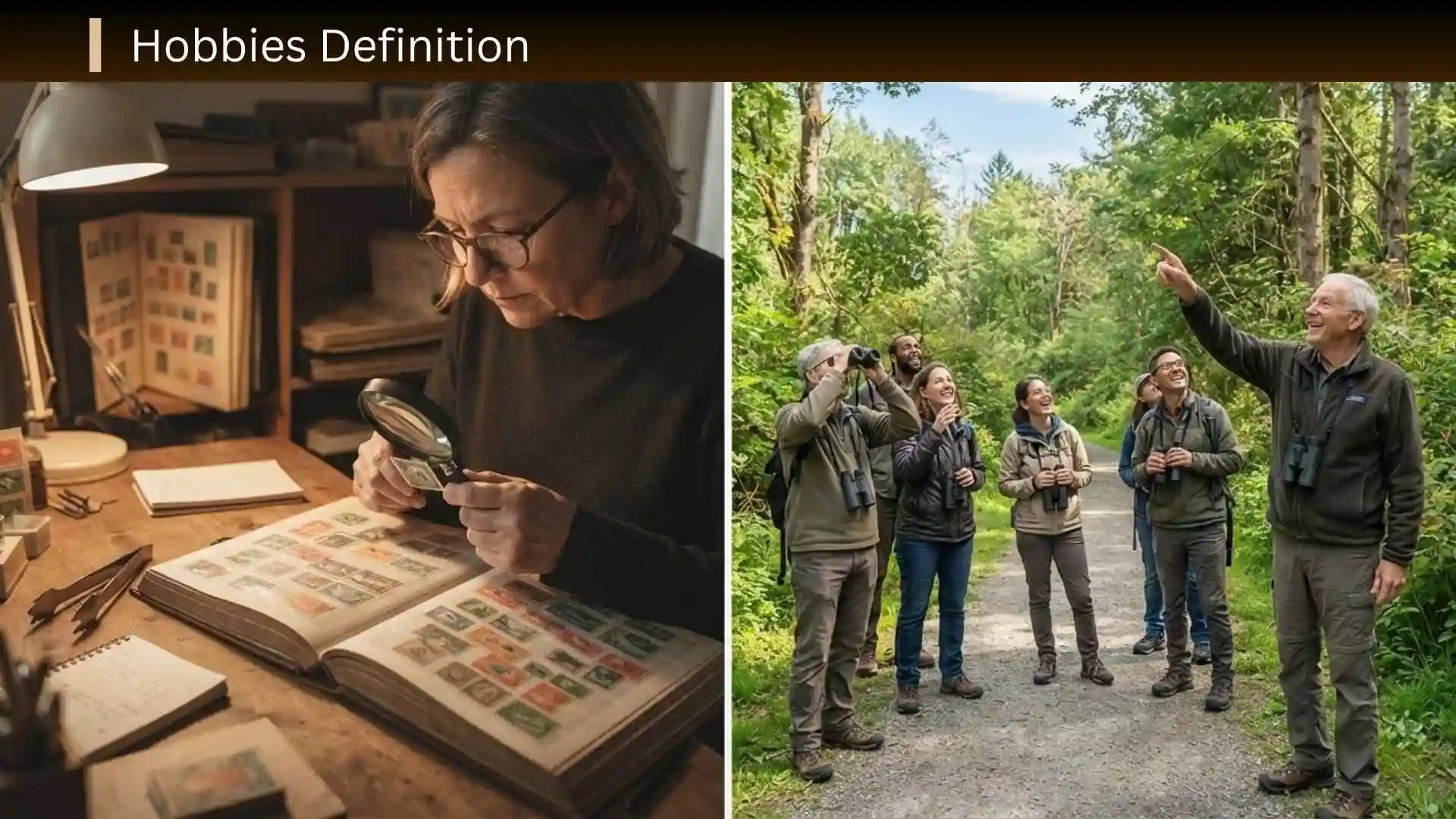
If you’ve ever wondered what hobbies really mean and why people enjoy them so much, you’re not alone. I believe a hobby is more than just something you do in your free time—it can reflect your interests, personality, creativity, and the things that make you feel happy. You may enjoy reading, painting, gardening, cooking, sports, collecting, or learning a new skill, and all of these can become meaningful hobbies. In this guide, you’ll discover the simple hobbies definition, what makes an activity a hobby, and how hobbies can add enjoyment and purpose to your everyday life.
What Is the Definition of a Hobby(Quick Answer)
A hobby is an activity that a person regularly or occasionally does for enjoyment during their free time, usually outside work or other required responsibilities. Cambridge Dictionary similarly defines a hobby as an activity done for pleasure when a person is not working.
For example:
- Someone who reads novels for fun has reading as a hobby.
- Someone who grows vegetables in their backyard may have gardening as a hobby.
- Someone who takes photographs in their spare time may consider photography a hobby.
- Someone who paints simply because they enjoy creating art has painting as a hobby.
- Someone who collects coins, stamps, or sports memorabilia may have collecting as a hobby.
A hobby can be done alone or with other people, at home or outdoors, with simple materials or specialized equipment.
What Does “Hobbies” Mean?
Hobbies is the plural form of hobby. It refers to two or more activities that a person enjoys during their free time.
For example, if someone enjoys reading, hiking, and baking, they might say:
“My hobbies are reading, hiking, and baking.”
The term can also refer generally to leisure activities enjoyed by a group of people.
The important distinction is that a hobby is generally pursued for personal enjoyment rather than because someone is required to do it for work, school, or another obligation.
What Makes Something a Hobby?
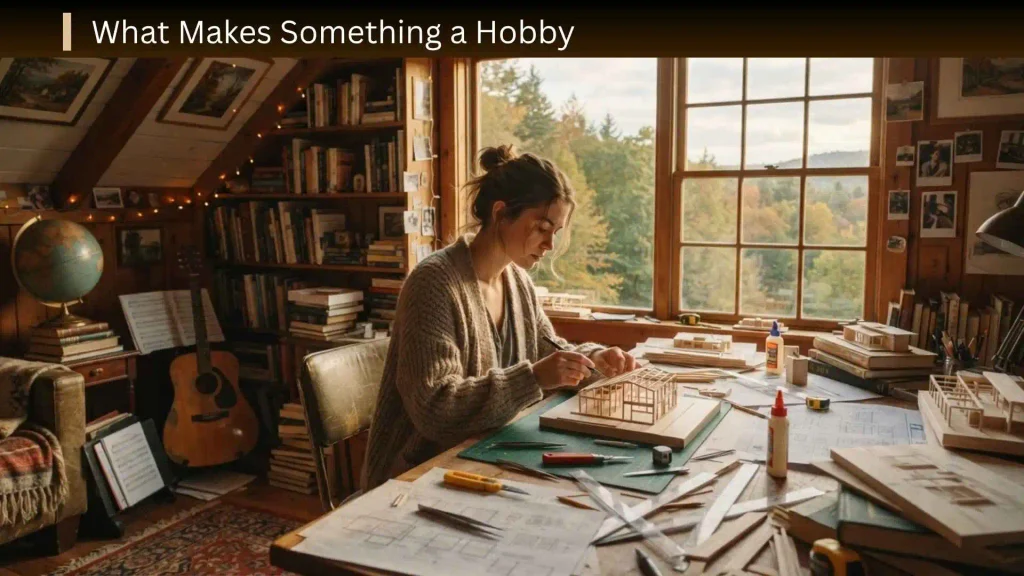
Not every activity someone does in their free time is necessarily a hobby. Several characteristics commonly distinguish hobbies from ordinary tasks or responsibilities.
1. Personal Enjoyment
A hobby usually provides some form of enjoyment, satisfaction, curiosity, relaxation, or personal interest.
For example, one person may find knitting relaxing while another person finds it boring. The activity itself does not have to be universally entertaining. What matters is that the individual enjoys it.
2. Voluntary Participation
Hobbies are generally chosen freely.
If someone gardens because they genuinely enjoy growing plants, gardening can be a hobby. If someone is required to maintain a garden as part of their job, the same activity is primarily work.
3. Free Time Activity
Hobbies are commonly associated with leisure time. They are activities people pursue outside their primary responsibilities.
That does not mean a hobby must happen every day. Someone might go hiking every weekend, paint once a month, or work on a model whenever they have time.
4. Personal Interest
A hobby usually involves an interest that encourages someone to continue learning, practicing, creating, exploring, or participating.
For example, a person interested in astronomy might begin by looking at the night sky and eventually learn about planets, constellations, telescopes, and astrophotography.
5. No Requirement to Earn Money
A hobby is normally pursued for enjoyment rather than financial compensation.
However, a hobby can sometimes develop into a business or career. For example, someone may begin photography as a hobby and later become a professional photographer. Once the activity becomes primarily paid work, its role may change from hobby to occupation, although the person can still enjoy photography recreationally.
Examples of Hobbies
There are thousands of possible hobbies because almost any enjoyable activity can become a hobby when someone chooses to pursue it during their free time.
Creative Hobbies
Creative hobbies allow people to make, design, or express something.
Examples include:
- Drawing
- Painting
- Sketching
- Writing
- Creative writing
- Calligraphy
- Photography
- Pottery
- Sculpting
- Knitting
- Crocheting
- Sewing
- Woodworking
- Jewelry making
- Scrapbooking
- Crafting
- Origami
Creative hobbies can be highly structured or completely informal. A beginner can sketch with a pencil and notebook without purchasing specialized equipment.
Outdoor Hobbies
Outdoor hobbies involve spending time outside and can range from relaxing activities to physically demanding pursuits.
Examples include:
- Hiking
- Camping
- Gardening
- Fishing
- Birdwatching
- Cycling
- Kayaking
- Nature photography
- Geocaching
- Stargazing
- Walking
- Outdoor cooking
Outdoor hobbies can also encourage people to explore parks, trails, gardens, natural areas, and other places they might not otherwise visit.
Indoor Hobbies
Indoor hobbies can be especially convenient for people who prefer activities they can do at home.
Examples include:
- Reading
- Baking
- Cooking
- Puzzles
- Board games
- Video games
- Model building
- Collecting
- Learning a language
- Playing music
- Journaling
- Drawing
- Watching or studying films
- DIY projects
Many indoor hobbies require little space or equipment, making them accessible to beginners.
Physical Hobbies
Physical hobbies involve movement, exercise, coordination, or physical skill.
Examples include:
- Running
- Swimming
- Cycling
- Dancing
- Yoga
- Hiking
- Tennis
- Basketball
- Golf
- Martial arts
- Rock climbing
- Skating
A physical hobby does not necessarily have to be competitive. Someone can swim, walk, dance, or cycle simply because they enjoy the activity.
Intellectual Hobbies
Some hobbies focus primarily on learning, thinking, investigation, or developing knowledge.
Examples include:
- Reading history
- Learning languages
- Chess
- Astronomy
- Genealogy
- Writing
- Studying philosophy
- Solving puzzles
- Learning mathematics
- Researching local history
- Learning about science
- Programming as a personal project
These hobbies can be pursued at many different skill levels.
Social Hobbies
Some people prefer hobbies that involve other people.
Examples include:
- Joining a book club
- Playing team sports
- Board-game groups
- Community theater
- Dancing
- Volunteering
- Choir
- Photography clubs
- Gardening groups
- Craft groups
- Hiking groups
Social hobbies can combine personal interests with opportunities to interact with people who share similar interests.
Hobbies vs. Interests: What Is the Difference?
The words hobby and interest are related, but they are not exactly the same.
An interest is something a person is curious about, likes, or wants to learn more about. A hobby generally involves actively doing something related to that interest.
For example:
| Interest | Possible Hobby |
| History | Researching local history |
| Animals | Birdwatching |
| Cars | Restoring or photographing cars |
| Books | Reading |
| Plants | Gardening |
| Art | Painting |
| Music | Playing an instrument |
| Space | Stargazing |
| Cooking | Baking or preparing new recipes |
| Sports | Playing or following a sport |
Someone can be interested in astronomy without having astronomy as a hobby. If they regularly spend their free time observing stars or learning about space, however, astronomy may become a hobby.
Hobbies vs. Pastimes
A pastime is generally something a person does to occupy or enjoy free time. A hobby is a type of leisure activity, but the word hobby often suggests a more sustained personal interest.
For example, casually watching television may be a pastime. Collecting vintage movie posters, researching films, and attending film events could be described as a hobby.
The distinction is not always strict. In everyday English, the terms can overlap.
Hobbies vs. Careers
A hobby and a career can involve the same activity but have very different purposes.
Consider photography:
- Taking photographs for fun → hobby
- Taking photographs for clients as a primary source of income → career
- Taking photographs professionally occasionally while maintaining another career → potentially both a hobby and a side business
The difference often comes down to purpose, responsibility, and compensation.
A person can also turn a hobby into a career, but doing so may change the experience. An activity that once provided relaxation can become subject to deadlines, customers, financial pressure, and professional expectations.
Can a Hobby Be Productive?
Yes. A hobby does not have to produce a measurable result to be valuable, but many hobbies naturally develop useful skills.
For example:
- Writing can strengthen communication skills.
- Cooking can develop practical kitchen skills.
- Gardening can teach plant care and planning.
- Photography can develop visual composition skills.
- Woodworking can develop craftsmanship and problem-solving.
- Playing an instrument can develop musical skills.
- Programming can provide opportunities to practice technical problem-solving.
- Gardening and DIY projects can involve planning, patience, and hands-on learning.
However, a hobby does not need to be productive to be worthwhile. Enjoyment itself is a legitimate reason to pursue a hobby.
Why Do People Have Hobbies?
People choose hobbies for many different reasons. There is no single purpose that applies to everyone.
Relaxation
Some hobbies provide a way to step away from work and everyday responsibilities.
Reading, gardening, drawing, knitting, fishing, puzzles, and similar activities may offer a quieter change of pace for people who enjoy them.
Learning
A hobby can provide an informal way to learn something new.
Someone interested in cooking might learn about ingredients, techniques, cuisines, and food preparation. Someone interested in astronomy might learn about planets, stars, telescopes, and observation.
Creativity
Creative hobbies give people opportunities to make something rather than simply consume information.
Painting, writing, crafting, photography, music, and woodworking are examples of activities that can involve creative expression.
Social Connection
Hobbies can bring people together around a shared interest.
Clubs, recreational sports, classes, community groups, and online communities can help hobbyists find other people who enjoy similar activities.
Personal Challenge
Some hobbies are appealing because they provide a sense of progression.
A beginner guitarist may want to learn increasingly difficult songs. A chess player may study strategies and improve their game. A runner may gradually increase distance or improve technique.
The challenge can become part of the enjoyment.
Do Hobbies Have to Be Expensive?
No. A hobby does not need to cost a lot of money.
Many hobbies can begin with items a person already owns.
For example:
- Reading can start with books from a library.
- Walking requires little equipment.
- Writing can begin with paper or a basic digital device.
- Drawing can begin with a pencil.
- Birdwatching can begin without expensive equipment.
- Gardening can start with a small container and a few plants.
- Photography can begin with a smartphone.
- Puzzles and games can sometimes be borrowed or shared.
Some hobbies, such as cycling, woodworking, photography, golf, or collecting, can become expensive depending on equipment and the level of participation. But high spending is not part of the definition of a hobby.
Do Hobbies Have to Be Skill Based?

No.
A person does not need to be particularly skilled at an activity for it to qualify as a hobby.
Someone can enjoy painting without being an accomplished artist. Someone can play guitar without performing publicly. Someone can garden without having expert knowledge of plants.
A hobby is about voluntary participation and personal enjoyment, not professional-level performance.
Do Hobbies Have to Be Done Regularly?
Not necessarily.
Regular participation is common, but there is no universal schedule required for something to be considered a hobby.
Someone might:
- Read every night.
- Garden every weekend.
- Go camping several times a year.
- Paint when inspiration strikes.
- Collect items whenever they find something interesting.
- Practice an instrument a few times each month.
The frequency can depend on the activity, available time, personal priorities, and the individual’s level of interest.
Can One Person Have Multiple Hobbies?
Absolutely.
Many people have several hobbies that serve different purposes.
For example, someone might enjoy:
- Reading for quiet leisure
- Hiking for outdoor recreation
- Cooking for creativity
- Photography for artistic expression
- Board games for social interaction
Having multiple hobbies can allow a person to choose an activity based on their mood, schedule, environment, or interests.
How to Choose a Hobby
If you do not currently have a hobby, you do not need to find the “perfect” one. It is usually more useful to experiment with activities that match your interests and circumstances.
Start With Your Interests
Think about subjects you naturally enjoy.
Ask yourself:
- What do I like learning about?
- What activities make me curious?
- Do I prefer making things or studying things?
- Do I enjoy being outdoors?
- Do I prefer quiet activities or social activities?
- Do I like physical challenges?
- Do I enjoy working with my hands?
Your answers can point toward suitable hobbies.
Consider Your Available Time
A hobby should fit realistically into your schedule.
If you only have a few minutes each day, reading, journaling, sketching, language practice, or puzzles may be convenient.
If you have larger blocks of free time, hiking, woodworking, gardening, sports, photography, or other activities may be easier to pursue.
Consider Your Budget
Start with a hobby at the simplest level before investing heavily.
For example, someone interested in photography can start with a smartphone before deciding whether purchasing a dedicated camera makes sense.
Try Before You Commit
You do not have to decide immediately that an activity is your permanent hobby.
Try something several times and ask:
- Did I enjoy it?
- Did I look forward to doing it?
- Was the cost reasonable?
- Does it fit my schedule?
- Do I want to improve?
- Would I willingly do it again?
If the answer is mostly yes, you may have found a hobby that suits you.
What Are Some Good Hobbies for Beginners?
The best beginner hobby depends on personal preferences, but several activities have relatively accessible starting points.
| Hobby | Good for people who enjoy | Typical starting point |
| Reading | Stories and learning | Library book or e-book |
| Walking | Simple outdoor activity | Comfortable shoes |
| Drawing | Visual creativity | Pencil and paper |
| Cooking | Food and experimentation | Basic kitchen tools |
| Gardening | Plants and nature | Small containers and plants |
| Photography | Visual storytelling | Smartphone camera |
| Journaling | Writing and reflection | Notebook |
| Puzzles | Problem-solving | Basic puzzle |
| Baking | Food and creativity | Basic ingredients |
| Birdwatching | Nature and observation | Outdoor observation; binoculars optional |
| Hiking | Nature and exploration | Suitable trail and basic gear |
| Learning an instrument | Music | Beginner instrument and learning resources |
There is no universal “best hobby.” The right choice is the one that fits your interests, resources, time, and preferences.
What Is a Hobbyist?
A hobbyist is a person who does something as a hobby. Cambridge Dictionary uses the term for someone who participates in an activity as a hobby.
For example:
- A person who builds model trains for fun can be a model-building hobbyist.
- Someone who photographs wildlife in their free time can be a photography hobbyist.
- A person who writes computer programs for personal projects can be a programming hobbyist.
The term does not necessarily mean the person is an expert. A hobbyist can be a beginner, intermediate participant, or highly experienced enthusiast.
What Is the Difference Between a Hobby and an Obsession?
A hobby is generally a voluntary leisure activity that a person enjoys. An obsession implies an unusually intense or persistent preoccupation.
Simply spending a lot of time on a hobby does not automatically make it an obsession. The important difference is how the activity affects the person’s life and whether participation remains balanced and voluntary.
For most people, a healthy hobby is simply an enjoyable part of their free time.
Can a Hobby Become a Business?
Yes.
A hobby can sometimes develop into a small business or professional activity. Examples include:
- Selling handmade crafts
- Selling photographs
- Publishing books
- Teaching music
- Selling baked goods where legally permitted
- Selling artwork
- Restoring and selling furniture
- Creating digital products
- Offering photography services
However, turning a hobby into a business introduces additional responsibilities such as pricing, customers, expenses, taxes, marketing, regulations, and record keeping. The activity may still be enjoyable, but it is no longer purely recreational.
Can a Hobby Be Both Fun and Educational?
Yes. Many hobbies naturally combine entertainment with learning.
For example, someone who enjoys cooking may learn about chemistry, nutrition, cultures, ingredients, and techniques. Someone who enjoys astronomy can learn about the universe while observing the night sky. Someone who enjoys woodworking can learn about materials, measurements, tools, and design.
This is one reason hobbies can be valuable beyond simple entertainment: they can create a self-directed environment for exploration and skill development.
Frequently Asked Questions About Hobbies
What is the simple definition of a hobby?
A hobby is an activity a person chooses to do for enjoyment during free time, usually outside work or other required responsibilities.
What is an example of a hobby?
Reading, gardening, cooking, painting, photography, hiking, collecting, playing music, and woodworking are examples of hobbies.
What are hobbies and interests?
Hobbies are activities people actively pursue for enjoyment, while interests are subjects or activities that attract their attention or curiosity. An interest can develop into a hobby when someone regularly participates in an activity related to it.
Is watching TV a hobby?
It can be considered a leisure activity or pastime, but whether someone describes it as a hobby depends on how they use the term. A hobby usually suggests a personal interest or activity that someone intentionally pursues.
Is sleeping a hobby?
Sleeping is generally considered a biological necessity rather than a hobby. Although someone may jokingly say that sleeping is their hobby, it does not normally fit the standard meaning of the word.
Is exercising a hobby?
Yes. Exercise can be a hobby when someone voluntarily participates in activities such as running, cycling, swimming, hiking, dancing, or strength training for enjoyment during free time.
Can work be a hobby?
An activity can be both work and a hobby depending on the context. For example, photography may be someone’s profession while also being something they pursue recreationally. However, work performed primarily as an obligation or source of income is generally not described as a hobby.
Can a hobby make money?
Yes. Some hobbies can eventually generate income, but making money is not required for an activity to qualify as a hobby.
How many hobbies should a person have?
There is no correct number. Some people enjoy one main hobby, while others have several. The ideal number is whatever fits comfortably into a person’s life.
What makes a hobby a hobby?
The central features are voluntary participation, personal interest, leisure time, and enjoyment. A hobby does not have to be expensive, difficult, productive, or highly skilled.
Conclusion
The simplest hobbies definition is: a hobby is an activity a person chooses to enjoy during their free time. It can be creative, physical, intellectual, social, practical, or simply entertaining.
Reading a book, growing flowers, taking photographs, playing chess, hiking a trail, collecting objects, baking, writing, or learning an instrument can all be hobbies. There is no requirement that a hobby be expensive, profitable, highly skilled, or done every day.
Ultimately, the value of a hobby comes from the personal interest and enjoyment it provides. A good hobby gives people something meaningful or enjoyable to do outside their everyday responsibilities and can, depending on the activity, also provide opportunities for creativity, learning, social connection, and personal growth.

I’m James Anderson, a dedicated writer and lifelong learner who enjoys researching topics and explaining them in a practical way. Through my work at Cognivoora, I aim to give readers reliable, easy-to-follow information that helps them learn something new. I always try to keep my writing natural, useful, and focused on the questions readers actually have.
Books:
- A Practical Guide to Better Thinking
- Questions Worth Asking