Finding a hobby doesn’t have to mean spending a lot of money. I know how easy it is to think that a fun hobby requires expensive gear, memberships, or a lot of free time—but that simply isn’t true. There are plenty of cheap hobbies for men that can keep you entertained, help you learn something new, and give you a break from the same daily routine.
Whether you want to stay productive at home, get outdoors, become more creative, or simply find something enjoyable to do after work, you have more options than you might expect. You can start many of these hobbies with things you already own or with a small budget.
In this guide, I’ll share practical and affordable hobby ideas so you can find something that fits your interests, budget, time, and lifestyle,without feeling like you need to spend a fortune just to have fun.
Cheap Hobbies for Men(Quick Answer)

Some of the best inexpensive hobbies include walking and hiking, reading, drawing, writing, cooking, gardening, bodyweight fitness, photography with a phone, fishing, birdwatching, chess, geocaching, woodworking with reclaimed materials, learning an instrument, coding, home brewing of non-alcoholic drinks, journaling, model building, stargazing, cycling, camping, puzzles, volunteering, and learning practical DIY skills.
For the lowest possible starting cost, begin with a hobby that uses something you already own. A smartphone can become a photography or birdwatching tool; a library card can support reading; household ingredients can introduce you to cooking; and a notebook can become the foundation for writing or journaling.
Cheap Hobbies for Men at a Glance
| Hobby | Typical Starting Cost | Difficulty | Time Commitment | Best Setting |
| Walking & Hiking | Free–Low | Easy | Low–High | Outdoor |
| Reading | Free–Low | Easy | Low–High | Indoor |
| Drawing | Free–Low | Easy | Low–High | Indoor |
| Writing | Free–Low | Easy | Low–High | Indoor |
| Cooking | Low | Easy–Moderate | Moderate | Indoor |
| Gardening | Low | Easy–Moderate | Moderate | Outdoor/Indoor |
| Bodyweight Fitness | Free | Easy–Moderate | Low–Moderate | Both |
| Phone Photography | Free–Low | Easy–Moderate | Low–High | Both |
| Birdwatching | Free–Low | Easy–Moderate | Low–High | Outdoor |
| Chess | Free–Low | Moderate | Low–High | Both |
| Geocaching | Free–Low | Easy | Low–Moderate | Outdoor |
| Fishing | Low–Moderate | Easy–Moderate | Moderate | Outdoor |
| Stargazing | Free–Low | Easy | Low–Moderate | Outdoor |
| Coding | Free | Moderate | Moderate–High | Indoor |
| Journaling | Free–Low | Easy | Low | Indoor |
| Cooking New Cuisines | Low | Moderate | Moderate | Indoor |
| DIY Projects | Low | Moderate | Moderate | Indoor |
| Cycling | Low–Moderate | Easy–Moderate | Moderate–High | Outdoor |
| Puzzles | Free–Low | Easy–Moderate | Low–Moderate | Indoor |
| Volunteering | Free | Easy | Flexible | Both |
| Learning an Instrument | Free–Low | Moderate | Moderate | Indoor |
| Model Building | Low | Moderate | Moderate | Indoor |
| Camping | Low–Moderate | Moderate | Occasional | Outdoor |
| Sketching Outdoors | Free–Low | Easy | Low–Moderate | Outdoor |
| Practical Skill Learning | Free–Low | Varies | Flexible | Both |
Costs vary considerably depending on what you already own, whether you buy new or used equipment, and how far you take the hobby.
1. Walking and Hiking
Walking is one of the easiest hobbies to make completely free. Hiking adds exploration and a stronger sense of adventure without requiring an expensive setup.
You can start by exploring local parks, public trails, nature preserves, or interesting neighborhoods. A comfortable pair of shoes, a water bottle, and weather-appropriate clothing may be all you need for shorter outings.
Why it stands out: It gives you a reason to get outside without requiring specialized equipment.
Best for: Men who want an active hobby with almost no financial barrier.
Keep it cheap: Use free trail maps and start with nearby routes rather than driving long distances to every trail.
2. Reading
Reading is inexpensive, portable, and surprisingly flexible as a hobby. You can read novels, biographies, history, science, business books, philosophy, sports writing, travel literature, or subjects connected to your other interests.
You do not need to buy every book. Public libraries, used bookstores, book exchanges, and legitimate digital lending services can dramatically reduce the cost.
A useful approach is to choose a subject you genuinely want to understand rather than deciding that you “should” read a particular type of book.
Beginner tip: Pick one book that solves a question you’re already curious about and read for 10–20 minutes a day.
3. Drawing and Sketching
Drawing does not require expensive art supplies. A pencil and inexpensive paper can take you surprisingly far.
Instead of worrying about producing professional-looking artwork, treat drawing as a skill-building activity. Practice objects around your home, faces, buildings, vehicles, plants, landscapes, or simple perspective exercises.
Sketching also works well as a companion hobby for travel, hiking, or coffee-shop visits.
Starting equipment: Pencil, eraser, and ordinary paper.
Difficulty: Easy to begin, but there is virtually unlimited room for improvement.
4. Writing
Writing can be completely free if you already have access to a phone or computer.
You might keep a personal journal, write short stories, maintain a blog, record observations, review books or films, write poetry, or document what you are learning in another hobby.
The inexpensive nature of writing is not its only advantage. It can also turn other interests into a deeper activity. Someone interested in cars, history, cooking, gaming, or travel can use writing to research and document that interest.
A simple starting exercise: Write 300 words about something you noticed today without worrying about whether it is publishable.
5. Cooking
Cooking is technically an expense because you need ingredients, but it can become an inexpensive hobby when you cook food you would otherwise purchase.
Rather than collecting specialized kitchen gadgets, concentrate on learning techniques: knife skills, roasting, sautéing, sauces, seasoning, dough preparation, and basic meal planning.
A useful challenge is to choose one inexpensive ingredient and learn several ways to prepare it.
Why it stands out: The hobby produces something practical rather than simply occupying your free time.
Keep it cheap: Use ordinary supermarket ingredients and build skills before buying specialty equipment.
6. Gardening
Gardening can be inexpensive if you start small. You do not need a large backyard; containers, pots, windowsills, balconies, and small garden beds can all work depending on what you want to grow.
Herbs and certain vegetables can be approachable starting points, while flowers and native plants offer a more ornamental direction.
The hobby combines planning with hands-on work. You also get to observe changes over time rather than expecting an immediate result.
Starting cost: Low if you reuse containers and begin with a few plants or seeds.
Best for: People who enjoy practical projects and spending time outdoors.
7. Bodyweight Fitness
You do not need a gym membership to make physical training a hobby.
Bodyweight exercises can include movements such as squats, lunges, push-ups, planks, and other exercises appropriate to your current ability. Walking, mobility work, and simple conditioning can also become part of the routine.
The main challenge is not buying equipment but developing consistency and learning appropriate technique.
Cost: Potentially free.
Space: A small clear area can be enough for many basic movements.
Beginner tip: Start with manageable exercises and focus on controlled technique rather than trying to imitate advanced workouts.
8. Photography With Your Phone
A modern smartphone can provide a perfectly adequate introduction to photography.
Instead of immediately buying a camera, learn composition, perspective, framing, light, shadows, and timing. Try photographing architecture, landscapes, food, pets, plants, street scenes where appropriate, or everyday objects.
You can make the hobby more interesting by choosing a theme each week, such as reflections, geometric shapes, interesting doors, shadows, or local wildlife.
Why it is cheap: Your primary camera may already be in your pocket.
Next step: Learn basic photo editing using free tools before considering dedicated camera equipment.
9. Birdwatching
Birdwatching is a good example of a hobby that can begin almost entirely for free.
Start by observing birds in your yard, neighborhood, park, or other suitable public spaces. A smartphone can help you photograph birds or research species. Binoculars are useful but not essential for getting started.
The hobby rewards patience and observation. You gradually become better at recognizing species by appearance, behavior, habitat, and calls.
Best for: Nature lovers who enjoy quiet outdoor activities.
Keep it cheap: Learn to identify common local birds before purchasing specialized equipment.
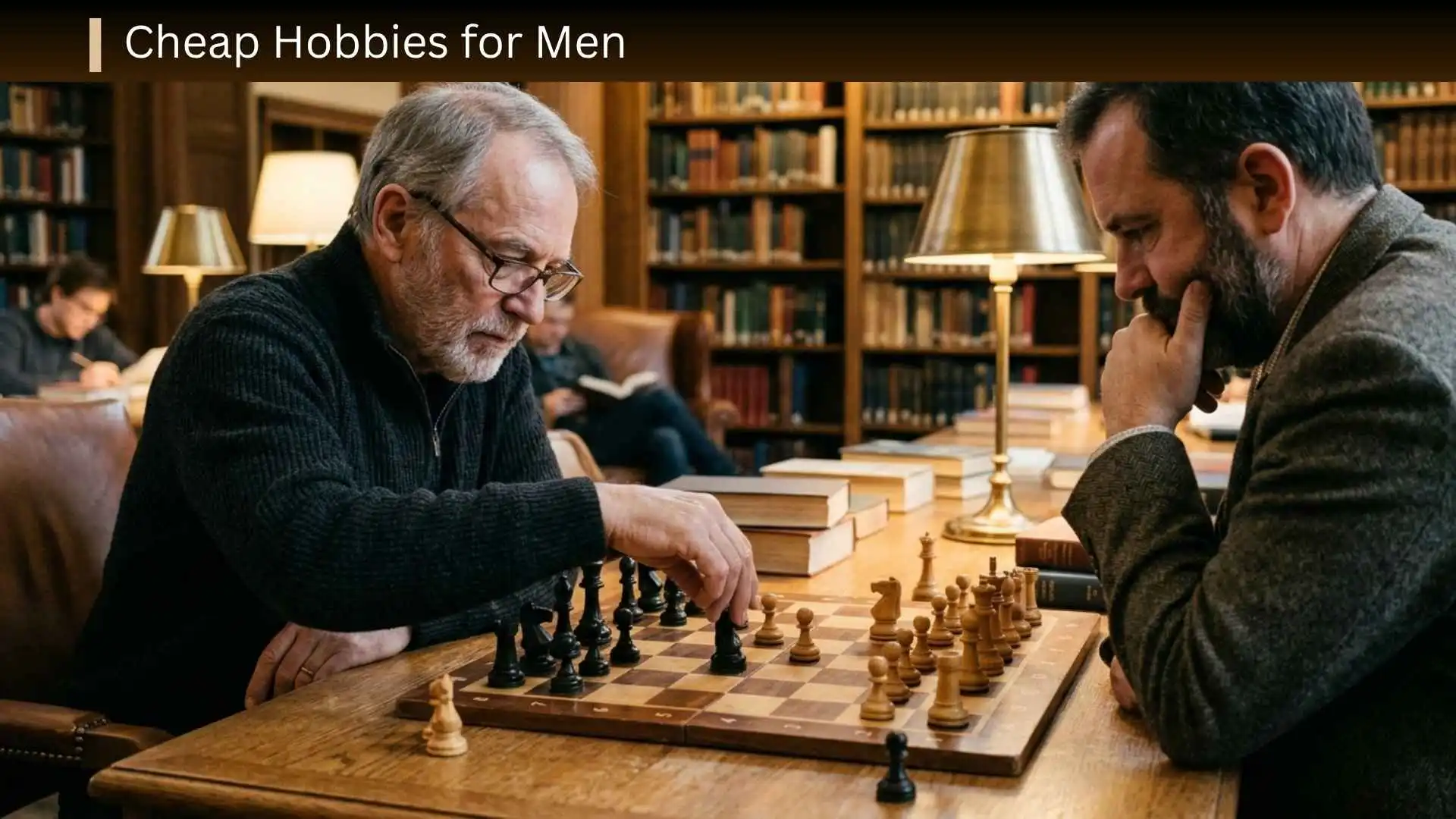
10. Chess
Chess offers an enormous amount of depth without requiring expensive equipment.
You can learn the rules quickly, then spend years exploring openings, tactics, endgames, strategy, and analysis. Free online resources and apps make it easy to practice without purchasing a physical set.
Playing against other people adds a social dimension, while solving puzzles gives you something to work on alone.
Cost: Free to low.
Difficulty: Easy to start; challenging to master.
Beginner tip: Learn basic tactics and principles before attempting to memorize large numbers of opening variations.
11. Geocaching
Geocaching combines walking, navigation, exploration, and problem-solving. Participants use GPS-enabled devices to locate hidden containers or “caches” placed in suitable locations.
The appeal is that an ordinary walk can become a small treasure hunt. Different caches can introduce puzzles, unusual locations, or varying levels of difficulty.
Because availability and rules vary by location, check the relevant geocaching platform and respect property restrictions and local regulations.
Best for: People who get bored with ordinary walks and want an objective to pursue.
12. Fishing
Fishing can be affordable, although it generally has a higher entry cost than reading or walking.
A basic rod and reel, appropriate tackle, bait or lures, and any required local license are the main considerations. Costs can rise quickly if you begin collecting specialized gear, so beginners are usually better served by keeping the setup simple.
Fishing also requires attention to local regulations, seasons, size limits, access rules, and licensing requirements.
Why it stands out: It combines outdoor recreation with patience, observation, and practical knowledge.
Keep it cheap: Borrow or buy a basic setup before deciding whether you want to invest in specialized equipment.
13. Stargazing
Stargazing can be almost completely free. You can begin simply by spending time outside on a clear night and learning to recognize prominent stars and constellations.
A phone app can help identify objects in the sky. You do not need a telescope immediately; learning the night sky with your unaided eyes can make later equipment much more useful.
For the best experience, darker locations away from strong artificial lighting are generally preferable.
Starting cost: Free–Low.
Best for: Curious people who enjoy science, nature, and quiet evenings.
14. Coding and Programming
Coding is one of the strongest free hobbies for someone who enjoys solving problems.
Free learning resources and development tools allow beginners to experiment with languages such as Python, JavaScript, HTML, and CSS without purchasing specialized hardware.
The trick is to build something rather than endlessly watching tutorials. A simple calculator, personal webpage, text-based game, automation script, or small data project can turn abstract lessons into an actual hobby.
Difficulty: Moderate.
Time commitment: Moderate to high if you want to develop serious proficiency.
Beginner tip: Choose a tiny project that can be completed in a week rather than starting with an enormous application.
15. Journaling
Journaling requires little more than paper and a pen—or a digital document.
It can take many forms. You might record daily events, ideas, goals, interesting observations, books you have read, projects you are working on, or questions you want to investigate.
It does not need to become a formal diary. A simple “what I learned today” journal can turn ordinary experiences into material worth revisiting.
Cost: Free–Low.
Time requirement: As little as a few minutes at a time.
16. Learning an Instrument
Music can become an expensive hobby, but learning does not have to start that way.
You might already own an instrument, borrow one, buy a used beginner instrument, or begin with a compact and relatively inexpensive option. Free instructional resources can supplement structured lessons.
The important distinction is between starting to learn an instrument and building a large collection of music equipment. The first can be inexpensive; the second can become costly quickly.
Best for: People who enjoy repetition, gradual skill development, and creative expression.
Beginner tip: Practice one or two fundamentals consistently instead of jumping between dozens of tutorials.
17. DIY and Home Repair Skills
Learning practical DIY skills can turn ordinary household problems into learning opportunities.
Depending on your living situation and abilities, you might learn basic painting, furniture repair, simple maintenance, measuring, fastening, organization, or other low-risk household tasks.
Start with projects appropriate to your experience. Electrical, structural, gas, roofing, and other potentially hazardous work may require professional knowledge or licensed professionals rather than casual experimentation.
Why it stands out: You are developing skills that can have practical value beyond the hobby itself.
18. Cycling
Cycling can be cheap if you already have access to a bicycle or purchase a reliable used one.
You can ride around your neighborhood, explore bike paths, commute, or gradually increase the distance of recreational rides. There is no need to start with an expensive performance bicycle.
A properly fitted helmet and attention to traffic laws and riding conditions are important parts of responsible cycling.
Keep it cheap: Maintain a simple bicycle instead of immediately buying specialized equipment for every type of ride.
19. Puzzles
Jigsaw puzzles, crosswords, logic puzzles, Sudoku, and mechanical puzzles provide different kinds of mental challenges.
Many digital puzzles are free, while physical puzzles can often be found secondhand or exchanged with other people.
Puzzles are particularly convenient when you want a hobby that can be picked up for 10 minutes or continued for several hours.
Best for: People who prefer structured challenges over open-ended creative activities.
20. Volunteering
Volunteering is an unusual hobby because its primary cost is time rather than money.
Local organizations may need help with community events, environmental projects, animal care, food distribution, mentoring, libraries, or other activities. Opportunities vary by location and by the organization’s requirements.
It can also introduce you to people with similar interests while giving you a concrete way to contribute to your community.
Cost: Usually free.
Time commitment: Flexible, depending on the organization.
21. Model Building
Model building can include plastic models, scale vehicles, paper models, miniature structures, or other kits.
It is inexpensive to begin at a basic level, although paints, specialized tools, and increasingly elaborate kits can raise the cost.
If your main goal is affordability, look for used kits, simpler models, and supplies that serve multiple projects.
Best for: People who enjoy careful hands-on work and visible progress.
22. Camping
Camping can be surprisingly inexpensive if you borrow equipment or start with gear you already own. It can also become expensive if you immediately buy premium tents, cooking systems, sleeping equipment, and accessories.
For a beginner, a simple overnight trip close to home can provide a better introduction than planning a complicated expedition.
Check campground rules, weather conditions, fire regulations, and local restrictions before heading out.
Keep it cheap: Borrow gear first and learn what you actually need before building a large camping kit.
23. Outdoor Sketching
Outdoor sketching combines two inexpensive hobbies: drawing and exploring.
Take a basic sketchbook and pencil to a park, trail, public garden, or other appropriate location. Instead of trying to produce polished artwork, focus on capturing shapes, proportions, textures, and light.
This can also improve observation because you start noticing details that are easy to overlook when simply walking through a place.
24. Learning Practical Skills
“Learning” itself can become a hobby when you approach it intentionally.
You might study basic astronomy, personal finance concepts, history, geography, electronics theory, language fundamentals, map reading, cooking techniques, public speaking, or another subject that interests you.
The key is to turn passive consumption into active learning. Take notes, solve problems, build small projects, explain concepts in your own words, or test yourself.
Cost: Often free or very low.
Best for: Curious people who enjoy acquiring knowledge without needing a physical collection of equipment.
25. Exploring Local History
You do not have to travel to famous historical destinations to enjoy history.
Research the history of your town, county, neighborhood, local buildings, transportation routes, parks, or surrounding communities. Libraries, museums, historical societies, public records, newspapers, and local archives can provide starting points.
You can turn the hobby into a personal project by creating a timeline, photographing historical locations, or writing short profiles of places you encounter.
Why it stands out: It changes the way you see familiar surroundings and can be pursued with little or no spending.
Cheap Creative Hobbies for Men
If you want your hobby to produce something rather than simply provide entertainment, focus on:
- Drawing and sketching
- Writing
- Photography
- Cooking
- Gardening
- Model building
- DIY projects
- Playing an instrument
- Journaling
Creative hobbies tend to have an important advantage for budget-conscious beginners: you can start with basic materials and add equipment only when you discover what you actually enjoy.
For example, there is little reason to buy a professional camera before learning whether you enjoy photography. Likewise, you can learn basic drawing with a pencil before purchasing specialized art supplies.
Cheap Outdoor Hobbies for Men
For men who would rather spend their free time outside, consider:
- Walking
- Hiking
- Birdwatching
- Geocaching
- Fishing
- Stargazing
- Cycling
- Gardening
- Outdoor sketching
- Local history exploration
- Camping
The cheapest choices are generally those that use public spaces and equipment you already have.
A useful strategy is to choose an activity plus a purpose. Instead of merely walking, try identifying birds along the route. Instead of simply visiting a park, photograph interesting architecture or sketch the landscape. Giving an outing a goal can make an inexpensive activity feel more like a genuine hobby.
Cheap Hobbies You Can Do at Home

If you prefer staying home, good options include:
- Reading
- Chess
- Writing
- Drawing
- Coding
- Journaling
- Cooking
- Puzzles
- Model building
- Learning an instrument
- DIY projects
- Studying a subject of interest
Home hobbies are particularly useful when weather, transportation, or a busy schedule makes outdoor activities difficult.
Cheap Hobbies for Men Who Get Bored Easily
If you lose interest quickly, avoid choosing a hobby that consists of repeating exactly the same activity every time.
Instead, choose something with multiple levels or directions.
Photography: Explore portraits, architecture, nature, composition, and editing.
Cooking: Work through different cuisines, ingredients, techniques, and recipes.
Coding: Build progressively more complicated projects.
Gardening: Experiment with different plants, containers, propagation methods, or layouts.
Hiking: Explore new routes, learn navigation, photograph wildlife, or combine hiking with nature observation.
Chess: Play games, solve puzzles, study positions, and analyze your own mistakes.
The best hobby for someone who gets bored easily is often one that creates new challenges without requiring a completely new activity.
Cheap Hobbies That Build Useful Skills
Some hobbies are especially attractive because the time spent practicing can produce practical abilities.
| Hobby | Skill You Can Develop |
| Cooking | Food preparation and kitchen techniques |
| Coding | Programming and problem-solving |
| DIY | Basic making and repair skills |
| Gardening | Plant care and planning |
| Photography | Visual composition |
| Writing | Communication and research |
| Cycling | Bike maintenance and riding skills |
| Fishing | Outdoor knowledge and patience |
| Cooking | Meal planning and technique |
| Instrument practice | Musical technique and discipline |
A useful distinction is that a hobby does not need to become a career to be worthwhile. Learning something simply because you enjoy becoming better at it is a valid reason to invest your time.
How to Choose the Right Cheap Hobby
The cheapest hobby is not necessarily the one with the lowest sticker price. A $5 hobby you abandon after two days is less valuable than a $30 hobby you enjoy for months.
Ask yourself these questions:
Do You Want to Be Active or Relaxed?
Choose walking, hiking, cycling, gardening, or other movement-based activities if you want to spend less time sitting.
Choose reading, chess, drawing, puzzles, writing, or coding if you want a quieter activity.
Do You Want to Make Something?
Cooking, woodworking, drawing, writing, gardening, model building, photography, and music all give you something to create or develop.
Do You Want a Social Hobby?
Chess clubs, volunteering, group hikes, cycling groups, community gardening, fishing, and local hobby groups can provide opportunities to meet people.
If social interaction is not your priority, many of these activities can also be practiced independently.
How Much Space Do You Have?
A person living in a small apartment may find reading, coding, drawing, chess, cooking, and photography easier than woodworking or large-scale gardening.
Space should be considered before buying equipment.
How Much Money Are You Willing to Spend Later?
Some hobbies are inexpensive at first but can become costly as you become more interested.
Photography, fishing, cycling, camping, music, model building, and DIY are good examples. Set a spending limit before equipment shopping so that enthusiasm does not automatically turn into a large collection of gear.
How to Keep a Hobby Cheap

Start With What You Already Own
Look around before shopping.
You may already have:
- A smartphone for photography
- A computer for coding or writing
- Kitchen equipment for cooking
- Walking shoes for exploring
- A pencil and paper for drawing
- Books waiting to be read
- A bicycle sitting unused
- Containers suitable for beginner gardening
Starting with existing resources reduces the pressure to spend money before you know whether the hobby suits you.
Buy Used When It Makes Sense
Used equipment can be particularly useful for hobbies such as cycling, fishing, musical instruments, camping, cameras, and model building.
However, inspect condition carefully and avoid buying safety-critical equipment simply because it is cheap.
Borrow Before Buying
Libraries, friends, community groups, hobby clubs, and local organizations may provide access to books, tools, equipment, or expertise.
Borrowing is one of the easiest ways to test a hobby before committing money.
Avoid the “Gear Trap”
A common mistake is assuming that better equipment will make the hobby more enjoyable.
Often, beginners need more practice rather than more gear.
Give yourself a period of consistent use before upgrading. When you eventually buy something, identify the specific limitation your new equipment is solving.
Give Yourself Small Projects
A hobby becomes easier to maintain when there is a clear next step.
Instead of saying, “I’m going to learn photography,” try:
“This week, I’m going to take 20 photos focused on natural light.”
Instead of:
“I’m going to learn coding.”
Try:
“I’m going to build a simple webpage.”
A specific project gives your hobby direction without requiring additional spending.
What Are the Cheapest Hobbies to Start?
If minimizing initial spending is the main priority, start with hobbies that require little or no specialized equipment.
Some of the strongest options are:
- Walking
- Reading through a library
- Writing
- Drawing with basic stationery
- Bodyweight exercise
- Chess through free digital platforms
- Journaling
- Birdwatching without binoculars
- Stargazing
- Coding with free software
- Local history research
- Volunteering
These hobbies also have another advantage: you can test them immediately rather than waiting until you can afford a complete setup.
Cheap Hobbies vs. Expensive Hobbies
A hobby’s cost usually depends on how far you take it.
For example, photography can start with a smartphone and later expand into cameras, lenses, lighting, storage, and editing equipment. Cycling can begin with a used bicycle but eventually involve specialized clothing, tools, components, and travel. Camping can be simple or equipment-heavy.
That does not make these bad choices. It simply means you should separate the cost of starting from the cost of becoming deeply invested.
If maintaining a strict budget matters, choose a hobby where skill development does not depend heavily on purchasing new equipment.
Common Mistakes When Starting a Cheap Hobby
Buying Everything Before Starting
You do not need the complete setup on day one. Start with the minimum practical equipment.
Choosing a Hobby Because It Sounds Impressive
A hobby should fit your personality and interests. Coding may be free, for example, but that does not make it a good choice for someone who dislikes sitting at a computer.
Confusing Consumption With Participation
Watching videos about photography is not the same as taking photographs. Watching cooking videos is not the same as cooking.
Use information to support the hobby, but spend most of your hobby time actually doing it.
Making the Goal Too Large
“Learn guitar” is vague. “Practice three chords for 15 minutes” is actionable.
Small goals make it easier to build a habit without turning leisure into another source of pressure.
Frequently Asked Questions About Cheap Hobbies for Men
What are the best cheap hobbies for men?
Walking, reading, drawing, writing, cooking, gardening, bodyweight fitness, photography with a phone, chess, birdwatching, coding, journaling, stargazing, and local history research are among the strongest low-cost choices. The best option depends on whether you want something active, creative, social, practical, or intellectually challenging.
What hobby can I start with almost no money?
Walking, reading through a public library, writing, drawing with basic stationery, journaling, bodyweight exercise, stargazing, birdwatching, and learning through free educational resources can all be started with little or no additional spending.
What are good cheap hobbies for men at home?
Reading, chess, writing, drawing, coding, cooking, puzzles, journaling, model building, music practice, and learning practical skills can all work well at home.
What are cheap outdoor hobbies for men?
Walking, hiking, birdwatching, geocaching, gardening, stargazing, outdoor sketching, local exploration, and cycling are good options. Fishing and camping can also be affordable when equipment is borrowed or purchased carefully.
What cheap hobbies are good for someone who gets bored easily?
Choose hobbies with built-in variety, such as photography, cooking, coding, gardening, hiking, chess, or learning an instrument. These activities can become progressively more challenging without requiring you to change hobbies constantly.
What cheap hobby can also teach a useful skill?
Cooking, coding, DIY, gardening, photography, writing, cycling maintenance, and learning an instrument can all develop practical or transferable skills while remaining hobbies.
Can a hobby really be cheap long term?
Yes, but it depends on how you approach it. Reading, writing, walking, drawing, coding, chess, journaling, and many forms of outdoor exploration can remain inexpensive for years. Other hobbies may have low starting costs but become expensive when you begin purchasing advanced equipment.
How do I choose a hobby if I don’t know what I like?
Try several hobbies using the cheapest possible entry point. Give each one a few sessions rather than judging it after 10 minutes. Pay attention to whether you look forward to practicing, whether you become curious about improving, and whether you enjoy the activity itself rather than just consuming content about it.
Conclusion
The best cheap hobbies for men are not necessarily the ones that cost the least,they are the ones that give you something worthwhile to do without requiring constant spending.
If you want movement, try walking, hiking, cycling, or gardening. For creativity, consider drawing, photography, writing, cooking, or music. For mental challenges, chess, coding, reading, puzzles, and local history are strong choices. And if you simply want to get outside and explore, birdwatching, geocaching, stargazing, and local discovery can turn ordinary surroundings into a hobby.
Start with what you already have, keep the first project small, and delay expensive upgrades until you know the hobby genuinely holds your interest.

I’m Sophia Carter, a writer who enjoys discovering interesting ideas and transforming them into helpful content. At Cognivoora, I write with a simple goal: to make information clearer, more accessible, and genuinely useful for readers. I value thoughtful research, easy explanations, and content that people can trust and return to whenever they need it.
Books:
- The Knowledge Journey
- Understanding the World Around Us