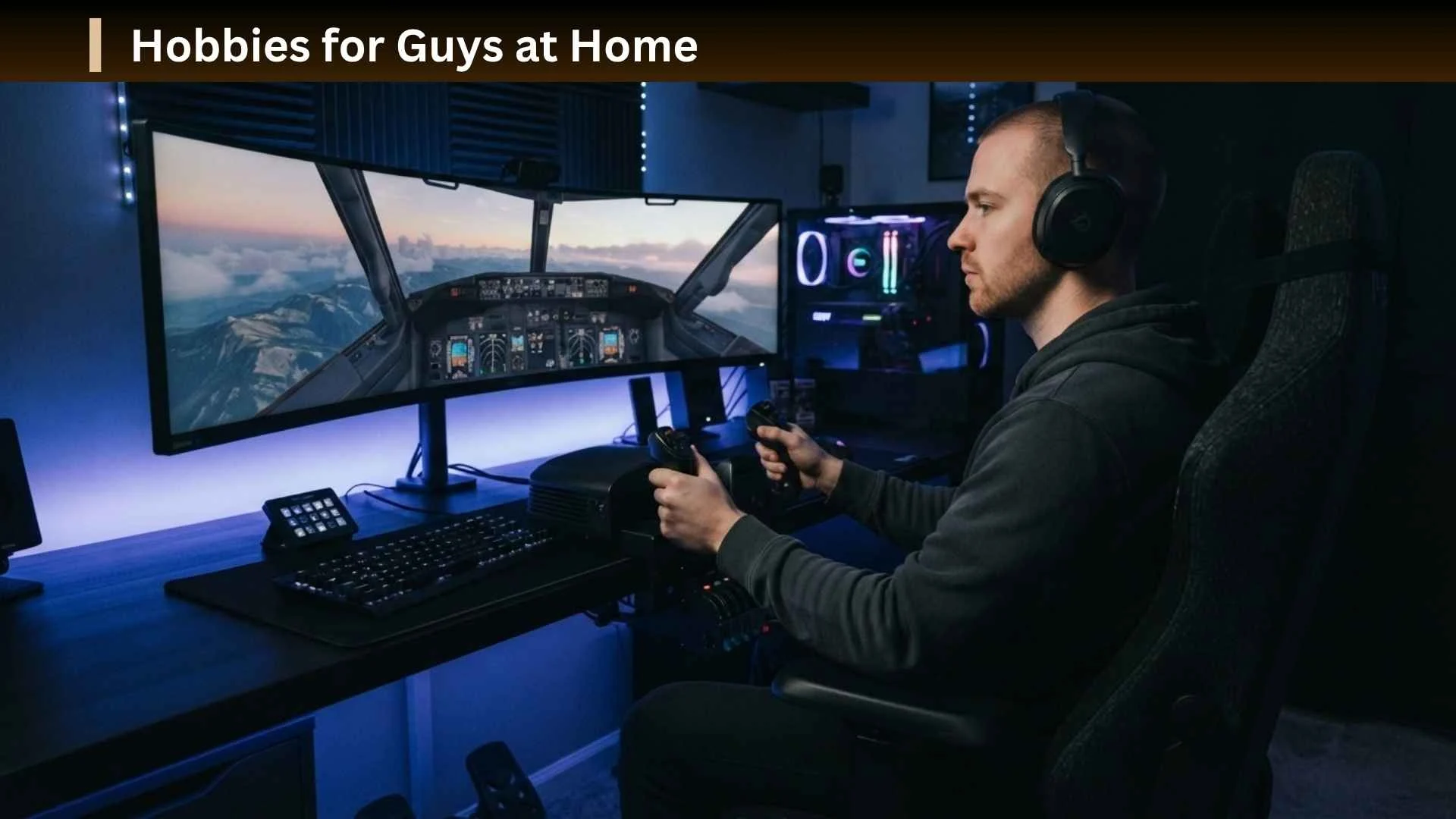
Finding the right hobbies for guys at home can make free time more enjoyable while giving you something meaningful to work on. The best home hobbies do not have to be expensive or complicated. Some require almost no equipment, while others can become creative projects, fitness routines, technical skills, or even long-term interests.
Whether you live in an apartment, work from home, want to save money, or simply prefer staying indoors, there are plenty of hobbies you can start without leaving the house.
What Are the Best Hobbies for Guys at Home (Quick Answer )
Some of the best hobbies for guys at home include:
- Cooking and experimenting with recipes
- Home workouts and strength training
- Reading
- Gaming
- Learning a musical instrument
- Photography and photo editing
- Drawing or digital art
- Building models
- Woodworking
- Gardening
- Coding
- Learning a new language
- Writing
- Chess and strategy games
- Collecting
- Coffee brewing
- Home brewing of non-alcoholic drinks
- DIY and home improvement
- Meditation and mindfulness
- Watching and studying movies
- Astronomy
- 3D printing
- Podcasting
- Puzzles
- Learning practical skills
The right choice depends on whether you want your hobby to be creative, relaxing, active, social, educational, technical, or hands-on.
25 Hobbies for Guys at Home
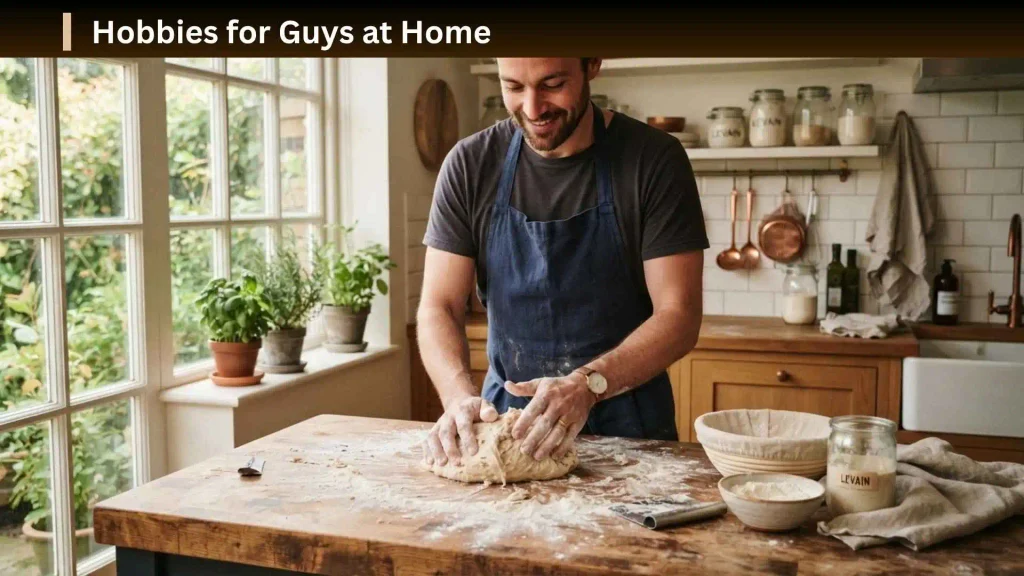
1. Cooking
Cooking is one of the most practical hobbies you can develop at home. Instead of simply following recipes, you can turn it into a skill-building project by learning techniques such as knife handling, seasoning, baking, grilling, sauces, or international cuisines.
You can start with meals you already enjoy and gradually experiment with new ingredients.
Best for: Creative people, food lovers, and beginners
Equipment: Basic kitchen equipment
Cost: Low to moderate
Time commitment: 20 minutes to several hours
2. Home Workouts
You do not need a gym membership to make exercise a hobby. Bodyweight exercises, resistance bands, dumbbells, mobility work, and other forms of home training can provide plenty of variety.
A simple routine can include exercises such as squats, push-ups, lunges, rows, and core exercises.
Best for: Active people and anyone who wants a structured routine
Equipment: Optional; bodyweight exercises require little equipment
Cost: Free to moderate
3. Reading
Reading is a flexible hobby because you can choose almost any subject. Fiction can provide entertainment, while nonfiction can help you explore history, science, business, psychology, biographies, technology, or other interests.
If you struggle to stay consistent, start with 10–15 minutes a day rather than setting an ambitious reading target.
Best for: Relaxation and learning
Equipment: A physical book, e-reader, or library access
Cost: Free to moderate
4. Gaming
Video games can be a legitimate leisure hobby when enjoyed in moderation. Different genres offer different experiences, from strategy and simulation games to role-playing, sports, racing, puzzle, and cooperative games.
Gaming can also become more interesting when you explore game design, speedrunning, competitive play, or strategy rather than simply playing casually.
Best for: Entertainment and strategy
Equipment: Gaming PC, console, or mobile device
Cost: Varies considerably
5. Learning Guitar
Learning an instrument gives you a hobby with a clear progression. You can begin with basic chords and gradually work toward scales, rhythm, music theory, fingerstyle, or learning complete songs.
A guitar also makes it easy to practice in short sessions.
Best for: Music lovers and creative learners
Equipment: Guitar and optional learning materials
Cost: Moderate
6. Photography
You do not necessarily need an expensive camera to explore photography. A smartphone can be enough for learning composition, lighting, framing, editing, and visual storytelling.
At home, you can practice photographing food, objects, plants, pets, products, or indoor scenes.
Best for: Visual and creative thinkers
Equipment: Smartphone or camera
Cost: Free to moderate
7. Photo Editing
If photography interests you, photo editing can become a separate hobby. You can learn cropping, exposure adjustments, color correction, retouching, composition, and other editing techniques.
It can also pair naturally with photography, graphic design, or social media content creation.
Best for: Detail-oriented creative people
Equipment: Computer or tablet and editing software
Cost: Free to moderate
8. Drawing
Drawing is an accessible creative hobby that can be practiced almost anywhere. You can begin with pencils and paper and explore sketching, portraits, landscapes, cartoons, technical drawing, or abstract art.
The goal does not have to be creating professional artwork. Learning to observe shapes, proportions, light, and perspective can be rewarding by itself.
Best for: Creative beginners
Equipment: Paper and pencils
Cost: Low
9. Digital Art
If you prefer technology, digital art provides another way to explore drawing and illustration. A tablet, stylus, or computer can be used with digital art software.
You can experiment with character design, illustrations, concept art, typography, or simple digital sketches.
Best for: Artists who enjoy technology
Equipment: Computer or tablet
Cost: Low to moderate
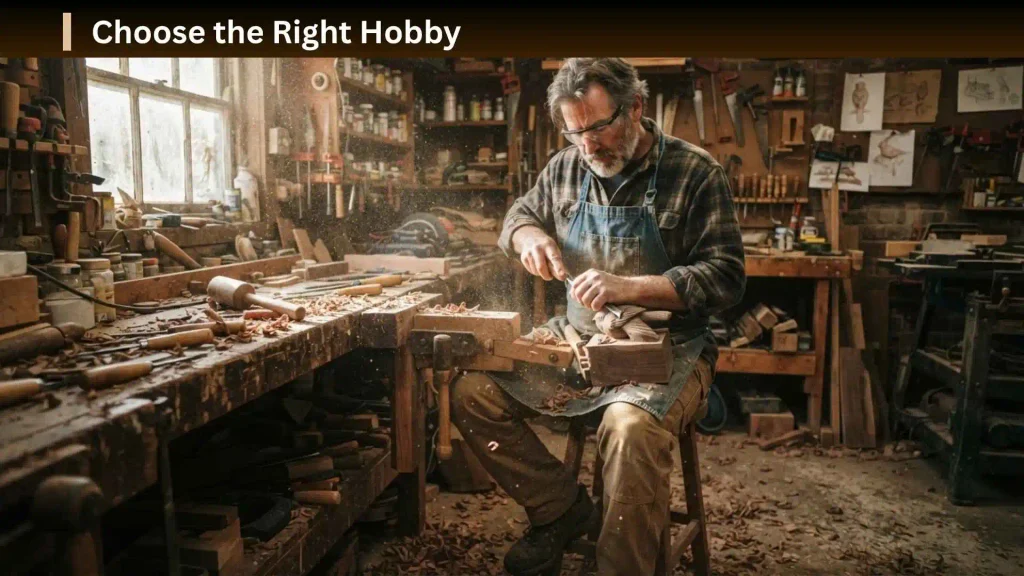
10. Woodworking
Woodworking is a hands-on hobby that can produce useful objects rather than purely decorative projects. Beginners can start with relatively simple projects such as shelves, small boxes, organizers, or basic furniture.
Because tools can be expensive and some equipment can cause serious injuries when misused, beginners should learn proper tool handling and workshop safety before attempting complex projects.
Best for: Hands-on and practical people
Equipment: Basic woodworking tools
Cost: Moderate to high
Space needed: More than most indoor hobbies
11. DIY Home Improvement
DIY projects can turn everyday household problems into opportunities to learn. Painting, assembling furniture, organizing storage, repairing minor household items, and improving a workspace are examples.
Start with projects appropriate for your skill level and avoid electrical, structural, plumbing, or other hazardous work unless you have the necessary knowledge or qualified assistance.
Best for: Practical problem-solvers
Equipment: Depends on the project
Cost: Low to moderate
12. Gardening
Gardening does not necessarily require a large yard. Container gardening allows you to grow herbs, vegetables, flowers, and some small plants in limited spaces.
Indoor plants can also make gardening accessible to people living in apartments.
Best for: Relaxing, hands-on activity
Equipment: Containers, growing medium, plants, and basic gardening supplies
Cost: Low to moderate
13. Coding
Coding can turn a computer into a creative tool. You can learn programming by building small projects rather than only watching tutorials.
For example, a beginner might create a simple website, calculator, text-based game, personal tracker, or small automation project.
Best for: Problem-solvers and technology enthusiasts
Equipment: Computer
Cost: Often free to start
14. Learning a New Language
A language-learning hobby can be practiced in short sessions throughout the week. You can combine vocabulary study with reading, listening, writing, and conversation practice.
Choose a language connected to a genuine interest—such as travel, literature, food, music, or family connections—to make consistent practice easier.
Best for: Lifelong learners
Equipment: Phone, computer, books, or other learning resources
Cost: Free to moderate
15. Chess
Chess is a convenient home hobby because you can play against another person or a computer. Beyond playing games, you can study openings, tactics, endgames, famous games, and strategic principles.
If you are a beginner, learning basic piece movement and simple tactical patterns is a better starting point than memorizing large numbers of openings.
Best for: Strategy lovers
Equipment: Chessboard or digital platform
Cost: Free to low
16. Model Building
Model building offers a detailed, hands-on activity for people who enjoy assembling and customizing objects. Depending on your interests, you might explore scale models, miniature vehicles, aircraft, ships, buildings, or other subjects.
Painting and weathering can add another creative dimension to the hobby.
Best for: Patient and detail-oriented people
Equipment: Model kits and basic tools
Cost: Low to moderate
17. Collecting
Collecting can turn an ordinary interest into a structured hobby. Possible collections include books, coins, sports memorabilia, vinyl records, postcards, watches, model vehicles, or other items.
A good collection usually benefits from a clear theme and a sensible budget. Collecting does not have to mean buying constantly; researching, organizing, documenting, and caring for what you already own are important parts of the hobby.
Best for: Enthusiasts and researchers
Equipment: Depends on the collection
Cost: Highly variable
18. Coffee Brewing
Coffee can become much more interesting when you explore brewing methods, grind size, water temperature, ratios, and different beans.
You can compare methods such as pour-over, French press, AeroPress, or other brewing approaches and keep notes about what you like.
Best for: People who enjoy routines and experimentation
Equipment: Depends on the brewing method
Cost: Low to moderate
19. Writing
Writing is an inexpensive hobby with almost unlimited directions. You could write short stories, personal essays, reviews, fictional scenes, poetry, journal entries, or articles.
You do not need to plan a book to become a writer. A 15-minute writing session can be enough to develop consistency.
Best for: Creative thinkers and reflective people
Equipment: Notebook or computer
Cost: Free to low
20. Puzzles
Jigsaw puzzles, logic puzzles, crosswords, Sudoku, and other puzzle formats offer different types of mental challenges.
Puzzles are particularly useful as a low-pressure hobby because you can stop and resume them whenever you have time.
Best for: Relaxation and problem-solving
Equipment: Depends on puzzle type
Cost: Free to moderate
21. Astronomy
Astronomy can begin without a telescope. Learning to identify major constellations, planets, and other visible objects can introduce you to the night sky.
Once your interest develops, you can explore astronomy books, sky maps, binocular observation, astrophotography, or telescope-based observing.
Best for: Science and space enthusiasts
Equipment: Optional binoculars or telescope
Cost: Free to high
22. 3D Printing
3D printing combines design, technology, and hands-on making. Beginners can start by learning how a printer works and using existing designs before eventually creating their own models.
The hobby can involve CAD design, troubleshooting, material selection, and post-processing.
Best for: Makers and technology enthusiasts
Equipment: 3D printer and related supplies
Cost: Moderate to high
23. Podcasting
Podcasting can be explored as a creative project even if you never intend to build a large audience. You can research topics, write scripts, record conversations, edit audio, and learn basic production techniques.
You can also practice privately before publishing anything publicly.
Best for: Communicators and storytellers
Equipment: Computer and microphone
Cost: Low to moderate
24. Movie Appreciation
Watching movies can become more engaging when you approach films analytically. Pay attention to cinematography, editing, sound, acting, screenwriting, production design, and storytelling structure.
You can keep a movie journal where you record what worked, what did not, and what you learned from each film.
Best for: Film and storytelling enthusiasts
Equipment: Screen and streaming or physical media
Cost: Varies
25. Learning Practical Skills
One of the most useful hobbies to pursue at home is learning practical skills. Depending on your interests, this could include basic sewing, bicycle maintenance, cooking techniques, organization, computer skills, electronics, basic repairs, or other everyday abilities.
The advantage is that the hobby can produce skills you can actually use in daily life.
Best for: People who want useful, transferable skills
Equipment: Depends on the skill
Cost: Low to moderate
How to Choose the Right Hobby
With so many options, the easiest approach is to decide what you want from your free time.
| If you want to… | Consider… |
| Relax | Reading, puzzles, gardening, movies |
| Stay active | Home workouts, mobility training |
| Make things | Woodworking, model building, 3D printing |
| Be creative | Drawing, digital art, photography, writing |
| Learn technology | Coding, photo editing, 3D printing |
| Develop practical skills | Cooking, DIY, repairs |
| Challenge your mind | Chess, coding, puzzles |
| Explore science | Astronomy, educational projects |
| Enjoy entertainment | Gaming, movies, collecting |
| Build a long-term skill | Music, language learning, cooking |
Best Low-Cost Hobbies for Guys at Home
If budget is your biggest concern, start with hobbies that require little or no specialized equipment.
Some good choices include:
- Reading through your local library
- Writing
- Drawing
- Bodyweight workouts
- Chess
- Language learning
- Meditation
- Puzzles
- Learning to code
- Movie appreciation
- Home organization
- Researching a subject you enjoy
A useful rule is to start with what you already have. Buying expensive equipment before knowing whether you enjoy the activity can turn a promising hobby into unnecessary spending.
Best Hobbies for Guys at Home Who Get Bored Easily
If you lose interest quickly, choose hobbies that offer variety and measurable progression.
Try project based hobbies
Instead of saying, “I’m going to learn woodworking,” choose a specific project. Instead of simply “learning coding,” build a small application.
Projects create a clear goal and give you a reason to continue.
Combine two hobbies
Some hobbies work particularly well together:
- Photography + photo editing
- Cooking + food photography
- Fitness + nutrition education
- Coding + electronics
- Drawing + digital art
- Astronomy + astrophotography
- Writing + podcasting
- Gardening + cooking
Combining interests can keep the experience fresh without requiring you to completely change hobbies.
Hobbies for Guys at Home That Can Become Skills
Not every hobby needs to remain purely recreational. Some can develop into useful abilities over time.
Cooking can improve your ability to prepare meals independently.
Coding can teach computational thinking and software development concepts.
Photography can develop visual composition and editing skills.
Writing can improve communication and storytelling.
Woodworking can develop measurement, planning, and practical making skills.
Music can develop rhythm, coordination, and musical knowledge.
The important distinction is that a hobby should remain enjoyable. You do not have to monetize everything you enjoy.
How to Start a New Home Hobby Without Quitting
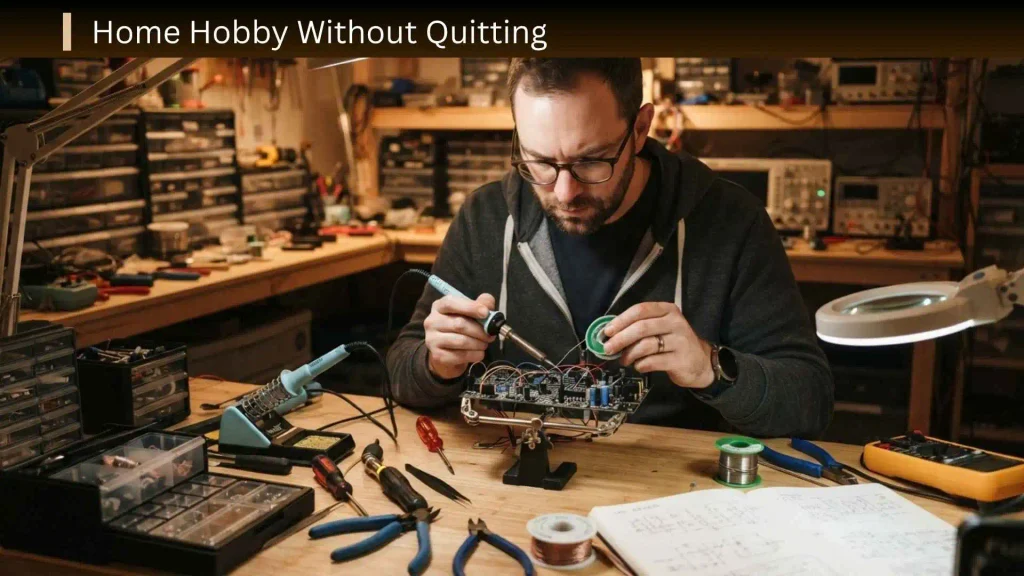
A common mistake is trying to do too much at the beginning.
Instead, use a simple progression:
- Pick one hobby.
- Set a small first goal.
- Use the equipment you already have when possible.
- Practice for a short, realistic period.
- Create something or complete a small challenge.
- Decide what you enjoyed and what you did not.
- Increase your investment only if you want to continue.
For example, someone interested in photography could begin by taking 10 intentional photos around the house rather than immediately buying a professional camera.
The goal at first is not mastery. It is finding out whether the activity genuinely holds your attention.
Should You Have More Than One Hobby?
Yes. Having several hobbies can be useful because different activities satisfy different needs.
For example, you might have:
- One active hobby for movement
- One creative hobby for making things
- One relaxing hobby for downtime
- One learning hobby for mental stimulation
You do not need four hobbies, however. One activity that you genuinely enjoy is better than maintaining a long list of hobbies you rarely practice.
FAQs About Hobbies for Guys at Home
What are some good hobbies for guys at home?
Good options include cooking, gaming, reading, home workouts, coding, photography, drawing, woodworking, gardening, chess, music, model building, writing, and DIY projects. The best choice depends on whether you want relaxation, creativity, exercise, learning, or hands-on activity.
What is a good hobby for a guy who is bored at home?
Choose an activity that involves participation rather than passive consumption. Cooking a new meal, building a model, learning guitar, completing a puzzle, coding a small project, or starting a home workout routine can give you something concrete to work toward.
What are the cheapest hobbies to do at home?
Reading, writing, drawing, bodyweight exercise, chess, language learning, coding, puzzles, and learning through free educational resources can all be started with little money.
What hobbies can guys do alone at home?
Almost all of the hobbies in this list can be practiced alone. Particularly suitable choices include reading, gaming, coding, cooking, drawing, photography, writing, chess against a computer, model building, gardening, and music.
What is a good hobby for someone who likes technology?
Coding, digital art, photo editing, gaming, 3D printing, electronics, video editing, and astronomy-related technology projects are good options for technology-minded hobbyists.
What hobbies involve making things?
Woodworking, cooking, model building, drawing, digital art, 3D printing, gardening, DIY projects, writing, and music all involve creating something rather than simply consuming entertainment.
Can a hobby become a side income?
Some hobbies can eventually lead to income, including photography, writing, digital art, woodworking, coding, music, crafting, and content creation. However, earning money is not guaranteed, and turning a relaxing hobby into a business can change the experience significantly.
Conclusion
The best hobbies for guys at home are not necessarily the most expensive, impressive, or complicated. A good hobby is one that fits your available space, budget, schedule, and interests while giving you a reason to keep coming back to it.
If you want something relaxing, try reading, puzzles, gardening, or movies. If you want to create, explore drawing, photography, cooking, woodworking, or digital art. If you want to learn, consider coding, languages, music, astronomy, or practical skills.
Start small, avoid buying unnecessary equipment at first, and give yourself enough time to discover what you genuinely enjoy.

I’m Olivia Bennett, a passionate writer who loves exploring ideas, learning new concepts, and sharing knowledge in a straightforward way. I write for Cognivoora with the goal of making useful topics easier to understand without unnecessary complexity. My approach combines research, clarity, and a reader-first perspective.
Books:
- Think Clearly, Live Better
- The Curious Reader’s Guide