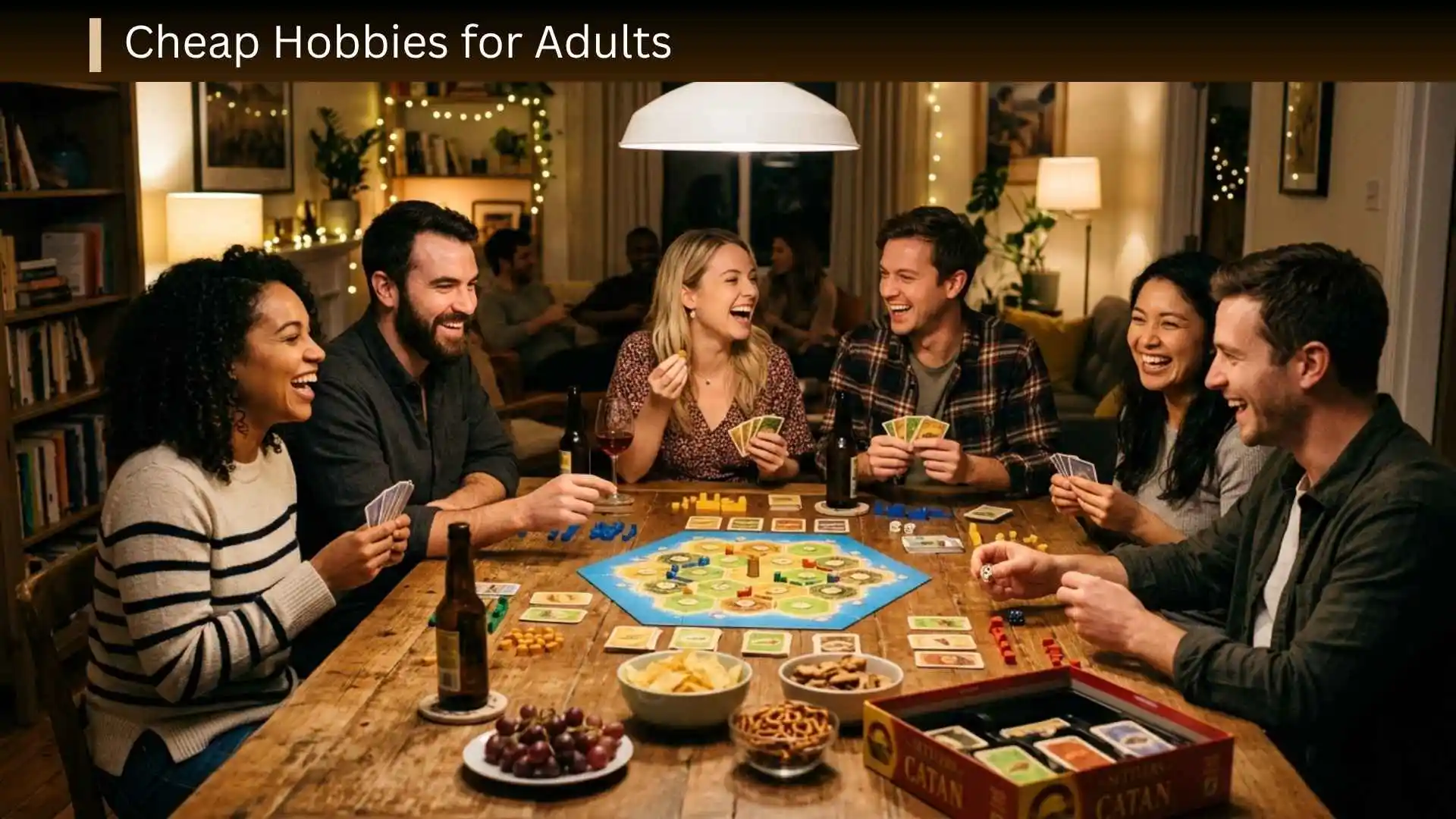
Finding a hobby you genuinely enjoy doesn’t have to mean spending a lot of money. I know how easy it is to think that a new hobby requires expensive equipment, classes, or a big time commitment,but that simply isn’t true. You can discover enjoyable, meaningful activities using things you may already have at home or with a small budget.
If you’re looking for cheap hobbies for adults, you’re in the right place. Whether you want to relax after a long day, learn a useful skill, get creative, stay active, or simply break away from your daily routine, you’ll find plenty of affordable options to explore. The best part? You can start many of them today without making a major investment. So, let’s find a hobby that fits your interests, budget, and lifestyle.
Cheap Hobbies for Adults(Quick Answer )

Some of the easiest inexpensive hobbies to start include walking, reading, journaling, drawing, photography with a smartphone, birdwatching, gardening from seeds, cooking, baking, hiking, geocaching, origami, learning a language, stargazing, puzzles, creative writing, knitting, sketching, and volunteering.
If your priority is spending almost nothing, start with a hobby that uses equipment you already have. If you are willing to spend a small amount initially, hobbies such as gardening, knitting, painting, or baking can offer months or years of activity without requiring expensive gear.
A Quick Comparison of Affordable Adult Hobbies
| Hobby | Difficulty | Typical Starting Cost | Time Flexibility | Where to Do It | Best For |
| Walking | Easy | Free | Very high | Outdoor | Movement and fresh air |
| Reading | Easy | Free–Low | Very high | Indoor | Learning and relaxation |
| Journaling | Easy | Free–Low | Very high | Indoor | Reflection and writing |
| Drawing | Easy | Free–Low | High | Indoor | Creativity |
| Smartphone photography | Easy | Free | High | Both | Visual creativity |
| Birdwatching | Easy | Free–Low | High | Outdoor | Nature observation |
| Gardening | Easy–Moderate | Low | Moderate | Outdoor/Indoor | Plants and hands-on work |
| Cooking | Easy–Moderate | Low | Moderate | Indoor | Practical creativity |
| Hiking | Easy–Moderate | Free–Low | Moderate | Outdoor | Exploration |
| Geocaching | Easy | Free–Low | High | Outdoor | Exploration and puzzles |
| Origami | Easy | Free–Low | High | Indoor | Quiet creativity |
| Creative writing | Easy | Free | Very high | Indoor | Storytelling |
| Knitting | Moderate | Low | High | Indoor | Making and relaxation |
| Stargazing | Easy | Free–Low | Moderate | Outdoor | Astronomy and quiet time |
| Volunteering | Easy | Usually free | Moderate | Both | Community and social connection |
Starting costs vary depending on what you already own, where you live, and whether you buy new or used supplies.
Cheap Hobbies for Adults That Cost Almost Nothing
You do not have to buy specialized equipment to begin a hobby. Several activities can be started immediately with everyday possessions or free resources.
1. Walking
Walking is one of the simplest hobbies to turn into a regular activity. Instead of treating it solely as exercise, give your walks a purpose: explore unfamiliar streets, photograph interesting buildings, listen to birds, discover local parks, or follow a different route each week.
What you need: Comfortable shoes and a safe route.
Cost: Usually free.
Make it more interesting: Create personal challenges such as visiting every park within a certain distance or keeping a photo diary of your walks.
2. Reading
Reading can become a surprisingly inexpensive long-term hobby when you use public libraries, used bookstores, book swaps, or free digital borrowing services offered through participating libraries.
You can make the hobby more engaging by choosing a theme each month, reading an author’s complete series, exploring a subject you know little about, or keeping notes on books you finish.
Best for: People who enjoy stories, learning, quiet time, or exploring new subjects.
3. Journaling
Journaling does not require an expensive notebook. A basic notebook, loose paper, or digital document is enough.
You can use the hobby for personal writing, recording observations, planning projects, collecting ideas, documenting trips, or simply writing about what you notice during the day.
Beginner tip: Do not impose a requirement to write several pages. Even five minutes of free writing can give you a manageable starting point.
4. Creative Writing
Creative writing turns imagination into a hobby without requiring specialized materials. You can write short stories, poems, personal essays, fictional characters, dialogue, microfiction, or scenes based on prompts.
Writing groups and workshops can also add a social dimension, while free writing communities and library programs can provide opportunities to learn.
Cost: Potentially zero.
Best for: People who enjoy storytelling and working independently.
5. Drawing
You can begin drawing with an ordinary pencil and paper. You do not need professional art supplies to practice observation, proportion, shading, perspective, or simple illustration.
Try drawing objects around your home instead of waiting for artistic inspiration. A mug, shoe, houseplant, kitchen utensil, or pair of glasses can become a useful practice subject.
Beginner mistake to avoid: Buying a large collection of art supplies before discovering whether you actually enjoy drawing.
6. Smartphone Photography
If you already own a smartphone, photography can be almost free to explore. The limitation can actually make the hobby more interesting because you learn to work with composition, available light, perspective, timing, and subject selection rather than relying on specialized equipment.
Try themes such as architecture, textures, shadows, plants, local businesses, landscapes, or everyday objects.
What to learn: Composition, framing, lighting, and basic editing.
7. People Watching and Urban Observation
Observing public spaces can become a quiet hobby when approached respectfully and within appropriate privacy boundaries. Instead of photographing strangers without permission, observe architecture, movement, public art, changing storefronts, transportation patterns, or interesting details.
A notebook can turn the activity into an observation journal.
8. Stargazing
Basic stargazing can begin without a telescope. Find a location with a reasonably open view of the sky, learn a few prominent constellations, and gradually become familiar with the Moon and brighter celestial objects.
A free or inexpensive astronomy app can help identify objects in the sky, although you can also learn using printed guides or library books.
Beginner tip: Start by learning a few easy-to-recognize patterns instead of trying to identify everything at once.
9. Birdwatching
Birdwatching is particularly accessible because you can begin by observing birds with your eyes and learning their shapes, behavior, calls, and habitats. Binoculars can be useful later but are not mandatory for starting.
Keep a simple list of birds you observe and note where and when you saw them.
Cost: Free to low-cost.
Best for: Nature lovers, patient observers, walkers, and people who enjoy learning species identification.
10. Nature Journaling
Nature journaling combines observation with writing and drawing. During a walk or visit to a park, record what you see, hear, and notice.
You might sketch a leaf, describe cloud formations, record seasonal changes, or write observations about insects and plants.
This is especially useful if you want a hobby that combines several interests instead of committing to a single creative activity.
Cheap Creative Hobbies for Adults
Creative hobbies are not necessarily expensive. The key is to learn the skill before accumulating specialized supplies.
11. Origami
Origami turns paper folding into a creative and often surprisingly challenging hobby. Basic models can be made with ordinary paper, while more complex designs introduce increasingly precise folds and techniques.
You can progress from simple animals and geometric forms to modular or advanced designs.
Cost: Very low.
Space required: Minimal.
Best for: People who enjoy quiet, hands-on projects.
12. Collage
Collage is a useful way to repurpose materials that might otherwise be discarded. Old magazines, packaging, newspapers, printed images, ticket stubs, and scrap paper can become raw materials.
You can make abstract compositions, mood boards, postcards, decorative pages, or themed artwork.
13. Sketching Outdoors
Outdoor sketching gives drawing a specific purpose: observe a place and capture its most interesting features.
You can sketch buildings, trees, bridges, street scenes, landscapes, or small details. A pocket notebook makes the hobby easy to carry.
14. Hand Lettering
Hand lettering focuses on creating visually interesting words and letters rather than simply writing quickly. A pencil or inexpensive pen is enough to practice basic lettering.
Once you understand spacing, stroke consistency, and letter shapes, you can experiment with greeting cards, signs, labels, or decorative journal pages.
15. Upcycling
Upcycling involves creatively reusing existing objects instead of immediately buying something new. Old containers, fabric, furniture, cardboard, jars, and other household materials can become the basis for practical or decorative projects.
The strongest version of this hobby is not buying cheap materials specifically to transform them. It is looking at things you already have and asking whether they can serve another purpose.
16. DIY Home Projects
Small DIY projects can turn practical household tasks into a hobby. Examples include refinishing a small piece of furniture, organizing a workspace, making simple decorations, repairing minor household items, or building storage solutions.
Start with projects appropriate to your skill level and use proper safety precautions when tools or electrical equipment are involved.
17. Origami-Inspired Paper Crafts
If traditional origami becomes repetitive, expand into paper cutting, paper sculpture, handmade cards, paper flowers, or modular paper constructions.
The advantage is that inexpensive paper can support many experiments before you need specialized materials.
Cheap Outdoor Hobbies for Adults
Outdoor hobbies can provide variety without requiring expensive memberships or equipment.
18. Hiking
Hiking can range from a short walk on a local trail to a full-day outing. You do not need to begin with technical trails or expensive equipment.
Start with established routes appropriate for your experience and conditions. For longer or remote hikes, prepare for weather, navigation, water, communication, and other practical needs.
Best for: People who enjoy exploration and spending time outdoors.
Cost: Often free or low-cost, although some parks or recreation areas charge entry or parking fees.
19. Geocaching
Geocaching combines outdoor exploration with a location-based treasure-hunt concept. Participants use coordinates and clues to locate hidden containers or other designated points of interest.
It can turn a familiar neighborhood or park into a puzzle-solving activity.
What makes it different: The destination is only part of the hobby; finding the location is the challenge.
20. Fishing
Fishing can become inexpensive if you borrow or buy basic used equipment and fish in locations where access is affordable. However, costs can increase significantly as you become interested in specialized rods, reels, tackle, boats, or other equipment.
Before fishing, check the regulations and licensing requirements that apply to the location.
21. Cycling
Cycling can be affordable if you already own a bicycle or find a reliable used one. A bike can also turn ordinary errands and local exploration into opportunities for the hobby.
For safety, use appropriate protective equipment, understand local cycling rules, and keep the bicycle maintained.
22. Nature Photography
Nature photography does not require a dedicated camera. A smartphone can be enough to begin photographing plants, insects, landscapes, textures, weather, and seasonal changes.
Rather than focusing on getting the most expensive equipment, develop an eye for composition and timing first.
23. Outdoor Sketching
Take a notebook to a park, trail, garden, or quiet public space and draw what is in front of you. Unlike studio drawing, outdoor sketching introduces changing light, moving subjects, weather, and unpredictable surroundings.
Those limitations can make the practice more engaging.
Cheap Indoor Hobbies for Adults
If weather, space, mobility, or personal preference keeps you indoors, you still have many inexpensive options.
24. Puzzles
Jigsaw puzzles, crossword puzzles, logic puzzles, word searches, Sudoku, and other puzzle formats can provide different kinds of mental challenges.
Libraries, thrift stores, puzzle swaps, and used marketplaces can sometimes make physical puzzles much cheaper. If space is limited, digital puzzle options can eliminate storage concerns.
25. Learning a Language
Language learning can be a long-term hobby rather than a short course. Free educational materials, library resources, conversation groups, and accessible digital tools can provide plenty of practice.
Make the hobby more enjoyable by connecting it to a culture, cuisine, music, literature, or travel destination that interests you.
Beginner tip: Choose one language and establish a realistic routine rather than collecting resources for several languages at once.
26. Cooking
Cooking is both a practical skill and a creative hobby. You can challenge yourself by learning one technique at a time rather than buying specialty ingredients for elaborate recipes.
For example, you could spend a month learning soups, homemade sauces, bread, vegetable dishes, or regional cuisines.
Cost-saving approach: Build your hobby around ingredients you already use instead of purchasing a completely different set of ingredients for every recipe.
27. Baking
Baking can be inexpensive when you focus on basic recipes and gradually build your skills. Cookies, simple breads, muffins, pancakes, and cakes can teach techniques such as measuring, mixing, fermentation, temperature control, and timing.
Specialty decorating equipment is optional rather than a requirement for getting started.
28. Knitting
Knitting has a relatively low entry barrier if you start with basic yarn and needles rather than buying an extensive collection.
Once you understand foundational stitches, you can progress toward scarves, hats, small household items, garments, or more complicated patterns.
Potential drawback: The first projects may feel slow while your hands learn the movements. Choose a simple project so the learning curve does not become discouraging.
29. Crochet
Crochet requires relatively little equipment and can be practiced in small spaces. A hook and yarn are enough for basic projects.
Small projects such as squares, simple accessories, or household items allow beginners to practice stitches without committing to a large project.
30. Origami and Paper Folding
For people who want a hobby that is quiet, portable, and inexpensive, paper folding is hard to beat. It also has a clear progression: simple models provide quick successes while advanced designs demand greater precision and patience.
Cheap Social Hobbies for Adults
An inexpensive hobby does not have to mean spending all your free time alone.
31. Volunteering
Volunteering can turn an interest into a recurring activity while connecting you with other people. Opportunities vary from community events and environmental projects to libraries, animal organizations, cultural programs, and local nonprofits.
Choose an organization whose work genuinely interests you rather than treating volunteering simply as a way to stay busy.
32. Book Clubs
A book club can make reading more social without requiring expensive entertainment. Libraries and community organizations sometimes host free groups, and friends can create informal clubs of their own.
You can also create a narrow theme, such as science fiction, biographies, mysteries, American history, or contemporary fiction.
33. Board Games
Board games can become a low-cost social hobby when you play games you already own, borrow them, buy used copies, or attend community game nights.
You do not need a large collection. A few games with different player counts and styles can provide considerable variety.
34. Community Classes and Clubs
Libraries, community centers, parks, recreation departments, colleges, and local organizations may offer affordable or free activities. Depending on your area, these can include art groups, walking clubs, gardening groups, book discussions, language exchanges, crafts, and educational events.
The main advantage is that the social connection is built into the activity.
35. Amateur Trivia and Quiz Nights
Trivia can become a hobby if you enjoy learning facts, solving questions, and competing casually with friends. You can participate in local events or organize your own quiz nights at home.
Instead of memorizing random information, choose categories that interest you and steadily build knowledge around them.
How to Choose the Right Cheap Hobby

The cheapest hobby is not necessarily the best hobby for you. A free activity that you never do is less valuable than a hobby that costs a few dollars but consistently holds your attention.
Consider these five questions before choosing:
What do you want from the hobby?
Your goal matters.
- Relaxation: Reading, drawing, knitting, gardening, puzzles, or stargazing
- Creativity: Writing, photography, sketching, collage, cooking, or crafts
- Movement: Walking, hiking, cycling, or recreational outdoor activities
- Learning: Languages, astronomy, birdwatching, history, or cooking
- Social connection: Volunteering, book clubs, board games, classes, or group activities
- Exploration: Hiking, geocaching, photography, or nature observation
How much money do you actually want to spend?
Separate the cost of starting from the ongoing cost.
A hobby may be cheap to start but expensive to maintain. Photography is a good example: a smartphone can cost nothing extra if you already own one, while dedicated cameras, lenses, storage, and accessories can eventually become expensive.
Conversely, a hobby such as drawing may remain inexpensive for a long time if you are satisfied with basic materials.
How much space do you have?
People living in apartments or small homes may prefer hobbies with minimal storage needs.
Good low-space choices include:
- Reading
- Writing
- Drawing
- Origami
- Language learning
- Puzzles
- Stargazing
- Walking
- Photography
- Birdwatching
Do you want a solo or social hobby?
Some hobbies naturally support solitude, while others become more rewarding through interaction.
If you want more social contact, consider volunteering, clubs, group walks, board games, classes, or book discussions.
If you need quiet personal time, reading, drawing, writing, puzzles, gardening, or nature observation may fit better.
Do you want a hobby with a clear skill progression?
Some people enjoy hobbies where they can see measurable improvement.
Good examples include:
- Drawing
- Cooking
- Photography
- Knitting
- Crochet
- Writing
- Language learning
- Chess and other strategy games
- Bird identification
- Astronomy
These hobbies give you something new to learn even after the beginner stage.
How to Keep a Hobby Cheap
The biggest hobby expense is often not the activity itself but the tendency to buy equipment before developing the skill.
Start with what you already own
Before purchasing anything, look around your home. Paper, pencils, kitchen equipment, smartphones, books, containers, fabric, and other ordinary items may be enough to test a hobby.
Borrow before buying
Libraries, friends, family members, community groups, and hobby clubs can sometimes provide access to books, tools, games, or equipment.
Borrowing is particularly useful when you are unsure whether you will continue with an activity.
Buy used when appropriate
Thrift stores, used marketplaces, garage sales, library sales, and hobby swaps can reduce costs for items where secondhand condition is easy to evaluate.
For equipment that affects safety or reliability, inspect it carefully and understand what condition is acceptable before buying it.
Avoid the “gear trap”
You do not need the professional version of every item to begin.
For example, someone interested in photography can learn composition using a smartphone. Someone interested in drawing can start with a pencil. Someone interested in hiking can begin with appropriate local trails rather than immediately buying specialized backpacking equipment.
Give yourself a trial period
Try a hobby several times before deciding whether it deserves additional spending.
A useful rule is simple: use the basic setup first, then upgrade only when you can identify a specific limitation.
Cheap Hobbies Based on Your Goal
| If You Want… | Consider… |
| Almost zero spending | Walking, writing, reading, observation, drawing |
| A creative outlet | Sketching, writing, collage, photography, paper crafts |
| A hobby at home | Cooking, puzzles, knitting, drawing, language learning |
| More time outdoors | Hiking, walking, birdwatching, geocaching, stargazing |
| A social activity | Volunteering, book clubs, board games, community groups |
| A skill to improve over time | Cooking, photography, drawing, languages, knitting |
| Something portable | Reading, journaling, photography, sketching, origami |
| Minimal storage | Writing, walking, photography, stargazing, language learning |
| A screen-free activity | Gardening, hiking, drawing, knitting, birdwatching |
| A hobby for short breaks | Journaling, sketching, puzzles, origami, reading |
Common Mistakes When Starting an Affordable Hobby
Buying everything at once
A beginner kit can look attractive, but purchasing every accessory before you understand the hobby often creates unnecessary expense.
Start with the minimum equipment.
Choosing a hobby because it looks impressive
A hobby should fit your interests, schedule, environment, and personality. Do not choose an activity simply because other people consider it interesting.
Starting with a project that is too difficult
Your first project should teach you the basics while remaining achievable. An unnecessarily ambitious first attempt can make a perfectly good hobby feel frustrating.
Confusing collecting with doing
It is easy to spend more time researching equipment, watching reviews, and buying supplies than actually practicing.
If your goal is to develop a hobby, put the activity itself ahead of acquiring gear.
Expecting instant mastery
Affordable hobbies can still require substantial practice. Drawing, cooking, playing an instrument, knitting, photography, and language learning all become more enjoyable when improvement is treated as part of the hobby rather than a prerequisite for enjoying it.
How to Turn a Cheap Hobby Into a Long Term Hobby
A hobby is more likely to stick when it has enough variety to remain interesting.
Try creating levels of progression:
Level 1: Explore
Spend a few sessions learning the basics.
Level 2: Practice
Repeat simple activities until they become comfortable.
Level 3: Experiment
Try different subjects, techniques, locations, or styles.
Level 4: Create projects
Give yourself something concrete to finish.
Level 5: Connect
Join a club, share your work, participate in events, or teach someone a beginner skill.
Level 6: Specialize
Only after you know what you enjoy should you consider investing in more specialized equipment or materials.
This approach keeps the hobby affordable while giving you room to grow.
Frequently Asked Questions About Cheap Hobbies for Adults
What are the cheapest hobbies for adults?
Walking, reading through a library, journaling, creative writing, drawing with basic supplies, smartphone photography, stargazing, nature observation, and many forms of exercise or outdoor exploration can cost very little to begin.
What is a good hobby for adults with no money?
Start with an activity that uses something you already have. Walking requires little more than appropriate footwear, while writing can be done with paper and a pen or a device you already own. Libraries can also provide free access to books and community activities in many areas.
What hobby can I start at home for cheap?
Drawing, writing, reading, cooking, baking, puzzles, origami, knitting, crochet, language learning, and journaling are all suitable for home use. Your best choice depends on whether you want creativity, learning, relaxation, or hands-on activity.
What are some cheap hobbies for adults who are bored?
Choose a hobby that introduces a specific challenge rather than simply filling time. Geocaching adds exploration, photography gives you subjects to find, cooking gives you techniques to master, and language learning provides a progression of skills.
What are inexpensive hobbies that can become social?
Volunteering, book clubs, board games, hiking groups, community classes, gardening groups, language exchanges, and trivia events can all combine an affordable activity with social interaction.
What are cheap hobbies that do not require much space?
Reading, writing, drawing, photography, origami, language learning, puzzles, knitting, and stargazing require little dedicated space. Outdoor hobbies such as walking and birdwatching require almost no storage space at home.
How can I avoid spending too much on a new hobby?
Start with the minimum equipment, borrow or buy used items where appropriate, and delay upgrades until you can identify a genuine need. Most importantly, spend more time practicing than shopping for supplies.
What is the best cheap hobby for adults?
There is no single best option. The right hobby is one that fits your interests and realistically fits your budget, available time, space, and desired level of social interaction. For an almost-free starting point, walking, reading, writing, drawing, and smartphone photography are particularly accessible.
Conclusion
The best cheap hobbies for adults are not necessarily the activities with the lowest possible price. They are activities that give you something meaningful to do without creating unnecessary financial pressure.
If you want almost no upfront cost, try walking, reading, writing, drawing, photography with your existing phone, or exploring nature. If you are comfortable making a small investment, gardening, cooking, knitting, crochet, puzzles, and hiking can offer much more room to develop.
Start small, use what you already have, and give yourself enough time to discover what genuinely holds your attention. Once you find an activity you enjoy, you can decide whether it is worth investing more in—not the other way around.

I’m Ethan Mitchell, a curious writer who enjoys turning complex ideas into simple, useful information. At Cognivoora, I focus on creating clear and engaging content that readers can understand and apply in everyday life. I believe good writing should educate, answer real questions, and leave readers with something valuable to remember.
Books:
- The Everyday Mind
- Simple Ideas, Better Thinking