Have you ever been working on a small hobby project and wished you could see the tiny details more clearly? I know how frustrating it can be when fine print, miniature parts, intricate patterns, or delicate craft work become difficult to see. That’s where the right magnifying glass can make a noticeable difference. Whether you enjoy jewelry making, model building, painting, sewing, stamp collecting, electronics, or other detailed hobbies, you want a magnifying tool that is comfortable, clear, and easy to use.
In this guide, I’ll help you explore the best magnifying glasses for hobbies so you can find an option that fits your project, workspace, and viewing needs.
Best Magnifying Glasses for Hobbies(Quick Answer)
For most hobbyists, these are the strongest choices by use case:
| Magnifier Type | Best For | Typical Useful Range | Main Advantage |
| Headband magnifier | Model making, miniatures, jewelry, electronics | 1.5x–3.5x | Both hands remain free |
| Illuminated magnifying lamp | Sewing, quilting, crafts, painting, bench work | Around 1.75x–3x | Large viewing area plus light |
| Handheld magnifying glass | Coins, stamps, crafts, occasional inspection | About 2x–6x | Simple and portable |
| Jeweler’s loupe | Jewelry, gemstones, stamps, tiny markings | 5x–10x+ | Strong detail inspection |
| Clip-on or eyeglass magnifier | Portable hands-free detail work | Varies | Works with or near regular eyewear |
| Digital magnifier | Very small details and screen-based inspection | Varies | Enlarged image on a display |
If you are unsure where to start, a 2x–3x hands-free magnifier is usually more versatile than immediately buying a very high-power lens. The trade-off is important: stronger magnification generally means a shorter working distance and a smaller useful viewing area.
What Makes a Magnifying Glass Good for Hobbies?
A good hobby magnifier should make small details easier to see without making the work itself harder.
That means looking beyond the number printed on the package. The most important characteristics are:
- Magnification
- Working distance
- Lens size
- Optical clarity
- Field of view
- Hands-free operation
- Lighting
- Comfort
- Compatibility with prescription glasses
- Portability
- Ease of adjustment
A 10x loupe may reveal a tiny hallmark beautifully, but it is not necessarily a good choice for painting an entire miniature. Conversely, a large 1.75x lens may be excellent for sewing but insufficient for inspecting a watch movement.
The best magnifier is therefore the one that gives you the right balance of detail, viewing area, distance, and control for your particular hobby.
Best Magnifying Glasses for Different Hobbies
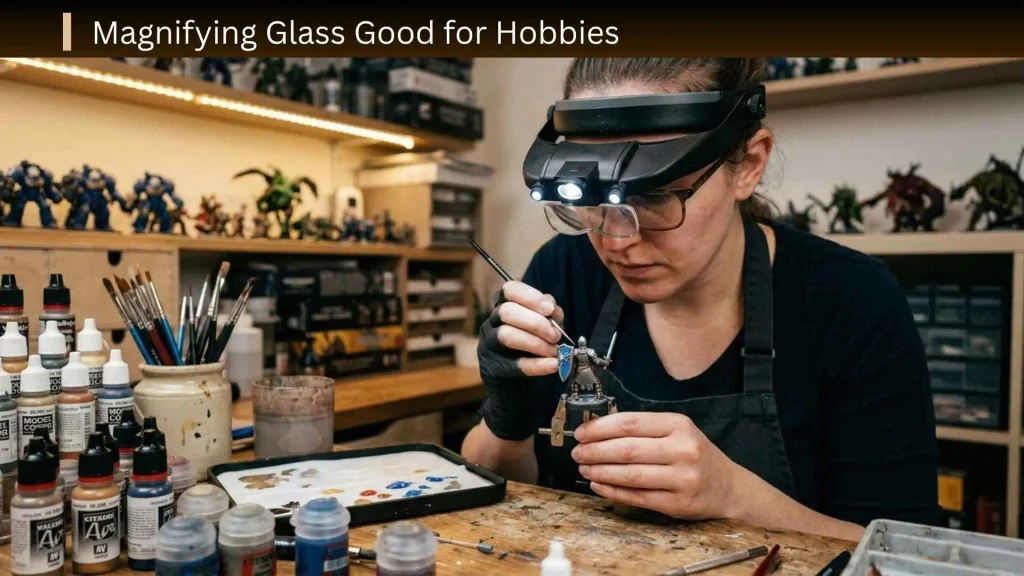
Best for Model Making and Miniature Painting: Headband Magnifiers
Miniature painting and scale-model building involve a mixture of normal-size and extremely small details. You may need to see the overall figure clearly one moment and a tiny panel line, decal, facial detail, or component the next.
A binocular headband magnifier is particularly useful because it leaves both hands available for the model and tools.
For example, the is available in several magnification levels from 1.5x to 3.5x, with different focal lengths. Its binocular design is intended for close, accurate work and can be worn over prescription or safety glasses.
Why it works well:
- Both hands remain free
- The magnifier moves with your head
- Binocular viewing preserves a natural sense of depth
- Different lens powers can accommodate different tasks
- You can move the visor away when magnification is unnecessary
For miniature painting, around 1.75x–2.5x is a sensible starting range for many tasks. Higher power can be useful for very fine details, but the reduced working distance can become inconvenient.
Beginner tip: Do not choose the strongest lens simply because it appears more powerful. If you constantly bump your brush or model into the lens because you have to work extremely close, the magnifier is working against you.
Best for Jewelry Making: Loupe or Headband Magnifier
Jewelry work can require two very different kinds of magnification.
For examining a tiny hallmark, gemstone inclusion, setting, or surface detail, a jeweler’s loupe is convenient. For work that involves both hands, such as setting, assembling, or manipulating small components, a headband magnifier can be easier to use.
A 10x double-lens jeweler’s loupe, for example, is designed specifically for close inspection of jewelry, gemstones, stamps, coins, and similarly small objects.
Choose a loupe when:
- You need short inspection sessions
- You are checking one small area
- Portability matters
- You want high magnification
Choose a headband magnifier when:
- You need both hands
- You are actively making or repairing something
- You need to move around the workpiece
- You want a more natural binocular view
For extended bench work, an illuminated magnifier can also be preferable because it combines magnification with consistent task lighting.
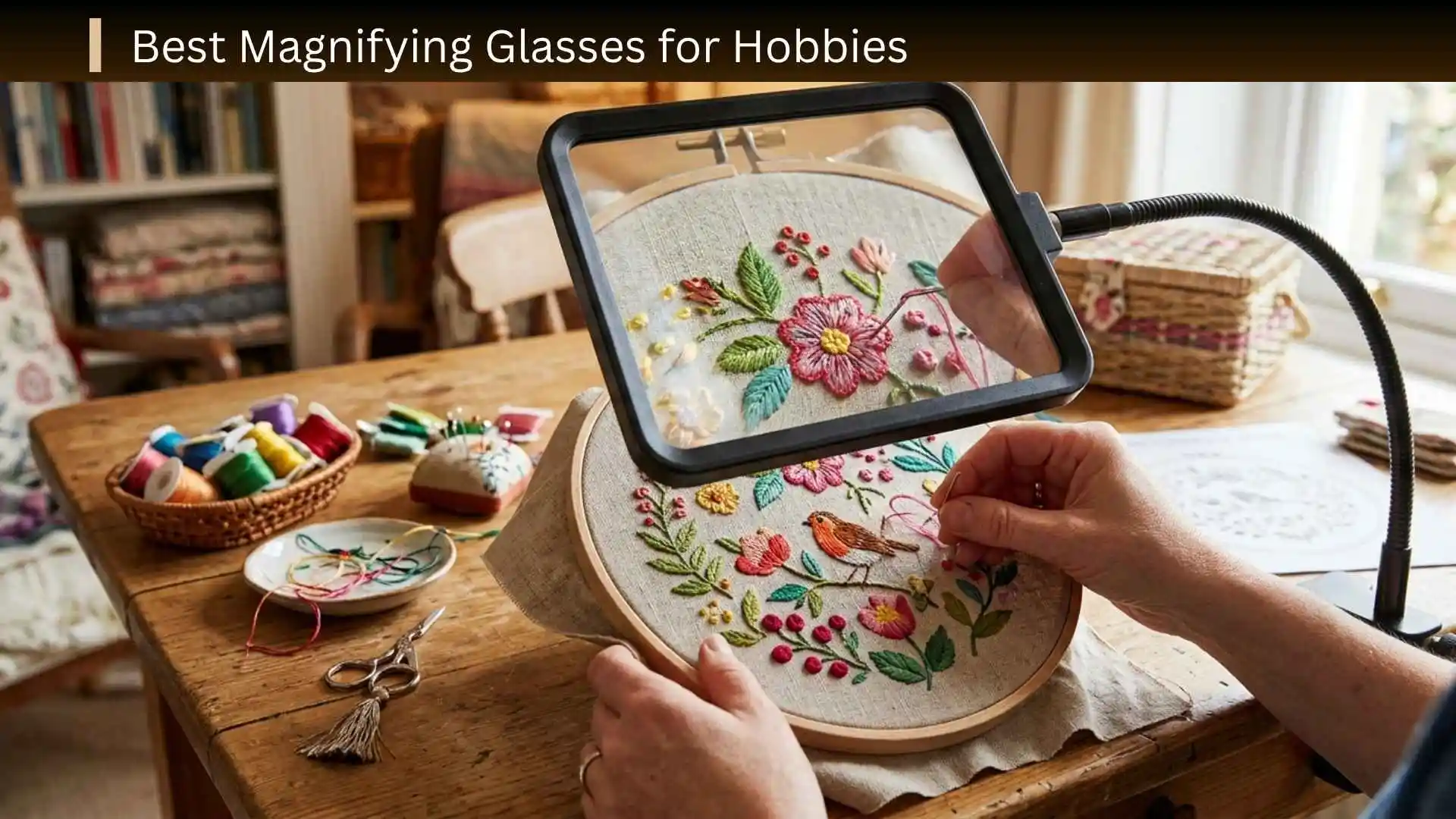
Best for Sewing, Embroidery, and Cross-Stitch: Illuminated Magnifying Lamps
Needlework is one of the clearest cases where a large lens and good lighting can be more useful than extreme magnification.
You need to see enough of the fabric to understand where the needle is going, while still being able to distinguish individual threads. A huge amount of magnification can actually make this harder because the visible area becomes too small.
A lamp-mounted magnifier is particularly convenient because it stays positioned over your work.
The uses a 5-inch glass lens with 1.75x magnification and adjustable lighting, including daylight, cool, and warm settings. Its manufacturer also specifies a 95+ CRI rating for the light source.
For sewing and embroidery, look for:
- A large lens
- Around 1.75x–2.5x magnification
- Hands-free positioning
- Adjustable brightness
- Stable base or clamp
- Good illumination across the fabric
The key is coverage rather than maximum power.
Best for Quilting: Large Illuminated Magnifier
Quilting presents a similar challenge, but the working area can be substantially larger.
A small handheld magnifying glass forces you to continually reposition the lens. A magnifying lamp with a large lens is generally more practical because the lens can cover a larger section of the project.
The is an example of a craft-oriented magnifying lamp with a 13 cm lens, 1.75x magnification, flexible positioning, and adjustable brightness.
For quilting, prioritize:
- Lens size
- Stable positioning
- Good illumination
- Comfortable working distance
- Magnification appropriate for thread and stitch detail
Best for Coin Collecting: Handheld Magnifier or Stand Magnifier
Coin collectors often need to inspect details such as dates, mint marks, lettering, surface characteristics, edge details, and signs of wear.
A handheld magnifier is convenient when examining individual coins. A stand or illuminated magnifier becomes more useful when sorting or documenting a larger collection.
A moderate magnification gives you a broader view of the coin. Very high magnification is useful for investigating a particular feature but is less convenient for examining the whole piece.
For collectors, optical clarity matters just as much as power. A distorted edge can make a magnified coin less useful than a slightly lower-power lens with a clearer image.
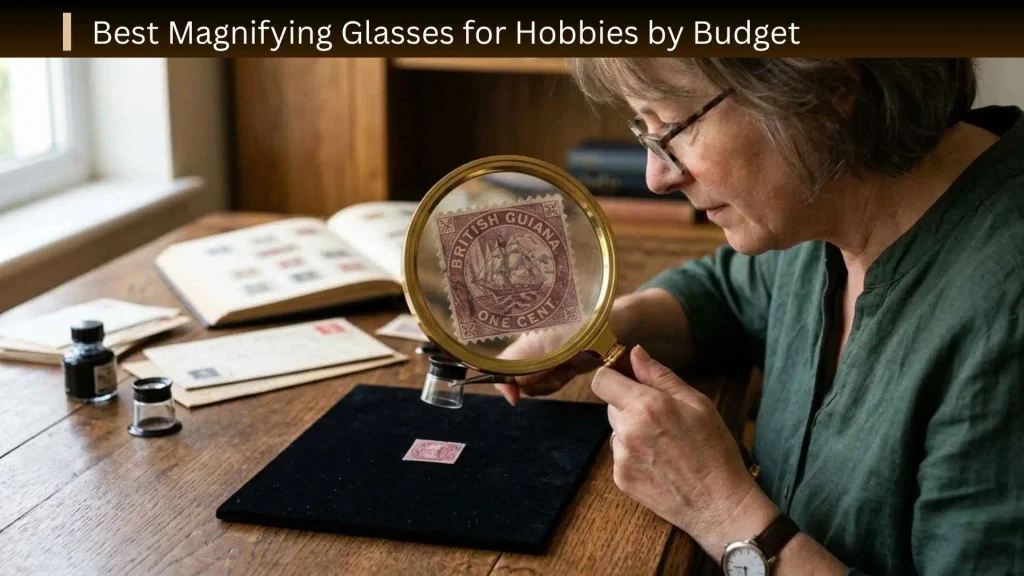
Best for Stamp Collecting: Illuminated Stand Magnifier
Stamp collecting benefits from a magnifier that lets you inspect a relatively large area at once.
Collectors may want to examine:
- Perforations
- Printing details
- Watermarks
- Fine lettering
- Color differences
- Cancellation marks
- Small design elements
A stand or lamp magnifier is particularly useful for longer sorting sessions because both hands remain available.
For routine collection examination, moderate magnification is usually more practical than extreme power. A stronger loupe can then be used for a particular tiny feature.
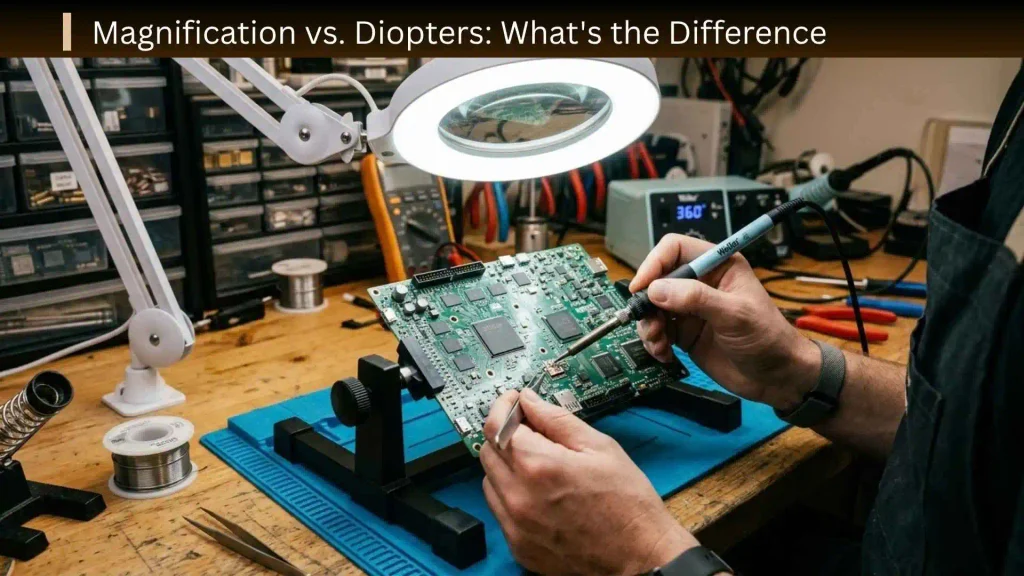
Best for Electronics and Soldering: Magnifying Lamp or Headband Magnifier
Electronics work creates a special requirement: you need magnification and enough working space for tools.
A handheld magnifying glass is usually inconvenient because one hand is occupied holding the lens. A headband magnifier or articulated magnifying lamp is much more suitable.
For bench electronics, look for:
- Hands-free operation
- Stable positioning
- Good illumination
- Adequate working distance
- A lens large enough to cover the circuit area
- The ability to move the magnifier away quickly
For example, the provides a 7-inch glass lens with 1.75x magnification, adjustable arm positioning, and built-in LED lighting.
If you are working on extremely small components, a higher-power secondary lens or dedicated inspection loupe may be useful.
Best for Beading and Jewelry Crafts: Headband or Table Magnifier
Seed beads, wirework, miniature findings, and small clasps can quickly become difficult to distinguish.
For projects where you need to manipulate components continuously, a hands-free magnifier is preferable.
A headband magnifier is a strong choice when you move around the workpiece. A table magnifier works better when the project remains in a fixed position.
If the beads themselves are easy to see but the problem is distinguishing thread, wire, or tiny openings, additional task lighting may improve your setup as much as additional magnification.
Best for Wood Carving and Fine Detail: Headband Magnifier
Fine carving can involve tiny surface details that are difficult to inspect while simultaneously holding a carving tool.
A head-mounted magnifier can keep your hands free while allowing you to move your head naturally around the work.
However, magnification should not interfere with your awareness of the tool or workpiece. For carving, a moderate-power lens is generally more practical than an extremely strong loupe.
Best for Paper Crafts and Model Building: Handheld or Headband Magnifier
Paper models, miniature structures, scale models, and detailed card-making projects benefit from flexible magnification.
A handheld lens works well for occasional inspection, while a headband model is better when you are repeatedly switching between cutting, gluing, folding, and positioning.
If your project involves glue, paint, or solvents, keep the magnifier’s lens clean and follow the manufacturer’s cleaning recommendations rather than using harsh chemicals.
Best Hobby Magnification: 1.5x, 2x, 3x, 5x, or 10x?
More magnification is not automatically better.
The optical relationship between magnification, focal length, and working distance means that stronger magnification generally requires you to work closer to the lens. Edmund Optics notes that actual magnifying power can vary with working distance, eye relief, and the observer’s eye.
A practical way to think about the ranges is:
| Magnification | Usually Best For |
| 1.5x–1.75x | Sewing, quilting, painting, larger craft areas |
| 2x | General hobby work, models, crafts, inspection |
| 2.5x–3x | Miniatures, electronics, jewelry crafts, fine stitching |
| 4x–5x | Small components and detailed inspection |
| 6x–10x | Jewelry, stamps, markings, tiny features |
| 10x+ | Specialized close inspection rather than general hobby work |
These are practical starting points, not rigid rules. Lens design and working distance can make two magnifiers with the same advertised power feel very different.
Why High Magnification Can Be Difficult
Suppose you choose a very powerful magnifier because you want to see extremely small details. You may discover that:
- The visible area becomes small
- You need to move the object closer
- Your hand movements become more noticeable
- Finding the correct viewing position takes longer
- It becomes difficult to see the surrounding area
This is why a 2x headband magnifier plus a 10x loupe can be more useful than one extremely powerful magnifier. Each tool handles a different level of detail.
Magnification vs. Diopters: What’s the Difference?
Many hobby magnifiers use diopters rather than simply listing magnification as “2x” or “3x.”
Diopter describes optical power, while magnifying power is commonly expressed as an X value. A commonly used approximation is:
Magnification ≈ (Diopters ÷ 4) + 1
For example:
- 3 diopters ≈ 1.75x
- 5 diopters ≈ 2.25x
- 8 diopters ≈ 3x
- 12 diopters ≈ 4x
The exact interpretation depends on how the manufacturer specifies magnifying power. Optical references also distinguish between different viewing conditions, so two products labeled in different ways should not be compared from the numbers alone.
The practical lesson is simple: check both the advertised magnification and the working distance.
Why Working Distance Matters So Much
Working distance is the space between the magnifier and the object when the object is in focus.
This is one of the most overlooked specifications when people shop for hobby magnifiers.
A high-power magnifier generally has a shorter focal length. A shorter focal length means the object must be positioned closer to the lens for clear viewing. Optical references demonstrate the relationship between focal length and magnifying power.
Imagine painting a miniature with a brush.
A magnifier that forces the brush tip only a few inches from the lens may provide impressive enlargement, but it can make brush positioning awkward. A lower-power lens with a longer working distance may be much easier to use.
For hands-on hobbies, working distance can be just as important as magnification.
Should You Choose Glass or Acrylic?
Both glass and optical plastics can be used successfully in hobby magnifiers.
Glass Lenses
Advantages can include:
- Excellent optical clarity
- Good scratch resistance
- Long-term durability
- Crisp viewing when properly manufactured
Glass can also make a magnifier heavier.
Acrylic or Other Optical Plastics
Advantages can include:
- Lower weight
- Easier handling
- Larger lightweight lenses
- Practical use in lamps and wearable systems
The quality of the lens matters more than simply seeing the word “glass” on the package.
A poorly designed glass lens can still provide a disappointing viewing experience, while a well-designed optical acrylic lens can be very useful.
For example, modern hobby magnifiers include both precision glass headband lenses and large acrylic lamp lenses. Donegan’s OptiVISOR uses interchangeable optical glass lenses, while Daylight’s iQ Magnifier uses a large lightweight acrylic lens.
Do You Need a Lighted Magnifying Glass?
Often, yes—especially for hobbies involving very small details.
Magnification and illumination solve different problems.
Magnification enlarges the detail.
Lighting makes the detail easier to distinguish.
A magnifier with an integrated LED can therefore be considerably more useful than a stronger unlit magnifier when your workspace is poorly illuminated.
For sewing, painting, jewelry, electronics, and model making, look for:
- Even illumination
- Adjustable brightness
- A light that follows the magnifier
- Minimal shadows
- A stable mounting system
For color-sensitive crafts, light quality can also matter. Some craft-oriented lamps specify high color-rendering performance; for example, Daylight lists a CRI of 95+ on several of its current craft magnifiers.
Headband Magnifier vs. Magnifying Lamp
This is one of the most important choices for hobbyists.
| Feature | Headband Magnifier | Magnifying Lamp |
| Hands-free | Excellent | Excellent |
| Moves with you | Yes | No |
| Large viewing area | Usually moderate | Often large |
| Built-in light | Some models | Usually |
| Portability | Good | Limited |
| Best for | Mobile detail work | Stationary projects |
| Long sessions | Good if comfortable | Often convenient |
| Workspace requirement | Low | Moderate to high |
Choose a Headband Magnifier If:
- You move around the object
- You need natural head movement
- You want something portable
- Your hands must remain completely free
- You work on models, jewelry, miniatures, or repairs
Choose a Magnifying Lamp If:
- Your project stays on a desk
- Lighting is part of the problem
- You want a larger lens
- You work for long periods at a fixed station
- You do sewing, quilting, painting, crafts, or bench work
Notable Hobby Magnifier Options to Consider
Rather than treating one product as universally “the best,” it is more useful to match established designs to specific jobs.
Donegan Optical OptiVISOR
The is a classic headband-style option for close, hands-free work.
Its available versions range from 1.5x to 3.5x, with focal lengths ranging from 20 inches to 4 inches. The manufacturer describes it as a binocular headband magnifier designed for close accurate work and says it can be worn over prescription or safety glasses.
Best suited to: model making, miniature painting, jewelry work, electronics, carving, and precision crafts.
Donegan Optical OptiVISOR Complete Set
For hobbyists who want flexibility, the includes six lens plates ranging from 1.5x to 3.5x, plus an OptiLOUPE and VisorLIGHT.
Best suited to: serious hobbyists who work across several levels of detail.
Its advantage is not simply higher power; it is the ability to change magnification according to the task.
Carson MagniVisor Dual Power
The Carson MagniVisor MV-23 provides 2x and 3x magnification. Carson’s instructions specify approximately 8.5 inches as the working distance at 2x and about 4.25 inches at 3x for best results.
Best suited to: crafts, model work, sewing, repairs, and other hands-free projects where two magnification levels are useful.
Daylight MAG Lamp S
The is designed around a 5-inch glass lens with 1.75x magnification and built-in LED illumination. It also provides multiple color-temperature settings and adjustable brightness.
Best suited to: sewing, crafting, painting, and fixed workstation projects.
Daylight Magnificent Pro
The is another craft-focused option, using a large 13 cm lens at 1.75x magnification with flexible positioning and three brightness levels.
Best suited to: sewing, crafts, painting, and people who prefer a floor- or table-lamp format.
Daylight iQ Magnifier
For hobbyists who need both broad and more concentrated magnification, combines a 3-diopter 1.75x lens with a 12-diopter 4x swing-arm lens.
Best suited to: serious craft work, inspection, painting, jewelry-related work, and users who want two levels of magnification in one workstation.
Best Magnifying Glasses for Hobbies by Budget
Best Budget Approach: Handheld Magnifier
If you only need magnification occasionally, start with a simple handheld lens.
This makes sense when you:
- Inspect coins occasionally
- Check stamps
- Read tiny model instructions
- Examine craft details
- Need a portable tool
There is little reason to purchase an expensive hands-free system if you only use magnification for a few minutes at a time.
Best Mid-Range Approach: Headband Magnifier
If you work on detailed hobbies every week, a headband magnifier is often a better investment.
You gain:
- Both hands free
- Consistent viewing position
- Better control during detailed work
- Easy access to different magnification levels on some models
Best Premium Approach: Illuminated Magnifying Workstation
If your hobby occupies a permanent desk, a magnifying lamp can justify the additional cost.
You are effectively buying two tools in one:
magnification + task lighting
That combination can be especially useful for sewing, miniature painting, electronics, jewelry work, and other precision hobbies.
How to Choose the Right Magnifying Glass for Your Hobby
Ask these questions before buying.
1. What Is the Smallest Detail You Need to See?
If you mainly need to see thread, paint lines, or larger model details, start with lower magnification.
If you need to inspect tiny markings, inclusions, solder joints, or jewelry details, consider a stronger lens.
2. Do You Need Both Hands?
If yes, eliminate ordinary handheld magnifiers from your primary choices.
Look at:
- Headband magnifiers
- Magnifying lamps
- Stand magnifiers
- Clip-on systems
3. How Long Will You Use It?
For a five-minute inspection, portability may matter most.
For an hour-long craft session, comfort, working distance, and lighting become much more important.
4. Do You Wear Prescription Glasses?
Check compatibility before purchasing.
Some headband systems are designed to fit over prescription glasses. Donegan specifically states that the OptiVISOR can be worn over prescription or safety glasses.
Other wearable magnifiers may not fit comfortably over your existing eyewear.
5. Is Your Hobby Color-Sensitive?
If you paint miniatures, match fabrics, work with beads, or distinguish subtle colors, consider the quality of the illumination rather than simply choosing the brightest lamp.
A high color-rendering light can be valuable when accurate color perception matters.
6. How Much Space Do You Have?
A handheld magnifier takes almost no workspace.
A headband magnifier takes little desk space but occupies your head.
A magnifying lamp requires a suitable desk, clamp point, or floor area.
Choose according to your actual workspace rather than an idealized setup.
Common Mistakes When Buying Hobby Magnifiers
Choosing the Highest Magnification
This is probably the most common mistake.
A 10x magnifier sounds better than a 2x magnifier until you discover that your entire project no longer fits inside the viewing area.
Ignoring Working Distance
A magnifier can have excellent optics and still be wrong for your hobby if you cannot comfortably position your hands.
Buying a Small Lens for a Large Project
For quilting, embroidery, painting, and broad craft work, a larger lens can be substantially more convenient.
Using a Handheld Magnifier for Two-Handed Work
If you need one hand for the object and another for a tool, holding a magnifying glass creates an immediate problem.
Assuming Lighting and Magnification Are the Same Thing
A stronger lens does not automatically solve poor lighting.
Sometimes moving your work under a well-positioned lamp is more useful than doubling the magnification.
Buying Without Checking Your Eyewear
If you normally wear glasses, check whether the magnifier is designed to work over them or whether you will need another configuration.
How to Use a Hobby Magnifier More Effectively
Once you have the right magnifier, setup matters.
Keep the Lens Clean
Dust, fingerprints, and smudges can reduce clarity.
Use the cleaning method recommended by the manufacturer. For example, Carson recommends a soft microfiber cloth and warns against harsh chemicals, solvents, and abrasives on its MagniVisor lens.
Position the Work Before Starting
Instead of constantly moving the magnifier, arrange your:
- Tools
- Materials
- Light
- Workpiece
- Instructions
within easy reach.
This is especially helpful for longer sessions.
Use the Lowest Magnification That Solves the Problem
If 2x gives you enough detail, there is usually little practical reason to switch to 5x.
Lower power can give you a larger field of view and more working room.
Add Light Before Adding Excessive Magnification
If the problem is shadows rather than size, better lighting may solve it.
Take Regular Breaks During Long Sessions
Magnification does not eliminate the need to change focus, reposition your body, or rest your eyes during prolonged close work.
If you experience persistent vision discomfort, headaches, double vision, or other symptoms, consider discussing them with an eye-care professional rather than simply increasing magnification.
Safety Tips for Hobby Magnifiers
Most hobby magnifiers are low-risk tools, but there is one important optical safety issue: never use a magnifying lens to look directly at the sun.
Concentrated sunlight can cause serious eye injury. Carson’s MagniVisor instructions specifically warn against looking directly at the sun through the product or with the naked eye.
Also:
- Keep lenses away from excessive heat unless designed for it.
- Store lenses where they will not be scratched.
- Follow the manufacturer’s cleaning instructions.
- Keep electrical magnifying lamps away from water.
- Make sure clamp-mounted lamps are securely attached.
- Do not allow a magnifier to obstruct your view when using sharp tools.
A Simple Buying Decision
If you still cannot decide, use this shortcut:
Choose a handheld magnifier if you need occasional inspection.
Choose a headband magnifier if you need both hands free for model making, miniature painting, jewelry, electronics, or detailed crafts.
Choose an illuminated magnifying lamp if you work at a fixed desk and need a larger viewing area plus consistent lighting.
Choose a loupe if you need very high magnification for tiny, localized details.
Choose a combination system if your hobby regularly shifts between ordinary detail work and extreme close inspection.
The most versatile setup for a serious detail hobbyist can therefore be a moderate-power hands-free magnifier plus a small high-power loupe, rather than one magnifier expected to do everything.
Frequently Asked Questions
What is the best magnification for hobby work?
For general hobby work, around 1.75x to 3x is a useful starting range. Higher magnification is better for specialized inspection, but it normally reduces working distance and viewing area.
Are headband magnifiers good for crafts?
Yes. Headband magnifiers are particularly useful for crafts that require both hands, such as miniature painting, model building, jewelry work, embroidery, and electronics. They allow the magnifier to remain in position while you manipulate the project.
What magnification is best for miniature painting?
Around 1.75x to 3x is a practical range to consider. Lower magnification gives you more working space, while stronger magnification can help with tiny details. The right choice depends on your eyesight, brush control, miniature scale, and preferred working distance.
Is a magnifying lamp better than magnifying glasses for sewing?
For many sewing and embroidery setups, a magnifying lamp is more convenient because it provides both hands-free magnification and dedicated illumination. A wearable magnifier can be better if you frequently move around your project.
What is better for coin collecting: 5x or 10x?
Neither is universally better. 5x can be more useful for examining a broader portion of a coin, while 10x is more appropriate for inspecting very small details. A collector may benefit from having both levels available.
How strong should a magnifier be for jewelry?
For general jewelry work, moderate magnification can be easier to work under, while 5x–10x is useful for close inspection of small markings, settings, and gemstones. A loupe is particularly convenient for short, detailed inspections.
Does higher magnification mean better quality?
No. Magnification and optical quality are different characteristics. A high-power lens can still be difficult to use if it has a tiny field of view, short working distance, or significant distortion.
Can I use a magnifying glass while wearing prescription glasses?
Some headband magnifiers are designed to fit over prescription glasses, but compatibility varies by design. Check the manufacturer’s specifications before buying. The Donegan OptiVISOR, for example, is specifically described as usable over prescription or safety glasses.
Conclusion
The best magnifying glasses for hobbies are the ones that match the scale and working style of your project,not necessarily the ones with the highest advertised power.
For miniature painting, model making, and hands-on precision work, start with a headband magnifier. For sewing, embroidery, quilting, and desk-based crafts, an illuminated magnifying lamp is often more practical. For coins, stamps, and jewelry, a handheld magnifier or loupe gives you convenient close inspection. For extremely fine work, combining moderate hands-free magnification with a higher-power loupe can provide more flexibility than relying on one lens.
Before buying, pay particular attention to magnification, working distance, lens size, optical clarity, lighting, comfort, and eyewear compatibility. A well matched 2x magnifier can be far more useful for a hobby than an inconvenient 10x model.

I’m Ethan Mitchell, a curious writer who enjoys turning complex ideas into simple, useful information. At Cognivoora, I focus on creating clear and engaging content that readers can understand and apply in everyday life. I believe good writing should educate, answer real questions, and leave readers with something valuable to remember.
Books:
- The Everyday Mind
- Simple Ideas, Better Thinking