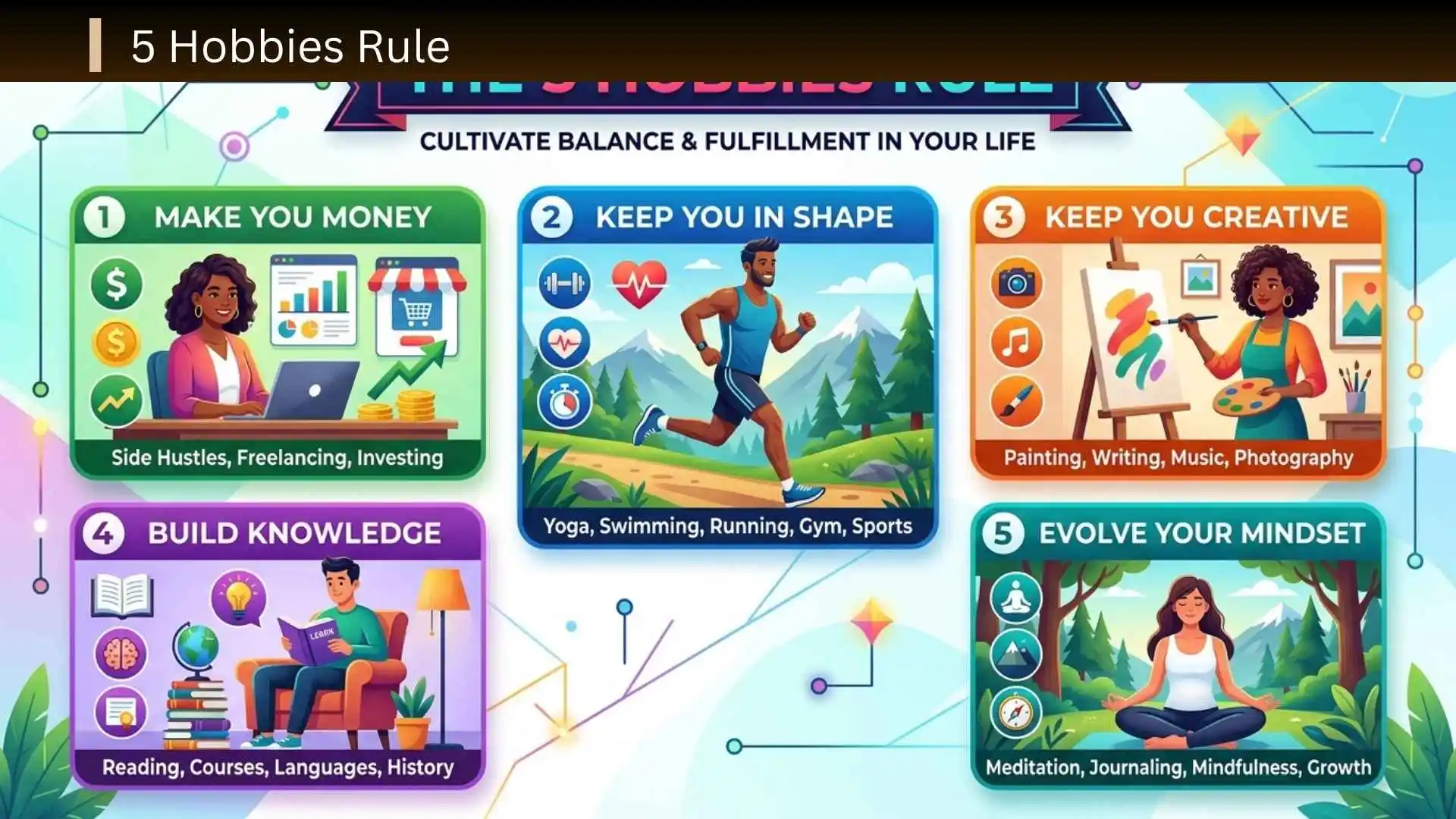
Have you ever felt like one hobby just isn’t enough to keep life interesting? I believe the 5 Hobbies Rule can change the way you think about your free time. Instead of putting all your energy into one activity, you can explore different hobbies that support different parts of your life from creativity and learning to relaxation, movement, and social connection.
You don’t have to be an expert at everything, and you don’t need to spend a lot of money to get started. When you give yourself permission to explore, you may discover interests you never knew you had. In this guide, I’ll show you what the 5 Hobbies Rule means, how you can use it in everyday life, and how choosing the right mix of hobbies can make your free time more enjoyable and meaningful.
What Is the 5 Hobbies Rule?
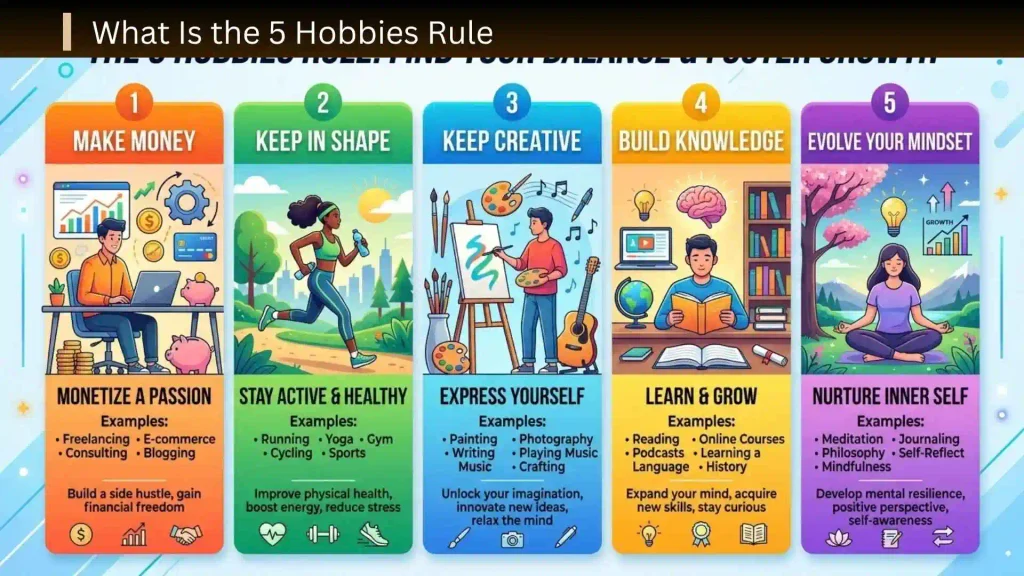
The 5 hobbies rule is a way of organizing your leisure activities into five broad categories:
- A hobby that can make you money
- A hobby that keeps you in shape
- A hobby that keeps you creative
- A hobby that builds knowledge
- A hobby that helps you evolve your mindset
This version has circulated online for several years, including social-media discussions dating back to at least 2021.
The framework does not mean that everyone literally needs five hobbies. In fact, one activity can often fit several categories. Photography, for example, can be creative and educational and may eventually become an income-generating skill. Gardening can combine movement, creativity, learning, relaxation, and social interaction.
So rather than treating the rule as a checklist, think of it as a hobby-planning framework.
The five categories at a glance
| Hobby category | Main purpose | Examples |
| Money | Develop a skill that may generate income | Photography, writing, coding, woodworking |
| Fitness | Add enjoyable physical activity | Hiking, swimming, cycling, tennis |
| Creativity | Make, perform, or express something | Painting, music, pottery, cooking |
| Knowledge | Learn and explore | Reading, languages, astronomy, history |
| Mindset | Reflect, decompress, or develop perspective | Journaling, meditation, gardening, fishing |
The categories overlap, and that overlap is often an advantage rather than a problem.
1. A Hobby That Can Make You Money

The first category is a hobby that can potentially develop into a source of income.
This does not mean every hobby needs to become a side hustle. Turning every enjoyable activity into a business can remove some of the freedom that makes hobbies appealing in the first place.
Instead, choose something where continued practice could produce a useful skill, service, product, or body of work.
Examples of money making hobbies
- Photography
- Writing
- Graphic design
- Coding
- Web design
- Sewing
- Woodworking
- Baking
- Illustration
- Video editing
- Craft making
- Teaching or tutoring
- Music production
For example, someone who enjoys photography could begin by learning composition and lighting, build a portfolio, and eventually offer portraits or event photography. Someone interested in woodworking might start by making projects for personal use before selling selected pieces.
Income is never guaranteed. Success depends on skill, demand, pricing, competition, marketing, consistency, and the type of market involved.
How to choose this hobby
Look for a skill that satisfies three conditions:
- You actually enjoy practicing it.
- You are willing to become better at it.
- There is a realistic way to create value for someone else.
The best choice is not necessarily the hobby with the highest theoretical earning potential. A modestly monetizable skill that you enjoy practicing may be more sustainable than a supposedly lucrative skill you quickly abandon.
Beginner tip
Do not start by buying professional equipment or building a business. Spend enough to test whether you genuinely enjoy the activity first.
2. A Hobby That Keeps You in Shape
The second category is a hobby involving physical movement.
This category works best when the activity feels like something you want to do rather than an obligation you have to complete.
Traditional exercise can certainly qualify, but hobbies such as hiking, cycling, swimming, dancing, tennis, recreational basketball, kayaking, or gardening may feel more engaging to someone who dislikes conventional workouts.
Examples of active hobbies
- Hiking
- Walking
- Cycling
- Swimming
- Tennis
- Pickleball
- Dancing
- Recreational sports
- Rowing
- Gardening
- Martial arts
- Kayaking
The right choice depends on your current fitness level, preferences, available facilities, weather, budget, and any physical limitations you need to consider.
For example, someone who enjoys competition may prefer tennis or pickleball, while someone who wants quieter outdoor movement may prefer walking or hiking.
Why enjoyment matters
A hobby does not need to look impressive to be useful.
A regular neighborhood walk can be a better personal choice than an activity you strongly dislike but believe is theoretically superior. The goal of this category is to find movement that fits naturally into your life.
Beginner tip
Choose the activity you can realistically imagine doing next month, not merely the one that sounds exciting today.
3. A Hobby That Keeps You Creative

Creativity is the third category.
Creative hobbies give you an opportunity to make decisions, experiment, solve problems, and produce something rather than simply consume entertainment.
You do not need to consider yourself an artist to benefit from a creative hobby.
Creative hobby ideas
- Painting
- Drawing
- Photography
- Creative writing
- Playing an instrument
- Singing
- Pottery
- Sewing
- Knitting
- Woodworking
- Cooking
- Baking
- Jewelry making
- Digital art
- Film making
- Floral arranging
Creative hobbies can range from highly structured activities to completely open-ended ones.
Learning to play guitar, for example, provides technical practice and musical expression. Baking involves following established techniques but also allows experimentation with flavors and presentation. Photography combines technical decisions with visual interpretation.
What makes a hobby creative?
A creative hobby does not necessarily require producing something traditionally considered “art.”
The important element is that you are making, composing, designing, performing, modifying, or expressing something.
That distinction can help you find creative activities that match your personality.
Beginner tip
Start with a small project instead of trying to master the entire craft.
If you want to try drawing, sketch one object. If you want to try photography, make a small series of photographs around one subject. If you want to learn cooking, master one dish before attempting an entire cuisine.
Small projects create visible progress without making the hobby feel like another full-time job.
4. A Hobby That Builds Knowledge
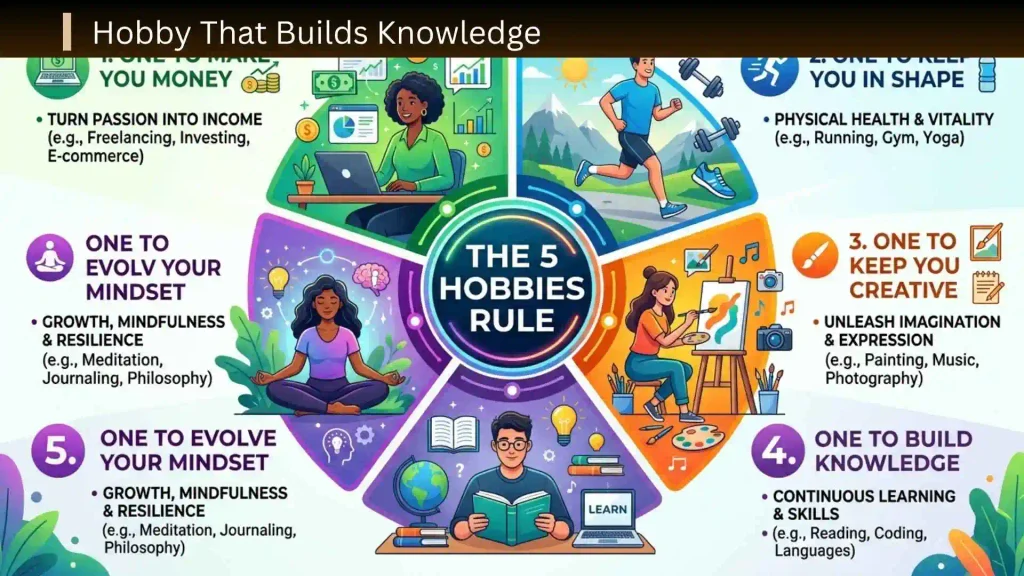
The fourth category focuses on curiosity and learning.
This is broader than simply reading books. A knowledge-building hobby can involve studying a subject, acquiring a practical skill, researching a topic, visiting museums, learning a language, observing nature, or taking structured classes.
Examples of knowledge-building hobbies
- Reading
- Learning a language
- Astronomy
- Birdwatching
- History
- Genealogy
- Chess
- Coding
- Learning about science
- Studying art history
- Taking online courses
- Researching local history
- Learning an instrument
- Cooking different cuisines
The best knowledge hobby usually begins with a question you genuinely want answered.
Instead of deciding, “I should learn something,” start with curiosity:
- How does the night sky work?
- Where did my town come from?
- How are different cuisines built around particular ingredients?
- How does a particular musical instrument work?
- What language would I enjoy learning?
- How can I identify birds in my neighborhood?
A specific question gives learning a direction.
Knowledge does not have to be academic
A hobby can build useful knowledge without becoming formal education.
Learning to repair bicycles, identify plants, read maps, understand personal photography, cook unfamiliar foods, or restore furniture can all expand your knowledge and practical abilities.
Beginner tip
Keep a simple record of what you learn. A notebook, digital document, reading list, or project log can make progress easier to see.
5. A Hobby That Helps You Evolve Your Mindset
The fifth category is usually described as a hobby that helps you evolve your mindset, although some versions describe this category as relaxation, mindfulness, or personal growth.
This category is intentionally less concrete than the others.
The goal is to have an activity that creates space for reflection, perspective, patience, or mental decompression.
Examples
- Journaling
- Meditation
- Gardening
- Fishing
- Walking without constant digital stimulation
- Reading reflective literature
- Nature observation
- Mindful cooking
- Puzzles
- Personal writing
- Volunteering
- Quiet creative activities
The right choice depends heavily on what you need from your free time.
Someone whose work is highly social might appreciate a solitary hobby. Someone who spends all day indoors might find that gardening or fishing creates a useful change of environment. Someone whose work is highly analytical might prefer an activity that uses their hands.
Mindset does not mean constant self-improvement
This is one of the most important ways to interpret the category.
A mindset hobby does not need to make you more productive every day.
Sometimes the value is simply creating enough mental distance from work and digital distractions to think clearly.
That is why relaxation can legitimately overlap with this category.
Do You Actually Need Five Hobbies?
No. The 5 hobbies rule is a framework, not a requirement.
There is no universal rule saying that a person needs exactly five hobbies to have a balanced life.
In fact, trying to maintain five completely separate hobbies can become unrealistic if you have a demanding job, family responsibilities, school, health considerations, or limited free time.
One online discussion about the framework highlights a practical issue: hobbies frequently overlap, so forcing every activity into only one category can make the system unnecessarily complicated.
Three carefully chosen hobbies may cover most or all five categories.
For example:
- Photography: creativity + knowledge + possible income
- Hiking: fitness + relaxation
- Book club: knowledge + social connection
You could therefore cover the framework without maintaining five separate weekly commitments.
Can One Hobby Count for More Than One Category?

Absolutely.
This is arguably one of the strongest features of the framework.
Consider gardening. It can involve:
- Physical movement
- Creative planning
- Learning about plants
- Time outdoors
- Relaxation
- Social interaction through gardening groups
Cooking can combine creativity and knowledge while potentially becoming an income-generating skill.
Photography can involve creativity, technical learning, outdoor activity, travel, and possible freelance work.
Playing in a recreational sports league can provide fitness, social connection, skill development, and enjoyment.
The goal is not to find five activities that each perform exactly one function.
A better question to ask
Instead of asking:
“Do I have five hobbies?”
Ask:
“Do my hobbies give me different kinds of experiences?”
That question produces a much more flexible system.
The Best 5 Hobbies Rule Examples
There is no universally correct set of five. Your choices should reflect your interests and circumstances.
Here are several practical combinations.
For someone who works at a desk
- Money: freelance writing or coding
- Fitness: cycling or swimming
- Creative: photography
- Knowledge: reading
- Mindset: gardening
This combination creates a strong contrast between screen-based work and physical, creative, and outdoor activities.
For someone who wants inexpensive hobbies
- Money: writing
- Fitness: walking
- Creative: sketching
- Knowledge: reading
- Mindset: journaling
Most of these can be started with equipment you may already have.
For someone who enjoys social activities
- Money: teaching a skill
- Fitness: recreational sports
- Creative: community theater or music
- Knowledge: book club
- Mindset: volunteering
This approach makes social interaction part of several hobbies rather than treating it as a separate obligation.
For someone who prefers quiet activities
- Money: writing
- Fitness: hiking
- Creative: drawing
- Knowledge: astronomy
- Mindset: gardening
The activities can largely be pursued independently while still providing variety.
For someone who wants hands on hobbies
- Money: woodworking
- Fitness: gardening
- Creative: pottery
- Knowledge: electronics
- Mindset: fishing
The emphasis here is on making, experimenting, and working with physical materials.
How to Choose Your Five Hobbies
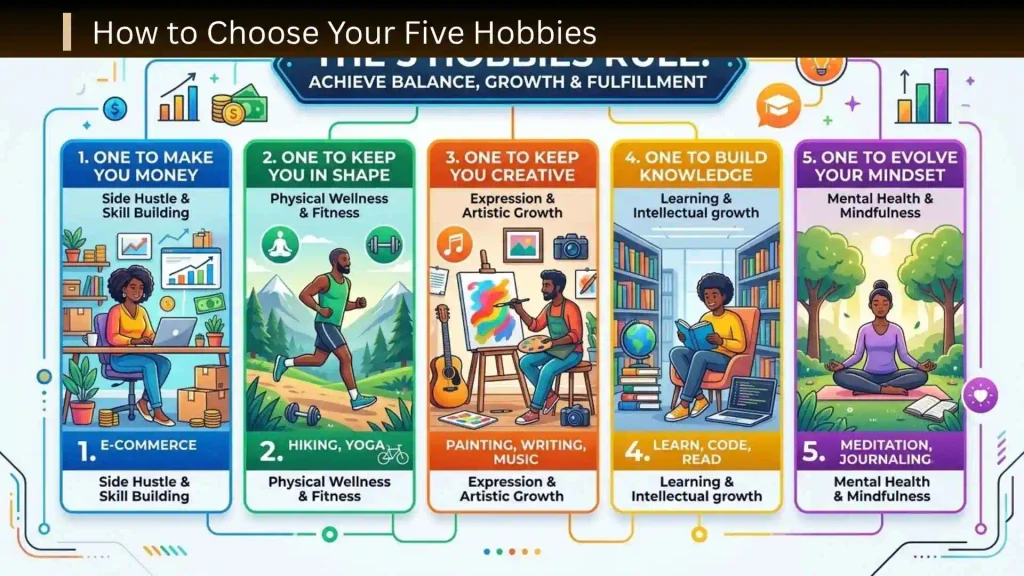
You do not need to decide all five immediately.
Start by examining your current life.
1. Identify what is missing
Ask yourself:
- Am I spending enough time moving?
- Do I have a creative outlet?
- Am I learning something because I want to?
- Do I have time away from screens?
- Do I have an activity that could eventually become useful professionally?
- Do I have hobbies that involve other people?
- Do I have anything I do purely because I enjoy it?
Your answers will reveal which category deserves attention.
2. Start with one category
You do not need to launch five new hobbies in the same month.
Choose the category that feels most neglected and experiment with one activity.
If you spend most of your day sitting, try an active hobby first. If your work leaves little room for creativity, try photography, drawing, music, cooking, or another making-based activity.
3. Test before committing
Give yourself permission to be a beginner.
Try a hobby several times before deciding whether you like it. The first session may feel awkward simply because you do not know what you are doing yet.
At the same time, you do not have to force yourself to continue something you genuinely dislike.
4. Consider the friction
A hobby can sound perfect but still fail because it is difficult to fit into your life.
Consider:
- Travel time
- Equipment
- Cost
- Available space
- Weather
- Scheduling
- Instruction
- Noise
- Physical demands
- Whether you need other people
A hobby that takes 10 minutes to begin at home may be easier to maintain than one that requires a one-hour drive to a specialized facility.
5. Let interests change
Your five hobbies do not need to remain the same forever.
You might spend a year learning photography, then become interested in gardening. You might stop playing tennis and discover hiking. A hobby that was perfect in college may no longer suit your schedule as an adult.
The framework should adapt to your life rather than dictate it.
How Much Time Should You Spend on the 5 Hobbies?
There is no universal time requirement.
The biggest mistake is treating five hobbies as five additional performance goals.
If you have only a few hours of free time each week, you could rotate activities instead of trying to practice every hobby every day.
For example:
| Day | Activity |
| Monday | 30 minutes of reading |
| Wednesday | 45-minute workout or active hobby |
| Friday | Creative project |
| Saturday | Outdoor activity |
| Sunday | Learning or personal project |
You could also have one primary hobby and several occasional hobbies.
The framework is about a variety of experiences, not maximizing the number of activities on your calendar.
Should Your Money Making Hobby Stay a Hobby?

This depends on your goals.
Monetizing a hobby can be rewarding when you enjoy the commercial side of the activity. But it can also introduce deadlines, customers, pricing pressure, marketing, taxes, competition, and expectations that did not exist when the activity was purely recreational.
For example, someone who enjoys baking might love making cakes for friends but dislike handling custom orders every weekend.
Someone who enjoys photography might love taking landscapes but have little interest in client photography.
That is perfectly fine.
A hobby can remain valuable even if it never produces a dollar.
If you do want to monetize it, treat the transition gradually. Build skill first, understand the market, and determine whether you actually enjoy the business side.
What If You Don’t Like the “Self-Improvement” Approach?
You can modify the rule.
The internet’s version of the 5 hobbies rule often frames hobbies around productivity: money, fitness, creativity, knowledge, and mindset. But leisure does not have to justify itself through productivity.
A hobby can simply be enjoyable.
Playing video games, collecting records, watching birds, baking cookies, building model kits, reading fiction, fishing, or playing cards can be worthwhile even when they do not improve your income or career.
A balanced hobby life should leave room for joy without optimization.
That is particularly important because turning every leisure activity into a measurable self-improvement project can make free time feel like another form of work.
Common Mistakes With the 5 Hobbies Rule
Treating five as a mandatory number
Five is simply the framework’s number. You may need two hobbies, four hobbies, or seven.
Choosing hobbies because they sound impressive
You do not need to learn an instrument, run marathons, or become an expert photographer because those activities look impressive.
Choose activities you genuinely want to explore.
Buying too much equipment too early
Beginners often confuse expensive equipment with commitment.
Test the hobby first. Upgrade when your actual needs justify it.
Making every hobby productive
Not everything needs to earn money, improve your career, or build a measurable skill.
Some activities are valuable precisely because they are enjoyable.
Trying to maintain everything simultaneously
Five new habits introduced at once can quickly become five abandoned habits.
Add activities gradually.
Ignoring overlap
Trying to find five completely separate hobbies can create unnecessary complexity. One well-chosen hobby can satisfy multiple categories.
Is the 5 Hobbies Rule Backed by Science?
Not as a formal five-hobby rule.
The concept is best understood as a popular self-development framework rather than an established scientific law or evidence-based prescription requiring exactly five hobbies. Contemporary discussions of the idea explicitly describe it as an internet framework, and versions differ in their categories.
That does not make the framework useless.
Its practical value comes from prompting people to consider whether their leisure time includes different forms of movement, creativity, learning, reflection, social interaction, and enjoyment.
The framework is therefore better used as a reflection tool than as a rule you must follow.
A Simple 5 Hobbies Rule Worksheet
If you want to build your own version, start here:
| Category | Your choice | Why you chose it |
| Money | __________ | __________ |
| Fitness | __________ | __________ |
| Creativity | __________ | __________ |
| Knowledge | __________ | __________ |
| Mindset | __________ | __________ |
Then add four practical questions:
How much will it cost?
Consider both startup expenses and ongoing costs.
Where will I do it?
Home, outdoors, a gym, studio, community center, club, or another location?
When will I do it?
Choose a realistic time rather than an idealized schedule.
What is my first small step?
Make the first action specific enough that you can complete it without extensive preparation.
For example, instead of writing “learn photography,” your first step could be “take 20 photographs using my phone this weekend and compare the results.”
The 5 Hobbies Rule vs. the 3 Hobby Rule
You may also encounter a 3-hobby rule online.
One common version suggests having:
- One hobby that can make you money or develop career-related skills
- One hobby that keeps you healthy
- One hobby purely for enjoyment
The 5-hobby version expands the concept by adding areas such as creativity, knowledge, and mindset.
Neither framework needs to be treated as a universal formula.
If three hobbies already give you the variety you want, there is no practical reason to add two more simply to reach five.
Frequently Asked Questions About the 5 Hobbies Rule
What is the 5 hobbies rule?
The 5 hobbies rule is a popular self-development framework that suggests having hobbies serving five purposes: potentially making money, maintaining physical activity, encouraging creativity, building knowledge, and developing your mindset. It is a flexible lifestyle concept, not a formal requirement.
What are the five hobbies everyone should have?
The commonly shared version recommends one hobby for money, one for fitness, one for creativity, one for knowledge, and one for mindset. However, there is no universal list of specific hobbies that everyone should have.
Do I really need five hobbies?
No. Five is simply the framework’s organizing number. You can have fewer hobbies, and one hobby can satisfy multiple categories.
What is a good money-making hobby?
Photography, writing, graphic design, coding, woodworking, sewing, baking, illustration, and video editing can potentially become income-generating skills. Actual income depends on skill, demand, customers, pricing, and consistency.
What is a good hobby for fitness?
Walking, hiking, cycling, swimming, dancing, tennis, pickleball, recreational sports, and kayaking are examples of active hobbies. Choose an activity appropriate for your abilities and one you are likely to enjoy consistently.
Can reading count as one of the five hobbies?
Yes. Reading can fit especially well into the knowledge category and may also serve as relaxation or personal reflection depending on what you read and how you use the activity.
Can one hobby count for multiple categories?
Yes. In practice, many hobbies naturally overlap. Photography can be creative and educational while potentially becoming a source of income. Gardening can combine physical activity, creativity, learning, relaxation, and social interaction.
What if I don’t have time for five hobbies?
Do not force five separate activities into your schedule. Start with one or two hobbies that address what you most want from your free time. You can add another later if it genuinely improves your life.
Conclusion
The 5 hobbies rule is most useful when treated as a flexible framework rather than a strict formula. Its five categories—money, fitness, creativity, knowledge, and mindset—encourage you to think about whether your hobbies provide different kinds of value.
You do not need five separate hobbies, and you do not need to turn every interest into a productivity project. The better goal is to build a collection of activities that fits your personality, budget, schedule, space, and interests.
If one hobby covers several categories, that is a strength. If a hobby serves no purpose other than making you happy, that is valuable too. The best hobby system is ultimately the one you can enjoy and sustain.

I’m James Anderson, a dedicated writer and lifelong learner who enjoys researching topics and explaining them in a practical way. Through my work at Cognivoora, I aim to give readers reliable, easy-to-follow information that helps them learn something new. I always try to keep my writing natural, useful, and focused on the questions readers actually have.
Books:
- A Practical Guide to Better Thinking
- Questions Worth Asking