
If you want inexpensive hobbies for men, you do not need expensive gear, a large workshop, or a lot of free time. Many rewarding hobbies can be started with items you already own or with a small initial budget.
The best low cost hobby depends on what you want from it: relaxation, creativity, fitness, learning, social connection, or simply something enjoyable to do after work.
35 Inexpensive Hobbies for Men
Here are practical options ranging from completely free activities to hobbies that require a modest starter investment.
| Hobby | Typical Starting Cost | Space Needed | Best For |
| Walking | $0 | Outdoor | Fitness and relaxation |
| Reading | $0–$20 | Small | Learning and escape |
| Writing | $0–$15 | Small | Creativity and reflection |
| Photography | $0 if using a phone | Small | Creativity |
| Hiking | $0–$30+ | Outdoor | Exercise and exploration |
| Bodyweight fitness | $0 | Small | Strength and fitness |
| Cooking | $0–$30+ | Kitchen | Practical skills |
| Baking | $5–$25+ | Kitchen | Creativity |
| Drawing | $5–$20 | Small | Art |
| Sketching | $5–$20 | Small | Observation and creativity |
| Birdwatching | $0–$50+ | Outdoor | Nature |
| Fishing | $20–$50+ | Outdoor | Relaxation |
| Gardening | $5–$30+ | Outdoor/indoor | Plants and hands-on work |
| Chess | $0–$25 | Small | Strategy |
| Puzzles | $5–$20 | Small | Mental stimulation |
| Geocaching | $0–$20+ | Outdoor | Exploration |
| Origami | $0–$10 | Small | Creativity |
| Calligraphy | $5–$20 | Small | Handwriting and art |
| Wood carving | $15–$40+ | Small/work area | Crafting |
| Model building | $10–$40+ | Small | Detailed projects |
| Home brewing coffee | $10–$40+ | Kitchen | Coffee appreciation |
| Learning a language | $0–$20+ | Small | Learning |
| Online courses | $0–$30+ | Small | Skill development |
| Coding | $0 | Small | Technology |
| Astronomy | $0–$50+ | Outdoor | Science |
| Stargazing | $0 | Outdoor | Relaxation |
| Journaling | $5–$15 | Small | Reflection |
| Origami | $0–$10 | Small | Creativity |
| Board games | $0–$30+ | Small | Socializing |
| Card games | $0–$15 | Small | Socializing |
| Volunteering | $0 | Varies | Community |
| DIY repair | $0–$30+ | Work area | Practical skills |
| Cycling | $0 if you own a bike | Outdoor | Fitness |
| Swimming | Varies | Outdoor/indoor | Fitness |
| Learning an instrument | $0–$50+ | Small | Music |
Costs are approximate starting ranges rather than fixed prices. Existing equipment, local fees, and the type of gear you choose can change the total.
1. Reading
Reading is one of the easiest inexpensive hobbies to start because libraries can provide books at little or no cost.
You can choose fiction, biographies, history, science, business, philosophy, sports, or subjects related to your other interests. Libraries and legitimate free digital-book sources can make the hobby especially affordable.
Why try it: It is flexible, portable, and requires very little equipment.
Starter setup: A library card or a book you already own.
2. Walking
Walking can become a surprisingly engaging hobby when you give it a purpose.
Instead of simply walking around the same block, explore different neighborhoods, parks, trails, waterfronts, or historic areas. You can also combine walking with photography, birdwatching, podcasts, or audiobooks.
Cost: Free if you already have suitable footwear.
Best for: People who want an inexpensive outdoor hobby with almost no learning curve.
3. Hiking
Hiking turns walking into exploration. You can start with local parks and easy trails rather than immediately buying specialized equipment.
As your interest grows, you can learn about trail navigation, wildlife, plants, weather, and outdoor safety.
For beginners, choosing trails appropriate for your fitness and checking local conditions before heading out is more important than buying expensive equipment.
4. Bodyweight Fitness

You do not necessarily need a gym membership to develop a consistent exercise hobby.
A basic bodyweight routine can include movements such as squats, lunges, push-ups, planks, and other exercises appropriate for your fitness level.
Cost: Potentially $0.
Equipment: None is required for many basic exercises, although an exercise mat can be useful.
The main advantage is convenience: you can practice at home without traveling to a gym.
5. Cooking
Cooking is both a hobby and a useful life skill.
Rather than trying complicated recipes immediately, choose a category you enjoy. You might learn how to make better pasta, soups, grilled foods, bread, sauces, curries, or inexpensive meals.
A good approach is to master one technique at a time—such as knife skills, roasting, sautéing, or making sauces.
6. Baking
Baking offers a creative alternative to everyday cooking.
You can start with simple recipes such as cookies, muffins, quick breads, or basic cakes. Once you understand how ingredients interact, you can experiment with flavors and techniques.
It is also a hobby that can produce something useful at the end of each project.
7. Photography With Your Phone
You do not need a dedicated camera to explore photography.
A smartphone can provide enough equipment to learn fundamentals such as composition, lighting, perspective, framing, and timing.
Try giving yourself small challenges:
- Photograph interesting architecture.
- Capture different types of natural light.
- Practice close-up photography.
- Photograph ordinary objects from unusual angles.
- Create a themed photo collection.
If photography becomes a serious interest, you can consider a dedicated camera later rather than buying one immediately.
8. Drawing
Drawing is one of the most accessible creative hobbies.
A pencil and inexpensive paper are enough to begin. Practice simple subjects such as household objects, plants, buildings, or people.
You do not need to aim for professional artwork. The useful part of the hobby is learning to observe shapes, proportions, shadows, and details.
9. Sketching
Sketching is similar to drawing but can be approached as a more spontaneous practice.
Carry a small notebook and sketch things you see during the day. You can sketch a coffee cup, a tree, a building, a bicycle, or anything else that catches your attention.
It works particularly well for people who enjoy hobbies that can be practiced in short sessions.
10. Writing
Writing can be completely free if you use a computer, phone, or basic notebook.
You might write:
- Short stories
- Personal essays
- Journal entries
- Reviews
- Poetry
- Travel notes
- Fiction
- Ideas for future projects
Writing can also complement other hobbies. For example, a hiking enthusiast could keep a trail journal, while a cook could document recipes and experiments.
11. Journaling
Journaling is a simpler form of writing that can fit into a few minutes a day.
You can record what you did, what you learned, ideas you want to explore, books you read, projects you completed, or goals you are working toward.
A basic notebook is enough.
12. Chess
Chess is an inexpensive hobby with substantial depth.
You can learn the basic rules with free online resources and play without purchasing anything if you use a digital platform. A physical chess set can be inexpensive if you prefer playing on a board.
The hobby can remain casual or become increasingly strategic as you study openings, tactics, endgames, and famous games.
13. Card Games
A standard deck of playing cards opens up many possibilities.
Depending on your interests and social circle, you can learn traditional games, strategy games, solitaire variations, or card-based games designed for groups.
The low equipment cost makes cards particularly useful when you want a hobby that can involve friends or family.
14. Puzzles
Jigsaw puzzles, logic puzzles, crossword puzzles, Sudoku, and other puzzle formats provide different kinds of mental challenges.
If physical puzzles become expensive, digital versions and library resources can reduce the cost.
Choose the format based on what you enjoy: visual problem-solving, wordplay, mathematics, deduction, or spatial reasoning.
15. Birdwatching
Birdwatching can start without binoculars.
Begin by observing birds in your backyard, neighborhood, local park, or other suitable outdoor areas. A free bird-identification resource can help you learn to recognize species by appearance, behavior, sound, and habitat.
Binoculars can be added later if you decide you enjoy the hobby.
16. Stargazing
Stargazing is another hobby where you can begin with almost no equipment.
Find a location with a reasonably unobstructed view of the sky and learn to identify prominent stars, planets, and constellations.
A smartphone astronomy app can help you learn what is visible, although you should avoid staring at bright phone screens continuously if you are trying to preserve night vision.
You can eventually explore binocular astronomy or telescopes if the hobby develops.
17. Astronomy
Astronomy takes stargazing a step further by focusing on understanding what you are observing.
You can learn about planets, stars, galaxies, stellar evolution, space missions, and the history of astronomical discoveries.
Books, public lectures, educational websites, and astronomy clubs can provide plenty of learning opportunities before you purchase equipment.
18. Gardening
Gardening can be inexpensive if you start small.
A few containers, soil, and seeds can be enough to begin growing herbs or other suitable plants. You can gradually learn about soil, watering, sunlight, propagation, pruning, and seasonal growing.
Container gardening is particularly useful if you do not have a large yard.
19. Fishing
Fishing has a higher starting cost than completely free hobbies, but basic equipment can still make it accessible.
A beginner generally needs suitable fishing equipment, bait or lures, and any required local license or permit. Rules vary by location, species, season, and waterway, so check applicable regulations before fishing.
The hobby can be as simple as spending a quiet afternoon outdoors or as technical as learning different rigs, species, and fishing techniques.
20. Geocaching
Geocaching combines technology with outdoor exploration.
Participants use GPS-enabled devices to locate hidden containers or other designated locations. Many people start with a smartphone and comfortable shoes.
It can turn an ordinary walk into a small treasure hunt and is particularly suitable for people who enjoy exploration and problem-solving.
21. Origami
Origami requires little more than paper and patience.
Start with simple models before attempting complex designs. The hobby teaches you to follow sequences of folds carefully and can become surprisingly challenging as the models become more intricate.
You can use ordinary paper while learning rather than immediately buying specialty supplies.
22. Calligraphy and Hand Lettering

Calligraphy is a good choice if you enjoy detailed, repetitive creative work.
You can begin with inexpensive pens and paper and practice basic strokes, spacing, letterforms, and consistency.
Modern hand lettering can also be explored without following traditional calligraphy techniques exactly.
23. Wood Carving
Wood carving requires somewhat more equipment and safety awareness than drawing or writing, but it can still be started on a modest budget.
A beginner can work on small projects rather than purchasing a large collection of tools.
Because sharp tools are involved, learning proper handling and using appropriate protective practices should come before attempting complex carving.
24. Model Building
Model building can include scale vehicles, aircraft, ships, buildings, miniatures, and other subjects.
The hobby rewards patience and attention to detail. You can begin with a simple kit and gradually learn assembly, painting, finishing, and customization.
It is a particularly good choice if you prefer hands-on projects that can be completed over several sessions.
25. DIY Repair
Learning basic household repair can turn everyday problems into practical projects.
You might learn how to:
- Tighten or replace hardware
- Patch minor household damage
- Assemble furniture
- Maintain basic household items
- Organize tools
- Perform simple maintenance tasks
Only attempt repairs appropriate to your knowledge and equipment. Electrical, gas, structural, or other hazardous work may require a qualified professional.
26. Coding
Coding can be an almost entirely free hobby.
You can start by learning the basics of a programming language and building small projects. Instead of spending months only watching tutorials, try creating something simple, such as a calculator, text-based game, personal webpage, or basic automation script.
The hobby becomes more rewarding when you use programming to solve a problem that interests you.
27. Learning a Language
Learning another language is inexpensive when you use free educational resources.
You can practice vocabulary, pronunciation, reading, listening, and writing using a combination of apps, books, videos, podcasts, and conversation practice.
Progress is usually more sustainable when you study consistently for a short period rather than attempting occasional marathon sessions.
28. Free Online Learning
Learning itself can become a hobby.
Choose a subject you genuinely want to understand—history, astronomy, economics, psychology, art, geography, technology, or another field—and create a personal learning project.
Libraries, educational websites, public lectures, and open course materials can provide plenty of material without requiring expensive courses.
29. Coffee Brewing
If you already drink coffee, learning more about brewing can turn an everyday routine into a hobby.
You can explore grind size, water temperature, brewing ratios, different preparation methods, and coffee origins.
You do not need an expensive espresso machine. Start by improving one variable at a time with the equipment you already have.
30. Cycling
Cycling can be inexpensive if you already own a functional bicycle.
Instead of treating it only as transportation or exercise, explore different routes and gradually learn basic bicycle maintenance.
Before buying specialized gear, determine what type of cycling you actually enjoy—casual neighborhood riding, commuting, recreational trails, or longer road rides.
31. Swimming
Swimming can be a recreational hobby as well as a form of physical activity.
The main cost depends heavily on access to a pool and local admission or membership fees. If you already have convenient access, it can be a relatively simple hobby with minimal equipment.
Beginners should focus on appropriate instruction and water safety.
32. Learning a Musical Instrument

You do not necessarily need an expensive instrument to explore music.
A used beginner-friendly instrument can be enough to determine whether you enjoy practicing. Free lessons and tutorials can help with fundamentals such as rhythm, chords, scales, and basic technique.
Choose an instrument based on your space, budget, and musical interests rather than buying the most expensive option available.
33. Volunteering
Volunteering is a hobby-like way to spend free time while contributing to a community.
Opportunities can include environmental projects, animal organizations, food assistance programs, community events, libraries, or other local organizations.
The financial cost can be minimal, although transportation and other incidental expenses may vary.
34. Thrifted DIY Projects
Thrift stores, garage sales, and items you already own can become sources of inexpensive creative projects.
For example, you might refinish a small piece of furniture, repurpose an old container, repair an item, or turn discarded materials into something useful.
The key is to choose projects where the potential material cost remains lower than simply purchasing a new item.
35. Collecting With a Clear Budget
Collecting can become expensive quickly, but it does not have to.
Choose a narrow category and establish a firm spending limit. You could collect postcards, interesting books, coins, vintage paper items, rocks, or another category that interests you.
The most important rule is to collect because you enjoy researching and appreciating the objects—not because you feel pressured to constantly buy more.
How to Choose the Right Inexpensive Hobby

With so many options, the easiest way to choose is to start with the experience you want.
If you want a relaxing hobby
Consider:
- Reading
- Fishing
- Gardening
- Stargazing
- Puzzles
- Coffee brewing
- Walking
These hobbies can provide slower-paced activities without requiring constant competition or performance.
If you want to stay active
Consider:
- Walking
- Hiking
- Cycling
- Swimming
- Bodyweight fitness
- Geocaching
Choose something you are realistically willing to do regularly rather than simply choosing the activity that sounds most impressive.
If you want to make things
Try:
- Cooking
- Baking
- Drawing
- Wood carving
- Model building
- Origami
- DIY projects
- Calligraphy
Creative hobbies can be especially satisfying because you can see a tangible result from your effort.
If you want to learn
Consider:
- Reading
- Coding
- Astronomy
- Language learning
- Chess
- Writing
- Online courses
These hobbies are useful when you enjoy making progress and developing knowledge over time.
If you want more social interaction
Look at:
- Chess
- Card games
- Board games
- Volunteering
- Cycling groups
- Hiking groups
- Community gardening
- Local hobby clubs
A low-cost hobby can become much more enjoyable when shared with other people.
How to Keep a Hobby Inexpensive

The hobby itself is not always what makes it expensive. Equipment upgrades and unnecessary purchases often increase the cost.
Start with what you already own
Before buying anything, look around your home.
You may already have:
- Books
- Cooking equipment
- A smartphone
- Exercise space
- Playing cards
- Basic tools
- Paper and pencils
- A bicycle
- Containers suitable for gardening
Use existing resources to test your interest first.
Set a starter budget
Give yourself a fixed amount for the first month or first project.
For example, rather than deciding that you need a complete photography kit, start with your phone and spend nothing. If you still enjoy photography after several weeks, then consider whether additional equipment would genuinely improve your experience.
Avoid buying everything at once
A common mistake with new hobbies is purchasing advanced equipment before developing the skill.
Start with the minimum equipment needed. Upgrade only when you can identify a specific limitation with what you currently have.
Choose hobbies with reusable supplies
Some hobbies require consumable materials every time you participate. Others rely primarily on equipment you can use repeatedly.
If keeping costs low is your priority, hobbies such as walking, writing digitally, coding, chess, stargazing, and bodyweight exercise can be easier to maintain cheaply.
Inexpensive Hobbies vs. Cheap Hobbies
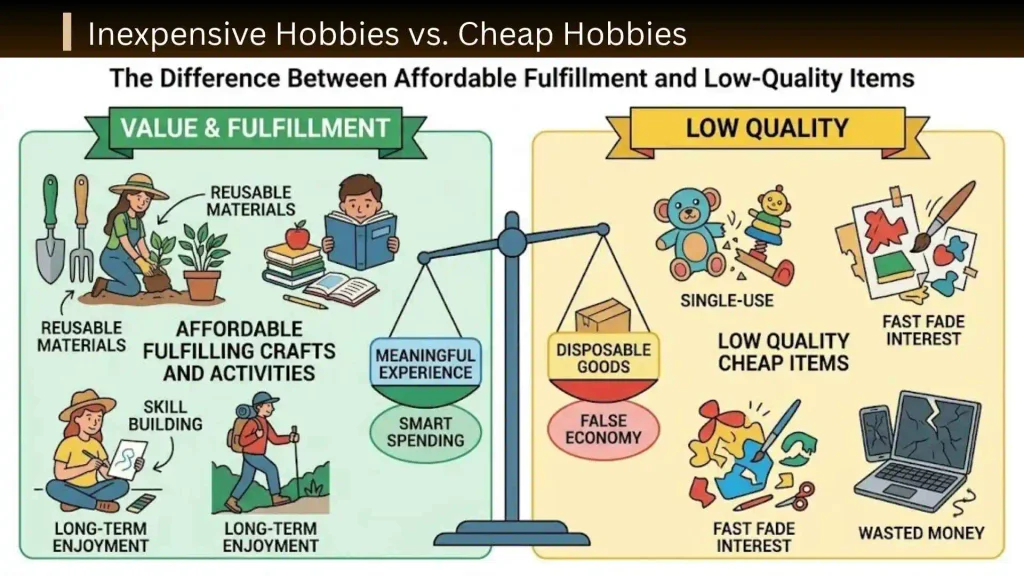
There is a useful distinction between a hobby being cheap to start and being cheap to maintain.
For example, a hobby might require only $20 initially but involve regular purchases afterward. Another hobby might cost $50 upfront but require almost no additional spending.
When comparing hobbies, consider three costs:
- Starting cost — what you need to begin.
- Recurring cost — what you regularly spend to continue.
- Upgrade cost — optional purchases you may make as your skill increases.
This approach gives you a better idea of the hobby’s real affordability.
A Simple Way to Start
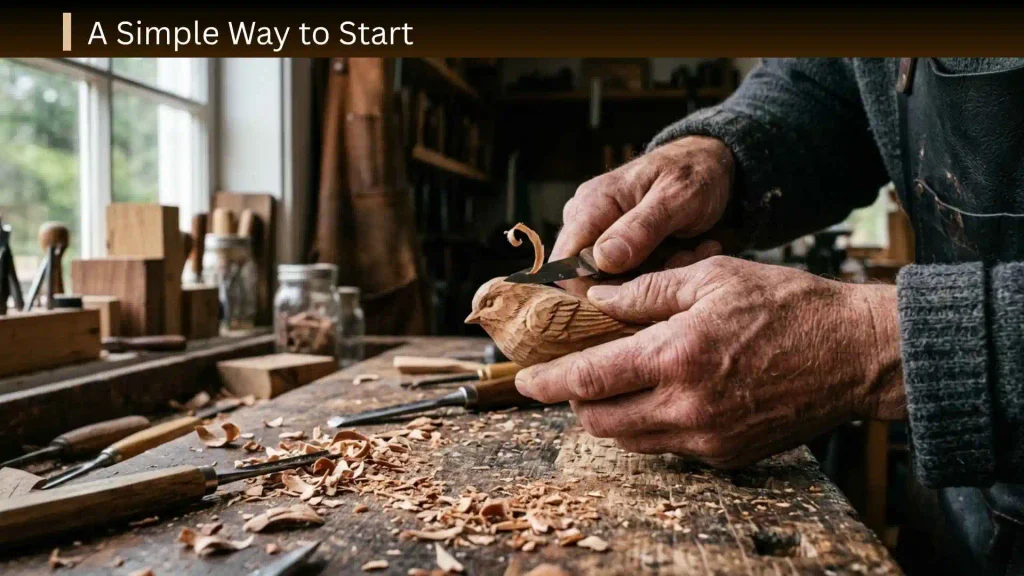
If you cannot decide between several hobbies, use a trial approach.
Pick three hobbies from different categories—for example:
- One active hobby
- One creative hobby
- One learning hobby
Give each one a few sessions before deciding whether to continue.
You do not need to find your lifelong hobby immediately. The goal is to discover which activity naturally makes you want to spend more of your free time doing it.
Frequently Asked Questions
What are the best inexpensive hobbies for men?
Some of the most accessible options include walking, reading, writing, drawing, bodyweight fitness, cooking, hiking, chess, photography with a smartphone, gardening, coding, stargazing, and learning a language. The best choice depends on whether you want relaxation, exercise, creativity, learning, or social interaction.
What hobbies can men do for free?
Walking, writing digitally, bodyweight exercise, reading library books, coding, stargazing, language learning with free resources, sketching with existing materials, and many forms of online learning can be started for little or no money.
What is a good hobby for a man who is bored at home?
Try cooking, drawing, reading, chess, puzzles, coding, writing, model building, learning an instrument, or DIY projects. If you want something more active, bodyweight workouts or indoor mobility exercises can provide movement without requiring a gym.
What are good inexpensive outdoor hobbies?
Walking, hiking, birdwatching, stargazing, gardening, geocaching, fishing, cycling, and photography are all possibilities. Your actual cost will depend on the equipment, location, transportation, and permits required.
What is a good hobby for a man who wants to learn a useful skill?
Cooking, coding, basic DIY repair, gardening, photography, writing, language learning, and bicycle maintenance can combine enjoyment with practical skill development.
How can I start a hobby without spending much money?
Start with the equipment you already have, use libraries and free educational resources, borrow equipment when appropriate, buy used items when practical, and avoid purchasing advanced gear until you know you enjoy the activity.
What inexpensive hobbies can be done alone?
Reading, writing, drawing, coding, chess, puzzles, gardening, photography, cooking, model building, stargazing, and learning a language can all be pursued independently.
What inexpensive hobbies are good for meeting people?
Chess clubs, card and board game groups, volunteering, hiking groups, cycling groups, community gardening, photography groups, and local classes can provide opportunities to meet people while pursuing an interest.
Conclusion
The best inexpensive hobbies for men are not necessarily the ones with the lowest price tag. A good hobby is one that fits your interests, available time, living situation, and budget well enough that you actually want to keep doing it.
Start small. Use what you already own, choose one activity that genuinely interests you, and give it enough time to see whether it holds your attention. If it does, develop the skill gradually rather than immediately spending money on expensive equipment.

I’m Sophia Carter, a writer who enjoys discovering interesting ideas and transforming them into helpful content. At Cognivoora, I write with a simple goal: to make information clearer, more accessible, and genuinely useful for readers. I value thoughtful research, easy explanations, and content that people can trust and return to whenever they need it.
Books:
- The Knowledge Journey
- Understanding the World Around Us