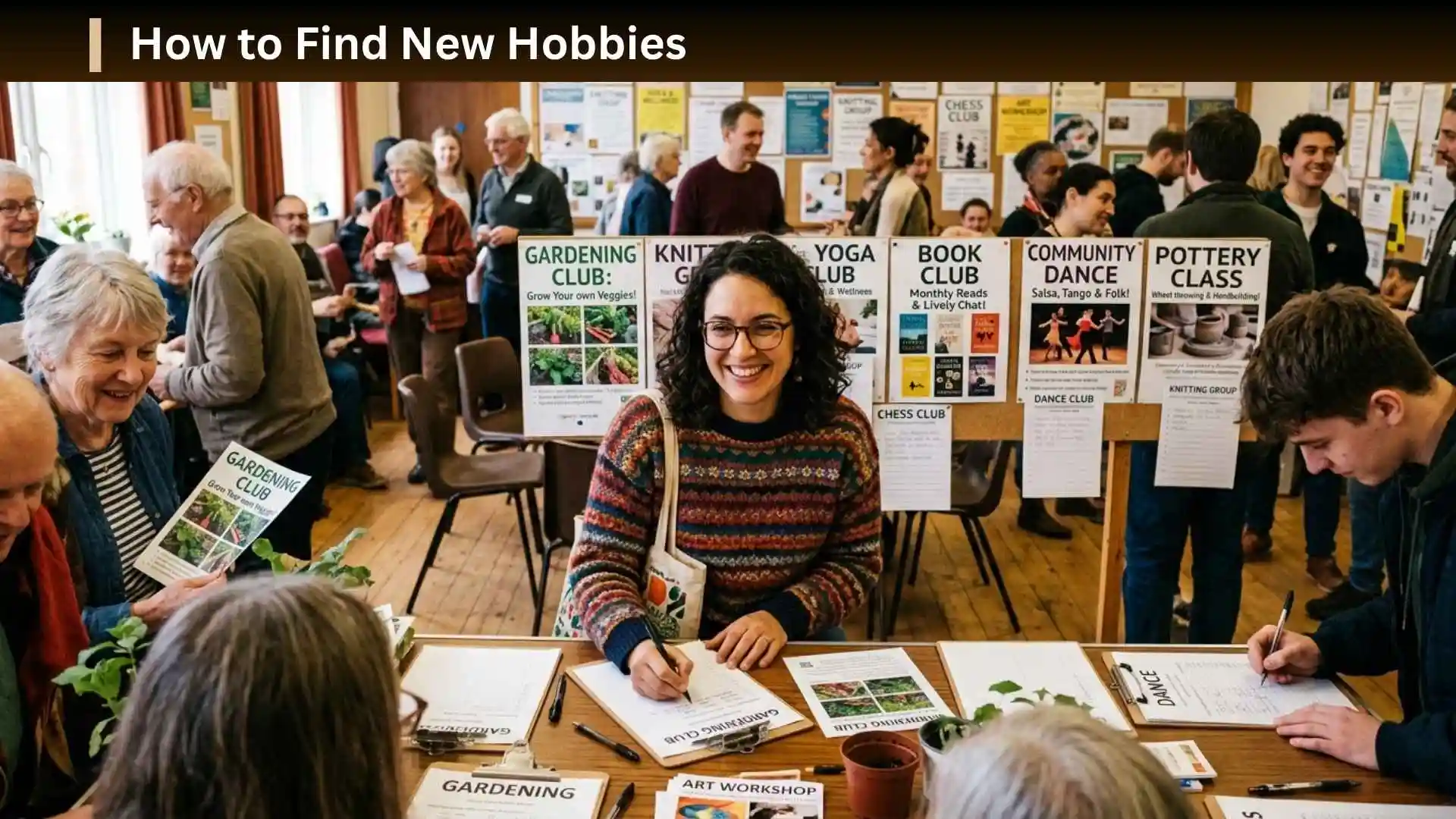
Finding a hobby as an adult can be surprisingly difficult. Work, family responsibilities, routines, and limited free time can make it hard to figure out what you actually enjoy doing.
The good news is that you do not need to discover a lifelong passion immediately. The most effective approach is to explore small possibilities, test them without much commitment, and pay attention to what you genuinely want to do again.
If you are wondering how to find hobbies as an adult, start by thinking about what you want your free time to provide: relaxation, creativity, exercise, learning, social connection, accomplishment, or simply fun. Then choose a few activities that fit your real schedule and try them before investing heavily in equipment or classes.
Why Finding a Hobby as an Adult Can Feel Difficult
Children often encounter hobbies through school, parents, friends, or organized activities. Adults have to create those opportunities themselves.
You may also feel pressure to choose something “useful,” productive, impressive, or worth the money. That can turn leisure into another task on your to-do list.
Another common obstacle is being uncomfortable as a beginner. Starting photography, pottery, guitar, painting, dancing, woodworking, or a new sport means being inexperienced at first. That feeling can discourage people before they discover whether they actually enjoy the activity.
Research on hobbies and leisure activities has associated enjoyable activities with aspects of psychological well-being, social connection, and quality of life, although these findings do not mean that every hobby will produce the same benefits for every person.
The goal, therefore, is not to find the “perfect” hobby. It is to find activities that are enjoyable and realistic enough for you to keep exploring.
Start With What You Want From a Hobby
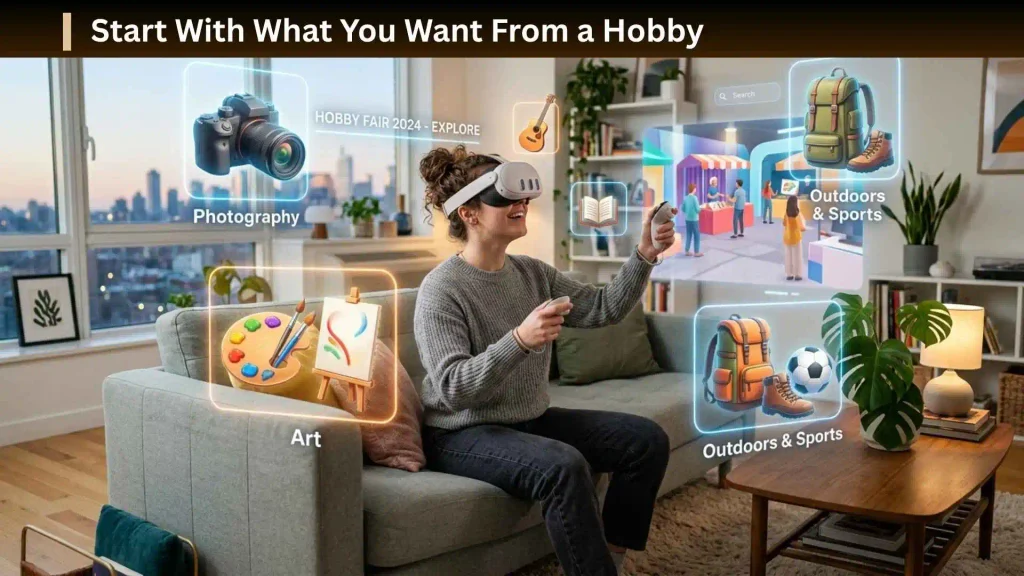
Before searching for hundreds of hobby ideas, ask yourself what you want the hobby to do for you.
If you want to relax
Look for activities with relatively low pressure and an enjoyable rhythm.
Examples include:
- Reading
- Gardening
- Drawing
- Coloring
- Journaling
- Puzzles
- Knitting
- Crochet
- Birdwatching
- Cooking
- Photography
- Walking
If you want to be more creative
Consider hobbies where you make, design, write, perform, or transform something.
Examples include:
- Painting
- Sketching
- Pottery
- Sewing
- Woodworking
- Creative writing
- Calligraphy
- Photography
- Baking
- Jewelry making
- Music
- DIY projects
If you want exercise without making exercise the entire point
Choose an activity where movement is naturally part of the experience.
Examples include:
- Hiking
- Cycling
- Swimming
- Dancing
- Kayaking
- Pickleball
- Tennis
- Rock climbing
- Golf
- Gardening
If you want to meet people
Social hobbies can make it easier to build regular connections because you repeatedly encounter people with a shared interest.
Consider:
- Board-game groups
- Running clubs
- Hiking groups
- Dance classes
- Book clubs
- Community theater
- Volunteer organizations
- Craft classes
- Recreational sports leagues
- Language-learning groups
The National Institute on Aging also recommends meaningful social and recreational activities as ways to remain engaged and connected, particularly as people age.
If you want to keep learning
Try hobbies with a clear learning curve.
Good options include:
- Learning a language
- Playing an instrument
- Chess
- Drawing
- Cooking
- Astronomy
- History
- Coding
- Genealogy
- Bird identification
- Photography
- Home repair
Look Back at What You Enjoyed Before
Your past can provide useful clues.
Ask yourself:
- What did I enjoy as a child?
- What did I naturally do when I had free time?
- What activities did I give up because of school or work?
- What did I enjoy before becoming busy with adult responsibilities?
- What hobbies did friends or family members introduce me to?
- What did I enjoy learning about even when nobody required me to learn it?
You do not have to return to exactly the same activity.
If you once enjoyed drawing, for example, you might explore digital illustration, watercolor, sketching, graphic design, or photography.
If you liked collecting things as a child, you might enjoy coins, books, records, vintage objects, plants, sports memorabilia, or another collection that interests you now.
Rediscovering old interests is a useful starting point because you already have some evidence that the subject attracted your attention. Looking at childhood interests and previously abandoned hobbies is also commonly recommended as a way to generate adult hobby ideas.
Pay Attention to What You Already Do for Fun
Your current behavior may reveal your interests more accurately than a generic list of hobbies.
Look at what you voluntarily search for, watch, read, or talk about.
For example:
| If you often… | You might explore… |
| Watch cooking videos | Cooking or baking |
| Look at travel photography | Photography |
| Watch home renovation content | DIY or woodworking |
| Read about history | Historical research or genealogy |
| Watch sports | Playing, coaching, collecting, or sports photography |
| Browse plants and gardens | Gardening |
| Listen to music constantly | An instrument, music production, or singing |
| Watch drawing tutorials | Sketching or illustration |
| Read novels | Reading groups or creative writing |
| Enjoy strategy games | Chess, board games, or puzzles |
The important distinction is between consuming content about a hobby and actually enjoying doing the activity.
You might love watching woodworking videos but dislike woodworking yourself. That is useful information, not failure.
Make a “Maybe” List Instead of Choosing One Hobby
Do not force yourself to select a lifelong hobby on day one.
Create a list of five to ten possibilities.
For example:
- Photography
- Hiking
- Cooking
- Watercolor painting
- Pickleball
- Gardening
- Chess
- Creative writing
Then narrow the list based on your actual circumstances.
A hobby can be exciting in theory but impractical in your current life. The best choice is often the one that is interesting and accessible.
Use the Five-Factor Hobby Test
Before trying a hobby, evaluate it using five practical factors.
1. Interest
Does the activity genuinely make you curious?
2. Time
Can you realistically give it the amount of time it requires?
A hobby that requires three uninterrupted hours may not work if you typically have 30-minute windows.
3. Cost
Can you try it inexpensively before making a larger investment?
4. Space
Do you have somewhere to practice, store equipment, or complete projects?
5. Access
Can you actually participate where you live?
For example, kayaking may sound appealing, but access to suitable water and equipment matters. A pottery hobby may require a studio or class rather than a spare corner of an apartment.
This approach prevents you from choosing hobbies based entirely on fantasy versions of your life.
Choose a Hobby That Fits Your Schedule
One of the biggest mistakes adults make is selecting a hobby that requires more time than they consistently have.
Instead, start with your available time.
If you have 10 20 minutes
Consider:
- Reading
- Journaling
- Sketching
- Language practice
- Puzzles
- Meditation
- Photography walks
- Hand lettering
If you have about an hour
Consider:
- Cooking
- Baking
- Guitar practice
- Drawing
- Crafting
- Exercise classes
- Gardening
- Chess
- Writing
If you have several hours on weekends
You can consider hobbies that require longer sessions, such as:
- Hiking
- Cycling
- Woodworking
- Pottery
- Golf
- Fishing
- Volunteering
- Home improvement
- Camping
- Larger creative projects
The National Institute on Aging similarly emphasizes finding a balance that fits your individual limits and starting with manageable activities rather than making enjoyable activities another source of stress.
Try Before You Commit
You do not need to buy everything associated with a hobby before discovering whether you like it.
Instead, create a low-cost trial.
For example:
- Borrow a camera before buying one.
- Try a free drawing tutorial before purchasing art supplies.
- Attend a beginner dance class before buying specialized clothing.
- Use a library book before building a home library.
- Borrow camping equipment before purchasing a full setup.
- Try a community garden before creating your own garden.
- Take an introductory class before buying expensive equipment.
The purpose of the first attempt is not mastery. It is information.
Ask yourself:
Did I enjoy doing this, or did I only like the idea of doing it?
That question can save you considerable time and money.
Give New Hobbies More Than One Attempt
One awkward first session does not necessarily mean a hobby is wrong for you.
The first experience can be distorted by:
- Not knowing what you are doing
- Poor instructions
- Uncomfortable equipment
- A difficult beginner project
- Nervousness
- Unrealistic expectations
- Choosing the wrong environment
- Being tired or distracted
Try an activity again under better conditions before eliminating it.
At the same time, you do not need to force yourself to continue something you consistently dislike.
A useful rule is:
Give a promising hobby enough attempts to get past the initial beginner awkwardness, but do not turn experimentation into an obligation.
Do Not Confuse Being Bad at Something With Not Enjoying It
This is especially important for adults.
You might enjoy playing guitar even if you are terrible at guitar right now.
You might enjoy painting even if your paintings do not look like professional artwork.
You might enjoy dancing even if you forget the steps.
A hobby does not have to produce impressive results to be worthwhile.
Ask two separate questions:
- Am I good at this yet?
- Do I enjoy doing this?
The second question matters more when your goal is leisure.
Starting something unfamiliar can also involve self-doubt because adults are accustomed to being competent in many areas of life. Learning to tolerate being a beginner can be part of the process itself.
Find the Right Difficulty Level
A hobby can be too easy, too difficult, or appropriately challenging.
If it is completely effortless, you may become bored.
If it is overwhelmingly difficult, you may become frustrated.
Look for something that gives you:
- A manageable starting point
- Small opportunities to improve
- Enough variety to stay interesting
- Challenges you can gradually increase
For example, someone interested in photography does not need to begin with advanced studio lighting.
A better progression might be:
Take photos → learn composition → experiment with manual settings → edit photos → develop a personal style.
The same principle applies to cooking, music, crafts, sports, writing, gardening, and other hobbies.
Match the Hobby to Your Personality and Social Preference
Think about how you prefer to spend your free time.
If you prefer solitude
Consider:
- Reading
- Painting
- Writing
- Gardening
- Photography
- Cooking
- Puzzles
- Model building
- Coding
- Collecting
If you prefer social activities
Consider:
- Recreational sports
- Dance classes
- Book clubs
- Board games
- Community theater
- Group hiking
- Volunteering
- Craft workshops
- Language exchanges
If you want both
Choose hobbies that can switch between solo and group participation.
Examples include:
- Photography
- Cycling
- Hiking
- Running
- Chess
- Cooking
- Gardening
- Music
- Art
You can practice independently and occasionally join a group or community.
Consider Hobbies That Give You Something to Make
If you find passive entertainment unsatisfying, try a hobby that produces a tangible result.
You could make:
- A meal
- A painting
- A piece of furniture
- A knitted item
- A garden
- A photograph
- A short story
- A handmade gift
- A piece of music
- A repaired object
This can create a visible sense of progress without requiring the hobby to become a business or achievement project.
Consider Hobbies That Get You Outside
If much of your day happens indoors or in front of a screen, an outdoor hobby can provide a useful change of environment.
Possible options include:
- Hiking
- Gardening
- Birdwatching
- Fishing
- Cycling
- Photography
- Geocaching
- Kayaking
- Walking
- Stargazing
- Nature journaling
You do not have to choose an intense outdoor activity. Even something as simple as learning to identify local birds or photographing interesting plants can become a genuine hobby.
Consider Hobbies You Can Do at Home
For adults with limited transportation, busy schedules, or limited access to clubs, home-based hobbies can be easier to maintain.
Try:
- Reading
- Baking
- Cooking
- Drawing
- Painting
- Crochet
- Knitting
- Sewing
- Creative writing
- Playing an instrument
- Chess
- Puzzles
- Model building
- Home gardening
- Language learning
The best home hobby is not necessarily the cheapest one. Look for something that fits your available space, cleanup tolerance, noise level, and storage capacity.
Find Hobbies Through Local Communities
Once you have a few ideas, look beyond the internet.
Potential places to discover hobbies include:
- Public libraries
- Community centers
- Parks and recreation departments
- Local recreation leagues
- Museums
- Art studios
- Colleges and continuing-education programs
- Independent bookstores
- Gardening clubs
- Makerspaces
- Volunteer organizations
- Local hobby shops
- Neighborhood groups
A class can be particularly useful when you need structure or feel unsure about starting alone.
It also gives you an opportunity to determine whether you enjoy the activity and the social environment surrounding it.
Use the “Opposite of Work” Strategy
One useful way to choose a hobby is to contrast it with your daily routine.
If you work at a computer all day, consider something tactile or physical.
If your job involves constant interaction with people, consider a quiet solo activity.
If your work is highly structured, try something creative with fewer rules.
If your work is physically demanding, a calmer hobby may feel more restorative.
For example:
| Your daily life | Hobby direction |
| Computer-heavy job | Gardening, hiking, woodworking |
| Physically demanding work | Reading, drawing, chess |
| Highly social job | Photography, puzzles, writing |
| Highly repetitive work | Creative projects, music |
| Constant decision-making | Simple crafts, gardening |
| Highly structured schedule | Open-ended art or writing |
This is not a rule. Some people genuinely want a hobby similar to their profession. The point is to consider whether your free time should balance your working life or complement it.
Avoid Choosing a Hobby Because It Looks Impressive
A hobby does not have to sound sophisticated.
Reading mystery novels is a hobby.
Watching birds is a hobby.
Playing video games is a hobby.
Building model kits is a hobby.
Baking cookies is a hobby.
Collecting baseball cards is a hobby.
Writing fan fiction is a hobby.
The value of a hobby comes from what it contributes to your life—not how impressive it sounds when you tell someone about it.
Avoid Turning Every Hobby Into a Side Hustle
Modern culture often encourages people to monetize everything.
But a hobby can remain a hobby.
You do not have to:
- Sell your artwork
- Start a cooking business
- Monetize your YouTube channel
- Sell photographs
- Become a professional musician
- Turn woodworking into a business
If making money motivates you, that is perfectly valid. But keeping an activity separate from work can also be valuable.
Research on leisure has found associations between enjoyable activities and psychological and physical well-being, reinforcing the idea that leisure does not need to be economically productive to have value.
Create a 30 Day Hobby Experiment
If you still cannot decide, turn the process into a simple experiment.
Week 1: Explore
Choose three hobbies that interest you.
Watch beginner material, read about them, visit a local class, or talk to someone who participates.
Week 2: Try
Spend at least one short session testing each option.
Do not worry about being good.
Week 3: Repeat
Return to the activity that interests you most.
Pay attention to how you feel before, during, and after doing it.
Week 4: Decide
Ask:
- Did I look forward to doing it?
- Did I enjoy the process?
- Was it realistic with my schedule?
- Was the cost reasonable?
- Did I want to learn more?
- Would I willingly do it again without someone reminding me?
If the answer is mostly yes, you may have found a promising hobby.
If not, choose another candidate.
A Simple Hobby Scorecard
You can make the decision more objective by scoring each hobby from 1 to 5.
| Factor | Score |
| Interest | /5 |
| Enjoyment | /5 |
| Fits my schedule | /5 |
| Affordable to try | /5 |
| Easy to access | /5 |
| Fits my space | /5 |
| Want to improve | /5 |
| Social fit | /5 |
| Total | /40 |
The score is not a scientific test. It is simply a way to identify practical differences between several possibilities.
A hobby with a slightly lower score may still be the better choice if you find yourself genuinely excited about it.
What If You Have No Interests at All?
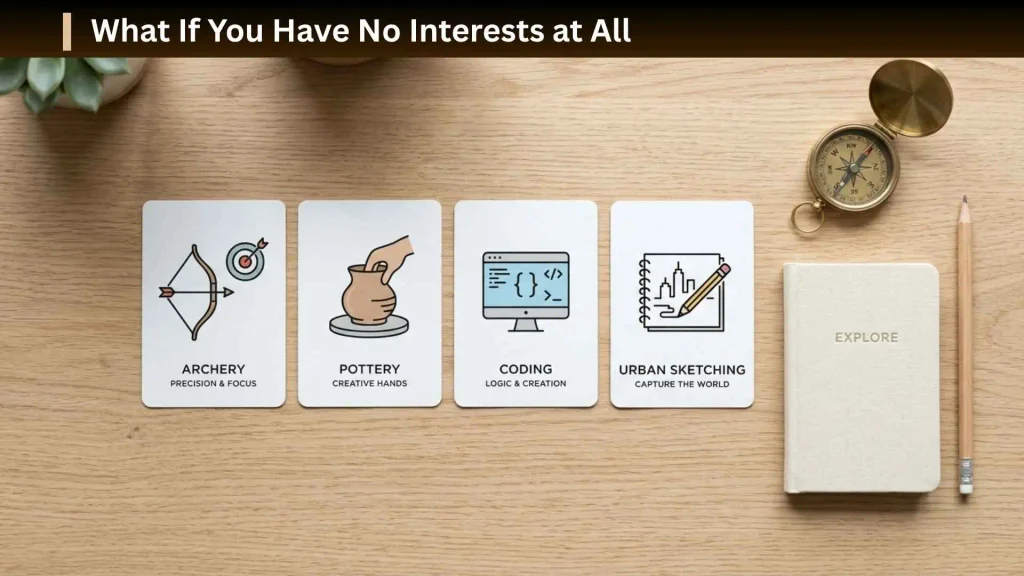
You may not actually have “no interests.”
You may simply be disconnected from them.
Instead of asking:
“What am I passionate about?”
ask smaller questions:
- What am I curious about?
- What sounds mildly interesting?
- What would I try if nobody judged me?
- What would I do if I could not use my phone for an evening?
- What topics do I repeatedly search for?
- What activities make time pass quickly?
- What did I enjoy before I became busy?
- What would I like to learn just because I can?
You only need enough curiosity to conduct the first experiment.
Passion does not have to come first.
What If You Lose Interest Quickly?
That is normal during hobby exploration.
Instead of assuming you are incapable of maintaining hobbies, examine the reason.
Maybe:
- The hobby was too expensive.
- The learning curve was too steep.
- The sessions were too long.
- You preferred doing it socially.
- You preferred doing it alone.
- You liked the subject but not the activity.
- You chose it because it looked impressive.
- You were trying to become good too quickly.
- The hobby did not fit your current lifestyle.
Changing hobbies is not necessarily wasted effort. Each trial gives you information about your preferences.
How Many Hobbies Should an Adult Have?
There is no required number.
One meaningful hobby can be enough.
Some people enjoy several activities because they serve different purposes—for example, one social hobby, one creative hobby, and one outdoor activity.
Others prefer a single activity they can explore deeply.
Do not create a large list of hobbies simply because you feel that you should be more interesting or productive.
The objective is to have leisure you actually enjoy.
Beginner Friendly Hobby Ideas for Adults
If you want a starting list, consider these categories:
Creative hobbies
- Drawing
- Painting
- Photography
- Creative writing
- Calligraphy
- Pottery
- Sewing
- Crochet
- Knitting
- Jewelry making
Active hobbies
- Walking
- Hiking
- Cycling
- Swimming
- Dancing
- Tennis
- Pickleball
- Golf
- Climbing
Intellectual hobbies
- Reading
- Chess
- Puzzles
- Learning languages
- Genealogy
- Astronomy
- History
- Creative writing
Nature based hobbies
- Gardening
- Birdwatching
- Hiking
- Fishing
- Nature photography
- Stargazing
- Plant identification
Social hobbies
- Book clubs
- Board games
- Recreational sports
- Dance classes
- Volunteering
- Community theater
- Craft groups
- Language exchanges
Hands on hobbies
- Cooking
- Baking
- Woodworking
- Model building
- DIY projects
- Sewing
- Electronics
- Home improvement
You can also explore online hobby classes when local opportunities are limited; current course directories include beginner options across subjects such as drawing, guitar, cooking, chess, crochet, and other interests.
The Best Hobby Is the One You Will Actually Do
When choosing among hobbies, it is tempting to ask which one is objectively best.
That is usually the wrong question.
A better question is:
“Which activity am I curious enough to try and able to fit into my actual life?”
A hobby that requires little equipment, fits into your schedule, and makes you want to return can be far more valuable than an exciting activity that is difficult to access.
Think of hobby discovery as experimentation rather than a major life decision.
Try something.
Learn from it.
Keep it if you enjoy it.
Change it if you do not.
Over time, you may discover interests that become important parts of your life.
Frequently Asked Questions
How do I find a hobby as an adult if I have no interests?
Start with curiosity rather than passion. Make a list of activities that sound even slightly interesting, then test a few inexpensive options. Look at your childhood interests, the subjects you search for online, and the activities you naturally enjoy watching or learning about.
What is the easiest way to find a hobby?
Start with activities that have a low barrier to entry. Reading, walking, drawing, cooking, photography with a phone, journaling, puzzles, gardening, and beginner classes can all provide simple ways to experiment.
How do I choose a hobby that I will stick with?
Choose based on your real schedule, budget, location, energy level, and social preferences. Then try the hobby several times instead of making a decision based entirely on one first session.
Is it too late to start a new hobby as an adult?
No. Adults can begin new hobbies at any age. You do not need previous experience to start learning something recreationally, and being a beginner is a normal part of developing a new interest.
What hobbies are good for adults who are busy?
Look for hobbies that can be divided into short sessions, such as reading, drawing, journaling, language learning, photography, puzzles, cooking, gardening, or playing an instrument. The best option depends on how much uninterrupted time you actually have.
How can I find a hobby that helps me meet people?
Look for activities that naturally involve repeated interaction, such as recreational sports, book clubs, dance classes, volunteer groups, hiking clubs, board-game groups, craft workshops, and language exchanges.
Should I spend money on a hobby before knowing whether I like it?
Usually, it makes sense to test the hobby first. Borrow equipment, use existing supplies, attend an introductory class, or find a low-cost version before making a larger purchase.
What if I try several hobbies and dislike all of them?
Treat each attempt as useful information. You may need to change the activity, difficulty, environment, social setting, or amount of time involved. You are not required to find a lifelong hobby immediately.
Conclusion
Learning how to find hobbies as an adult is less about discovering one perfect passion and more about giving yourself permission to experiment.
Start with what you want from your free time. Think about old interests, current curiosity, and activities you naturally gravitate toward. Then filter your ideas through practical considerations such as time, cost, space, accessibility, and whether you prefer solo or social activities.
Most importantly, try before you commit.
You do not need to be talented, productive, or passionate on the first day. A good hobby is simply an activity you enjoy enough to return to—and sometimes the only way to discover that is to give yourself permission to be a beginner.

I’m Olivia Bennett, a passionate writer who loves exploring ideas, learning new concepts, and sharing knowledge in a straightforward way. I write for Cognivoora with the goal of making useful topics easier to understand without unnecessary complexity. My approach combines research, clarity, and a reader-first perspective.
Books:
- Think Clearly, Live Better
- The Curious Reader’s Guide