If you are wondering whether to include hobbies on your resume, the answer is: sometimes. Hobbies can strengthen a resume when they reveal relevant skills, interests, personality traits, or experiences that support the position you want. They are especially useful for students, recent graduates, career changers, and applicants with limited professional experience.
The key is to be selective. Your hobbies should add information that your work experience, education, and skills sections do not already communicate.
Should You Put Hobbies on Your Resume?
Yes, you can put hobbies on your resume when they are relevant and provide useful context about your qualifications.
Hobbies are usually an optional resume section, not a replacement for professional experience, education, certifications, or job-related skills. They work best when they demonstrate qualities that matter for the position or help explain your interests and transferable abilities.
Consider including hobbies when:
- You have limited professional experience.
- You are a student or recent graduate.
- You are changing careers.
- A hobby demonstrates a skill relevant to the position.
- Your hobby directly relates to the industry or job.
- The employer specifically asks about hobbies or interests.
- The activity provides meaningful evidence of teamwork, creativity, leadership, discipline, or another relevant quality.
If you already have substantial professional experience and your resume is crowded, hobbies may be less valuable than additional information about your accomplishments and skills.
Best Hobbies to Put on a Resume
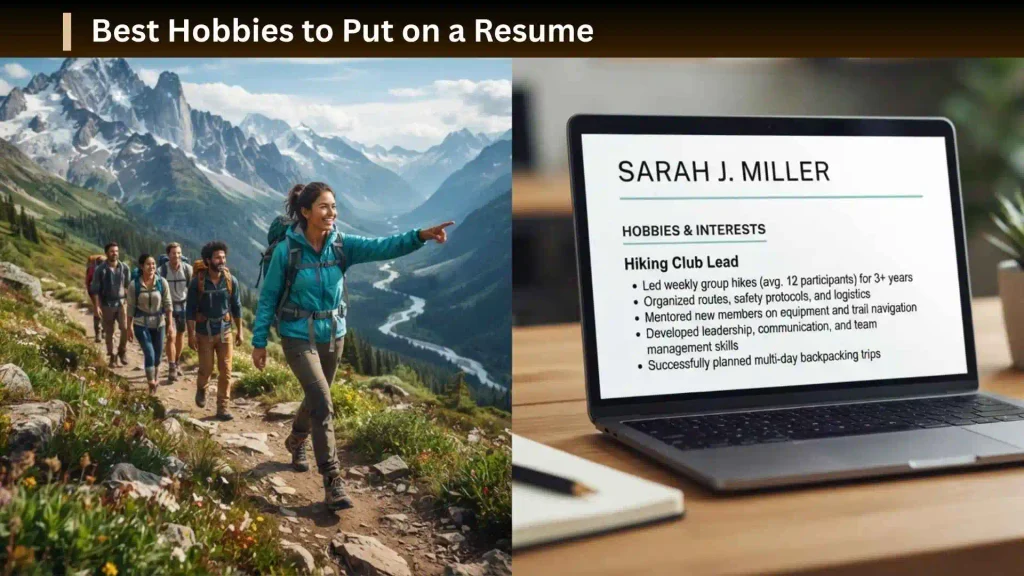
The best hobbies on a resume are not necessarily the most unusual ones. They are the activities that help demonstrate something relevant about you as a candidate.
Here are useful examples and the qualities they may communicate.
| Hobby | Potentially Demonstrates | Best Fit For |
| Team sports | Teamwork, communication, cooperation | Sales, management, customer service |
| Running or endurance sports | Discipline, persistence, goal-setting | Many professional roles |
| Photography | Creativity, visual awareness, technical skills | Marketing, media, design |
| Writing or blogging | Communication, research, creativity | Writing, marketing, communications |
| Painting or drawing | Creativity, visual thinking, attention to detail | Design, advertising, creative roles |
| Coding personal projects | Technical ability, problem-solving, initiative | Technology and software roles |
| Chess | Strategy, concentration, analytical thinking | Analytical and technical roles |
| Playing an instrument | Practice, discipline, creativity | Education, creative roles, general applications |
| Volunteering | Service, teamwork, responsibility | Nonprofits, education, healthcare-related workplaces |
| Cooking or baking | Organization, creativity, attention to detail | Hospitality, food-related roles |
| Woodworking or DIY projects | Planning, problem-solving, precision | Skilled trades, engineering, design |
| Travel | Planning, adaptability, cultural awareness | Travel, hospitality, international roles |
| Book clubs | Communication, discussion, collaboration | Education, communications, community roles |
| Gardening | Patience, planning, consistency | Environmental, community, outdoor roles |
These examples should be tailored to the job rather than copied as a generic list. Career guidance from Indeed similarly recommends choosing hobbies that connect to the position, company, or skills the employer is seeking.
Hobbies on Resume Examples
Simply writing “Reading” or “Sports” provides limited information. A more specific description can explain what you actually do and why the activity matters.
Team Sports
Instead of:
Sports
Try:
Basketball: Play in a local recreational league, developing teamwork, communication, and collaboration skills.
This gives the employer more context than a single word.
Photography
Instead of:
Photography
Try:
Photography: Create and edit landscape and event photography projects using digital photography and editing tools.
This can be particularly useful for someone pursuing creative, marketing, media, or communications work.
Writing
Instead of:
Writing
Try:
Creative Writing: Regularly write short-form articles and fiction, focusing on clear communication, storytelling, and editing.
For a writing-related position, this hobby may also provide a natural talking point during an interview.
Coding
Instead of:
Coding
Try:
Programming Projects: Build small personal software projects to practice programming, debugging, and problem-solving.
For technology applicants, personal projects may be more valuable when presented in a dedicated Projects section rather than buried under hobbies.
Volunteering
Instead of:
Volunteering
Try:
Community Volunteering: Help organize local community events and support volunteer activities throughout the year.
If the volunteering involves substantial responsibilities, it may deserve its own Volunteer Experience section instead of being classified as a hobby. Volunteer experience can provide meaningful evidence of skills, particularly for candidates with limited professional experience.
Hobbies for Different Types of Jobs
A hobby becomes more useful when it supports the qualities required by the job.
Hobbies for Business and Management Resumes
Consider hobbies such as:
- Team sports
- Coaching
- Community leadership
- Chess
- Public speaking
- Organizing events
- Volunteering
These activities can provide examples of collaboration, planning, leadership, communication, or strategic thinking.
Hobbies for Marketing Resumes
Relevant options may include:
- Photography
- Blogging
- Graphic design
- Video creation
- Writing
- Social media projects
- Podcasting
- Event planning
If a hobby has produced measurable work, such as a portfolio, publication, or completed project, consider presenting the achievement as a project rather than simply calling it a hobby.
Hobbies for Creative Jobs
Creative applicants might include:
- Drawing
- Painting
- Photography
- Illustration
- Creative writing
- Music
- Filmmaking
- Crafting
- Fashion design
Creative hobbies can provide evidence of creativity and initiative when professional experience is limited.
Hobbies for Technology Jobs
Potentially relevant hobbies include:
- Programming
- Building websites
- Robotics
- Electronics projects
- Game development
- Data projects
- 3D printing
- Technology experimentation
For technical candidates, however, a Projects or Technical Projects section is often a better place for substantial work.
Hobbies for Education Jobs
Potentially relevant activities include:
- Reading
- Writing
- Tutoring
- Coaching
- Volunteering
- Music
- Theater
- Educational clubs
If you regularly mentor, tutor, coach, or teach others, describe the actual responsibility rather than reducing it to a casual hobby.
Hobbies for Students and Recent Graduates

Hobbies can be particularly useful when you do not yet have extensive professional experience.
A student may not have years of employment history, but extracurricular activities, hobbies, volunteer work, clubs, sports, and personal projects can demonstrate transferable skills.
For example:
Photography: Develop photography projects focused on composition, lighting, and digital editing.
Soccer: Member of a university soccer team, participating in regular practices and competitive matches.
Community Service: Participate in local volunteer activities supporting community events.
These examples give an employer additional evidence about how you spend your time and what skills you practice.
Career guidance commonly recommends hobbies and extracurricular activities for applicants who have limited work experience because they can help demonstrate skills beyond formal employment.
Hobbies for a Career Change Resume
Hobbies can also support a career transition when they connect your existing experience with your new career direction.
Suppose you worked in an administrative role but want to move into graphic design. A hobby involving photography, illustration, web design, or visual projects may help demonstrate that your interest in the new field is genuine.
However, do not rely on the hobby alone.
If you have completed relevant courses, freelance projects, certifications, volunteer work, or personal projects, those should usually receive greater emphasis.
The hobby can provide additional context rather than pretending to replace professional experience.
How to Choose Hobbies for Your Resume
Choosing the right hobbies requires more thought than making a list of everything you enjoy.
1. Start With the Job Description
Look at the qualities and responsibilities emphasized in the job posting.
If the role emphasizes teamwork, a genuine team-based hobby may be useful.
If it emphasizes creativity, a creative hobby may be relevant.
If it involves community engagement, volunteering may provide useful context.
The connection should be logical rather than forced.
2. Choose Hobbies That Demonstrate Something
Ask yourself:
What does this hobby tell an employer that the rest of my resume does not?
For example:
- Team sports → collaboration
- Photography → creativity and technical practice
- Chess → strategic thinking
- Volunteering → community involvement and responsibility
- Writing → communication
- Personal coding → technical initiative
Indeed recommends choosing hobbies that demonstrate skills or interests relevant to the position rather than simply listing activities without context.
3. Be Specific
“Travel” is broad.
A more informative description could be:
International Travel: Plan independent trips and explore different cultures and destinations.
Likewise, “music” is vague.
A stronger version might be:
Guitar: Practice and perform guitar regularly, including informal group performances.
Specificity makes the activity easier for a hiring manager to understand.
4. Be Honest
Only include hobbies you genuinely participate in or have meaningful knowledge of.
Do not add an activity simply because you think it sounds impressive.
A hiring manager may ask about anything on your resume, so you should be comfortable discussing every hobby you list.
5. Keep the Section Short
Hobbies should not take over your resume.
A few strong, relevant examples are generally more useful than a long catalog of activities. Indeed recommends keeping the section concise and placing it toward the end of the resume.
How to List Hobbies on a Resume
A simple format works well:
Hobbies & Interests
- Photography: Create landscape and event photography projects using digital editing tools.
- Basketball: Participate in a local recreational league and regularly practice with teammates.
- Creative Writing: Write short stories and articles as an ongoing personal project.
You can also use a shorter format if space is limited:
Hobbies & Interests
Photography • Basketball • Creative Writing • Community Volunteering
The descriptive format is preferable when the hobby demonstrates a specific skill or experience that is relevant to the position.
Where Should Hobbies Go on a Resume?
In most cases, hobbies and interests should appear near the bottom of the resume, after the more important qualifications.
A typical order might be:
- Contact information
- Professional summary or objective
- Work experience
- Education
- Skills
- Certifications or projects, when relevant
- Hobbies and interests
The exact order can vary depending on your experience and the position. Hobbies should not push important qualifications off the page simply to make room for personal interests.
Hobbies vs. Interests on a Resume
Although the terms are often used together, they are not exactly the same.
A hobby is generally an activity you actively participate in, such as playing basketball, painting, photography, gardening, or woodworking.
An interest can be broader or more passive. For example, someone may have an interest in baseball because they follow games and statistics without actually playing the sport.
You do not necessarily need separate sections for both. A single Hobbies & Interests section is often sufficient.
Hobbies You Should Usually Leave Off Your Resume
Not every personal activity belongs on a professional resume.
Be cautious about including hobbies that:
- Have no meaningful connection to the position.
- Take up valuable space without adding useful information.
- Could distract from your qualifications.
- You cannot comfortably discuss in an interview.
- Reveal personal information you would rather keep private.
- Could reasonably be interpreted as dangerous or inappropriate.
You should also avoid listing hobbies simply because they sound impressive.
The goal is not to make your resume look more interesting at any cost. The goal is to provide useful evidence about your fit for the role. Indeed specifically advises considering how an employer might interpret a hobby before including it.
Should You List Common Hobbies Like Reading or Watching Movies?
You can, but common hobbies usually need context to be valuable.
“Reading” by itself tells an employer very little because it is extremely broad.
A more specific example might be:
Reading: Regularly read business and nonfiction books focused on communication, leadership, and technology.
Even then, include it only if it contributes something useful to your application.
Similarly, “watching movies” generally provides little professional value unless there is a meaningful connection to the position, such as film production, criticism, media, or filmmaking.
Should Hobbies Be Included on an ATS Resume?
An Applicant Tracking System (ATS) is software employers may use to help manage and screen job applications.
Hobbies generally should not be used as a substitute for important job-related keywords, qualifications, skills, experience, or accomplishments.
For an ATS-friendly resume, prioritize the terminology and qualifications that genuinely match the job description. If you include hobbies, keep them concise and relevant.
For example:
Hobbies & Interests: Photography, creative writing, recreational basketball
Do not stuff the section with keywords simply to influence screening software.
Hobbies vs. Skills: Which Is More Important?
Skills are generally more important than hobbies.
A skill section tells an employer directly what you can do. A hobby may provide supporting evidence of interests or transferable qualities.
For example:
Skill: Adobe Photoshop
is more direct than:
Hobby: Photography
If photography has helped you develop practical editing skills, you can potentially mention both—but the professional skill should receive greater emphasis when it is relevant to the job.
The same principle applies to programming, writing, design, project management, coaching, and other activities that can develop demonstrable skills.
When a Hobby Should Become a Project or Experience
Sometimes the activity is too substantial to be treated as a simple hobby.
Consider moving it into another resume section if you:
- Built a website or application.
- Created a significant design portfolio.
- Published articles or books.
- Sold products you made.
- Organized major events.
- Coached a sports team.
- Led a community initiative.
- Completed substantial freelance work.
- Created a business around the activity.
For example, instead of:
Hobby: Web development
you could use:
Personal Project Portfolio Website: Designed and developed a responsive personal website to showcase projects and professional work.
That communicates substantially more value.
Common Mistakes When Listing Hobbies
Listing Too Many Hobbies
A long list can make the resume look unfocused.
Choose the strongest activities rather than everything you enjoy.
Using Generic One Word Lists
“Reading, music, travel, sports” does not provide much useful information.
When appropriate, add enough detail to show why the activity matters.
Choosing Hobbies That Are Unrelated
A hobby does not need to match the job perfectly, but there should be a reason for including it.
Repeating Information Already on the Resume
If your professional experience already demonstrates leadership, adding several hobbies solely to show leadership may add little new information.
Exaggerating Your Involvement
Do not describe casual participation as significant expertise.
Accuracy matters throughout a resume, including the hobbies section.
Putting Hobbies Too High on the Page
Your most relevant professional qualifications should generally receive priority.
Hobbies usually belong toward the end unless the activity is directly relevant and substantial enough to function as experience or a project.
A Simple Formula for Writing Hobbies on a Resume
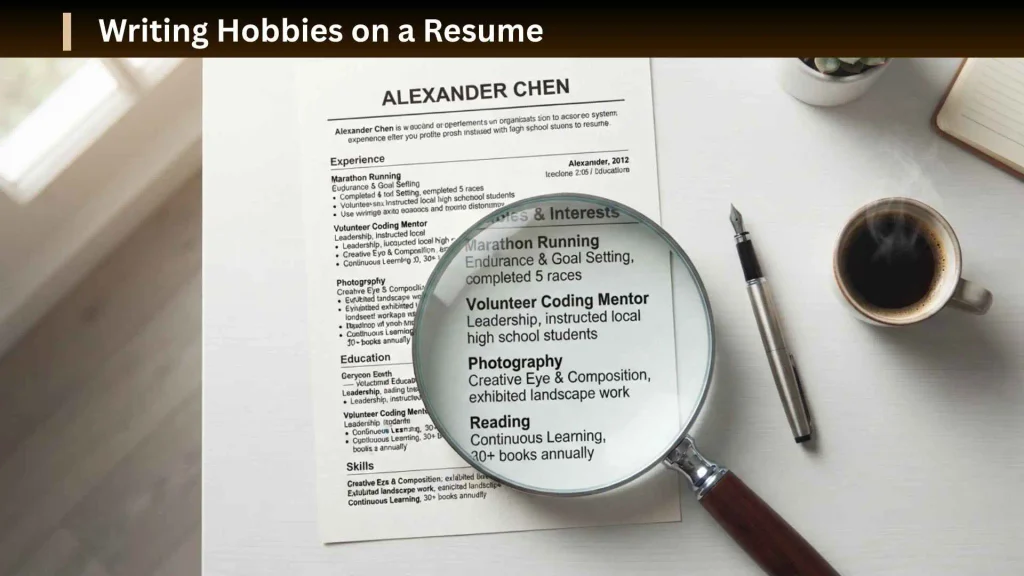
A useful formula is:
Hobby + specific activity + relevant skill or outcome
For example:
Photography: Create landscape and event photography projects, developing skills in composition, visual storytelling, and digital editing.
Or:
Basketball: Participate in a recreational league, practicing teamwork, communication, and coordinated play.
Or:
Woodworking: Design and build small furniture projects, using planning, measurement, and precision skills.
This approach makes the hobby useful without overstating its professional importance.
Quick Checklist Before Adding Hobbies
Before submitting your resume, ask:
- Is this hobby genuine?
- Is it relevant to the position?
- Does it demonstrate a useful quality or skill?
- Does it add information that is not already elsewhere on my resume?
- Can I explain it naturally in an interview?
- Is the description specific?
- Is the section short?
- Does it leave enough space for more important qualifications?
If the answer to most of these questions is no, the hobby probably does not need to be on your resume.
FAQs
What are good hobbies to put on a resume?
Good hobbies include team sports, photography, writing, creative arts, volunteering, coding projects, music, chess, and other activities that demonstrate qualities relevant to the job. The best choice depends on the position and your actual experience.
How many hobbies should I put on my resume?
Usually, a small selection is better than a long list. Focus on a few relevant hobbies that add useful information and keep the section concise.
Should I put hobbies on my resume if I have no experience?
Yes. Hobbies, extracurricular activities, volunteer work, and personal projects can help students and entry-level applicants demonstrate transferable skills when professional experience is limited.
Should hobbies go at the top or bottom of a resume?
Hobbies generally belong toward the bottom of the resume after your more important qualifications. Work experience, education, skills, and relevant projects should normally receive greater emphasis.
Are hobbies important for an ATS resume?
Hobbies are usually less important than job-related skills, qualifications, experience, and terminology. Include them only when they add meaningful value to your application.
Should I include hobbies that are unrelated to the job?
Usually, unrelated hobbies are not worth the space unless they reveal a particularly useful quality, provide meaningful context, or are specifically requested by the employer.
Can hobbies count as skills on a resume?
A hobby can help demonstrate a skill, but it does not automatically make you professionally qualified. If the hobby has helped you develop a genuine, demonstrable skill, consider listing the skill separately and using the hobby as supporting context.
What is the difference between hobbies and interests on a resume?
Hobbies are generally activities you actively participate in, while interests can be broader or more passive. Both can be included in a single “Hobbies & Interests” section when they provide useful information about your candidacy.
Conclusion
Hobbies on a resume can be useful when they add relevant information rather than simply filling space. The strongest choices demonstrate transferable skills, support your career goals, connect naturally with the position, or provide useful context when professional experience is limited.
Choose genuine activities, make them specific, keep the section concise, and place it after your primary qualifications. If a hobby has developed into substantial work, a portfolio, volunteer experience, or a personal project, consider giving that experience a more prominent section on your resume.
Your hobbies should complement your qualifications—not compete with them.

I’m James Anderson, a dedicated writer and lifelong learner who enjoys researching topics and explaining them in a practical way. Through my work at Cognivoora, I aim to give readers reliable, easy-to-follow information that helps them learn something new. I always try to keep my writing natural, useful, and focused on the questions readers actually have.
Books:
- A Practical Guide to Better Thinking
- Questions Worth Asking