
If you enjoy technology, science, games, fantasy, collecting, puzzles, or learning how things work, there are plenty of hobbies for geeks that go far beyond spending time on a screen. The best geeky hobbies let you explore your interests while building skills, creating something tangible, solving problems, or connecting with people who enjoy the same things.
Whether you are a lifelong geek or simply looking for a new hobby that matches your personality, this guide covers practical options for different interests, budgets, and skill levels.
What Are Good Hobbies for Geeks?
Good hobbies for geeks are activities that encourage curiosity, creativity, problem-solving, collecting, building, learning, or deep exploration of a particular subject.
Some popular choices include:
- Coding and programming
- Electronics and Arduino projects
- 3D printing
- Robotics
- Board games
- Tabletop role-playing games
- Model building
- LEGO and construction sets
- Astronomy
- Amateur radio
- Photography
- Creative writing
- Chess
- Puzzle solving
- Video game development
- Collecting
- Reading science fiction and fantasy
- Genealogy
- Geocaching
- Digital art
- Mechanical keyboards
- Home lab projects
- Cosplay
- Language learning
- Dungeons & Dragons
The right choice depends less on whether a hobby is traditionally considered “geeky” and more on what kind of curiosity you want to pursue.
25 Hobbies for Geeks to Try
1. Coding and Programming
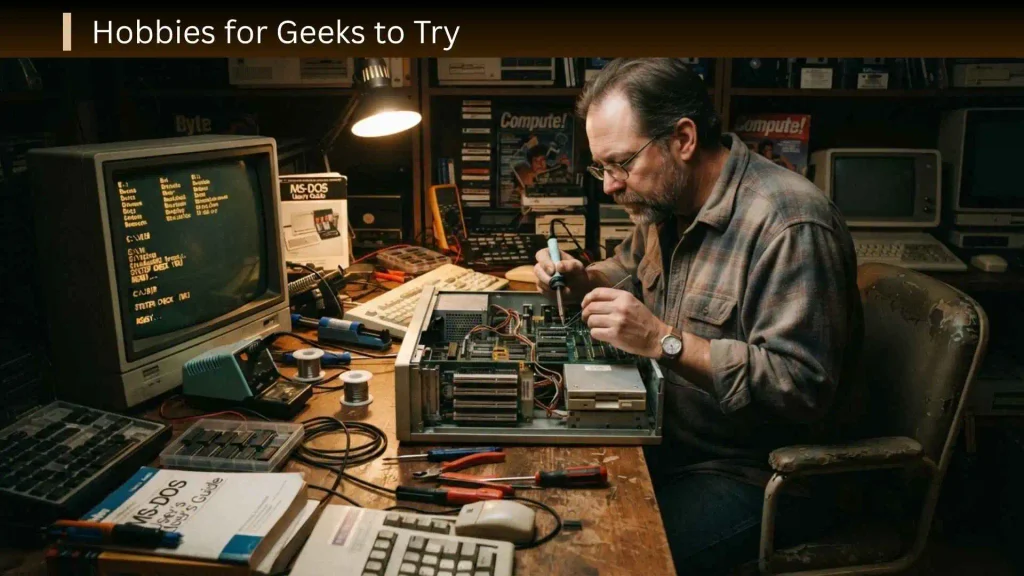
Coding is one of the most flexible hobbies for people who enjoy technology and logical problem-solving.
You can start with simple projects such as:
- A personal website
- A calculator
- A small game
- A weather dashboard
- A personal productivity tool
- A simple automation script
You do not need to become a professional software developer. Learning to program can simply be a way to turn ideas into working projects.
Best for: Tech enthusiasts, problem solvers, and people who enjoy building things.
Cost: Free to low-cost
Difficulty: Beginner to advanced
2. Electronics Projects
If you like knowing what happens inside computers, gadgets, and appliances, electronics can be an excellent hands-on hobby.
Beginner projects can involve LEDs, sensors, switches, small motors, and microcontrollers. Platforms such as Arduino make it possible to experiment with electronics without designing every component from scratch.
As your skills improve, you can build increasingly sophisticated devices.
Best for: Tinkerers and hardware enthusiasts.
Cost: Low to moderate
Difficulty: Beginner to advanced
3. 3D Printing
3D printing combines technology, design, engineering, and creativity.
You can download existing models or design your own objects using 3D modeling software. Projects might include:
- Desk organizers
- Game accessories
- Replacement parts
- Miniatures
- Decorative objects
- Storage solutions
- Custom tools
One advantage of 3D printing as a hobby is that you can gradually move from printing other people’s designs to creating your own.
Best for: Makers, designers, gamers, and engineering enthusiasts.
Cost: Moderate
Difficulty: Beginner to advanced
4. Robotics
Robotics is a natural choice for geeks who enjoy combining software and hardware.
A beginner robot might simply move around and respond to sensors. More advanced projects can involve computer vision, autonomous navigation, robotic arms, or other forms of automation.
Robotics also teaches several related skills, including programming, electronics, mechanics, and troubleshooting.
Best for: STEM enthusiasts and builders.
Cost: Moderate to high
Difficulty: Intermediate to advanced
5. Board Games
Modern board games offer much more variety than traditional classics.
Strategy games, cooperative games, deck-building games, civilization games, deduction games, and thematic games can appeal to people who enjoy complex systems and decision-making.
Board gaming also has a strong social component, making it a good option if you want a hobby that gets you away from your computer.
Best for: Strategy fans and social gamers.
Cost: Low to moderate
Difficulty: Beginner to advanced
6. Dungeons & Dragons
Dungeons & Dragons combines storytelling, strategy, character creation, improvisation, world-building, and social interaction.
Players create characters and participate in adventures guided by a Dungeon Master. You can focus on different parts of the hobby depending on your interests.
For example, you might enjoy:
- Creating characters
- Learning game mechanics
- Acting in character
- Writing adventures
- Designing worlds
- Painting miniatures
- Creating maps
Best for: Fantasy fans, storytellers, gamers, and creative people.
Cost: Low to moderate
Difficulty: Beginner-friendly
7. Model Building
Model building is a great hobby for geeks who enjoy detailed, hands-on projects.
Possible subjects include:
- Cars
- Aircraft
- Ships
- Trains
- Military vehicles
- Science-fiction spacecraft
- Architecture
Building models can involve assembling, painting, weathering, and customizing pieces.
Best for: Detail-oriented hobbyists.
Cost: Low to moderate
Difficulty: Beginner to advanced
8. LEGO and Construction Sets
Building with LEGO is not limited to children. Adults can approach construction sets as a creative, engineering, collecting, or display hobby.
You can follow official instructions or create original designs from individual pieces.
For a more challenging experience, try designing functional mechanisms, vehicles, buildings, or automated creations.
Best for: Builders and creative problem solvers.
Cost: Moderate
Difficulty: Beginner to advanced
9. Astronomy
Astronomy lets you explore space without leaving Earth.
You can begin with no equipment by learning to identify prominent stars, planets, constellations, and celestial events. Later, you might purchase binoculars or a telescope.
Astronomy can also lead to related interests such as astrophotography, space history, and observational science.
Best for: Science enthusiasts and people fascinated by space.
Cost: Free to high, depending on equipment
Difficulty: Beginner to advanced
10. Amateur Radio
Amateur radio combines electronics, communication, geography, technology, and experimentation.
Licensed operators can communicate using radio equipment and explore different communication techniques. The hobby can become as technical or social as you want.
In the United States, amateur radio operation requires an appropriate license from the Federal Communications Commission.
Best for: Electronics enthusiasts and communication hobbyists.
Cost: Moderate
Difficulty: Intermediate
11. Chess
Chess is an accessible hobby for people who enjoy strategy and intellectual challenges.
You can play casually, study openings, analyze games, solve chess puzzles, or participate in organized competitions.
Unlike many hobbies, chess requires very little physical equipment. A board and pieces—or a digital platform—are enough to get started.
Best for: Strategists and analytical thinkers.
Cost: Free to low-cost
Difficulty: Beginner to expert
12. Puzzle Solving
Puzzles provide a simple way to exercise logical thinking and concentration.
Options include:
- Jigsaw puzzles
- Sudoku
- Crossword puzzles
- Logic puzzles
- Mechanical puzzles
- Escape-room puzzles
- Cryptic puzzles
- Puzzle hunts
You can choose puzzles based on whether you prefer mathematics, language, spatial reasoning, or lateral thinking.
Best for: Problem solvers who enjoy challenges.
Cost: Free to moderate
Difficulty: Beginner to advanced
13. Collecting
Collecting can turn a specific interest into a long-term hobby.
Geek-oriented collections might include:
- Comic books
- Trading cards
- Action figures
- Video game memorabilia
- LEGO sets
- Science-fiction books
- Movie props
- Vintage electronics
- Coins
- Stamps
A good collection does not need to be expensive. Defining a specific theme or collecting rule can make the hobby more manageable.
Best for: Enthusiasts who enjoy research and organization.
Cost: Highly variable
Difficulty: Beginner-friendly
14. Reading Science Fiction and Fantasy
Books can provide an inexpensive way to explore entire fictional worlds.
Science fiction may appeal to readers interested in technology, space, artificial intelligence, future societies, and scientific concepts. Fantasy offers opportunities to explore mythology, magic, fictional cultures, and epic storytelling.
You can also join book clubs or online communities to make reading more social.
Best for: Readers, world-builders, and speculative-fiction fans.
Cost: Free to moderate
Difficulty: Beginner
15. Creative Writing
Creative writing is especially suitable for geeks who spend a lot of time imagining fictional worlds, characters, technologies, or alternate histories.
You can write:
- Short stories
- Science-fiction stories
- Fantasy fiction
- Fan fiction
- Screenplays
- Comic scripts
- Game narratives
- World-building documents
You do not need to publish anything. Writing can simply be a way to develop ideas and creativity.
Best for: Storytellers and imaginative thinkers.
Cost: Free to low-cost
Difficulty: Beginner to advanced
16. Video Game Development
If you love playing games and wonder how they are made, game development can turn that curiosity into a creative hobby.
A small first project might involve creating a simple 2D game rather than attempting to build a huge open-world title.
Game development can introduce you to:
- Programming
- Game design
- Animation
- Sound
- Storytelling
- Level design
- User interface design
Best for: Gamers who want to become creators.
Cost: Free to moderate
Difficulty: Intermediate
17. Digital Art
Digital art combines creativity with technology.
You can create illustrations, character designs, concept art, pixel art, environments, or digital paintings using a computer or tablet.
Digital art is particularly useful for geeks who enjoy gaming, comics, animation, science fiction, or fantasy.
Best for: Visual creatives.
Cost: Free to moderate
Difficulty: Beginner to advanced
18. Photography
Photography can appeal to technical and artistic personalities at the same time.
You can experiment with:
- Landscape photography
- Architecture
- Night photography
- Macro photography
- Street photography
- Wildlife photography
- Product photography
- Astrophotography
You can start with a smartphone before investing in dedicated camera equipment.
Best for: Visual learners and technology enthusiasts.
Cost: Free to high
Difficulty: Beginner to advanced
19. Cosplay
Cosplay combines costume design, crafting, performance, photography, and fandom.
You can create costumes based on characters from movies, games, comics, anime, books, or other fictional worlds.
For people who enjoy making things, cosplay can become a surprisingly technical hobby involving sewing, foam crafting, 3D printing, electronics, painting, and prop construction.
Best for: Creative makers and pop-culture fans.
Cost: Low to high
Difficulty: Beginner to advanced
20. Geocaching
Geocaching turns outdoor exploration into a real-world treasure hunt.
Participants use GPS-enabled devices to locate hidden containers and follow clues. It can be a good choice for someone who enjoys technology but also wants an outdoor activity.
It also gives you a reason to explore parks, trails, neighborhoods, and other public places.
Best for: Outdoor geeks and adventure seekers.
Cost: Free to low-cost
Difficulty: Beginner
21. Genealogy
Genealogy combines history, research, organization, and detective-style investigation.
You can research family names, historical records, census information, immigration documents, photographs, and other records to construct a family tree.
The hobby can become a long-term research project because each discovery may lead to another question.
Best for: History lovers and research-oriented people.
Cost: Free to moderate
Difficulty: Beginner to advanced
22. Mechanical Keyboard Building
Mechanical keyboards have become a popular hobby for people interested in computer hardware and customization.
Depending on the type of keyboard, enthusiasts can experiment with:
- Switches
- Keycaps
- Cases
- Stabilizers
- Layouts
- Sound
- Firmware
- Custom designs
It can be as simple as changing keycaps or as involved as assembling a keyboard from individual components.
Best for: Computer enthusiasts and hardware tinkerers.
Cost: Moderate
Difficulty: Beginner to advanced
23. Home Lab Projects
A home lab can provide a practical environment for experimenting with computers, networking, operating systems, virtualization, and self-hosted software.
Instead of learning only through tutorials, you can create projects and troubleshoot them yourself.
For example, you might explore:
- Virtual machines
- Local file storage
- Networking
- Linux
- Self-hosted applications
- Server management
- Automation
Best for: IT enthusiasts and technically curious hobbyists.
Cost: Low to high
Difficulty: Intermediate to advanced
24. Language Learning
Learning another language may not immediately sound like a geek hobby, but it can be an excellent fit for people who enjoy systems, patterns, culture, and continuous learning.
You can study grammar, vocabulary, writing systems, pronunciation, literature, and cultural history.
You can also combine language learning with another interest—for example, reading science-fiction novels in another language or learning the terminology associated with a favorite game.
Best for: Lifelong learners and language enthusiasts.
Cost: Free to moderate
Difficulty: Beginner to advanced
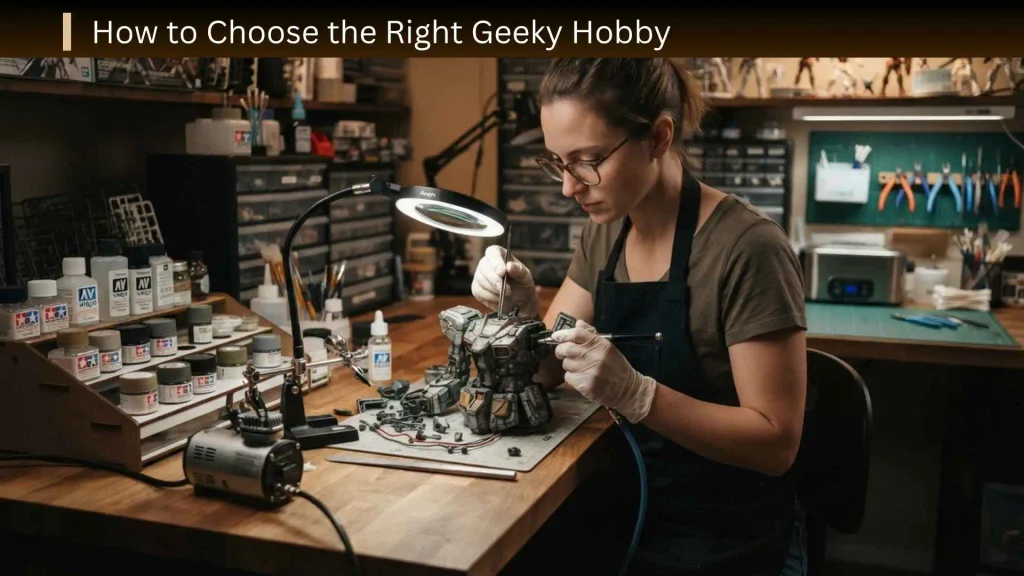
25. Miniature Painting
Miniature painting is particularly popular among tabletop gaming and fantasy communities, but you do not have to play a game to enjoy it.
The hobby focuses on painting small detailed figures and can teach you about:
- Brush control
- Color theory
- Shading
- Highlighting
- Composition
- Fine detail
- Patience
You can paint fantasy creatures, science-fiction characters, historical figures, or custom models.
Best for: Artists, tabletop gamers, and detail-oriented makers.
Cost: Low to moderate
Difficulty: Beginner to advanced
How to Choose the Right Geeky Hobby
With so many possibilities, choosing one can be harder than getting started.
A useful approach is to consider what you want the hobby to give you.
If You Want to Build Things
Try:
- 3D printing
- Electronics
- Robotics
- LEGO
- Model building
- Mechanical keyboards
These hobbies provide tangible projects you can see, modify, and improve.
If You Want to Solve Problems
Consider:
- Chess
- Programming
- Logic puzzles
- Robotics
- Electronics
- Home lab projects
These are particularly suitable if you enjoy troubleshooting and figuring out how systems work.
If You Want to Be More Creative
Consider:
- Digital art
- Creative writing
- Cosplay
- Miniature painting
- Photography
- Game development
These allow you to turn ideas into something original.
If You Want a Social Hobby
Try:
- Board games
- Dungeons & Dragons
- Chess clubs
- Amateur radio
- Cosplay
- Tabletop gaming
- Book clubs
These can connect you with people who share particular interests.
If You Want to Spend Less Time on Screens
Choose:
- Model building
- Board games
- Chess
- Astronomy
- Geocaching
- Miniature painting
- Collecting
- Photography
These can still satisfy your curiosity without requiring you to sit at a computer for hours.
Best Hobbies for Geeks by Budget
| Hobby | Typical Starting Cost | Equipment Needed | Social Potential |
| Coding | Free | Computer | Medium |
| Chess | Free–$30+ | Board or app | High |
| Creative writing | Free | Notebook or computer | Low–Medium |
| Puzzle solving | Free–$30+ | Puzzles or books | Low–Medium |
| Geocaching | Free–Low | Smartphone/GPS device | Medium |
| Reading | Free–Moderate | Books or library access | Medium |
| Board games | $20+ | Games | High |
| Model building | $20+ | Model and tools | Medium |
| Miniature painting | $30+ | Miniatures, brushes, paints | High |
| Electronics | $20+ | Components and tools | Medium |
| 3D printing | Moderate | 3D printer and supplies | Medium |
| Robotics | Moderate–High | Robot kit/components | High |
Prices vary significantly by equipment, brand, collection size, and how deeply you pursue the hobby. You can often begin many of these activities with equipment you already own.
Geeky Hobbies That Are Easy for Beginners
If you are completely new to hobbies, avoid choosing something simply because it looks impressive.
Start with an activity that has a low barrier to entry.
Good beginner options include:
- Chess
- Reading
- Coding
- Creative writing
- Puzzle solving
- Geocaching
- Photography with a smartphone
- Board games
- LEGO
- Astronomy with basic stargazing
The goal at first is not mastery. It is finding out whether you enjoy the activity enough to keep exploring it.
Geeky Hobbies You Can Do at Home
Many hobbies for geeks work particularly well in a home environment.
Best indoor options
- Coding
- Programming
- Digital art
- Creative writing
- Board games
- Chess
- Electronics
- 3D printing
- Model building
- Miniature painting
- Collecting
- Reading
- Game development
- Mechanical keyboard customization
If space is limited, prioritize hobbies that require little physical equipment, such as programming, writing, chess, reading, or digital art.
If you have a dedicated workspace, making hobbies such as electronics, 3D printing, and model building become easier to organize.
Hobbies for Geeks Who Like Gaming
Gaming interests can naturally lead into other hobbies.
If you enjoy video games, consider exploring:
- Game development
- Game design
- 3D modeling
- Digital art
- Cosplay
- Miniature painting
- Board games
- Dungeons & Dragons
- Game collecting
- Creative writing
This approach can make a hobby feel more meaningful because you are expanding an existing interest instead of starting from zero.
Hobbies for Geeks Who Love Science
Science-minded hobbyists have many options.
Astronomy is an obvious choice, but you can also explore:
- Electronics
- Robotics
- Programming
- Citizen science
- Microscopy
- Amateur radio
- Model building
- Science reading
- Engineering projects
- Mathematics puzzles
The best option depends on whether you prefer observation, experimentation, building, or theoretical learning.
Hobbies for Geeks Who Like Collecting
If your favorite part of geek culture is discovering and organizing interesting objects, collecting may be ideal.
Potential collections include:
- Comic books
- Trading cards
- Books
- Coins
- Stamps
- Vintage technology
- Action figures
- Movie memorabilia
- Game cartridges
- LEGO sets
Before beginning an expensive collection, establish a clear theme and budget. A defined collecting strategy can prevent the hobby from becoming an uncontrolled accumulation of items.
How to Turn a Geeky Interest Into a Real Hobby

An interest becomes a sustainable hobby when you give it some structure.
Start with a small project
Instead of saying, “I’m going to learn robotics,” choose something concrete such as building a basic sensor project.
Instead of saying, “I’m going to learn programming,” create a small application.
A specific project gives you a clear starting point.
Set a realistic budget
You do not need the most advanced equipment immediately.
Start with basic tools and upgrade when you understand what you actually enjoy.
Give yourself permission to be a beginner
Geek hobbies can involve communities where people have spent years developing specialized skills. Comparing your first project with an expert’s work can make learning unnecessarily frustrating.
Focus on improvement rather than expertise.
Combine two interests
Combining interests can produce especially engaging hobbies.
For example:
- Astronomy + photography = astrophotography
- Programming + gaming = game development
- Electronics + cosplay = illuminated costumes and props
- Writing + fantasy = world-building
- 3D printing + tabletop gaming = custom miniatures and terrain
- History + collecting = historical memorabilia
- Art + gaming = character illustration
This is often one of the easiest ways to discover a hobby that feels uniquely suited to you.
How to Make Geek Hobbies More Social
Some geek hobbies are naturally solitary, but they do not have to remain that way.
Look for:
- Local hobby clubs
- Board-game groups
- Chess clubs
- Maker spaces
- Book clubs
- Tabletop gaming groups
- Astronomy clubs
- Photography groups
- Conventions
- Community workshops
Online communities can also help you learn techniques, troubleshoot projects, and exchange ideas. However, local groups can add an important face-to-face social element.
Frequently Asked Questions
What are the best hobbies for geeks?
The best hobbies depend on the person’s interests. Coding, electronics, 3D printing, robotics, board games, chess, astronomy, model building, tabletop gaming, creative writing, and digital art are all strong options for people who enjoy technology, strategy, creativity, science, or detailed projects.
What are some cheap hobbies for geeks?
Chess, reading, creative writing, coding, puzzle solving, stargazing, digital learning, and geocaching can all be started relatively inexpensively. Many have free resources available, allowing you to explore the hobby before spending money.
What hobbies are good for introverted geeks?
Reading, programming, writing, digital art, collecting, astronomy, miniature painting, model building, and puzzle solving can work well for people who prefer independent activities. These hobbies can also be socialized later through clubs and communities if desired.
What are good hobbies for geeks who like technology?
Programming, electronics, robotics, 3D printing, home lab projects, game development, digital art, photography, and mechanical keyboard building are particularly suitable for technology enthusiasts.
What are good geeky hobbies away from a computer?
Board games, chess, model building, miniature painting, astronomy, geocaching, collecting, LEGO, photography, and cosplay can provide a break from computer-based activities while still engaging analytical or creative interests.
Can geeky hobbies become careers?
Some hobbies can develop into professional skills, although there is no guarantee that a hobby will become a career. Programming, photography, digital art, writing, 3D modeling, electronics, game development, and robotics can all provide skills that are useful in professional fields.
What is a good geek hobby for someone with no experience?
Start with something that has a low entry barrier, such as chess, reading, puzzles, creative writing, coding, photography with a smartphone, or LEGO. Choose a small beginner project rather than trying to master the entire subject immediately.
Conclusion
The best hobbies for geeks are not defined by a particular fandom or technology. They are activities that give you something interesting to investigate, create, solve, collect, learn, or share.
If you enjoy technology, start with coding, electronics, robotics, or 3D printing. If you prefer creativity, explore writing, digital art, cosplay, or miniature painting. For strategy and social interaction, chess, board games, and Dungeons & Dragons are excellent choices. And if you want to step away from screens, astronomy, model building, collecting, photography, and geocaching offer plenty of ways to stay curious.
You do not need to choose the most complicated hobby. Choose the one that makes you curious enough to start—and interested enough to keep going.

I’m Ethan Mitchell, a curious writer who enjoys turning complex ideas into simple, useful information. At Cognivoora, I focus on creating clear and engaging content that readers can understand and apply in everyday life. I believe good writing should educate, answer real questions, and leave readers with something valuable to remember.
Books:
- The Everyday Mind
- Simple Ideas, Better Thinking