
Hobbies are activities people choose to do regularly for enjoyment, relaxation, creativity, learning, or personal satisfaction. A hobby is usually something you do during your free time because you are interested in it—not because it is required for work, school, or daily responsibilities.
Understanding the meaning is useful because the word covers a very wide range of activities, from reading and gardening to photography, painting, cooking, collecting, sports, and crafts.
What Does Hobbies Mean?
The word hobbies is the plural form of hobby. A hobby is an activity that someone enjoys doing regularly in their spare time.
In simple terms:
A hobby is something you enjoy doing in your free time for pleasure, interest, creativity, relaxation, or personal growth.
For example, someone might spend their free time reading novels, playing guitar, baking, hiking, drawing, gardening, or building model kits. These activities can all be hobbies when the person chooses to do them for enjoyment or personal interest.
The word can refer to almost any voluntary leisure activity, as long as it is pursued as an interest rather than simply as an obligation.
Hobbies Meaning in Simple English
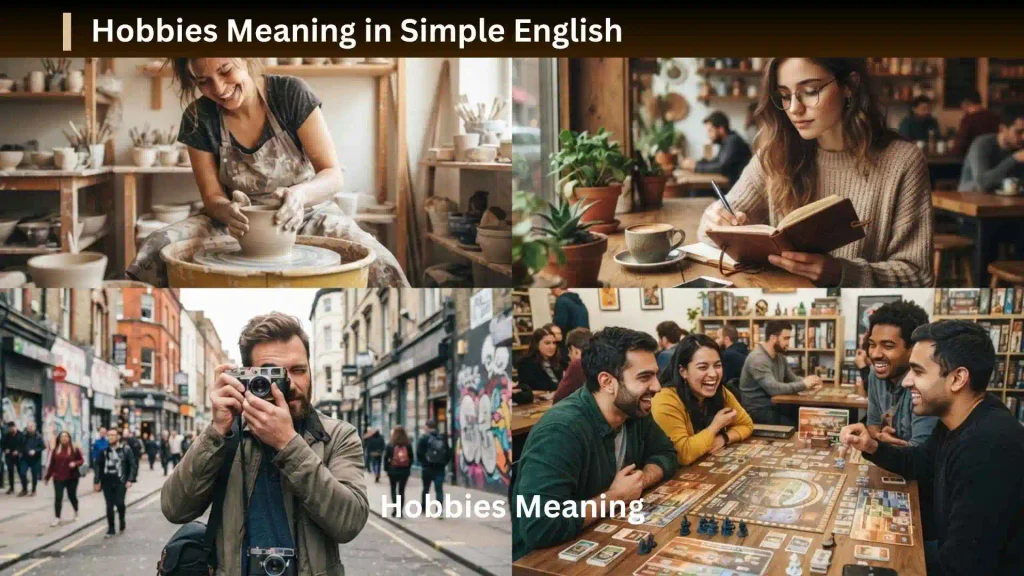
The simplest meaning of hobbies is activities people enjoy doing in their free time.
For example:
- Reading books can be a hobby.
- Painting can be a hobby.
- Gardening can be a hobby.
- Playing basketball can be a hobby.
- Photography can be a hobby.
- Cooking can be a hobby.
- Collecting coins can be a hobby.
- Knitting can be a hobby.
- Hiking can be a hobby.
- Playing a musical instrument can be a hobby.
A hobby does not have to be expensive, difficult, or unusual. Something as simple as listening to music, journaling, or taking walks can become a meaningful hobby if you regularly enjoy doing it.
What Is a Hobby?
A hobby is generally a voluntary activity pursued during leisure time because the person finds it enjoyable, interesting, creative, challenging, or personally rewarding.
Hobbies can involve many different kinds of activities. Some are primarily creative, while others involve physical activity, intellectual effort, social interaction, collecting, making things, or spending time outdoors.
For instance:
| Type of Hobby | Examples |
| Creative | Drawing, painting, writing, pottery |
| Physical | Running, cycling, swimming, hiking |
| Intellectual | Reading, chess, learning languages |
| Outdoor | Gardening, fishing, birdwatching |
| Social | Board games, dancing, community activities |
| Collecting | Coins, stamps, books, memorabilia |
| Crafting | Knitting, woodworking, crochet |
| Technology | Coding, digital art, electronics |
| Culinary | Baking, cooking, cake decorating |
The important feature is not the category. The activity becomes a hobby because of how a person chooses to engage with it.
What Is the Difference Between a Hobby and a Job?
One of the easiest ways to understand hobbies is to compare them with work.
A job is usually performed because it is an employment responsibility and provides income. A hobby is generally pursued during free time because of personal interest or enjoyment.
For example, a professional photographer may take photographs for clients as part of their job. Another person may photograph landscapes on weekends simply because they enjoy photography. The same activity can therefore be both a profession and a hobby depending on the context.
| Hobby | Job |
| Usually pursued for enjoyment | Usually performed as employment |
| Generally takes place during leisure time | Usually takes place during working hours |
| Personal choice is central | Responsibilities and expectations are involved |
| Income is not normally the main purpose | Earning income is generally a central purpose |
| Can be informal | Usually has defined work responsibilities |
The distinction is not always absolute. A hobby can eventually become a side business or career, but it does not have to.
Why Do People Have Hobbies?
People choose hobbies for many different reasons. There is no single reason that applies to everyone.
Relaxation and Leisure
Some hobbies provide a way to step away from work, school, household responsibilities, or other everyday demands.
Reading, gardening, coloring, fishing, walking, and listening to music can all provide forms of leisure.
Creativity
Creative hobbies give people opportunities to make, design, write, build, or express ideas.
Examples include:
- Painting
- Drawing
- Photography
- Writing
- Sewing
- Woodworking
- Pottery
- Crafting
- Playing music
Learning
A hobby can also be a way to learn something outside formal education.
Someone might learn:
- A new language
- Musical skills
- Cooking techniques
- Gardening
- Astronomy
- History
- Drawing
- Computer programming
- Chess
Because hobbies are self-directed, people can often explore subjects at their own pace.
Physical Activity
Some hobbies naturally involve movement and time outdoors.
Examples include hiking, cycling, swimming, running, dancing, kayaking, and recreational sports.
A physical activity can be a hobby even when the person has no intention of competing professionally.
Social Connection
Some hobbies are especially social. Joining a recreational sports group, book club, photography group, crafting community, or board-game group can create opportunities to interact with other people who share similar interests.
Personal Fulfillment
Hobbies can also provide a sense of accomplishment. Completing a painting, growing vegetables, learning a song, finishing a model, or reading a challenging book can be satisfying simply because you accomplished something meaningful to you.
Types of Hobbies

There are thousands of possible hobbies, and many activities can fit into more than one category.
Creative Hobbies
Creative hobbies involve making or expressing something.
Popular examples include:
- Drawing
- Painting
- Creative writing
- Photography
- Calligraphy
- Scrapbooking
- Sewing
- Crochet
- Knitting
- Pottery
- Jewelry making
These hobbies can range from simple beginner activities to highly developed skills.
Outdoor Hobbies
Outdoor hobbies involve spending time outside and may involve nature, exploration, exercise, or observation.
Examples include:
- Hiking
- Camping
- Fishing
- Gardening
- Birdwatching
- Cycling
- Geocaching
- Nature photography
Outdoor hobbies can be particularly appealing to people who prefer active or nature-based leisure.
Indoor Hobbies
Indoor hobbies can be practiced at home or in other indoor spaces.
Examples include:
- Reading
- Puzzles
- Board games
- Baking
- Cooking
- Drawing
- Playing music
- Model building
- Journaling
- Collecting
Many indoor hobbies require little space and can be adapted to different budgets.
Intellectual Hobbies
Intellectual hobbies focus on learning, thinking, research, strategy, or problem-solving.
Examples include:
- Reading
- Chess
- Learning languages
- History research
- Astronomy
- Creative writing
- Puzzles
- Coding
- Studying philosophy
An intellectual hobby does not necessarily have to involve formal classes or academic study.
Active Hobbies
Active hobbies involve physical movement.
Examples include:
- Running
- Swimming
- Cycling
- Dancing
- Hiking
- Tennis
- Basketball
- Yoga
- Martial arts
The appropriate activity depends on a person’s interests, abilities, available facilities, and comfort level.
Hobby vs Interest: Are They the Same?
A hobby and an interest are related, but they are not always the same thing.
An interest is something you are curious about, like astronomy, history, fashion, or wildlife. A hobby usually involves actively spending time doing something connected with that interest.
For example, someone might be interested in astronomy by enjoying space documentaries and articles. If they regularly use a telescope, identify celestial objects, or participate in amateur astronomy activities, astronomy may function as a hobby.
In short:
Interest = something you care about or want to know more about.
Hobby = an activity you regularly pursue because of that interest or enjoyment.
Can a Hobby Become a Career?
Yes. Some hobbies can eventually develop into businesses, freelance work, or full-time careers.
For example:
- Photography can become a photography business.
- Baking can lead to a bakery or catering business.
- Writing can become freelance or professional writing.
- Woodworking can develop into furniture making.
- Painting can lead to selling artwork.
- Gardening can develop into landscaping work.
- Coding can lead to professional software development.
However, turning a hobby into a career changes the relationship with the activity. Once income, deadlines, customers, and business responsibilities become involved, the activity may no longer feel like the same kind of leisure pursuit.
That does not mean a hobby should never become a career. It simply means that enjoying an activity and making a living from it are different experiences.
How Do You Choose a Hobby?
There is no universally best hobby. A good choice depends on your interests, available time, budget, space, and the kind of experience you want.
Consider these questions:
What Do You Enjoy?
Think about activities that naturally hold your attention.
If you enjoy making things, crafts or woodworking may appeal to you. If you enjoy being outdoors, hiking or gardening might be a better fit.
How Much Time Do You Have?
Some hobbies can be enjoyed in short sessions, while others require longer blocks of time.
For example, journaling might take only a few minutes, whereas camping may require an entire weekend.
What Is Your Budget?
Hobbies can range from nearly free to expensive.
Low-cost options include:
- Walking
- Writing
- Reading free library books
- Drawing
- Journaling
- Birdwatching
- Learning through free educational resources
More equipment-intensive hobbies may require an initial investment.
Do You Prefer Being Alone or With Others?
If you enjoy independent activities, reading, painting, collecting, or writing may suit you.
If you prefer social interaction, recreational sports, dance groups, clubs, classes, and tabletop games may be more appropriate.
Do You Want to Learn or Relax?
Some people want hobbies that challenge their minds or develop skills. Others want something calming and uncomplicated.
Your goal can help narrow your choices.
Are Hobbies Important?
Hobbies are not mandatory, and people have different ways of spending their free time. However, hobbies can give leisure time a sense of purpose and provide opportunities for creativity, learning, physical activity, social interaction, or relaxation.
The value of a hobby depends largely on the individual. A hobby does not have to be productive in the traditional sense to be worthwhile.
Reading a novel, making a craft, collecting postcards, playing a game, or tending a garden can simply be enjoyable. That enjoyment is enough to make the activity meaningful as a leisure pursuit.
Examples of Hobbies for Different Personalities and Preferences

Rather than choosing a hobby based on a personality label, it can be more useful to start with the experience you want.
| If you want to… | You might consider… |
| Be creative | Painting, drawing, writing, crafting |
| Spend time outdoors | Hiking, gardening, fishing |
| Stay physically active | Cycling, swimming, dancing |
| Learn something new | Languages, cooking, astronomy |
| Relax at home | Reading, puzzles, coloring |
| Meet people | Sports, clubs, board games |
| Make things | Woodworking, pottery, model building |
| Work with plants | Gardening, bonsai, indoor plants |
| Explore technology | Coding, electronics, digital art |
| Collect items | Coins, stamps, books, memorabilia |
These are starting points rather than strict categories. A single hobby can satisfy several needs at once.
What Makes an Activity a Hobby?
An activity does not need a special certification or formal definition to become a hobby.
Several characteristics commonly distinguish a hobby from an ordinary task:
- Voluntary: You choose to participate.
- Leisure-based: It is generally done outside required responsibilities.
- Interest-driven: You have some level of personal interest in it.
- Enjoyable or rewarding: You get satisfaction from doing it.
- Repeatable: You may return to it regularly or over an extended period.
The activity itself is not necessarily what determines whether it is a hobby. The purpose and context matter.
For example, cooking dinner because you have to feed your family may simply be a daily responsibility. Spending Saturday experimenting with bread recipes because you enjoy learning about baking can be a hobby.
Frequently Asked Questions About Hobbies Meaning
What is the exact meaning of hobbies?
Hobbies means activities that people regularly choose to do during their free time for enjoyment, interest, relaxation, creativity, learning, or personal satisfaction.
What is an example of a hobby?
Reading is a common example of a hobby. Other examples include gardening, painting, hiking, photography, cooking, playing music, collecting, crafting, and recreational sports.
What is the difference between a hobby and a pastime?
The words are closely related. A pastime is generally an activity used to occupy leisure time, while a hobby usually suggests a recurring personal interest or activity that someone enjoys pursuing.
Can watching movies be a hobby?
Yes. If someone regularly watches movies as a leisure activity because they enjoy film, storytelling, cinema history, or analyzing movies, it can function as a hobby.
Can a hobby make money?
Yes. Some hobbies can develop into income-generating activities, such as photography, writing, crafting, baking, woodworking, art, or collecting. However, earning money is not required for an activity to be a hobby.
How many hobbies should a person have?
There is no ideal number. Some people focus deeply on one hobby, while others enjoy several different activities. The right number depends on personal interests, time, and responsibilities.
Is a hobby supposed to be productive?
No. A hobby does not need to produce a measurable result. Enjoyment, relaxation, curiosity, creativity, or personal satisfaction can all be valid reasons for pursuing one.
What are some easy hobbies for beginners?
Beginner-friendly options include walking, reading, journaling, drawing, photography with a smartphone, gardening, puzzles, cooking, baking, and learning a new skill online.
Conclusion
The meaning of hobbies is simple: hobbies are activities people choose to pursue in their free time because they enjoy, value, or find interest in them. They can be creative, physical, intellectual, social, outdoor, indoor, or a combination of several types.
A hobby does not have to be expensive, complicated, productive, or professionally useful. What matters most is that it gives you a reason to spend some of your leisure time doing something you genuinely value.
Whether you enjoy reading a book, growing plants, taking photographs, playing sports, making crafts, learning an instrument, or exploring a completely new skill, that activity can become a hobby when it becomes a meaningful part of your free time.

I’m Olivia Bennett, a passionate writer who loves exploring ideas, learning new concepts, and sharing knowledge in a straightforward way. I write for Cognivoora with the goal of making useful topics easier to understand without unnecessary complexity. My approach combines research, clarity, and a reader-first perspective.
Books:
- Think Clearly, Live Better
- The Curious Reader’s Guide