
I believe finding a hobby should feel exciting, not like another task on your to-do list. If you’re looking for 100 hobbies for guys, you’ve got plenty of options from creative and relaxing activities to outdoor adventures, fitness, technology, collecting, and hands-on skills. You might want to learn something completely new, spend less time scrolling, meet people with similar interests, or simply find a better way to enjoy your free time.
You don’t need to be naturally talented or experienced to get started. I’ve put together a wide range of ideas so you can discover a hobby that fits your personality, budget, schedule, and lifestyle. Whether you want something productive, adventurous, social, or just fun, keep reading,you may find a hobby you’ve been looking for without even realizing it.
What Are the Best Hobbies for Guys?
Some of the best hobbies for guys include hiking, woodworking, photography, fishing, cooking, weight training, cycling, camping, playing guitar, gardening, home brewing, drawing, coding, golf, running, automotive restoration, chess, 3D printing, reading, and volunteering.
The best choice depends less on being a “guy hobby” and more on what you want from your free time. If you want exercise, try a physical hobby. If you like making things, consider woodworking or 3D printing. If you prefer quiet concentration, chess, reading, or model building may be a better fit.
100 Hobbies for Guys at a Glance
| # | Hobby | Difficulty | Cost to Start | Setting | Best For |
| 1 | Hiking | Easy | Low | Outdoor | Adventure |
| 2 | Fishing | Easy | Moderate | Outdoor | Relaxation |
| 3 | Camping | Easy | Moderate | Outdoor | Adventure |
| 4 | Cycling | Easy | Moderate–High | Both | Fitness |
| 5 | Running | Easy | Low | Outdoor | Fitness |
| 6 | Weight Training | Moderate | Low–Moderate | Indoor | Strength |
| 7 | Swimming | Easy | Low–Moderate | Both | Fitness |
| 8 | Rock Climbing | Moderate | Moderate | Both | Challenge |
| 9 | Golf | Moderate | Moderate–High | Outdoor | Social |
| 10 | Kayaking | Moderate | Moderate–High | Outdoor | Water adventure |
| 11 | Woodworking | Moderate | Moderate | Indoor | Making |
| 12 | Cooking | Easy | Low–Moderate | Indoor | Practical skills |
| 13 | Grilling | Easy | Moderate | Outdoor | Food |
| 14 | Gardening | Easy | Low–Moderate | Both | Nature |
| 15 | Photography | Moderate | Moderate | Both | Creativity |
| 16 | Drawing | Easy | Low | Indoor | Art |
| 17 | Painting | Easy | Low–Moderate | Indoor | Creativity |
| 18 | Playing Guitar | Moderate | Moderate | Indoor | Music |
| 19 | Drumming | Moderate | Moderate–High | Indoor | Music |
| 20 | Singing | Easy | Low | Both | Performance |
| 21 | Chess | Moderate | Low | Both | Strategy |
| 22 | Reading | Easy | Low | Both | Learning |
| 23 | Writing | Easy | Low | Both | Creativity |
| 24 | Coding | Moderate | Low | Indoor | Technology |
| 25 | 3D Printing | Moderate | Moderate | Indoor | Technology |
| 26 | Home Automation | Moderate | Moderate | Indoor | Technology |
| 27 | Electronics | Moderate | Moderate | Indoor | Making |
| 28 | Robotics | Advanced | Moderate–High | Indoor | Engineering |
| 29 | Astronomy | Moderate | Low–High | Outdoor | Science |
| 30 | Birdwatching | Easy | Low–Moderate | Outdoor | Nature |
| 31 | Homebrewing | Moderate | Moderate | Indoor | Craft |
| 32 | Coffee Brewing | Easy | Low–Moderate | Indoor | Food & drink |
| 33 | Baking | Easy | Low | Indoor | Cooking |
| 34 | Fermentation | Moderate | Low–Moderate | Indoor | Food |
| 35 | Knife Making | Advanced | Moderate–High | Indoor | Craft |
| 36 | Leatherworking | Moderate | Moderate | Indoor | Craft |
| 37 | Pottery | Moderate | Moderate | Indoor | Art |
| 38 | Model Building | Easy–Moderate | Low–Moderate | Indoor | Detail work |
| 39 | Metalworking | Advanced | High | Indoor | Making |
| 40 | Welding | Advanced | Moderate–High | Indoor | Practical skills |
| 41 | Automotive Repair | Moderate | Moderate | Indoor | Cars |
| 42 | Car Restoration | Advanced | High | Indoor | Cars |
| 43 | Motorcycle Maintenance | Moderate | Moderate | Indoor | Mechanics |
| 44 | RC Cars | Easy–Moderate | Moderate | Both | Technology |
| 45 | Drones | Moderate | Moderate | Outdoor | Technology |
| 46 | Geocaching | Easy | Low | Outdoor | Exploration |
| 47 | Orienteering | Moderate | Low | Outdoor | Navigation |
| 48 | Archery | Moderate | Moderate | Outdoor | Precision |
| 49 | Disc Golf | Easy | Low | Outdoor | Recreation |
| 50 | Skateboarding | Moderate | Moderate | Outdoor | Skill |
| 51 | Surfing | Advanced | High | Outdoor | Water sports |
| 52 | Paddleboarding | Easy–Moderate | Moderate–High | Outdoor | Water |
| 53 | Snowboarding | Advanced | High | Outdoor | Winter sports |
| 54 | Skiing | Moderate | High | Outdoor | Winter sports |
| 55 | Mountain Biking | Moderate | High | Outdoor | Adventure |
| 56 | Trail Running | Moderate | Low | Outdoor | Fitness |
| 57 | Martial Arts | Moderate | Moderate | Indoor | Discipline |
| 58 | Boxing | Moderate | Moderate | Indoor | Fitness |
| 59 | Brazilian Jiu-Jitsu | Moderate | Moderate | Indoor | Skill & fitness |
| 60 | Tennis | Moderate | Moderate | Outdoor | Sport |
| 61 | Pickleball | Easy | Low–Moderate | Both | Social sport |
| 62 | Basketball | Easy | Low | Outdoor | Sport |
| 63 | Soccer | Moderate | Low | Outdoor | Team sport |
| 64 | Volleyball | Easy | Low | Outdoor | Social |
| 65 | Bowling | Easy | Moderate | Indoor | Social |
| 66 | Pool | Moderate | Low–High | Indoor | Precision |
| 67 | Table Tennis | Easy | Low–Moderate | Indoor | Social |
| 68 | Disc Collecting | Easy | Low–Moderate | Both | Collecting |
| 69 | Vinyl Collecting | Easy | Moderate | Indoor | Music |
| 70 | Watch Collecting | Easy | Low–High | Indoor | Collecting |
| 71 | Coin Collecting | Easy | Low–High | Indoor | History |
| 72 | Sports Memorabilia | Easy | Low–High | Indoor | Sports |
| 73 | Comic Collecting | Easy | Low–High | Indoor | Pop culture |
| 74 | LEGO Building | Easy | Low–High | Indoor | Creativity |
| 75 | Board Games | Easy | Low–Moderate | Indoor | Social |
| 76 | Magic: The Gathering | Moderate | Low–High | Indoor | Strategy |
| 77 | Dungeons & Dragons | Moderate | Low–Moderate | Indoor | Social creativity |
| 78 | Photography Editing | Moderate | Low | Indoor | Digital creativity |
| 79 | Video Editing | Moderate | Low | Indoor | Media |
| 80 | Music Production | Moderate | Low–High | Indoor | Music |
| 81 | DJing | Moderate | Moderate | Indoor | Music |
| 82 | Podcasting | Moderate | Low–Moderate | Indoor | Communication |
| 83 | Stand-Up Comedy | Advanced | Low | Both | Performance |
| 84 | Magic Tricks | Moderate | Low–Moderate | Both | Performance |
| 85 | Calligraphy | Easy–Moderate | Low | Indoor | Art |
| 86 | Origami | Easy | Low | Indoor | Creativity |
| 87 | Home Improvement | Moderate | Moderate | Indoor | Practical skills |
| 88 | Interior Design | Easy–Moderate | Low–Moderate | Indoor | Design |
| 89 | Bonsai | Moderate | Moderate | Indoor/Outdoor | Gardening |
| 90 | Beekeeping | Advanced | Moderate–High | Outdoor | Nature |
| 91 | Volunteering | Easy | Low | Both | Community |
| 92 | Learning a Language | Moderate | Low | Both | Learning |
| 93 | Genealogy | Easy–Moderate | Low | Indoor | History |
| 94 | Travel Planning | Easy | Low | Both | Exploration |
| 95 | Meditation | Easy | Low | Indoor/Outdoor | Relaxation |
| 96 | Journaling | Easy | Low | Indoor | Reflection |
| 97 | Film Appreciation | Easy | Low | Indoor | Entertainment |
| 98 | Home Fitness | Easy–Moderate | Low–Moderate | Indoor | Fitness |
| 99 | DIY Furniture Building | Moderate | Moderate | Indoor | Making |
| 100 | Learning Survival Skills | Moderate | Low–Moderate | Outdoor | Practical skills |
Active and Outdoor Hobbies for Guys

If sitting at home all day is not appealing, outdoor hobbies offer a combination of movement, exploration, and skill development. You do not need to be an elite athlete to enjoy most of them.
1. Hiking
Hiking involves walking established trails or natural routes, ranging from short local walks to demanding backcountry trips.
It is an excellent starting point if you want an outdoor hobby without buying specialized equipment immediately. Beginners can start with local trails and gradually explore longer or more technical routes.
Best for: Nature, exercise, exploration, and solo or social adventures.
Beginner tip: Start with a route that comfortably fits your current fitness level and check weather and trail conditions before leaving.
2. Fishing
Fishing combines patience, outdoor time, equipment knowledge, and technique. It can be a quiet solo activity or a social weekend hobby.
You can specialize in freshwater fishing, saltwater fishing, fly fishing, ice fishing, or other approaches depending on where you live.
Best for: Relaxation, nature, and learning a practical outdoor skill.
Beginner tip: Learn the local regulations and start with simple tackle rather than buying a large collection of equipment.
3. Camping
Camping gives you an opportunity to spend extended time outdoors while learning practical skills such as campsite organization, cooking outdoors, navigation, and equipment selection.
You can begin with a campground close to home before moving toward more remote trips.
Best for: Adventure, weekends outdoors, and social trips.
4. Cycling
Cycling can mean road riding, mountain biking, commuting, touring, or casual recreational rides.
One advantage is its scalability: a beginner can ride around the neighborhood while an experienced cyclist may plan long-distance routes or technical mountain-bike trails.
Best for: Fitness, exploration, and measurable progression.
5. Running
Running requires relatively little equipment and can fit into almost any schedule.
You can keep it casual or turn it into a structured hobby by working toward longer distances, trail races, or personal pace goals.
Best for: People who want a low-cost activity with clear progress markers.
6. Rock Climbing
Rock climbing challenges both physical technique and problem-solving. Indoor climbing gyms are often the most accessible place for beginners to learn movement and basic climbing skills before progressing outdoors.
Best for: People who enjoy puzzles, physical challenges, and skill development.
Safety: Learn from qualified instruction and use properly maintained equipment and established climbing practices.
7. Golf
Golf combines technique, concentration, walking, and social interaction. Unlike many sports, you can continue refining your game for years without needing to compete at a high level.
Best for: Socializing, precision, and a long-term skill hobby.
8. Kayaking
Kayaking can be peaceful on calm water or more adventurous depending on the environment and discipline.
Beginners should learn basic paddling, understand local water conditions, and use appropriate safety equipment.
Best for: Water lovers and people who want outdoor recreation without traditional team sports.
9. Geocaching
Geocaching turns exploration into a treasure-hunting game using GPS-enabled devices or smartphones to locate hidden caches.
It is particularly useful for people who want a reason to explore parks, trails, neighborhoods, and unfamiliar places.
Best for: Exploration, technology, and low-pressure outdoor activity.
10. Orienteering
Orienteering combines navigation with outdoor movement. Participants use maps and navigation techniques to locate designated points.
It is a good choice if ordinary hiking feels too passive and you enjoy figuring out routes.
11. Birdwatching
Birdwatching is an accessible nature hobby that rewards observation rather than athletic ability.
A pair of binoculars, a field guide or identification app, and access to suitable habitat can be enough to begin.
12. Astronomy
Astronomy can start with nothing more than learning the night sky and identifying visible planets, stars, and constellations.
As your interest grows, you can explore binocular astronomy, telescopes, astrophotography, and more advanced observation techniques.
13. Mountain Biking
Mountain biking adds technical terrain, route planning, and bike handling to traditional cycling.
It is particularly appealing if you enjoy forests, trails, and a more dynamic form of riding.
14. Trail Running
Trail running combines running with natural terrain and changing conditions.
Compared with road running, trails can introduce roots, rocks, elevation changes, and uneven surfaces, so beginners should choose routes appropriate to their experience.
15. Paddleboarding
Stand-up paddleboarding provides a slower-paced way to explore lakes, calm coastal water, and other suitable waterways.
Balance and basic water awareness are more important at first than speed.
16. Surfing
Surfing has a steeper learning curve than many recreational water hobbies because it involves balance, wave timing, board control, and ocean awareness.
Best for: People willing to practice consistently and learn from experienced instructors.
17. Skiing
Skiing combines technique, balance, speed control, and winter travel.
Lessons are particularly valuable for beginners because proper technique can make the learning process safer and more enjoyable.
18. Snowboarding
Snowboarding offers a different movement style from skiing and appeals to people who enjoy board sports.
Expect a learning period involving balance, turning, and getting comfortable on snow.
19. Disc Golf
Disc golf is relatively inexpensive to try and can be played casually with friends or approached competitively.
It combines walking with throwing technique and course strategy.
20. Skateboarding
Skateboarding is a skill-heavy hobby in which small improvements in balance, foot placement, and board control become noticeable over time.
Protective equipment and appropriate practice areas are important, especially for beginners.
Fitness and Sports Hobbies
Sports can make free time more engaging because they provide a built-in reason to practice. They also offer different levels of competition, from casual games with friends to organized leagues.
21. Weight Training
Weight training involves exercises using free weights, machines, body weight, or other resistance.
The hobby can be structured around strength, muscle development, general fitness, technique, or simply maintaining an active routine.
Beginner tip: Learn exercise technique before worrying about lifting heavy weights.
22. Swimming
Swimming is both a recreational activity and a skill-based sport. You can swim casually, practice specific strokes, or follow structured workouts.
It is also useful for people who prefer exercise that does not involve running or jumping.
23. Martial Arts
Martial arts include many disciplines with different philosophies, techniques, and training styles.
The right school matters as much as the specific discipline, so beginners should look for qualified instructors and an environment that emphasizes controlled practice and safety.
24. Boxing
Boxing can be practiced for technique and fitness without entering competitive matches.
Training may include footwork, punching technique, conditioning, and defensive movement.
25. Brazilian Jiu-Jitsu
Brazilian Jiu-Jitsu focuses heavily on grappling, positioning, leverage, and controlled technique.
It appeals to people who enjoy technical problem-solving and learning through repeated practice with training partners.
26. Tennis
Tennis offers a combination of movement, hand-eye coordination, strategy, and one-on-one or doubles competition.
You can practice casually or join leagues as your skills develop.
27. Pickleball
Pickleball is relatively accessible to beginners and works well as a social recreational sport.
Its smaller court and straightforward basic rules can make it easy to organize casual games.
28. Basketball
Basketball can be as simple as shooting around at a local court or as social as joining a recreational league.
It is particularly good for people who prefer spontaneous games rather than scheduled workouts.
29. Soccer
Soccer is a strong choice if you enjoy team competition, continuous movement, and tactical play.
Adult recreational leagues can provide a structured way to play without requiring professional-level ability.
30. Volleyball
Volleyball works well for groups and can be played indoors or outdoors depending on the format.
It is a good option if your priority is combining physical activity with social interaction.
31. Bowling
Bowling has a relatively gentle entry barrier and can be enjoyed casually or competitively.
You can focus on improving consistency, accuracy, and technique without needing an outdoor venue.
32. Pool
Playing pool develops precision, positioning, patience, and strategic thinking.
A major advantage is that you can practice socially without needing to treat every game as a serious competition.
33. Table Tennis
Table tennis combines quick reactions with placement, spin, and strategy.
It can work in a garage, recreation center, club, or dedicated indoor space.
Creative Hobbies for Guys
Creative hobbies are not limited to traditional arts. Building, designing, recording, cooking, writing, and making digital projects are all forms of creative expression.
34. Photography
Photography turns ordinary surroundings into opportunities to practice composition, lighting, perspective, and visual storytelling.
You can specialize in landscapes, portraits, street photography, wildlife, sports, architecture, or macro photography.
Beginner tip: Learn composition and light before assuming that expensive camera equipment will make better photographs.
35. Drawing
Drawing is one of the cheapest creative hobbies to begin.
You can explore sketching, illustration, character design, architecture, portraits, or observational drawing.
36. Painting
Painting offers a broad creative range, from watercolor and acrylic to oil and other media.
Instead of trying to master everything, choose one medium and complete several small projects.
37. Playing Guitar
Guitar provides a clear progression from basic chords to songs, fingerstyle, improvisation, and more advanced techniques.
Digital lessons, books, instructors, and structured practice plans can all support learning.
38. Drumming
Drumming is ideal for people who enjoy rhythm and energetic music-making.
If noise is an issue, electronic drums with headphones may be worth considering, although equipment and setup costs vary.
39. Singing
Singing can be developed privately or socially through lessons, choirs, karaoke, bands, or casual practice.
You do not need to pursue professional performance for vocal training to become a rewarding hobby.
40. Writing
Writing can take many forms: short stories, fiction, essays, poetry, personal journals, scripts, or online publishing.
It is especially useful if you enjoy developing ideas rather than producing something physical.
41. Calligraphy
Calligraphy focuses on controlled lettering, spacing, strokes, and composition.
It requires little space and can be practiced in short sessions, making it suitable for people with busy schedules.
42. Origami
Origami turns paper into structured forms through folding techniques.
It is inexpensive, portable, and surprisingly deep once you move beyond basic models.
43. Pottery
Pottery combines design with hands-on material work.
Local studios and community classes can be easier starting points than purchasing a full home setup.
44. LEGO Building
LEGO can be approached as casual construction, collecting, architectural modeling, mechanical experimentation, or original design.
Adults can make the hobby as simple or elaborate as they want.
45. Model Building
Model building includes scale cars, aircraft, ships, military models, miniatures, and other subjects.
It rewards patience and attention to small details.
46. Photography Editing
Photo editing can become a separate hobby from taking photographs.
You can learn cropping, exposure adjustments, color correction, retouching, compositing, and digital organization.
47. Video Editing
Video editing combines storytelling with technical skills.
You can create travel videos, short films, sports edits, family projects, tutorials, or entirely fictional productions.
48. Music Production
Music production allows you to create recordings using a digital audio workstation, instruments, samples, and virtual effects.
You can start with simple loops and gradually learn arrangement, recording, mixing, and mastering concepts.
49. DJing
DJing involves selecting, organizing, blending, and presenting music.
It can remain a private hobby or become a social performance skill for parties and events.
50. Podcasting
Podcasting combines research, conversation, storytelling, recording, editing, and publishing.
You do not need an elaborate studio to learn the fundamentals. A focused subject and consistent production process matter more at the beginning.
51. Stand-Up Comedy
Stand-up comedy is a demanding creative hobby because writing jokes is only part of the process. Timing, delivery, audience response, and repeated performance all matter.
Open-mic events can provide a structured environment for people who want to test material.
52. Magic Tricks
Learning magic combines memorization, hand coordination, presentation, and audience management.
Close-up magic is particularly portable because many effects can be performed with ordinary playing cards or small props.
Hands On and DIY Hobbies
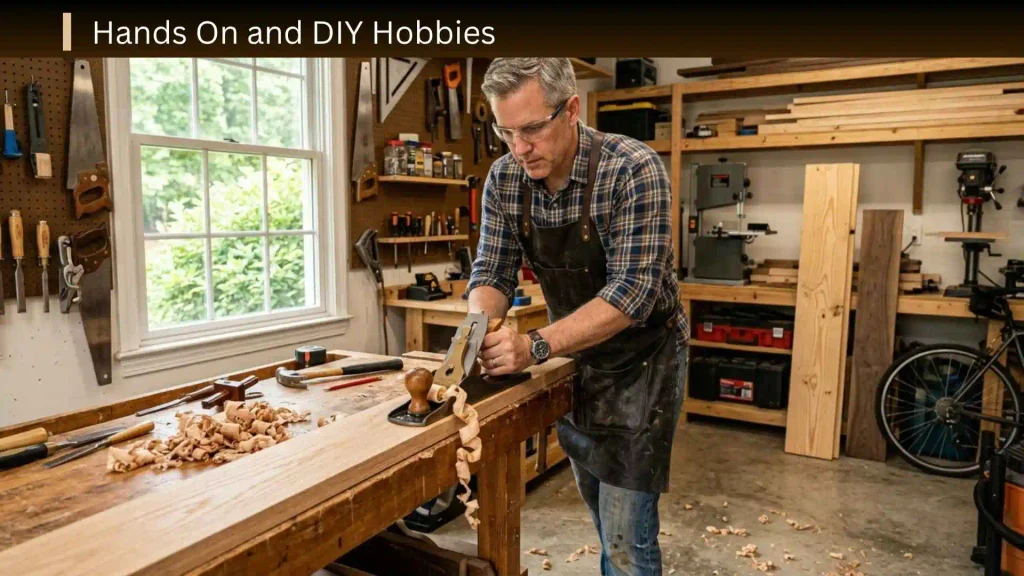
If you enjoy turning raw materials or components into something useful, hands-on hobbies provide visible results and opportunities to develop practical skills.
53. Woodworking
Woodworking can range from simple shelves and boxes to furniture and detailed joinery.
Beginners do not need a professional workshop. A small collection of appropriate hand tools can support basic projects.
Safety: Learn proper tool handling, wear suitable protective equipment, and follow manufacturer instructions.
54. DIY Furniture Building
Building your own furniture combines woodworking, design, measurement, finishing, and problem-solving.
It can also give you a practical reason to learn how materials behave rather than simply practicing isolated techniques.
55. Leatherworking
Leatherworking includes wallets, belts, bags, knife sheaths, accessories, and decorative projects.
Basic projects can be relatively compact, making this a good option for someone without a large workshop.
56. Electronics
Electronics can begin with simple circuits and gradually progress toward sensors, microcontrollers, audio projects, and custom devices.
A structured beginner kit can reduce the number of components you need to purchase individually.
Safety: Use appropriate low-voltage projects when learning and understand the hazards before working with mains electricity.
57. Robotics
Robotics combines programming, electronics, mechanics, and problem-solving.
It is especially rewarding if you like building a physical object and then writing software that makes it behave in a particular way.
58. 3D Printing
3D printing turns digital models into physical objects.
Beyond printing decorative pieces, hobbyists can create organizers, replacement parts, prototypes, models, and custom tools or accessories.
The learning curve includes basic modeling, printer calibration, material selection, and troubleshooting.
59. Home Automation
Home automation involves connecting devices, sensors, lighting, security equipment, or routines to make a living space more responsive.
It can appeal to people who enjoy both technology and practical problem-solving.
60. Welding
Welding can lead to practical projects involving metal fabrication and repair.
Because welding involves heat, electrical equipment, fumes, and fire hazards, proper instruction, ventilation, protective equipment, and a suitable workspace are essential.
61. Metalworking
Metalworking covers many disciplines, including machining, fabrication, forming, and finishing.
It has a steeper equipment and safety barrier than many crafts but can become a deeply technical long-term hobby.
62. Knife Making
Knife making combines metalworking, shaping, grinding, handle construction, and finishing.
It involves potentially hazardous tools, heat, sharp edges, and airborne particles, so beginners should learn through appropriate instruction and use suitable protective equipment.
63. Home Improvement
Home improvement turns practical household needs into opportunities to develop skills.
Painting, basic repairs, shelving, trim work, fixture replacement, and other projects can gradually build confidence.
For electrical, gas, structural, or other regulated work, use qualified professionals where appropriate.
64. Gardening
Gardening is a hands-on hobby with a slower feedback cycle than many crafts.
Growing herbs, vegetables, flowers, or ornamental plants teaches you to observe seasons, soil, light, watering, and plant growth.
65. Bonsai
Bonsai focuses on cultivating and shaping trees and other plants in miniature form.
It rewards patience because meaningful changes often take place over long periods rather than a single weekend project.
66. Beekeeping
Beekeeping combines animal husbandry, seasonal observation, equipment management, and honey production.
It requires substantially more preparation than ordinary gardening, including understanding local regulations, bee behavior, protective equipment, and colony management.
Food and Drink Hobbies
Food-related hobbies have an immediate practical benefit: your experiments can become something you actually eat or share.
67. Cooking
Cooking is one of the most versatile hobbies because you can explore cuisines, techniques, ingredients, meal planning, grilling, baking, or specialized diets without being locked into one style.
A good progression is to master a few basic techniques before collecting specialized equipment.
68. Grilling
Grilling can become a serious hobby once you move beyond simply putting meat over heat.
Temperature control, timing, seasoning, vegetables, seafood, and different cooking methods provide plenty of room for experimentation.
69. Baking
Baking introduces a different kind of cooking because measurements, ratios, temperature, and timing can have a major effect on the result.
Bread, cookies, cakes, pies, and pastries each offer different challenges.
70. Coffee Brewing
Coffee brewing can be as simple as improving your morning cup or as detailed as comparing beans, grind sizes, brewing methods, water, and extraction variables.
You can explore pour-over, French press, espresso, AeroPress-style brewing, cold brew, and other approaches.
71. Fermentation
Fermentation can involve foods and beverages such as pickled vegetables, cultured foods, sourdough, and other traditionally fermented products.
Because fermentation involves controlled biological processes, follow reliable recipes and food-safety practices rather than improvising with questionable storage conditions.
72. Homebrewing
Homebrewing involves producing beer or other fermented beverages at home.
It can become a detailed hobby involving ingredients, recipes, fermentation, equipment, and tasting. Legal requirements vary by location, so check applicable federal, state, and local rules before beginning.
Technology and Intellectual Hobbies

Not every hobby needs to produce something physical. Some are rewarding because they make you think, solve problems, or understand how something works.
73. Coding
Coding can be a hobby even if you never intend to become a professional programmer.
You can build websites, small games, automation scripts, mobile projects, data tools, or personal utilities.
Best for: People who enjoy logical problems and creating systems.
74. Chess
Chess provides an almost endless learning curve.
Beginners can learn the rules and basic tactics quickly, while experienced players can spend years studying openings, endgames, strategy, and calculation.
75. Reading
Reading is broad enough to become several hobbies in one.
You might focus on history, science, biographies, philosophy, fiction, business, technology, sports, or specialized subjects.
76. Learning a Language
Language learning combines memory, listening, reading, speaking, and cultural exploration.
Progress tends to be easier when you use the language regularly rather than relying only on occasional study sessions.
77. Genealogy
Genealogy involves researching family history through records, documents, archives, photographs, and conversations with relatives.
It can become an absorbing research project, especially when you enjoy historical investigation and organizing information.
78. Board Games
Modern board games range from short party games to complex strategy games that require planning, resource management, negotiation, or cooperation.
This is an especially strong choice if you want a hobby that creates regular opportunities to meet with friends.
79. Dungeons & Dragons
Dungeons & Dragons combines collaborative storytelling, role-playing, rules, improvisation, and strategic decision-making.
You can participate as a player or eventually learn to run games as a Dungeon Master.
80. Magic: The Gathering
Magic: The Gathering combines card collecting with strategic gameplay and deck construction.
You can approach it casually, competitively, socially, or primarily as a collecting hobby.
Collecting Hobbies
Collecting can turn a casual interest into a structured pursuit. The key is to establish a collecting theme and budget before the hobby starts consuming unnecessary space or money.
81. Coin Collecting
Coin collecting can involve modern coins, historical pieces, world currency, minting varieties, or particular time periods.
The research component is often as interesting as owning the objects themselves.
82. Vinyl Collecting
Vinyl collecting combines music discovery with physical media, artwork, pressing variations, and record-care practices.
You can focus on particular artists, genres, eras, labels, or simply records you genuinely enjoy.
83. Watch Collecting
Watch collecting can range from affordable everyday watches to expensive mechanical pieces.
A sensible approach is to establish a theme or budget instead of buying pieces simply because they are collectible.
84. Sports Memorabilia
Sports memorabilia can include cards, jerseys, signed items, programs, equipment, and other objects connected to athletes or teams.
If authenticity and value matter to you, learn about provenance and reputable authentication practices before making expensive purchases.
85. Comic Collecting
Comic collecting can focus on characters, publishers, artists, storylines, eras, or particular editions.
The hobby can be as much about reading and discovering stories as it is about collecting physical issues.
86. LEGO Collecting
Some people collect LEGO sets for display, others for building, investment speculation, nostalgia, or particular themes.
The strongest reason to collect is usually personal interest rather than assuming every set will increase in value.
87. Disc Collecting
Collecting physical discs can include CDs, DVDs, Blu-ray releases, video games, or other physical media.
It appeals to people who like owning tangible versions of entertainment rather than relying exclusively on streaming services.
Social and Lifestyle Hobbies
A good hobby does not always have to be about mastering a technical skill. Sometimes its greatest value is giving you a reason to spend time with other people.
88. Volunteering
Volunteering can turn an interest into community involvement.
You might help at animal shelters, food programs, environmental projects, community organizations, sporting events, libraries, or other causes.
The best choice depends on the skills you want to use and the type of commitment you can realistically maintain.
89. Travel Planning
Travel planning can become a hobby even when you are not traveling every week.
Researching destinations, transportation, neighborhoods, attractions, food, history, and practical logistics can be surprisingly engaging.
90. Film Appreciation
Film appreciation goes beyond watching movies casually.
You can explore directors, cinematography, screenwriting, editing, film history, international cinema, genres, or particular periods.
91. Journaling
Journaling provides a simple way to record ideas, goals, observations, experiences, or creative thoughts.
It can be structured or completely informal.
92. Meditation
Meditation can be practiced as a quiet, low-cost hobby focused on attention and awareness.
There are different approaches, so beginners may want to experiment with short sessions and find a method that feels practical and sustainable.
Unique Hobbies for Guys
If conventional hobbies do not appeal to you, unusual combinations of interests can lead to something much more engaging.
93. Survival Skills
Survival-oriented hobbies can include navigation, shelter concepts, outdoor cooking, weather awareness, first aid, knot work, and other practical outdoor knowledge.
Focus on learning responsibly through established instruction rather than treating risky situations as entertainment.
94. RC Cars
Remote-controlled cars combine driving, electronics, mechanical maintenance, customization, and competition.
You can choose between casual models and more specialized platforms designed for racing, off-road driving, or crawling.
95. Drones
Drone flying combines technology, spatial awareness, photography, and piloting skills.
Before flying, learn the applicable U.S. aviation rules, airspace restrictions, registration requirements, and local restrictions.
96. Automotive Repair
Learning basic automotive maintenance can be both useful and intellectually satisfying.
Start by understanding your vehicle’s maintenance schedule and learning procedures appropriate to your skill level before attempting complicated repairs.
97. Car Restoration
Car restoration is a long-term project rather than a casual weekend hobby.
It can involve mechanical work, bodywork, paint, upholstery, research, sourcing parts, and historical accuracy.
The biggest challenge is usually managing scope, time, storage, and budget.
98. Motorcycle Maintenance
Motorcycle maintenance offers a practical way to understand how a machine works.
Basic maintenance can eventually lead to deeper interests in mechanics, customization, restoration, or touring.
Always follow the manufacturer’s service procedures and use proper safety equipment.
99. Home Fitness
Home fitness is useful if you want an activity that does not depend on a gym schedule.
Depending on your goals and available space, it can involve bodyweight training, resistance bands, free weights, mobility work, or cardiovascular equipment.
100. Coffee and Food Experimentation
Combining cooking, coffee, baking, fermentation, and tasting into a personal food-experimentation hobby can be more engaging than following recipes mechanically.
You can compare techniques, keep notes, modify recipes, and gradually develop your own preferences.
How to Choose the Right Hobby
With 100 possibilities, the easiest way to narrow the list is to start with the experience you want rather than the hobby’s popularity.
If You Want to Get More Active
Consider:
- Hiking
- Running
- Cycling
- Swimming
- Weight training
- Rock climbing
- Martial arts
- Tennis
- Mountain biking
- Trail running
Choose an activity you can realistically repeat. A moderate hobby you enjoy is usually more sustainable than an ambitious activity you quickly stop doing.
If You Want to Make Things
Try:
- Woodworking
- Leatherworking
- Pottery
- Model building
- 3D printing
- Electronics
- DIY furniture
- Gardening
- LEGO building
- Metalworking
Hands-on hobbies are particularly satisfying if you like seeing a tangible result at the end of a project.
If You Want a Cheap Hobby
Start with activities that require little specialized equipment:
- Reading
- Running
- Drawing
- Writing
- Journaling
- Chess
- Meditation
- Hiking
- Basketball
- Origami
You can always spend more later if the hobby becomes a serious interest.
If You Want a Social Hobby
Consider:
- Golf
- Pickleball
- Tennis
- Bowling
- Board games
- Dungeons & Dragons
- Soccer
- Volleyball
- Volunteering
- Brazilian Jiu-Jitsu
Social hobbies have an advantage over purely individual activities: the people involved can become part of the reason you continue.
If You Prefer Solitary Hobbies
Good choices include:
- Reading
- Photography
- Fishing
- Drawing
- Writing
- Coding
- Chess
- Astronomy
- Model building
- Gardening
Solo does not have to mean isolated. Many of these hobbies also have clubs and online communities if you eventually want to connect with others.
If You Want to Learn a Valuable Skill
Consider:
- Cooking
- Coding
- Automotive repair
- Home improvement
- Electronics
- Woodworking
- Photography
- A foreign language
- Gardening
- First-aid or outdoor skills
A useful hobby can make your free time enjoyable while also building knowledge you can apply elsewhere.
If You Want a Relaxing Hobby
Try:
- Fishing
- Gardening
- Reading
- Photography
- Birdwatching
- Painting
- Journaling
- Meditation
- Bonsai
- Coffee brewing
The right relaxing hobby is one that absorbs your attention without creating another source of pressure.
How Much Should You Spend on a New Hobby?
You generally do not need to buy the best equipment immediately.
A useful approach is to create three stages:
Stage 1: Try it cheaply.
Borrow equipment, attend a class, rent gear, use a local facility, or buy only basic supplies.
Stage 2: Practice consistently.
Once you know you enjoy the activity, identify what equipment genuinely improves your experience.
Stage 3: Invest selectively.
Spend more on equipment when you understand what you need and why you need it.
This prevents the common beginner mistake of buying a large amount of specialized gear before discovering whether the hobby actually suits you.
How to Start a Hobby Without Losing Interest
Pick a Small First Project
Instead of saying, “I’m going to learn woodworking,” choose one manageable project.
Instead of “I’m going to become a photographer,” commit to taking and editing a small series of photographs.
A concrete first goal makes it easier to begin.
Schedule the Hobby
Free time tends to disappear when it is completely unplanned. Even one or two dedicated sessions each week can give a hobby enough consistency to develop.
Track Progress
Progress can be measured in different ways:
- A longer running distance
- A completed woodworking project
- A new guitar song
- A finished painting
- A new chess rating
- A new recipe
- A successful garden harvest
- A completed coding project
Visible progress can make practice more rewarding.
Avoid Turning Every Hobby Into a Competition
Competition is motivating for some people, but it can also remove the reason you started.
A hobby can simply be something you enjoy getting better at.
How to Find a Hobby That Actually Sticks
Ask yourself five questions:
- What do I naturally enjoy learning about?
- Do I want to be active or relaxed?
- Do I prefer working alone or with people?
- How much time and money can I realistically commit?
- Do I want entertainment, creativity, skill development, social connection, or a combination?
Your answers can narrow 100 options down to a handful worth trying.
For example, someone who enjoys technology, prefers working alone, and wants to build things might gravitate toward coding, electronics, 3D printing, robotics, or home automation.
Someone who wants outdoor adventure and social interaction might prefer hiking, camping, kayaking, golf, climbing, or recreational sports.
Someone who wants quiet creative work might be happier with photography, drawing, writing, model building, woodworking, or painting.
Frequently Asked Questions About Hobbies for Guys
What is a good hobby for a guy to start?
Good beginner choices include hiking, cooking, photography, reading, running, gardening, drawing, cycling, fishing, chess, and woodworking. The best option depends on whether you want exercise, creativity, social interaction, relaxation, or practical skills.
What are some hobbies for guys who are bored at home?
Try cooking, guitar, drawing, reading, coding, chess, 3D printing, model building, LEGO, woodworking, journaling, video editing, music production, or home improvement. Many can be started with equipment you already have.
What are inexpensive hobbies for guys?
Reading, running, hiking, drawing, writing, chess, basketball, journaling, meditation, and origami can all be started relatively inexpensively. Costs vary depending on whether you choose to upgrade equipment later.
What are good hobbies for guys who like working with their hands?
Woodworking, leatherworking, gardening, pottery, model building, electronics, 3D printing, DIY furniture, automotive repair, and home improvement are strong options for hands-on learners.
What are good social hobbies for guys?
Golf, pickleball, tennis, bowling, basketball, soccer, volleyball, board games, Dungeons & Dragons, martial arts, volunteering, and recreational clubs can provide regular opportunities to meet and interact with people.
What are good hobbies for guys who want to stay active?
Running, hiking, cycling, swimming, weight training, climbing, martial arts, boxing, skiing, snowboarding, tennis, and mountain biking are all active options. Choose based on your interests, current ability, available facilities, and preferred level of challenge.
What hobbies can guys do alone?
Photography, fishing, reading, writing, coding, drawing, gardening, astronomy, chess, model building, woodworking, cooking, and hiking can all work well as solo hobbies.
How do I choose a hobby if I don’t know what I like?
Start with the type of experience you want rather than trying to identify your perfect hobby immediately. Pick two or three inexpensive options from different categories and give each enough time to determine whether you enjoy the activity itself, not just the idea of it.
Final Thoughts
The best hobby is not necessarily the most impressive, expensive, or traditionally masculine one. It is the activity that gives you a reason to spend your free time in a way you genuinely value.
Use this list of 100 hobbies for guys as a starting point. If you want more movement, look toward sports and outdoor activities. If you enjoy making things, explore woodworking, electronics, cooking, crafts, or DIY projects. If you prefer mental challenges, consider chess, coding, languages, or research-based hobbies. And if your priority is relaxation, fishing, reading, gardening, photography, or meditation may be a better fit.
You do not have to commit to one hobby forever. Try something, learn what you enjoy about it, and let your interests evolve.

I’m Sophia Carter, a writer who enjoys discovering interesting ideas and transforming them into helpful content. At Cognivoora, I write with a simple goal: to make information clearer, more accessible, and genuinely useful for readers. I value thoughtful research, easy explanations, and content that people can trust and return to whenever they need it.
Books:
- The Knowledge Journey
- Understanding the World Around Us