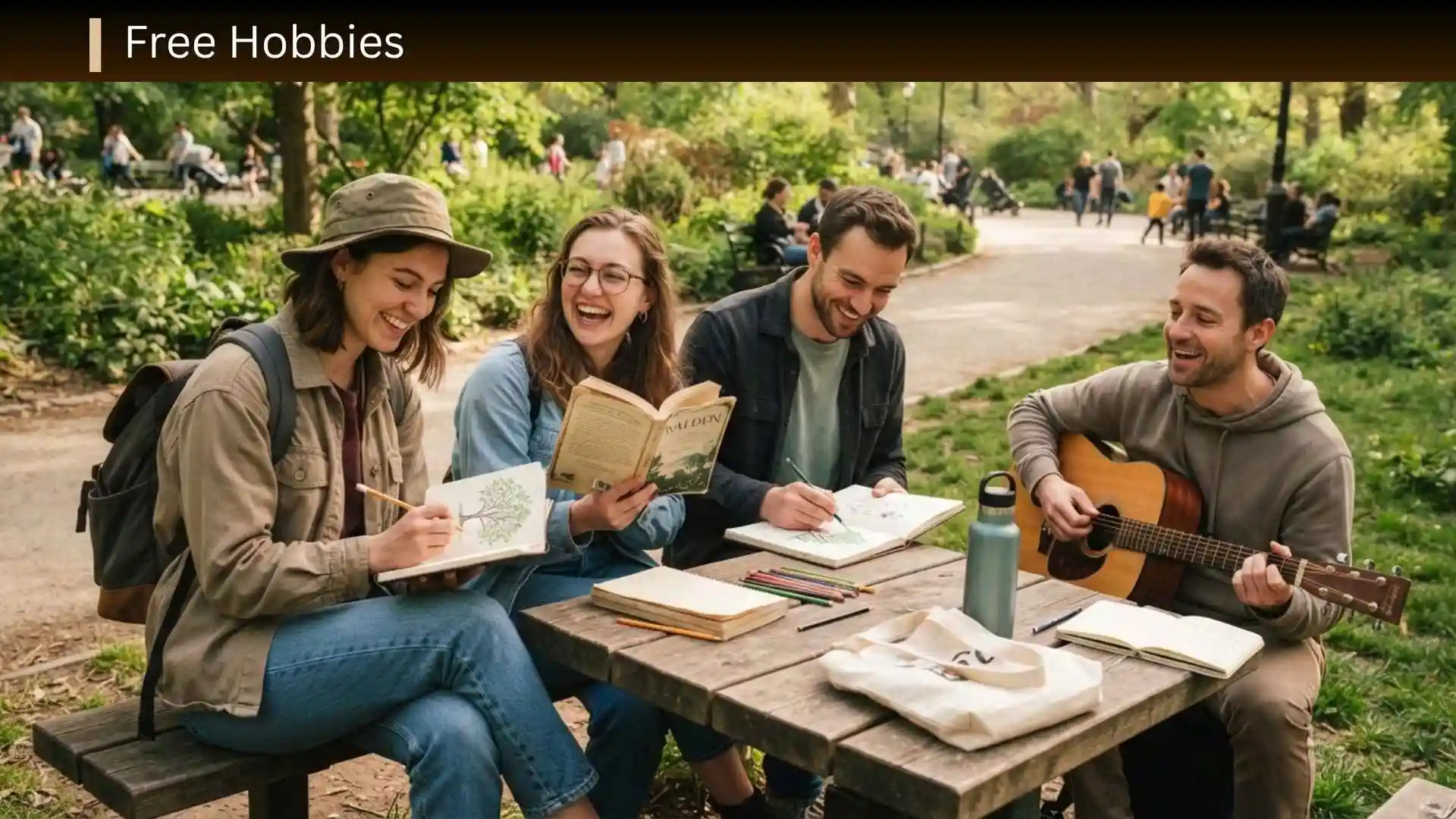
I used to think that starting a new hobby always meant spending money, buying special supplies, or signing up for expensive classes. But I’ve learned that some of the most enjoyable hobbies can cost absolutely nothing. If you’re looking for free hobbies, you can discover plenty of fun, creative, relaxing, and useful activities without putting pressure on your budget.
You don’t need expensive equipment or a lot of free time to get started. Whether you want to learn something new, stay active, express your creativity, or simply escape your daily routine, there’s likely a free hobby that fits you. In this guide, I’ll help you explore practical ideas so you can find something you genuinely enjoy and start today without spending a dime.
What Are Free Hobbies?
Free hobbies are activities you can enjoy without spending money to get started. They may require time, practice, internet access, or items you already own, but they do not require a significant initial investment.
Examples include:
- Reading books you already own or borrow from a library
- Writing
- Drawing
- Hiking on free public trails
- Photography with a smartphone
- Birdwatching
- Journaling
- Learning a language with free resources
- Stargazing
- Meditation
- Cooking with ingredients already available at home
- Geocaching using free resources
- Walking
- People-watching
- Learning about history
- Volunteering
Some hobbies are completely free, while others are free to start but may eventually involve optional costs. For example, you can begin photography with a smartphone without buying a camera.
50+ Free Hobbies to Try
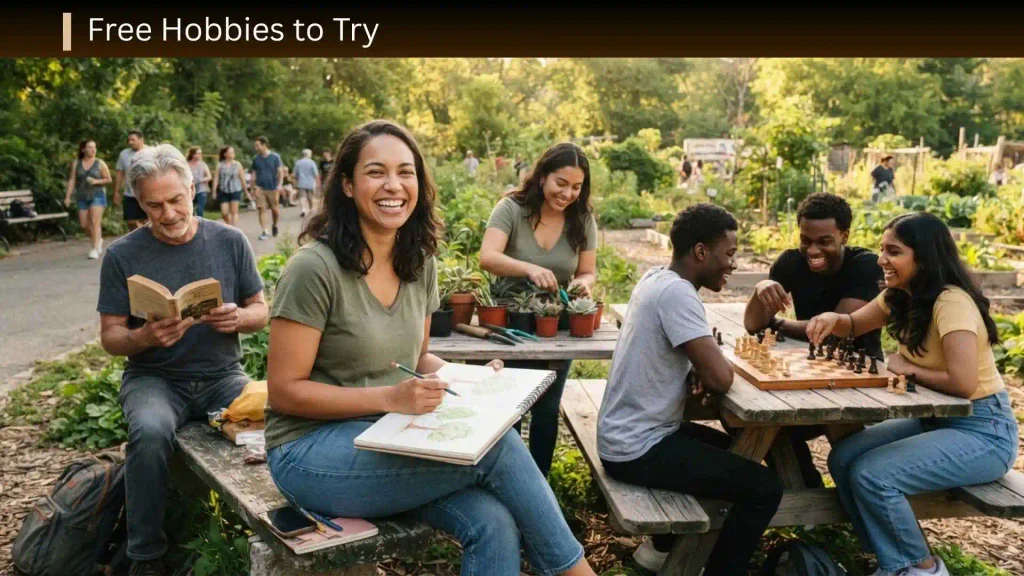
The following hobbies are organized by the type of experience they provide, making it easier to find something that matches your interests, available space, and preferred lifestyle.
1. Reading
Reading is one of the easiest free hobbies because you can use books you already own or borrow from a public library.
Try novels, biographies, history, essays, poetry, or nonfiction on subjects you’ve always wanted to understand.
Best for: Quiet, solo learning and entertainment.
2. Writing
You do not need a publishing platform or expensive notebook to become a writer. You can write on your phone, computer, or on scrap paper.
Try short stories, poetry, personal essays, observations, or fictional scenes.
Best for: Creative people who enjoy expressing ideas.
3. Journaling
Journaling can be as simple as writing a few sentences about your day, recording ideas, or keeping a list of things you’re curious about.
A basic notes app can work just as well as a dedicated journal.
Best for: Reflection, organization, and developing a regular writing habit.
4. Drawing
A pencil and ordinary paper are enough to begin drawing. Practice objects around your home, people, animals, landscapes, or simple shapes.
Rather than worrying about artistic talent, focus on observing proportions, lines, shadows, and details.
Best for: Creative practice without specialized equipment.
5. Sketching
Sketching is similar to drawing but often emphasizes quick observations rather than polished finished artwork.
Take a pencil outside and sketch buildings, trees, objects, or scenes around you.
Best for: People who enjoy visual observation and short creative sessions.
6. Photography With Your Phone
A smartphone can provide everything you need to explore photography.
Experiment with composition, natural light, reflections, shadows, textures, architecture, plants, or everyday objects.
Best for: Creative exploration using equipment you already have.
7. Birdwatching
Birdwatching can begin in your backyard, neighborhood, local park, or another suitable outdoor area.
You can learn to identify birds by their appearance, behavior, habitat, and calls. Free online resources can help you research species.
Best for: Nature lovers who enjoy observation.
8. Nature Observation
You do not need to identify every plant or animal to enjoy observing nature.
Spend time noticing trees, insects, clouds, seasonal changes, flowers, rocks, or local wildlife.
Best for: Anyone looking for a quiet outdoor activity.
9. Hiking
Hiking can be free when you use public trails or other locations that do not charge an entrance fee.
Start with easy routes and choose trails appropriate for your fitness level and conditions.
Best for: People who want an active outdoor hobby.
10. Walking
Walking is particularly accessible because it requires little more than comfortable clothing and a safe place to walk.
You can make it more interesting by exploring different neighborhoods, parks, or routes.
Best for: A simple hobby that fits into short periods of free time.
11. Stargazing
You do not need a telescope to begin exploring the night sky.
Start by learning to recognize the Moon, bright planets, and major constellations. A clear view away from bright city lights can make observation easier.
Best for: Curious people interested in astronomy.
12. Cloud Watching
Cloud watching requires no equipment and can turn an ordinary outdoor break into an observation activity.
Look for changes in cloud shapes, patterns, movement, and weather conditions.
Best for: Relaxation and creative observation.
13. People Watching
In appropriate public settings, observing the movement and interactions around you can become an interesting way to study everyday human behavior.
You can use the experience as inspiration for writing or drawing.
Best for: Observant and creative people.
14. Learning a New Language
You can begin learning a language using free online lessons, library resources, educational videos, or conversation practice.
Focus on basic vocabulary, pronunciation, listening, and common phrases before worrying about advanced grammar.
Best for: People who enjoy structured learning.
15. Learning History
History offers almost unlimited subjects to explore.
Choose a period, country, historical figure, invention, war, cultural movement, or social change and build your knowledge gradually through free library and educational resources.
Best for: Lifelong learners.
16. Creative Writing
Creative writing can include fiction, poetry, scripts, flash fiction, or character development.
Give yourself simple challenges, such as writing a 500-word story or describing the same scene from two different perspectives.
Best for: Storytellers and imaginative thinkers.
17. Poetry
Poetry does not require specialized tools. Experiment with free verse, rhyme, imagery, rhythm, or different structures.
Reading poetry can also help you discover forms and styles you enjoy.
Best for: People who like concise creative expression.
18. Learning to Cook
Cooking does not have to mean buying new ingredients specifically for a hobby.
Instead, choose ingredients already in your kitchen and learn how to prepare them in different ways.
Best for: People who enjoy practical skills and food.
19. Recipe Experimentation
Take a familiar recipe and experiment with available ingredients, seasonings, cooking methods, or presentation.
Keep notes about what works so you can improve future attempts.
Best for: Curious home cooks.
20. Meditation
Meditation can be practiced without paid classes or specialized equipment.
A simple beginner approach is to sit comfortably, focus attention on your breathing, and gently return your attention whenever your mind wanders.
Best for: People looking for a quiet mindfulness practice.
21. Stretching
Gentle stretching can be done at home without specialized equipment.
Learn basic movements from reliable educational resources and avoid forcing uncomfortable positions.
Best for: People who prefer a low-equipment physical activity.
22. Bodyweight Exercise
Exercises such as squats, lunges, push-ups, and other bodyweight movements do not require a gym membership.
If you are new to exercise, start at an appropriate level and prioritize proper technique.
Best for: People who want a no-equipment fitness hobby.
23. Dancing
You can practice dancing at home using music you already have access to.
Try learning basic steps, creating your own movements, or practicing a style that interests you.
Best for: People who want movement combined with creativity.
24. Singing
Singing is an accessible hobby because your voice is the primary instrument.
You can practice songs you already know or work on pitch, breathing, rhythm, and vocal control.
Best for: Music lovers.
25. Learning Music Theory
Music theory can be studied without owning an instrument.
Learn about scales, rhythm, chords, intervals, notation, and musical structure using free educational materials.
Best for: People interested in understanding how music works.
26. Listening to and Analyzing Music
Instead of simply listening to music, pay attention to its structure.
Notice instruments, rhythm, melody, harmony, lyrics, changes in intensity, and recurring patterns.
Best for: Music enthusiasts who enjoy deeper listening.
27. Learning to Identify Plants
Start by identifying common plants in your neighborhood or local parks.
Use free educational resources to compare leaves, flowers, stems, and other characteristics.
Best for: Nature enthusiasts.
28. Gardening From Existing Materials
Traditional gardening can involve expenses, but experimenting with plants you already have, saved seeds, or suitable household containers can sometimes be done at little or no additional cost.
Research the needs of each plant before attempting propagation or planting.
Best for: People interested in plants and outdoor projects.
29. Composting
If your living situation permits it, learning about composting can become a practical environmental hobby.
You can study different composting methods and determine which approach is suitable for your available space and local guidelines.
Best for: Environmentally minded hobbyists.
30. Volunteering
Volunteering can turn your free time into a meaningful activity while helping a community organization, public project, or local cause.
Opportunities vary by location and may involve applications or age requirements.
Best for: People who want a social or community-oriented hobby.
31. Learning About Psychology
Psychology provides countless subjects to explore, including memory, perception, learning, decision-making, personality, and social behavior.
Use reputable educational resources rather than treating popular psychology claims as established facts.
Best for: Curious learners interested in human behavior.
32. Philosophy
Philosophy can be explored through books, lectures, essays, and discussions available through libraries and educational resources.
Choose one question or philosophical tradition and explore it gradually.
Best for: People who enjoy abstract questions and critical thinking.
33. Learning About Space
Astronomy and space science offer a large amount of material for self-directed learning.
You can study planets, stars, galaxies, spacecraft, cosmology, or the history of space exploration.
Best for: Science enthusiasts.
34. Genealogy
Family history research can become a long-term hobby.
Begin with information already known within your family, organize names and dates carefully, and distinguish documented facts from family stories that have not been verified.
Best for: People interested in history and family stories.
35. Digital Decluttering
Organizing your computer files, photos, documents, and email can become a surprisingly engaging project.
Create logical folders, remove unnecessary duplicates, and establish a simple system for finding important files.
Best for: Organized people who enjoy practical projects.
36. Learning Basic Coding
If you have access to a computer, you can begin learning programming through free educational resources.
Start with fundamentals such as variables, conditions, loops, functions, and simple projects.
Best for: Problem-solvers and technology enthusiasts.
37. Web Design Practice
You can practice basic web design with free development tools and educational resources.
Try creating a simple personal webpage or experimenting with HTML and CSS.
Best for: Creative people interested in technology.
38. Chess
Chess can be played with a physical set you already own or through free online platforms.
Study basic openings, tactics, endgames, and common strategic principles.
Best for: People who enjoy strategy and problem-solving.
39. Puzzles
Crosswords, logic puzzles, riddles, Sudoku, and similar activities can provide mental challenges without requiring specialized equipment.
You can find many puzzles in newspapers, libraries, books you already own, or free online resources.
Best for: Short, mentally engaging sessions.
40. Learning Origami
Origami can be started with ordinary paper.
Begin with simple folds and gradually attempt more complicated designs.
Best for: People who enjoy hands-on precision and creativity.
41. Calligraphy Practice
If you already have a pen and paper, you can practice handwriting styles and lettering.
Focus on consistency, spacing, letterforms, and control rather than buying specialized tools.
Best for: People interested in typography and decorative writing.
42. Scrap Art
Before throwing away cardboard, paper packaging, magazines, or other suitable materials, consider whether they can become art supplies.
You can create collages, paper sculptures, or mixed-media projects.
Best for: Creative hobbyists who enjoy repurposing materials.
43. Learning Public Speaking
Practice speaking by choosing a subject and explaining it aloud for several minutes.
You can record yourself, review your delivery, and work on clarity, pacing, structure, and confidence.
Best for: People who want to develop communication skills.
44. Storytelling
Storytelling can be practiced alone or with friends and family.
Take an ordinary event and practice explaining it with a clear beginning, middle, and ending.
Best for: Communicators and writers.
45. Debating Ideas
You can practice structured argument by choosing a topic and developing arguments for different sides.
The goal should be understanding reasoning and evidence rather than simply winning an argument.
Best for: Critical thinkers.
46. Learning Sign Language
Free educational resources can help you begin learning basic signs and concepts.
For meaningful communication, remember that sign languages are complete languages with their own grammar and cultural contexts.
Best for: People interested in languages and communication.
47. Exploring Local Architecture
Walk through suitable public areas and observe buildings, architectural styles, materials, layouts, and historical details.
You can photograph or sketch buildings if permitted.
Best for: People interested in design, cities, and history.
48. Map Exploration
Maps can become a hobby in themselves.
Explore geography, historical maps, transportation networks, physical landscapes, or places you would like to visit someday.
Best for: Geography enthusiasts and curious travelers.
49. Learning Geography
Choose a region and gradually learn its countries, states, cities, rivers, mountains, climate, and cultural features.
Interactive maps can make the process more engaging.
Best for: People who enjoy facts and global knowledge.
50. Creative Challenges
Create your own weekly challenges.
For example:
- Write one short story
- Take five interesting photographs
- Draw one object every day
- Learn ten new words
- Identify five local birds
- Try a new walking route
- Read one chapter
- Learn one historical event
Best for: Anyone who has trouble deciding which hobby to pursue.
51. DIY Repair Learning
You can learn about basic household maintenance and repair through free educational resources before attempting anything that is safe and appropriate for your skill level.
For electrical, gas, structural, or otherwise hazardous work, use qualified professionals rather than treating online information as a substitute for training.
Best for: Practical learners.
52. Learning About Cars
If cars interest you, you can learn about automotive history, vehicle systems, maintenance concepts, design, and engineering.
You do not need to own a vehicle to study how cars work.
Best for: Automotive enthusiasts.
53. Learning About Aircraft
Explore aviation history, aircraft design, flight principles, famous aircraft, and the development of commercial aviation.
Best for: People interested in engineering and transportation.
54. Learning About Your Local Area
Become a local-history researcher.
Explore the history of your town or city through libraries, historical societies, public archives, maps, newspapers, and other reliable resources.
Best for: People who want a hobby connected to where they live.
55. Online Learning
Free educational courses, lectures, tutorials, digital libraries, and public educational resources can turn almost any subject into a hobby.
The key is to choose a topic you genuinely want to understand rather than trying to study everything at once.
Best for: Lifelong learners.
Best Free Hobbies by Interest
If you are overwhelmed by the number of choices, start with the type of experience you want.
| If you want… | Try… |
| A creative hobby | Drawing, writing, photography, poetry |
| An outdoor hobby | Walking, hiking, birdwatching, nature observation |
| A quiet hobby | Reading, journaling, stargazing, puzzles |
| A learning hobby | History, languages, geography, astronomy |
| A social hobby | Volunteering, dancing, discussion groups |
| A physical hobby | Walking, dancing, bodyweight exercise |
| A technology hobby | Coding, web design, digital projects |
| A practical hobby | Cooking, organizing, repair learning |
| A nature hobby | Birdwatching, plant identification, gardening |
| A hobby for short breaks | Sketching, puzzles, journaling, cloud watching |
How to Choose a Free Hobby You’ll Actually Keep
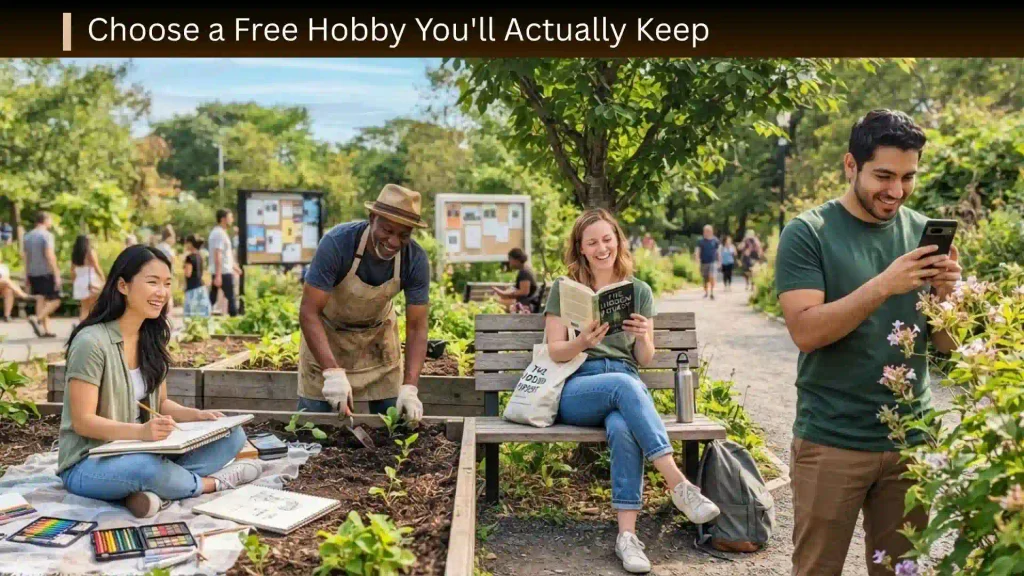
The best hobby is not necessarily the most impressive one. It is the activity you are likely to return to.
Consider four questions.
Do You Want to Create, Learn, Move, or Explore?
This is a useful starting point.
- Create: drawing, writing, photography, music
- Learn: history, languages, science, philosophy
- Move: walking, dancing, hiking, bodyweight exercise
- Explore: birdwatching, maps, local history, architecture
How Much Time Do You Have?
If you only have 10–15 minutes, choose something that can be started and stopped easily, such as reading, sketching, journaling, or language practice.
If you have several uninterrupted hours, activities such as hiking, volunteering, creative projects, or deeper research may be more suitable.
Do You Prefer Being Alone or With Others?
Solo options include reading, writing, photography, drawing, stargazing, and coding.
Social options can include volunteering, dancing, group walks, discussion groups, or community activities.
Do You Want a Hobby That Could Develop Into a Skill?
Some free hobbies naturally build transferable skills.
For example:
- Writing can improve communication.
- Coding can develop problem-solving skills.
- Photography can develop visual composition.
- Cooking can develop practical kitchen skills.
- Language learning can develop communication abilities.
- Public speaking can improve presentation skills.
A hobby does not need to become a career to be valuable.
Free Hobbies You Can Start Today
If you want something you can begin immediately, try this short list:
- Take a walk and photograph five interesting things with your phone.
- Write 300 words about a subject you enjoy.
- Draw an object sitting near you.
- Read a chapter of a book you already own.
- Learn ten words in a language you’re interested in.
- Identify three plants or birds in your area.
- Watch the night sky and identify visible celestial objects.
- Organize your digital photos.
- Try a free puzzle or chess game.
- Research one historical event you’ve always wondered about.
The point is not to choose the “perfect” hobby. It is to test an activity and see whether you naturally want to do it again.
How to Keep a Hobby Free
A hobby can start free and gradually become expensive if you keep buying equipment, subscriptions, or supplies. If your goal is to maintain a genuinely low-cost hobby, set boundaries from the beginning.
Use What You Already Own
Before buying anything, look around your home.
Paper, pencils, a smartphone, books, kitchen ingredients, computers, clothing, and other everyday objects can support many activities.
Use Libraries and Public Resources
Public libraries can provide access to books, digital resources, educational materials, community programs, and other resources depending on your local library system.
Borrow Before Buying
If an activity eventually requires equipment, borrowing may help you determine whether you actually enjoy the hobby before spending money.
Learn Before Upgrading
Many beginners buy equipment before developing the underlying skill.
In many hobbies, learning the fundamentals with basic tools can be more useful than immediately purchasing specialized equipment.
Watch for Hidden Costs
“Free” can sometimes mean free to begin rather than free forever.
Possible future costs include:
- Equipment
- Transportation
- Memberships
- Replacement materials
- Software
- Classes
- Event fees
If avoiding spending is important, choose hobbies that do not depend on these extras.
Free Hobbies That Can Become More Expensive

Not every hobby remains free as you advance.
Photography, for example, can begin with a smartphone but eventually involve cameras, lenses, lighting, storage, and editing software.
Gardening can begin with existing plants or materials but later involve soil, containers, tools, seeds, and other supplies.
Cooking can be practiced with existing ingredients, while specialized cooking equipment can increase costs.
The important distinction is free to start versus permanently free. If your budget is tight, look for activities where additional spending is optional rather than necessary.
Frequently Asked Questions
What are the best free hobbies?
The best free hobby depends on your interests. Reading, writing, drawing, walking, photography with a smartphone, birdwatching, language learning, journaling, stargazing, and online learning are all accessible starting points.
What hobby can I start with no money?
You can start writing, walking, reading books you already own or borrow, drawing with existing paper and pencils, observing nature, journaling, learning, singing, stretching, or exploring your local area.
What are some free hobbies for adults?
Adults can try creative hobbies such as writing and drawing, outdoor activities such as hiking and birdwatching, educational hobbies such as history and languages, or practical activities such as cooking and digital organization.
What are some free hobbies to do at home?
Good at-home options include reading, writing, drawing, journaling, singing, meditation, bodyweight exercise, cooking, puzzles, coding, language learning, and online education.
What are some free outdoor hobbies?
Walking, hiking on free trails, birdwatching, nature observation, cloud watching, stargazing, photography, local exploration, and plant identification are examples of outdoor hobbies that can often be started without purchasing equipment.
Can a hobby really be completely free?
Some hobbies can be practiced without spending money, particularly activities based on skills, observation, movement, or resources you already have. Other hobbies may be free to start but have optional costs as you progress.
How do I find a hobby I actually enjoy?
Try several activities for short periods rather than committing immediately to one. Pay attention to which activities make you curious enough to continue practicing without needing external motivation.
Conclusion
There are far more free hobbies available than many people realize. You can write, draw, read, walk, explore nature, learn a language, study history, practice photography with your phone, volunteer, solve puzzles, or develop a completely new skill without making a major financial commitment.
Start with what you already have and choose an activity that fits your available time, interests, and preferred environment. If you enjoy it, keep going. If you don’t, try another option—the goal is to discover something worth returning to, not to find a hobby that looks impressive on paper.

I’m Ethan Mitchell, a curious writer who enjoys turning complex ideas into simple, useful information. At Cognivoora, I focus on creating clear and engaging content that readers can understand and apply in everyday life. I believe good writing should educate, answer real questions, and leave readers with something valuable to remember.
Books:
- The Everyday Mind
- Simple Ideas, Better Thinking